Downloaded 2,792 times

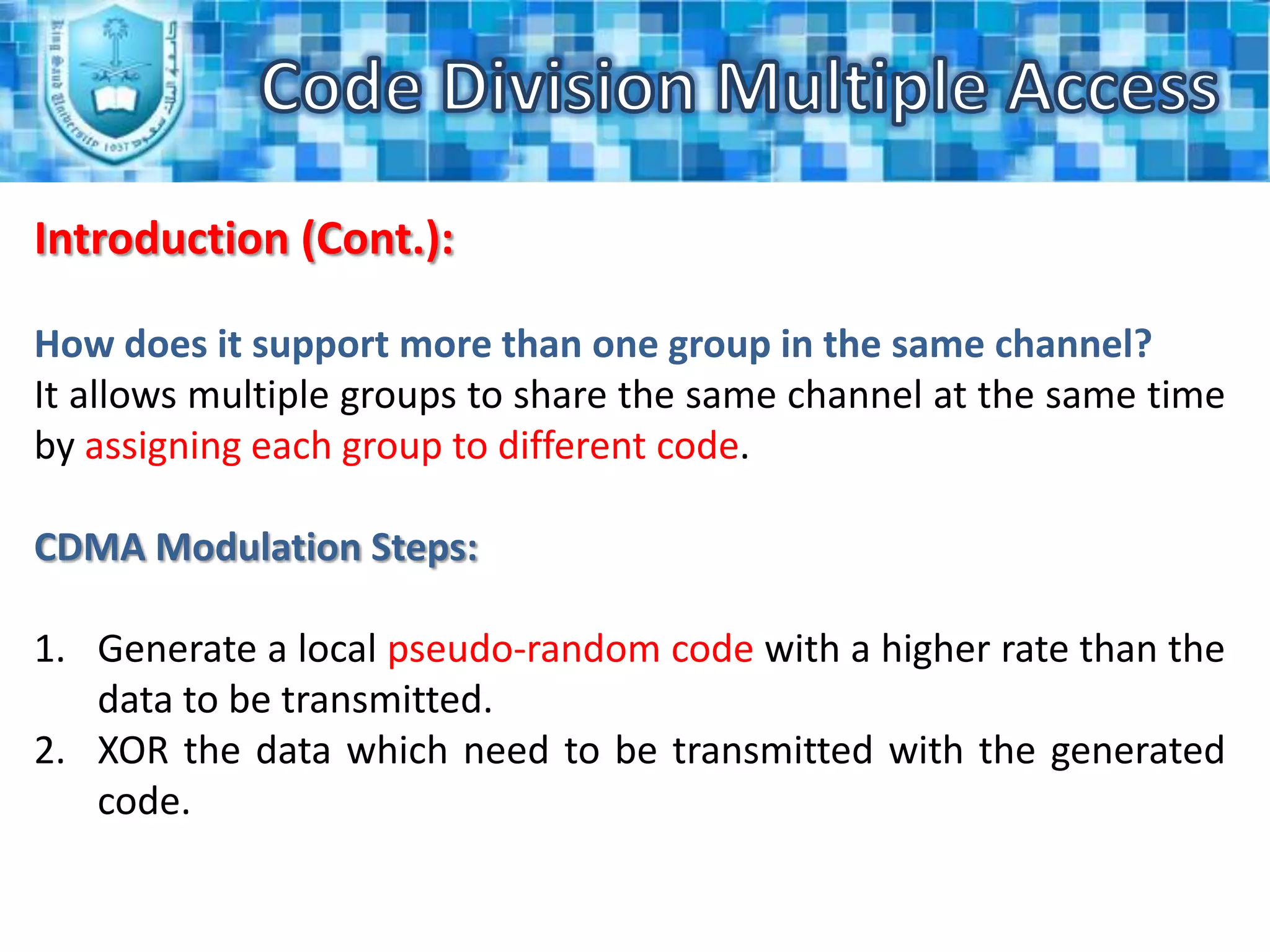


CDMA allows multiple users to share the same channel by assigning each user a unique code. It spreads the user's data signal over a wider bandwidth through multiplication with a pseudo-random code. This allows different signals to be separated at the receiver through correlation with the corresponding code. Major technologies using CDMA include WiFi, Bluetooth, and GPS, which employ techniques like DSSS, FHSS, and long/short codes. Performance of 802.11 networks can be analyzed based on collision probability and throughput calculations under saturated traffic conditions. Later developments expanded CDMA capabilities with techniques like W-CDMA, TD-CDMA, and TD-SCDMA.


