CODE DIVISION MULTIPLE ACCESS
TECHNOLOGY

Guided by: Mr. RANJEET SIR
Presented by: AJIT KUMAR
ECE (VII th Sem.)
U.C.E.T. (V.B.U.)
email: ajitece@yahoo.co.in

ASST. PROF. (E.C.E.)
U.C.E.T.
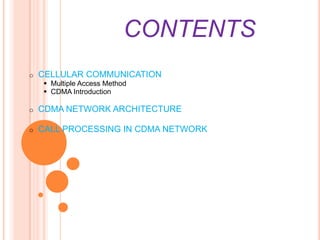
CONTENTS
o

CELLULAR COMMUNICATION
 Multiple Access Method
 CDMA Introduction

o

CDMA NETWORK ARCHITECTURE

o

CALL PROCESSING IN CDMA NETWORK
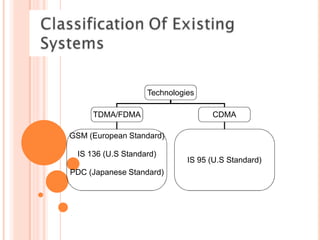
Technologies
TDMA/FDMA

CDMA

GSM (European Standard)
IS 136 (U.S Standard)
PDC (Japanese Standard)

IS 95 (U.S Standard)
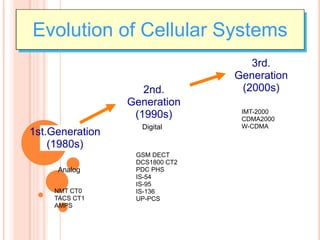
Evolution of Cellular Systems
2nd.
Generation
(1990s)
1st.Generation
(1980s)
Analog
NMT CT0
TACS CT1
AMPS

Digital

GSM DECT
DCS1800 CT2
PDC PHS
IS-54
IS-95
IS-136
UP-PCS

3rd.
Generation
(2000s)
IMT-2000
CDMA2000
W-CDMA
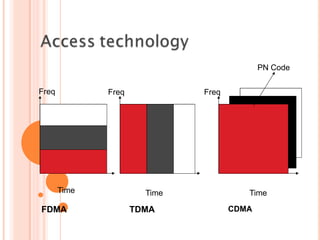
PN Code
Freq

Freq

Time

FDMA

Freq

Time

TDMA

Time
CDMA
• In FDMA, the entire allocated cellular frequency
spectrum is divided into a number of 30-kHz
channels .
• The power transmitted by a cell is only large
enough to communicate with mobile stations
located near the edge of the cell’s coverage area.
• The radius of a cell might be one mile or lessreferred to as a small cell.
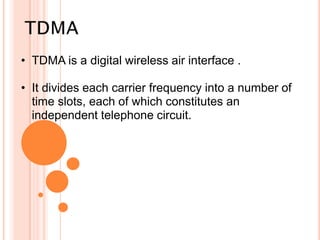
• TDMA is a digital wireless air interface .

• It divides each carrier frequency into a number of
time slots, each of which constitutes an
independent telephone circuit.
TDMA Overview

Frequency

A
B

f0

C B A C B A C B A C B A

C
Time
• A digital multiple access technique specified by
the Telecommunications Industry Association
(TIA) as "IS-95."
• One of the unique aspect of CDMA is that while
there are certainly limits to the number of phone
calls that can be handled by a carrier, this is not
a fixed number .
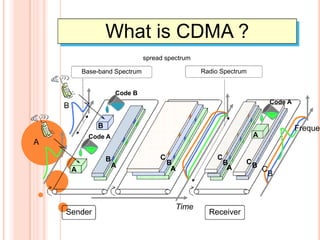
• Code division multiple access (CDMA) is a digital
air interface standard, claiming eight to fifteen
times the capacity of analog.
What is CDMA ?
spread spectrum
Radio Spectrum

Base-band Spectrum
Code B

Code A

B
B
A

Code A

A

B
A

Sender

Frequen

C
A

B
A

Time

C

B
A

Receiver

CB

C
B
• Classification of CDMA Systems

CDMA SYSTEMS

CDMA
one

IS95

IS95B

CDMA
2000

JSTD 008

Narrow Band

Wide Band
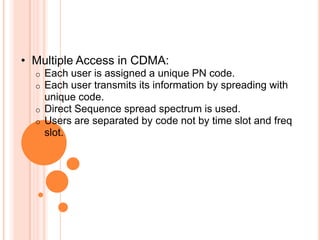
• Multiple Access in CDMA:
o
o
o
o

Each user is assigned a unique PN code.
Each user transmits its information by spreading with
unique code.
Direct Sequence spread spectrum is used.
Users are separated by code not by time slot and freq
slot.
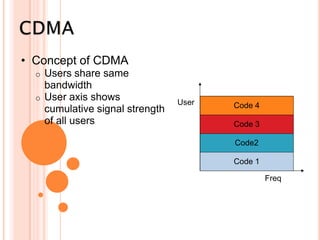
• Concept of CDMA
o

o

Users share same
bandwidth
User axis shows
cumulative signal strength
of all users

User

Code 4
Code 3
Code2
Code 1
Freq
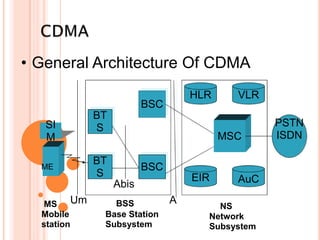
• General Architecture Of CDMA
HLR

BSC
SI
M
ME

BT
S

MSC

BT
S

BSC
EIR

Abis
Um
MS
Mobile
station

VLR

BSS
Base Station
Subsystem

A

AuC

NS
Network
Subsystem

PSTN
ISDN
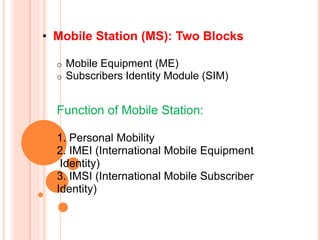
• Mobile Station (MS): Two Blocks
o
o

Mobile Equipment (ME)
Subscribers Identity Module (SIM)

Function of Mobile Station:
1. Personal Mobility
2. IMEI (International Mobile Equipment
Identity)
3. IMSI (International Mobile Subscriber
Identity)
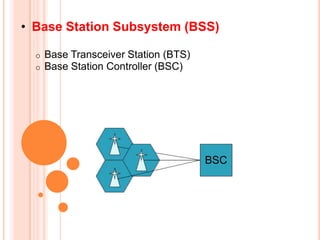
• Base Station Subsystem (BSS)
o
o

Base Transceiver Station (BTS)
Base Station Controller (BSC)

BSC











BTS : Base Transceiver station
1. It defines the cell .
2. It handles the radio link protocol with the mobile station
BSC: Base station Controller
1. It manages radio resources for one or more BTS.
2. Allocation and Deallocation of channels.
3. Transmitter power control.
4. Handoff control

BSC
HLR

BS
C

VLR

MSC
EIR

PSTN
ISDN

AuC

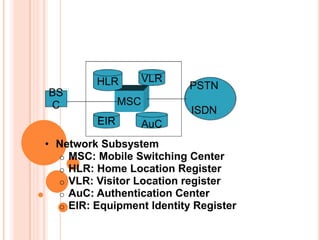
• Network Subsystem
o MSC: Mobile Switching Center
o HLR: Home Location Register
o VLR: Visitor Location register
o AuC: Authentication Center
o EIR: Equipment Identity Register
Mobile Switching center:(MSC)

1 Call set up/supervision/release
2 Call routing
3 Billing information collection
4 Mobility management
5 Paging, Echo cancellation
connection to BSC, other MSC and other local exchange
networks
6 Access to HLR and VLR
Home Location Register (HLR)
1 One HLR per CDMA operator
2 Contains permanent M database of all the
subscribers in the network
3 Contains MSRN(mobile station routing no.)
4 It is referred for every incoming call
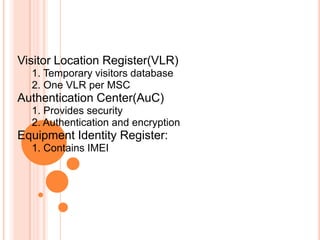
Visitor Location Register(VLR)
1. Temporary visitors database
2. One VLR per MSC

Authentication Center(AuC)
1. Provides security
2. Authentication and encryption

Equipment Identity Register:
1. Contains IMEI
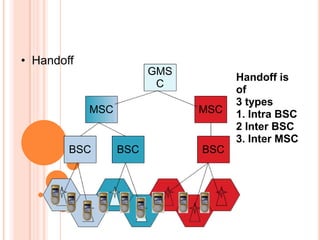
• Handoff
GMS
C
MSC

BSC

MSC

BSC

BSC

Handoff is
of
3 types
1. Intra BSC
2 Inter BSC
3. Inter MSC
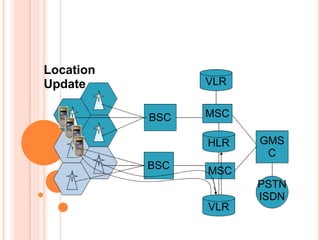
Location
Update

VLR
BSC

MSC
HLR

BSC

GMS
C

MSC
PSTN
ISDN
VLR
Comparison between CDMA and
TDMA/FDMA:
• In TDMA Band width available for transmission is
small which leads to compromise in quality of
transmission. Whereas in CDMA systems entire
spectrum is used which enhances voice quality.
• In TDMA/FDMA, cell design requires more frequency
planning which is tough job. Whereas in CDMA
frequency planning is minimal.
• TDMA is Band limited system. CDMA is Power
limited system
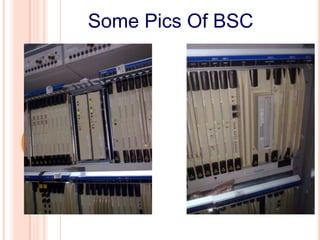
Some Pics Of BSC
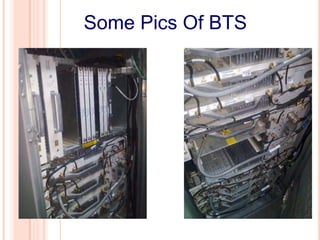
Some Pics Of BTS
ADVANTAGES OF CDMA
• Increased Cellular Communication Security.
• Soft Handoff Because Of Same Carrier Frequency
• Increased Efficiency, Meaning That The Carrier Can Serve More
Subscriber.

• Smaller Phones.
• Low Power Requirements And Little Cell-to-Cell Coordination
Needed By Operators.

• Extended Reach - Beneficial To Rural Users Situated Far From Cells.
DISADVANTAGES OF CDMA
• Near far problem.
• CDMA is relatively low, and the network is not as mature as GSM.
• CDMA can not offer international roaming, a large GSM advantage.
Conclusion

CDMA cellular system is deemed superior to the FDMA and TDMA
cellular systems for the time being.

Therefore, CDMA technique becomes more important in radio
communication systems.
CDMA is based on the spread spectrum technique which has been
used at military field.
REFERENCES
http://www.tubex.com/category/cdma/gsm
 http://www.bsnl.co.in:cdma/architecture.html



SPECIAL THANKS TO:

Mr. RANJEET SIR
ASST. PROF. (U.C.E.T.)
V.B.U.
HAZARIBAG

Cdma ppt for ECE

  • 1.
    CODE DIVISION MULTIPLEACCESS TECHNOLOGY Guided by: Mr. RANJEET SIR Presented by: AJIT KUMAR ECE (VII th Sem.) U.C.E.T. (V.B.U.) email: ajitece@yahoo.co.in ASST. PROF. (E.C.E.) U.C.E.T.
  • 2.
    CONTENTS o CELLULAR COMMUNICATION  MultipleAccess Method  CDMA Introduction o CDMA NETWORK ARCHITECTURE o CALL PROCESSING IN CDMA NETWORK
  • 3.
    Technologies TDMA/FDMA CDMA GSM (European Standard) IS136 (U.S Standard) PDC (Japanese Standard) IS 95 (U.S Standard)
  • 4.
    Evolution of CellularSystems 2nd. Generation (1990s) 1st.Generation (1980s) Analog NMT CT0 TACS CT1 AMPS Digital GSM DECT DCS1800 CT2 PDC PHS IS-54 IS-95 IS-136 UP-PCS 3rd. Generation (2000s) IMT-2000 CDMA2000 W-CDMA
  • 5.
  • 6.
    • In FDMA,the entire allocated cellular frequency spectrum is divided into a number of 30-kHz channels . • The power transmitted by a cell is only large enough to communicate with mobile stations located near the edge of the cell’s coverage area. • The radius of a cell might be one mile or lessreferred to as a small cell.
  • 7.
    • TDMA isa digital wireless air interface . • It divides each carrier frequency into a number of time slots, each of which constitutes an independent telephone circuit.
  • 8.
    TDMA Overview Frequency A B f0 C BA C B A C B A C B A C Time
  • 9.
    • A digitalmultiple access technique specified by the Telecommunications Industry Association (TIA) as "IS-95." • One of the unique aspect of CDMA is that while there are certainly limits to the number of phone calls that can be handled by a carrier, this is not a fixed number . • Code division multiple access (CDMA) is a digital air interface standard, claiming eight to fifteen times the capacity of analog.
  • 10.
    What is CDMA? spread spectrum Radio Spectrum Base-band Spectrum Code B Code A B B A Code A A B A Sender Frequen C A B A Time C B A Receiver CB C B
  • 11.
    • Classification ofCDMA Systems CDMA SYSTEMS CDMA one IS95 IS95B CDMA 2000 JSTD 008 Narrow Band Wide Band
  • 12.
    • Multiple Accessin CDMA: o o o o Each user is assigned a unique PN code. Each user transmits its information by spreading with unique code. Direct Sequence spread spectrum is used. Users are separated by code not by time slot and freq slot.
  • 13.
    • Concept ofCDMA o o Users share same bandwidth User axis shows cumulative signal strength of all users User Code 4 Code 3 Code2 Code 1 Freq
  • 14.
    • General ArchitectureOf CDMA HLR BSC SI M ME BT S MSC BT S BSC EIR Abis Um MS Mobile station VLR BSS Base Station Subsystem A AuC NS Network Subsystem PSTN ISDN
  • 15.
    • Mobile Station(MS): Two Blocks o o Mobile Equipment (ME) Subscribers Identity Module (SIM) Function of Mobile Station: 1. Personal Mobility 2. IMEI (International Mobile Equipment Identity) 3. IMSI (International Mobile Subscriber Identity)
  • 16.
    • Base StationSubsystem (BSS) o o Base Transceiver Station (BTS) Base Station Controller (BSC) BSC
  • 17.
           BTS : BaseTransceiver station 1. It defines the cell . 2. It handles the radio link protocol with the mobile station BSC: Base station Controller 1. It manages radio resources for one or more BTS. 2. Allocation and Deallocation of channels. 3. Transmitter power control. 4. Handoff control BSC
  • 18.
    HLR BS C VLR MSC EIR PSTN ISDN AuC • Network Subsystem oMSC: Mobile Switching Center o HLR: Home Location Register o VLR: Visitor Location register o AuC: Authentication Center o EIR: Equipment Identity Register
  • 19.
    Mobile Switching center:(MSC) 1Call set up/supervision/release 2 Call routing 3 Billing information collection 4 Mobility management 5 Paging, Echo cancellation connection to BSC, other MSC and other local exchange networks 6 Access to HLR and VLR
  • 20.
    Home Location Register(HLR) 1 One HLR per CDMA operator 2 Contains permanent M database of all the subscribers in the network 3 Contains MSRN(mobile station routing no.) 4 It is referred for every incoming call
  • 21.
    Visitor Location Register(VLR) 1.Temporary visitors database 2. One VLR per MSC Authentication Center(AuC) 1. Provides security 2. Authentication and encryption Equipment Identity Register: 1. Contains IMEI
  • 22.
    • Handoff GMS C MSC BSC MSC BSC BSC Handoff is of 3types 1. Intra BSC 2 Inter BSC 3. Inter MSC
  • 23.
  • 24.
    Comparison between CDMAand TDMA/FDMA: • In TDMA Band width available for transmission is small which leads to compromise in quality of transmission. Whereas in CDMA systems entire spectrum is used which enhances voice quality. • In TDMA/FDMA, cell design requires more frequency planning which is tough job. Whereas in CDMA frequency planning is minimal. • TDMA is Band limited system. CDMA is Power limited system
  • 25.
  • 26.
  • 27.
    ADVANTAGES OF CDMA •Increased Cellular Communication Security. • Soft Handoff Because Of Same Carrier Frequency • Increased Efficiency, Meaning That The Carrier Can Serve More Subscriber. • Smaller Phones. • Low Power Requirements And Little Cell-to-Cell Coordination Needed By Operators. • Extended Reach - Beneficial To Rural Users Situated Far From Cells.
  • 28.
    DISADVANTAGES OF CDMA •Near far problem. • CDMA is relatively low, and the network is not as mature as GSM. • CDMA can not offer international roaming, a large GSM advantage.
  • 29.
    Conclusion CDMA cellular systemis deemed superior to the FDMA and TDMA cellular systems for the time being. Therefore, CDMA technique becomes more important in radio communication systems. CDMA is based on the spread spectrum technique which has been used at military field.
  • 30.
  • 32.
     SPECIAL THANKS TO: Mr.RANJEET SIR ASST. PROF. (U.C.E.T.) V.B.U. HAZARIBAG