
SPACE DIVISION MULTIPLE
ACCESS (SDMA)
Soumen Santra
Multiple Access
Provide communication service to multiple users.
 Use a single channel.
 It allows for many users at one time by sharing finite
amount of spectrum.
It is a channel access method based on creating parallel
spatial channels.
 It uses advanced antenna technology.
 It uses of smart antenna array systems at the base
station.
It exploit spatial diversity.
The communication channel encountered by this array of
antennas.
SDMA : Definition
Smart Antenna
A Smart Antenna is an antenna array.
It dynamically adapts its radiation pattern.
It improve system performance.
The overall radiation pattern is determined by the
relative amplitude and phase of the excitation currents.
SDMA ?
To increase system capacity, speed and quality.
 To increasing demand for wireless services.
 It increases system capacity.
It can be exploited Spatial diversity in both Uplink
and Downlink.
 Uplink (Mobile User transmitting to Base Station)
 Downlink (Base Station transmitting to Mobile User).
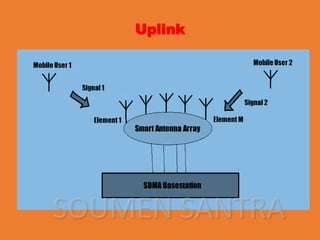
Uplink
Uplink Transmission
 The smart antenna array is operating in a passive mode.
Electromagnetic signals induce currents on the array
elements from mobile users .
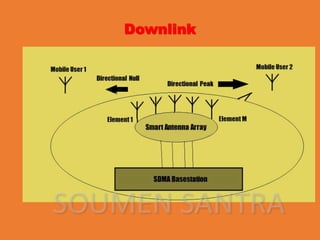
Downlink
Downlink Transmission
Working upon two mobile users.
Smart antenna is operating in an active mode.
It uses focus mobile user data as an appropriate user.
A null is placing in the radiation pattern of the other
mobile user.
Interference signal of one mobile user to be minimized.
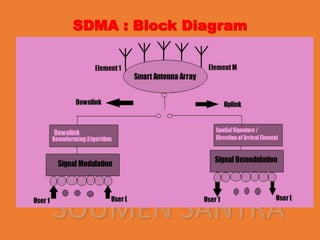
SDMA : Block Diagram
SDMA : Features
 Spatial separation between multiple transmissions.
 Multiple-Input Multiple Output architecture.
 Set of users in wireless mode communicate with each
other by antennas.
 Used in Wireless, Satellite and Optical Communication.
 Controls the radiated energy in space.
 Stations communicate at the same time using the same
channel.
SDMA : Features
 The same set of cell phone frequencies in a given service
area.
 Allocating a separated space to users in wireless network.
 Smart antennas with beams pointed at the direction of the
mobile station.
 It serves with different users within the same region.
 One satellite can communicate with other’s receivers by
same frequency.
 The directional spot-beam antennas of base station can
track a moving user.
 Combination work with FDMA or TDMA or CDMA.
SDMA : Beam Frequency Reuse
It is also called as Multiple Beam Frequency Reuse.
It reuses the same set of cell phone frequencies in a given
service area.
Two cells or two small regions can make use of same set of
frequencies if they separated by an allowable distance which
is called the reuse distance.
SDMA : Advantages
 Increases the capacity and speed of the system.
 Increases transmission quality by focusing the
signal into narrow transmission beams.
 Free from interference.
 All users can communicate at the same time
using the same channel.
 Two different signals can use the same
frequency.
 The narrow beam width also allows greater
gain and clarity.
 It minimizes system cost.
SDMA : Disadvantages
High insertion losses because input must have the
capability to be split into any output.
 Very expensive.
 Complicated to construct and design.
THANK YOU
GIVE FEEDBACK

SPACE DIVISION MULTIPLE ACCESS (SDMA) SATELLITE COMMUNICATION

  • 1.
    SPACE DIVISION MULTIPLE ACCESS(SDMA) Soumen Santra
  • 2.
    Multiple Access Provide communicationservice to multiple users.  Use a single channel.  It allows for many users at one time by sharing finite amount of spectrum.
  • 3.
    It is achannel access method based on creating parallel spatial channels.  It uses advanced antenna technology.  It uses of smart antenna array systems at the base station. It exploit spatial diversity. The communication channel encountered by this array of antennas. SDMA : Definition
  • 4.
    Smart Antenna A SmartAntenna is an antenna array. It dynamically adapts its radiation pattern. It improve system performance. The overall radiation pattern is determined by the relative amplitude and phase of the excitation currents.
  • 5.
    SDMA ? To increasesystem capacity, speed and quality.  To increasing demand for wireless services.  It increases system capacity. It can be exploited Spatial diversity in both Uplink and Downlink.  Uplink (Mobile User transmitting to Base Station)  Downlink (Base Station transmitting to Mobile User).
  • 6.
  • 7.
    Uplink Transmission  Thesmart antenna array is operating in a passive mode. Electromagnetic signals induce currents on the array elements from mobile users .
  • 8.
  • 9.
    Downlink Transmission Working upontwo mobile users. Smart antenna is operating in an active mode. It uses focus mobile user data as an appropriate user. A null is placing in the radiation pattern of the other mobile user. Interference signal of one mobile user to be minimized.
  • 10.
    SDMA : BlockDiagram
  • 11.
    SDMA : Features Spatial separation between multiple transmissions.  Multiple-Input Multiple Output architecture.  Set of users in wireless mode communicate with each other by antennas.  Used in Wireless, Satellite and Optical Communication.  Controls the radiated energy in space.  Stations communicate at the same time using the same channel.
  • 12.
    SDMA : Features The same set of cell phone frequencies in a given service area.  Allocating a separated space to users in wireless network.  Smart antennas with beams pointed at the direction of the mobile station.  It serves with different users within the same region.  One satellite can communicate with other’s receivers by same frequency.  The directional spot-beam antennas of base station can track a moving user.  Combination work with FDMA or TDMA or CDMA.
  • 13.
    SDMA : BeamFrequency Reuse It is also called as Multiple Beam Frequency Reuse. It reuses the same set of cell phone frequencies in a given service area. Two cells or two small regions can make use of same set of frequencies if they separated by an allowable distance which is called the reuse distance.
  • 14.
    SDMA : Advantages Increases the capacity and speed of the system.  Increases transmission quality by focusing the signal into narrow transmission beams.  Free from interference.  All users can communicate at the same time using the same channel.  Two different signals can use the same frequency.  The narrow beam width also allows greater gain and clarity.  It minimizes system cost.
  • 15.
    SDMA : Disadvantages Highinsertion losses because input must have the capability to be split into any output.  Very expensive.  Complicated to construct and design.
  • 16.