Power Saving in Wireless Sensor NetworksEng. MshariAlabdulkarim
Energy Saving in WSNsOutline:Studied Paper.
Introduction.
Power Consumption in WSNs.
Sleep-wake Scheduling.
MAC Protocol for WSN.
In-network Processing.
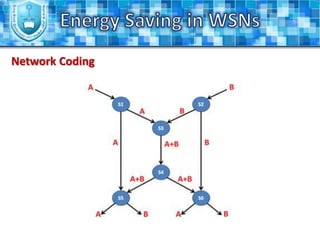
Network Coding.
Communication Protocol.Energy Saving in WSNsStudied PaperTopic: Energy saving in wireless sensor networks.By: Hnin Yu Shew, JIANG Xiao-hong, Susumu Horiguchi(Department of Computer Science, Graduate School of Information Science, Tohoku University, Sendai 980-8579, Japan) Date:  May 2009Type:   Survey on the main techniques used for energy saving in WSNs.
Energy Saving in WSNsIntroductionWireless Sensor Network?A wireless sensor network is a collection of nodes “sensors” organized into a cooperative network. The nodes communicate wirelessly and often self-organize after being deployed in an ad-hoc fashion.Base StationDetectionSensor Field
Energy Saving in WSNsIntroduction (Cont.)What are the components of the wireless sensor?Processor.Memory.RF transceiver.Power source.Sensor.
Energy Saving in WSNsIntroduction (Cont.)What is the goal of the sensor node?The goal from the sensor node is to collect the data at regular intervals, then transform the data into an electrical signal and finally send the signal to the sink or the base node.
Energy Saving in WSNsIntroduction (Cont.)
Energy Saving in WSNsIntroduction (Cont.)Wireless Sensor Network Applications:Monitoring Space.environmental and habitat monitoring, precision agriculture, indoor climate control, surveillance, treaty verification, and intelligent alarms.Monitoring Objects.structural monitoring, condition-based equipment maintenance, medical diagnostics, and urban terrain mapping.Monitoring Interactions of Objects and Space.wildlife habitats, disaster management, emergency response, ubiquitous computing environments, asset tracking, healthcare, and manufacturing process flow.
Energy Saving in WSNsIntroduction (Cont.)Wireless Sensor Network Example (1):
Energy Saving in WSNsIntroduction (Cont.)Wireless Sensor Network Example (2):
Energy Saving in WSNsIntroduction (Cont.)Short Video
Energy Saving in WSNsPower Consumption in WSNsThe power issue in the wireless sensor network is one of the biggest challenges, because the sensor has a limited source of power which is also hard to replace or recharge “e.g. sensors in the battle field, sensors in a large forest … etc”. Why limited source of power?Inexpensive nature.Limited size and weight.Redundant nature.
Energy Saving in WSNssources of power consumption:Useful power consumption:Transmitting or resaving data.
Processing query requests.
Forwarding queries and data to the neighbors.Wasteful power consumption:Idle listening to the channel “waiting for possible traffic”.
Retransmitting because of collisions “e.g. two packets arrived at the same time at the same sensor”.
Overhearing “when a sensor received a packet doesn’t belong to it”.
 Generating and handling control packets.
Over-emitting “when a sensor received a packet while it is not ready”.Energy Saving in WSNsHow to minimize the energy consumption of sensor nodes while meeting the application requirements? Sleep-wake Scheduling.
In-network Processing.
Network Coding.
Communication Protocol.Energy Saving in WSNsSleep-wake schedulingWake StateSleep StateGoal: reduce the time where the sensor is being idle.Drawback: Additional delay because of waiting for the next-hop node to wake up.
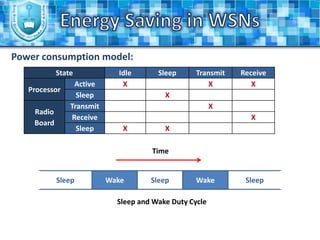
Energy Saving in WSNsPower consumption model:TimeWakeWakeSleepSleepSleepSleep and Wake Duty Cycle
Energy Saving in WSNs
Energy Saving in WSNsOn-demandScheme:Strategy:Sensor should be awakening just when it receives a packet from neighbors.Advantages:Minimize the power consumption.
The best sleep-wake scheme for the applications with low duty cycle.Disadvantages:Additional delay incurred when a node has to wait for its next hop node to wake up.
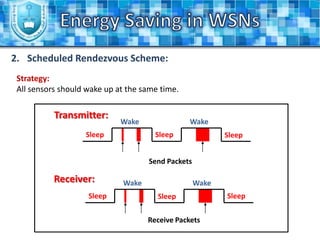
Not suitable for Disruption Tolerant Network (DTN).Energy Saving in WSNsScheduled Rendezvous Scheme:Strategy:All sensors should wake up at the same time. Transmitter:WakeWakeSleepSleepSleepSend PacketsReceiver:WakeWakeSleepSleepSleepReceive Packets
Energy Saving in WSNsScheduled Rendezvous Scheme (Cont.):Advantages:All sensors are awake in the same time “which allowing the broadcast massages”.Disadvantages:All sensors should be synchronized in order to wake and work in the same time.Energy Saving in WSNsAsynchronous Scheme:Strategy:All neighbors should have an overlapping between their wake periods. Transmitter:WakeSleepPreambleDataSleepSend PacketsReceiver:WakeSleepSleepDataCheck the channelCheck the channel and receive
Energy Saving in WSNsAsynchronous Scheme (Cont.):Advantages:The sensors don’t have to be synchronized together.
Allow each node in the WSN to set its own sleep/wake schedule independently.

Power Saving in Wireless Sensor Networks

  • 1.
    Power Saving inWireless Sensor NetworksEng. MshariAlabdulkarim
  • 2.
    Energy Saving inWSNsOutline:Studied Paper.
  • 3.
  • 4.
  • 5.
  • 6.
  • 7.
  • 8.
  • 9.
    Communication Protocol.Energy Savingin WSNsStudied PaperTopic: Energy saving in wireless sensor networks.By: Hnin Yu Shew, JIANG Xiao-hong, Susumu Horiguchi(Department of Computer Science, Graduate School of Information Science, Tohoku University, Sendai 980-8579, Japan) Date: May 2009Type: Survey on the main techniques used for energy saving in WSNs.
  • 10.
    Energy Saving inWSNsIntroductionWireless Sensor Network?A wireless sensor network is a collection of nodes “sensors” organized into a cooperative network. The nodes communicate wirelessly and often self-organize after being deployed in an ad-hoc fashion.Base StationDetectionSensor Field
  • 11.
    Energy Saving inWSNsIntroduction (Cont.)What are the components of the wireless sensor?Processor.Memory.RF transceiver.Power source.Sensor.
  • 12.
    Energy Saving inWSNsIntroduction (Cont.)What is the goal of the sensor node?The goal from the sensor node is to collect the data at regular intervals, then transform the data into an electrical signal and finally send the signal to the sink or the base node.
  • 13.
    Energy Saving inWSNsIntroduction (Cont.)
  • 14.
    Energy Saving inWSNsIntroduction (Cont.)Wireless Sensor Network Applications:Monitoring Space.environmental and habitat monitoring, precision agriculture, indoor climate control, surveillance, treaty verification, and intelligent alarms.Monitoring Objects.structural monitoring, condition-based equipment maintenance, medical diagnostics, and urban terrain mapping.Monitoring Interactions of Objects and Space.wildlife habitats, disaster management, emergency response, ubiquitous computing environments, asset tracking, healthcare, and manufacturing process flow.
  • 15.
    Energy Saving inWSNsIntroduction (Cont.)Wireless Sensor Network Example (1):
  • 16.
    Energy Saving inWSNsIntroduction (Cont.)Wireless Sensor Network Example (2):
  • 17.
    Energy Saving inWSNsIntroduction (Cont.)Short Video
  • 18.
    Energy Saving inWSNsPower Consumption in WSNsThe power issue in the wireless sensor network is one of the biggest challenges, because the sensor has a limited source of power which is also hard to replace or recharge “e.g. sensors in the battle field, sensors in a large forest … etc”. Why limited source of power?Inexpensive nature.Limited size and weight.Redundant nature.
  • 19.
    Energy Saving inWSNssources of power consumption:Useful power consumption:Transmitting or resaving data.
  • 20.
  • 21.
    Forwarding queries anddata to the neighbors.Wasteful power consumption:Idle listening to the channel “waiting for possible traffic”.
  • 22.
    Retransmitting because ofcollisions “e.g. two packets arrived at the same time at the same sensor”.
  • 23.
    Overhearing “when asensor received a packet doesn’t belong to it”.
  • 24.
    Generating andhandling control packets.
  • 25.
    Over-emitting “when asensor received a packet while it is not ready”.Energy Saving in WSNsHow to minimize the energy consumption of sensor nodes while meeting the application requirements? Sleep-wake Scheduling.
  • 26.
  • 27.
  • 28.
    Communication Protocol.Energy Savingin WSNsSleep-wake schedulingWake StateSleep StateGoal: reduce the time where the sensor is being idle.Drawback: Additional delay because of waiting for the next-hop node to wake up.
  • 29.
    Energy Saving inWSNsPower consumption model:TimeWakeWakeSleepSleepSleepSleep and Wake Duty Cycle
  • 30.
  • 31.
    Energy Saving inWSNsOn-demandScheme:Strategy:Sensor should be awakening just when it receives a packet from neighbors.Advantages:Minimize the power consumption.
  • 32.
    The best sleep-wakescheme for the applications with low duty cycle.Disadvantages:Additional delay incurred when a node has to wait for its next hop node to wake up.
  • 33.
    Not suitable forDisruption Tolerant Network (DTN).Energy Saving in WSNsScheduled Rendezvous Scheme:Strategy:All sensors should wake up at the same time. Transmitter:WakeWakeSleepSleepSleepSend PacketsReceiver:WakeWakeSleepSleepSleepReceive Packets
  • 34.
    Energy Saving inWSNsScheduled Rendezvous Scheme (Cont.):Advantages:All sensors are awake in the same time “which allowing the broadcast massages”.Disadvantages:All sensors should be synchronized in order to wake and work in the same time.Energy Saving in WSNsAsynchronous Scheme:Strategy:All neighbors should have an overlapping between their wake periods. Transmitter:WakeSleepPreambleDataSleepSend PacketsReceiver:WakeSleepSleepDataCheck the channelCheck the channel and receive
  • 35.
    Energy Saving inWSNsAsynchronous Scheme (Cont.):Advantages:The sensors don’t have to be synchronized together.
  • 36.
    Allow each nodein the WSN to set its own sleep/wake schedule independently.