Ad-Hoc NetworksEng. MshariAlabdulkarim
Ad-Hoc NetworksOutline: Introduction.
 Advantages and Applications.
Cellular VS Ad-Hoc Networks.
Technical Challenges and Issues.
Ad-Hoc Wireless Media Access Protocols.
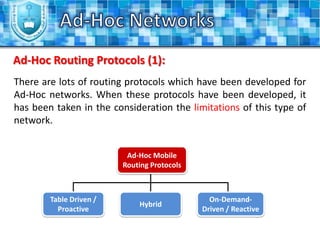
Ad-Hoc Routing Protocols.
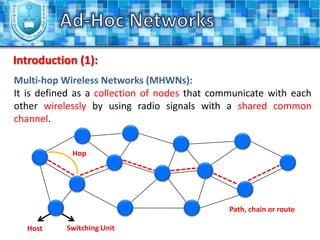
Providing Quality of Service in Ad-Hoc Networks.Ad-Hoc NetworksIntroduction (1):Multi-hop Wireless Networks (MHWNs): It is defined as a collection of nodes that communicate with each other wirelessly by using radio signals with a shared common channel.HopPath, chain or routeSwitching UnitHost
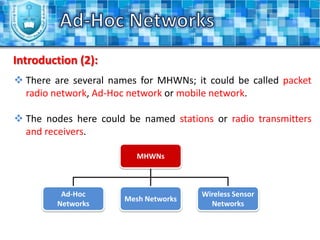
Ad-Hoc NetworksIntroduction (2):There are several names for MHWNs; it could be called packet radio network, Ad-Hoc network or mobile network.
The nodes here could be named stations or radio transmitters and receivers.MHWNsAd-Hoc NetworksMesh NetworksWireless Sensor Networks
Ad-Hoc NetworksIntroduction (3):Ad-Hoc Networks:It is a type of MHWNs.
Nodes in the network are mobile in general.
The wireless hosts in such networks, communicate with each other without the existing of a fixed infrastructure and without a central control.
A mobile ad-hoc network can be connected to other fixed networks or to the Internet.
Most of the Ad-Hoc networks use the allocated frequencies for the Industrial, Scientific and Medical (ISM) band. Ad-Hoc NetworksAdvantages and Applications (1):Ad-hoc networks have several advantages over the traditional networks, like:Ad-hoc networks can have more flexibility.
It is better in mobility.
It can be turn up and turn down in a very short time.
It can be more economical.
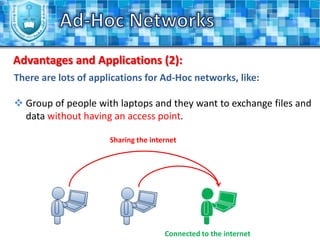
It considered a robust network because of its non-hierarchical distributed control and management mechanisms.Ad-Hoc NetworksAdvantages and Applications (2):There are lots of applications for Ad-Hoc networks, like: Group of people with laptops and they want to exchange files and data without having an access point.Sharing the internetConnected to the internet
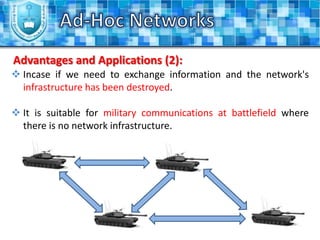
Ad-Hoc NetworksAdvantages and Applications (2):Incase if we need to exchange information and the network's infrastructure has been destroyed.
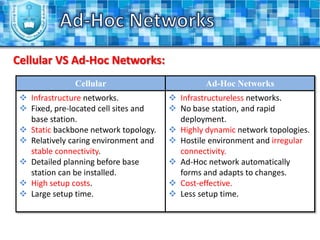
It is suitable for military communications at battlefield where there is no network infrastructure.Ad-Hoc NetworksCellular VS Ad-Hoc Networks:Infrastructure networks.
Fixed, pre-located cell sites and base station.
Static backbone network topology.
Relatively caring environment and stable connectivity.
Detailed planning before base station can be installed.
High setup costs.
Large setup time.
Infrastructureless networks.
No base station, and rapid deployment.
Highly dynamic network topologies.
Hostile environment and irregular connectivity.
Ad-Hoc network automatically forms and adapts to changes.
Cost-effective.
Less setup time. Ad-Hoc NetworksTechnical Challenges and Issues (1):There are several challenges that Ad-Hoc network faces such as:Limited wireless range.
Hidden terminals.
Packet losses.
Routes changes.
Devices heterogeneity.
Battery power constraints.Ad-Hoc NetworksTechnical Challenges and Issues (2):The main challenges face the Ad-Hoc networks are the following:Energy conservation: Nodes in Ad-Hoc networks are equipped with limited batteries.
Unstructured and/or time-varying network topology: Because of the nodes mobility, that makes the network topology usually unstructured and makes the optimizing process a difficult task.
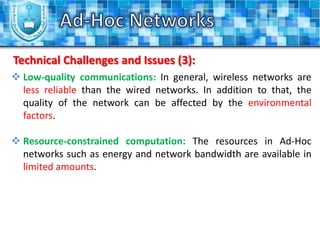
Scalability: In some cases, there will be a huge number of nodes.Ad-Hoc NetworksTechnical Challenges and Issues (3):Low-quality communications: In general, wireless networks are less reliable than the wired networks. In addition to that, the quality of the network can be affected by the environmental factors.
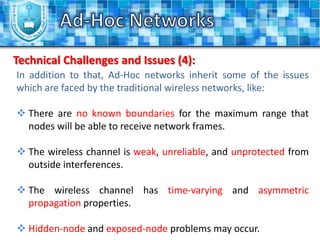
Resource-constrained computation: The resources in Ad-Hoc networks such as energy and network bandwidth are available in limited amounts.Ad-Hoc NetworksTechnical Challenges and Issues (4):In addition to that, Ad-Hoc networks inherit some of the issues which are faced by the traditional wireless networks, like:There are no known boundaries for the maximum range that nodes will be able to receive network frames.
The wireless channel is weak, unreliable, and unprotected from outside interferences.
The wireless channel has time-varying and asymmetric propagation properties.
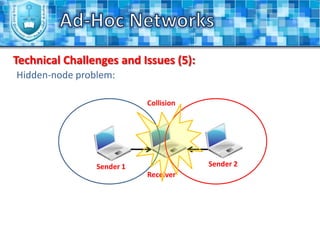
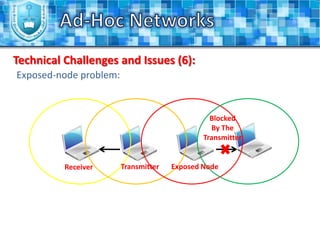
Hidden-node and exposed-node problems may occur.Ad-Hoc NetworksTechnical Challenges and Issues (5):Hidden-node problem:CollisionSender 2Sender 1Receiver
Ad-Hoc NetworksTechnical Challenges and Issues (6):Exposed-node problem:BlockedBy TheTransmitterTransmitterExposed NodeReceiver
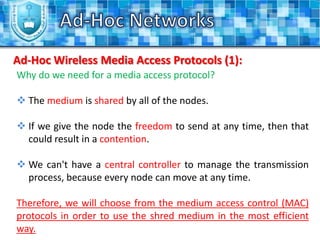
Ad-Hoc NetworksAd-Hoc Wireless Media Access Protocols (1):Why do we need for a media access protocol?The medium is shared by all of the nodes.
If we give the node the freedom to send at any time, then that could result in a contention.
We can't have a central controller to manage the transmission process, because every node can move at any time.Therefore, we will choose from the medium access control (MAC) protocols in order to use the shred medium in the most efficient way.
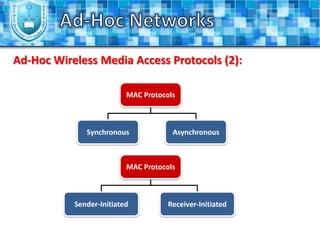
Ad-Hoc NetworksAd-Hoc Wireless Media Access Protocols (2):MAC ProtocolsSynchronousAsynchronousMAC ProtocolsSender-InitiatedReceiver-Initiated
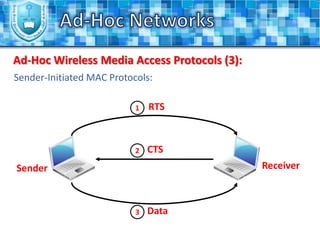
Ad-Hoc NetworksAd-Hoc Wireless Media Access Protocols (3):Sender-Initiated MAC Protocols:RTS1CTS2ReceiverSenderData3
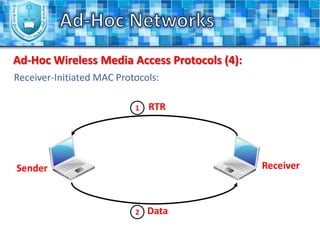
Ad-Hoc NetworksAd-Hoc Wireless Media Access Protocols (4):Receiver-Initiated MAC Protocols:RTR1ReceiverSenderData2
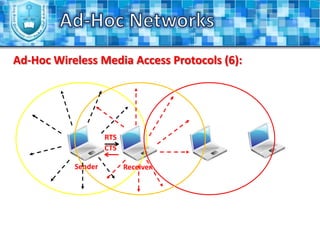
Ad-Hoc NetworksAd-Hoc Wireless Media Access Protocols (5):Existing Ad-Hoc MAC Protocols:Multiple Access with Collision Avoidance (MACA):It was proposed as a solution for both hidden terminal and exposed node problems.
It has the ability to control the transmitter power for each packet.
It uses a three-way handshake, RTS-CTS-Data.

Ad-Hoc Networks