Spread Spectrum
Unit - III
 Analog or digital data
 Analog signal
 Spread data over wide bandwidth
 Makes jamming and interception harder
 Frequency hoping
 Signal broadcast over seemingly random series of frequencies
 Direct Sequence
 Each bit is represented by multiple bits in transmitted signal
 Chipping code
Spread Spectrum
 Input fed into channel encoder
 Produces narrow bandwidth analog signal around central frequency
 Signal modulated using sequence of digits
 Spreading code/sequence
 Typically generated by pseudonoise / pseudorandom number generator
 Increases bandwidth significantly
 Spreads spectrum
 Receiver uses same sequence to demodulate signal
 Demodulated signal fed into channel decoder
Spread Spectrum Concept
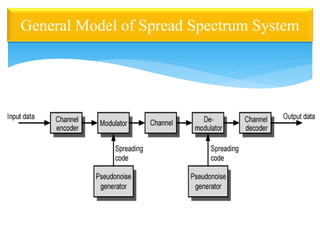
General Model of Spread Spectrum System
 Immunity from various noise and multipath distortion
 Including jamming
 Can hide/encrypt signals
 Only receiver who knows spreading code can retrieve signal
 Several users can share same higher bandwidth with little
interference
 Cellular telephones
 Code division multiplexing (CDM)
 Code division multiple access (CDMA)
Gains
 Generated by algorithm using initial seed
 Deterministic algorithm
 Not actually random
 If algorithm good, results pass reasonable tests of randomness
 Need to know algorithm and seed to predict sequence
Pseudorandom Numbers
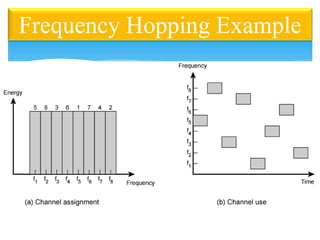
 Signal broadcast over seemingly random series of frequencies
 Receiver hops between frequencies in sync with transmitter
 Eavesdroppers hear unintelligible blips
 Jamming on one frequency affects only a few bits
Frequency Hopping Spread Spectrum (FHSS)
 Typically 2k carriers frequencies forming 2k channels
 Channel spacing corresponds with bandwidth of input
 Each channel used for fixed interval
 300 ms in IEEE 802.11
 Some number of bits transmitted using some encoding scheme
 May be fractions of bit (see later)
 Sequence dictated by spreading code
Basic Operation
Frequency Hopping Example
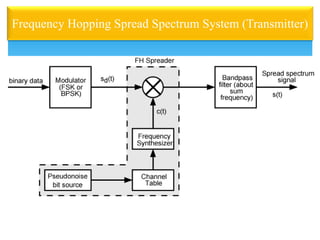
Frequency Hopping Spread Spectrum System (Transmitter)
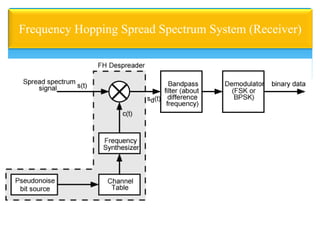
Frequency Hopping Spread Spectrum System (Receiver)
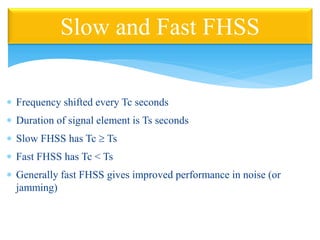
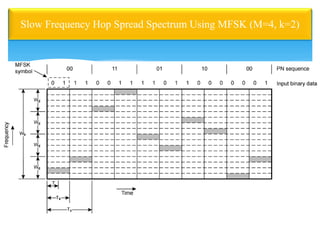
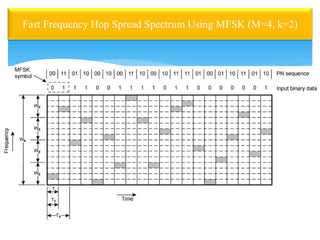
 Frequency shifted every Tc seconds
 Duration of signal element is Ts seconds
 Slow FHSS has Tc  Ts
 Fast FHSS has Tc < Ts
 Generally fast FHSS gives improved performance in noise (or
jamming)
Slow and Fast FHSS
Slow Frequency Hop Spread Spectrum Using MFSK (M=4, k=2)
Fast Frequency Hop Spread Spectrum Using MFSK (M=4, k=2)
 Typically large number of frequencies used
 Improved resistance to jamming
FHSS Performance Considerations
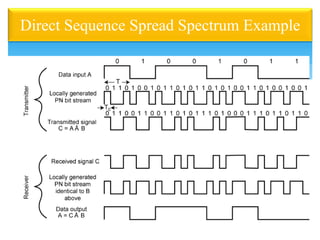
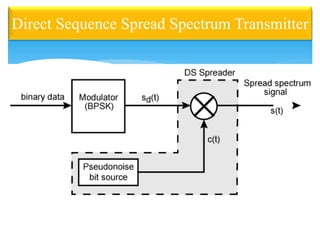
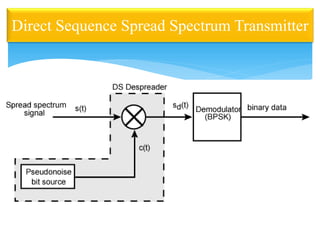
 Each bit represented by multiple bits using spreading code
 Spreading code spreads signal across wider frequency band
 In proportion to number of bits used
 10 bit spreading code spreads signal across 10 times bandwidth of 1 bit code
 One method:
 Combine input with spreading code using XOR
 Input bit 1 inverts spreading code bit
 Input zero bit doesn’t alter spreading code bit
 Data rate equal to original spreading code
 Performance similar to FHSS
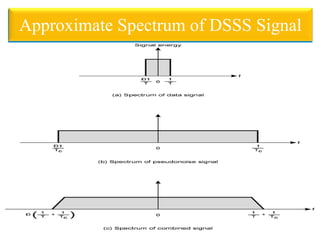
Direct Sequence Spread Spectrum (DSSS)
Direct Sequence Spread Spectrum Example
Direct Sequence Spread Spectrum Transmitter
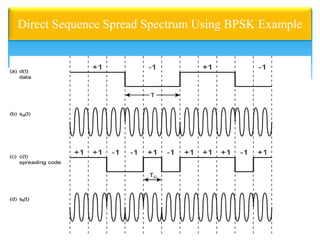
Direct Sequence Spread Spectrum Using BPSK Example
Approximate Spectrum of DSSS Signal
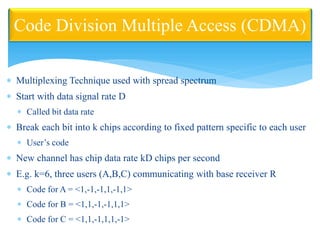
 Multiplexing Technique used with spread spectrum
 Start with data signal rate D
 Called bit data rate
 Break each bit into k chips according to fixed pattern specific to each user
 User’s code
 New channel has chip data rate kD chips per second
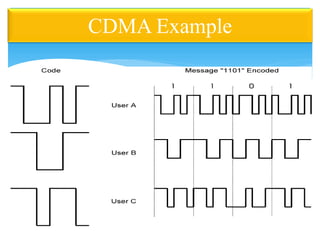
 E.g. k=6, three users (A,B,C) communicating with base receiver R
 Code for A = <1,-1,-1,1,-1,1>
 Code for B = <1,1,-1,-1,1,1>
 Code for C = <1,1,-1,1,1,-1>
Code Division Multiple Access (CDMA)
CDMA Example
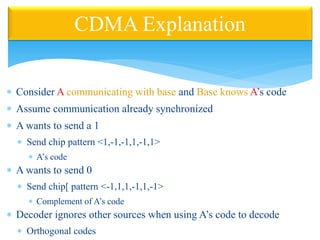
 Consider A communicating with base and Base knows A’s code
 Assume communication already synchronized
 A wants to send a 1
 Send chip pattern <1,-1,-1,1,-1,1>
 A’s code
 A wants to send 0
 Send chip[ pattern <-1,1,1,-1,1,-1>
 Complement of A’s code
 Decoder ignores other sources when using A’s code to decode
 Orthogonal codes
CDMA Explanation
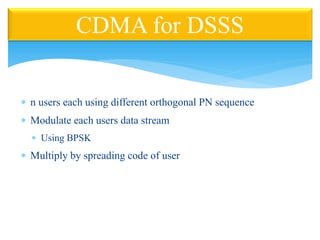
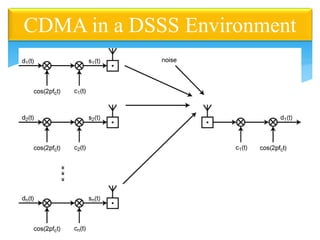
 n users each using different orthogonal PN sequence
 Modulate each users data stream
 Using BPSK
 Multiply by spreading code of user
CDMA for DSSS
CDMA in a DSSS Environment
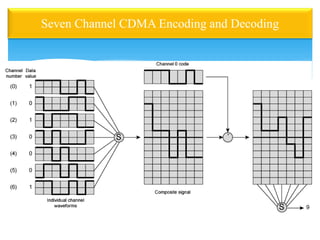
Seven Channel CDMA Encoding and Decoding
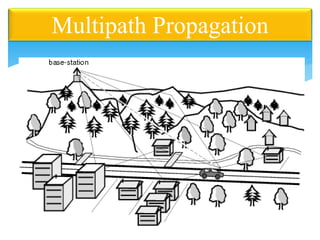
Multipath Propagation
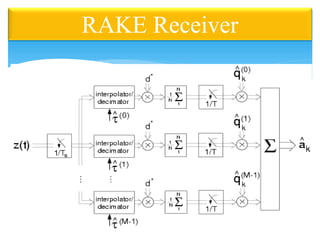
RAKE Receiver
RAKE Receiver
 Received signal sampled at the rate 1/Ts> 2/Tc for detection and
synchronization
 Fed to all M RAKE fingers. Interpolation/decimation unit provides
a data stream on chiprate 1/Tc
 Correlation with the complex conjugate of the spreading sequence
and weighted (maximum-ratio criterion)summation over one
symbol
 RAKE Receiver has to estimate:
 Multipath delays
 Phase of multipath components
 Amplitude of multipath components
 Number of multipath components
 Main challenge is receiver synchronization in fading channels
RAKE Receiver

Spread spectrum

  • 1.
  • 2.
     Analog ordigital data  Analog signal  Spread data over wide bandwidth  Makes jamming and interception harder  Frequency hoping  Signal broadcast over seemingly random series of frequencies  Direct Sequence  Each bit is represented by multiple bits in transmitted signal  Chipping code Spread Spectrum
  • 3.
     Input fedinto channel encoder  Produces narrow bandwidth analog signal around central frequency  Signal modulated using sequence of digits  Spreading code/sequence  Typically generated by pseudonoise / pseudorandom number generator  Increases bandwidth significantly  Spreads spectrum  Receiver uses same sequence to demodulate signal  Demodulated signal fed into channel decoder Spread Spectrum Concept
  • 4.
    General Model ofSpread Spectrum System
  • 5.
     Immunity fromvarious noise and multipath distortion  Including jamming  Can hide/encrypt signals  Only receiver who knows spreading code can retrieve signal  Several users can share same higher bandwidth with little interference  Cellular telephones  Code division multiplexing (CDM)  Code division multiple access (CDMA) Gains
  • 6.
     Generated byalgorithm using initial seed  Deterministic algorithm  Not actually random  If algorithm good, results pass reasonable tests of randomness  Need to know algorithm and seed to predict sequence Pseudorandom Numbers
  • 7.
     Signal broadcastover seemingly random series of frequencies  Receiver hops between frequencies in sync with transmitter  Eavesdroppers hear unintelligible blips  Jamming on one frequency affects only a few bits Frequency Hopping Spread Spectrum (FHSS)
  • 8.
     Typically 2kcarriers frequencies forming 2k channels  Channel spacing corresponds with bandwidth of input  Each channel used for fixed interval  300 ms in IEEE 802.11  Some number of bits transmitted using some encoding scheme  May be fractions of bit (see later)  Sequence dictated by spreading code Basic Operation
  • 9.
  • 10.
    Frequency Hopping SpreadSpectrum System (Transmitter)
  • 11.
    Frequency Hopping SpreadSpectrum System (Receiver)
  • 12.
     Frequency shiftedevery Tc seconds  Duration of signal element is Ts seconds  Slow FHSS has Tc  Ts  Fast FHSS has Tc < Ts  Generally fast FHSS gives improved performance in noise (or jamming) Slow and Fast FHSS
  • 13.
    Slow Frequency HopSpread Spectrum Using MFSK (M=4, k=2)
  • 14.
    Fast Frequency HopSpread Spectrum Using MFSK (M=4, k=2)
  • 15.
     Typically largenumber of frequencies used  Improved resistance to jamming FHSS Performance Considerations
  • 16.
     Each bitrepresented by multiple bits using spreading code  Spreading code spreads signal across wider frequency band  In proportion to number of bits used  10 bit spreading code spreads signal across 10 times bandwidth of 1 bit code  One method:  Combine input with spreading code using XOR  Input bit 1 inverts spreading code bit  Input zero bit doesn’t alter spreading code bit  Data rate equal to original spreading code  Performance similar to FHSS Direct Sequence Spread Spectrum (DSSS)
  • 17.
    Direct Sequence SpreadSpectrum Example
  • 18.
    Direct Sequence SpreadSpectrum Transmitter
  • 19.
    Direct Sequence SpreadSpectrum Transmitter
  • 20.
    Direct Sequence SpreadSpectrum Using BPSK Example
  • 21.
  • 22.
     Multiplexing Techniqueused with spread spectrum  Start with data signal rate D  Called bit data rate  Break each bit into k chips according to fixed pattern specific to each user  User’s code  New channel has chip data rate kD chips per second  E.g. k=6, three users (A,B,C) communicating with base receiver R  Code for A = <1,-1,-1,1,-1,1>  Code for B = <1,1,-1,-1,1,1>  Code for C = <1,1,-1,1,1,-1> Code Division Multiple Access (CDMA)
  • 23.
  • 24.
     Consider Acommunicating with base and Base knows A’s code  Assume communication already synchronized  A wants to send a 1  Send chip pattern <1,-1,-1,1,-1,1>  A’s code  A wants to send 0  Send chip[ pattern <-1,1,1,-1,1,-1>  Complement of A’s code  Decoder ignores other sources when using A’s code to decode  Orthogonal codes CDMA Explanation
  • 25.
     n userseach using different orthogonal PN sequence  Modulate each users data stream  Using BPSK  Multiply by spreading code of user CDMA for DSSS
  • 26.
    CDMA in aDSSS Environment
  • 27.
    Seven Channel CDMAEncoding and Decoding
  • 28.
  • 29.
  • 30.
    RAKE Receiver  Receivedsignal sampled at the rate 1/Ts> 2/Tc for detection and synchronization  Fed to all M RAKE fingers. Interpolation/decimation unit provides a data stream on chiprate 1/Tc  Correlation with the complex conjugate of the spreading sequence and weighted (maximum-ratio criterion)summation over one symbol
  • 31.
     RAKE Receiverhas to estimate:  Multipath delays  Phase of multipath components  Amplitude of multipath components  Number of multipath components  Main challenge is receiver synchronization in fading channels RAKE Receiver