SPREAD SPECTRUM
COMMUNICATION


  PRESENTED BY:

  Manish Srivastava
CONTENTS:

• INTRODUCTION
• WHY SPREAD SPECTRUM
  COMMUNICATION?
• HOW IT WORKS
• SPREAD SPECTRUM TECHNIQUES
• APPLICATIONS
• CONCLUSION
INTRODUCTION TO SPREAD                             Wireless Networks
                                                          Spring 2005


 SPECTRUM COMMUNICATION
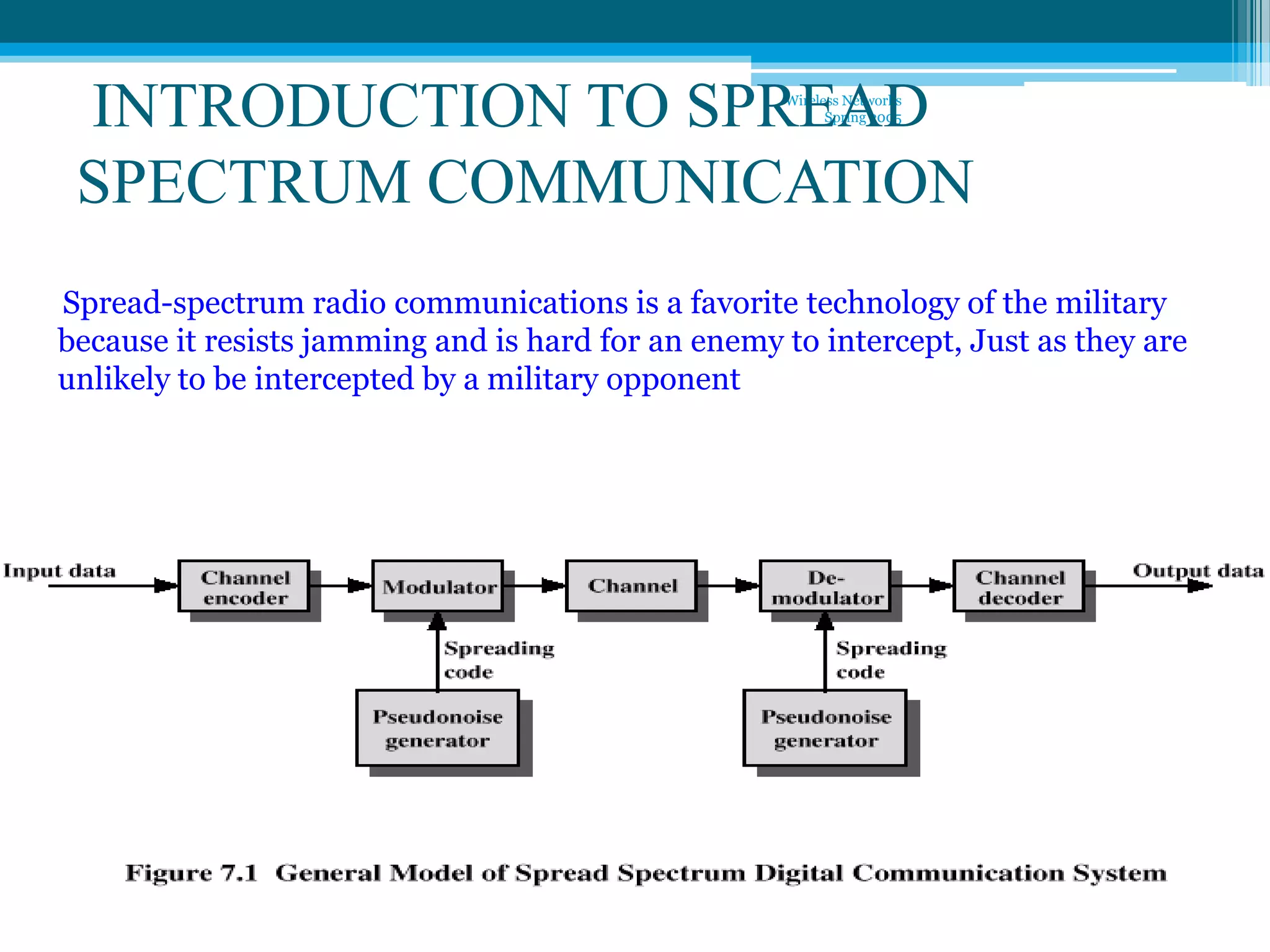
Spread-spectrum radio communications is a favorite technology of the military
because it resists jamming and is hard for an enemy to intercept, Just as they are
unlikely to be intercepted by a military opponent
4


Overview of Spread Spectrum
Communications
• Spread Spectrum is a means of transmission in which
  the data sequence occupies a bandwidth in excess of the
  minimum bandwidth necessary to send it.
  ▫ Effectively the signal is mapped to a higher dimension signal
    space

• Signal spreading is done before transmission by using a
  spreading sequence. The same sequence is used at the
  receiver to retrieve the signal

• Spread Spectrum is most effective against interference
  (intentional or non-intentional) with fixed energy.
• Main commercial applications in wireless and GPS.
5


Spread Spectrum Background
 • Like the computer, the basic technology, spread
   spectrum, has no single specific inventor
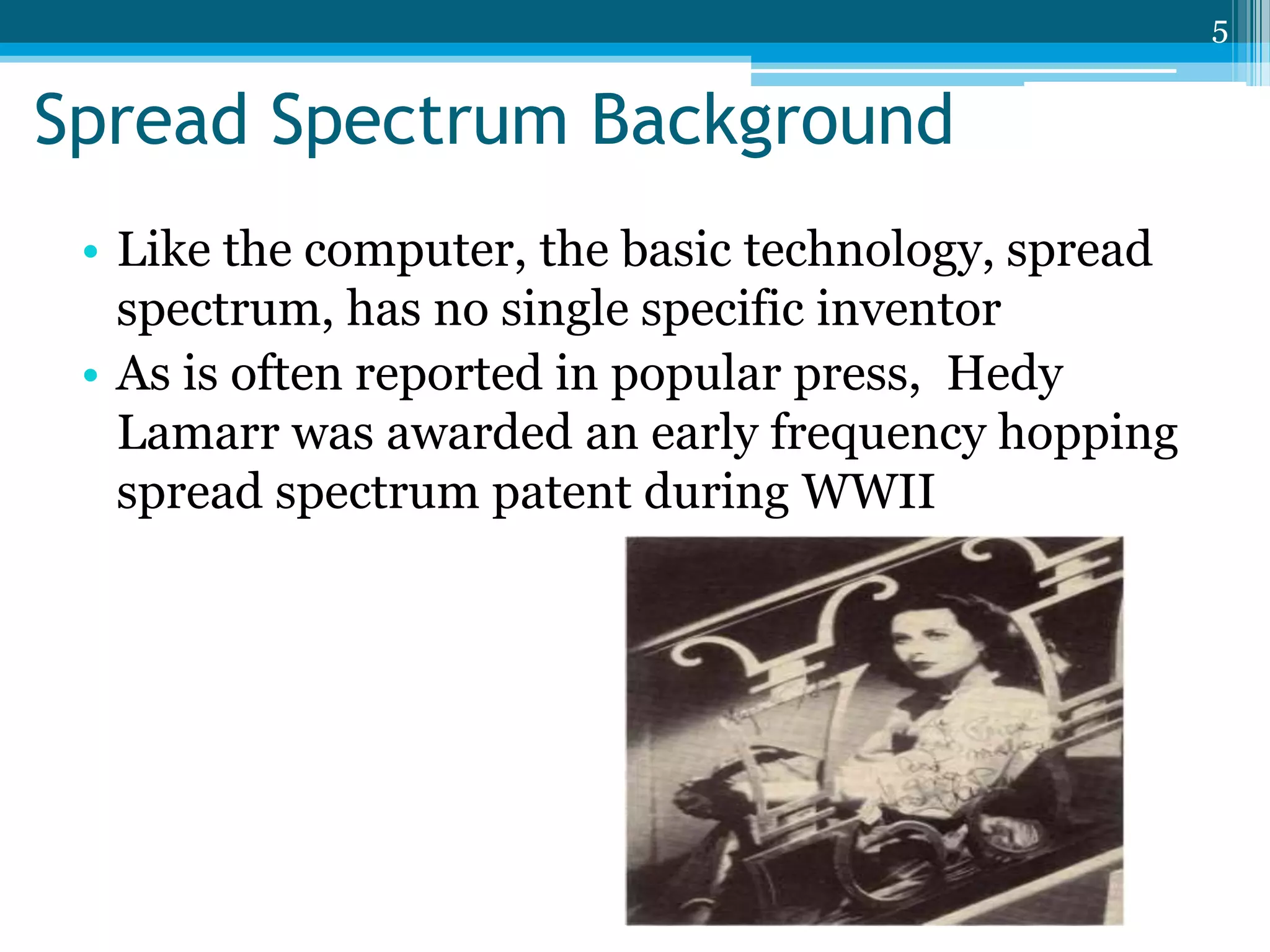
 • As is often reported in popular press, Hedy
   Lamarr was awarded an early frequency hopping
   spread spectrum patent during WWII
Wireless Environment
                                  and Wireless LANs
                                                    6


Why Spread Spectrum?
• Spread spectrum signals are distributed over a
  wide range of frequencies and then collected
  back at the receiver
  ▫ These wideband signals are noise-like and hence
    difficult to detect or interfere with
• Initially adopted in military applications, for its
  resistance to jamming and difficulty of
  interception
• More recently, adopted in commercial wireless
  communications
Wireless Environment
                                   and Wireless LANs
                                                     7


NEED FOR SPREAD SPECTRUM


• Safeguards for physical
  security must be even greater
  in wireless communications
• Encryption: intercepted
  communications must not be
  easily interpreted
• Authentication: is the node
  who it claims to be?
How Spread Spectrum Works
• Spread Spectrum uses wide band, noise-like signals. Because
    Spread Spectrum signals are noise-like, they are hard to detect.

• Spread Spectrum signals are also hard to Intercept or
  demodulate.

• Further, Spread Spectrum signals are harder to jam (interfere
  with) than narrowband signals.

• These Low Probability of Intercept (LPI) and anti-jam (AJ)
  features are why the military has used Spread Spectrum for so
  many years.

.
9


Spreading Codes
 • A noise-like and random signal has to be
   generated at the transmitter.
 • The same signal must be generated at the receiver
   in synchronization.
 • We limit the complexity by specifying only one bit
   per sample, i.e., a binary sequence.
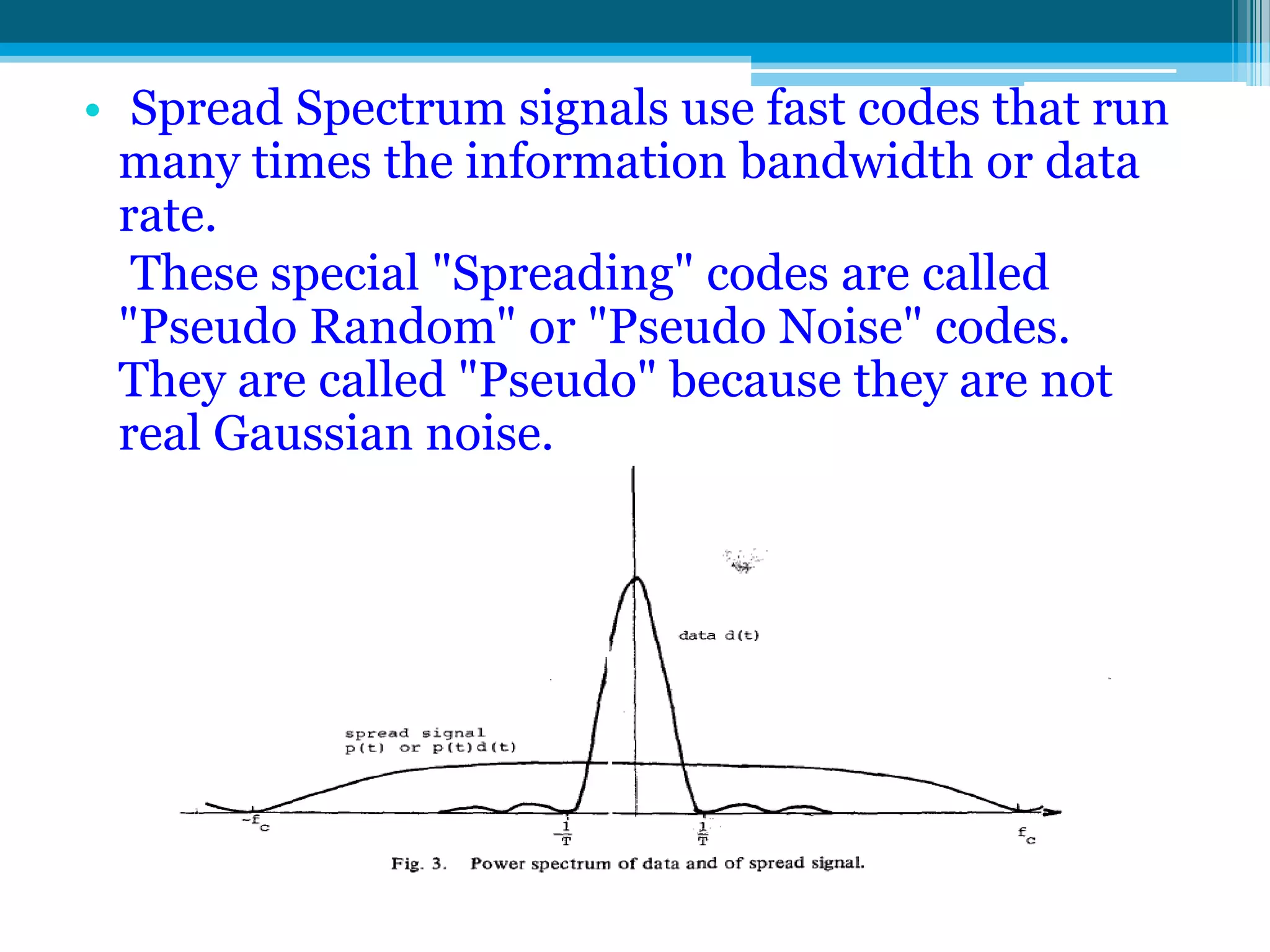
• Spread Spectrum signals use fast codes that run
  many times the information bandwidth or data
  rate.
   These special "Spreading" codes are called
  "Pseudo Random" or "Pseudo Noise" codes.
  They are called "Pseudo" because they are not
  real Gaussian noise.
Wireless Networks
                                                     Spring 2005


PN Sequences
• PN generator produces periodic sequence that appears to be
  random
• PN Sequences
  ▫ Generated by an algorithm using initial seed
  ▫ Sequence isn’t statistically random but will pass many test of
    randomness
  ▫ Sequences referred to as pseudorandom numbers or pseudonoise
    sequences
  ▫ Unless algorithm and seed are known, the sequence is impractical to
    predict
Wireless Networks
                                 Spring 2005


Important PN Properties
• Randomness
  ▫ Uniform distribution
     Balance property
     Run property
  ▫ Independence
  ▫ Correlation property
• Unpredictability
13


               1953 MIT Lincoln Lab
               System
• Developed by Paul Green as a
  thesis project
• One of earliest PN systems
• Technology of the day limited
  size
SPREAD SPECTRUM TECHNIQUES
  • THE MAJOR SPREAD SPECTRUM
    TECHNIQUES ARE


  • DSSS


  • FHSS
Wireless Environment
                                                    and Wireless LANs


Direct Sequence Spread Spectrum
                                                                     15


(DSSS)
 11010111010100100001101010010011111010100100111

    Spreading code                 11010111010100100001101010010011111010100100111 (…)


             User data             Information after spreading
           1101010010011


• Data signal is multiplied by a spreading code,
  and resulting signal occupies a much higher
  frequency band
• Spreading code is a pseudo-random sequence
Processing Gain (spreading factor)
  Period of one
  data bit
                     PG = SF = Tb / Tc


Period of
one chip
Wireless Environment
                and Wireless LANs
                                 17


DSSS Example
Frequency Hopping Spread Spectrum
                             Wireless Environment
                              and Wireless LANs
                                               18


(FHSS)

• Data signal is modulated with a narrowband
  signal that hops from frequency band to
  frequency band, over time
• The transmission frequencies are determined by
  a spreading, or hopping code (a pseudo-random
  sequence)
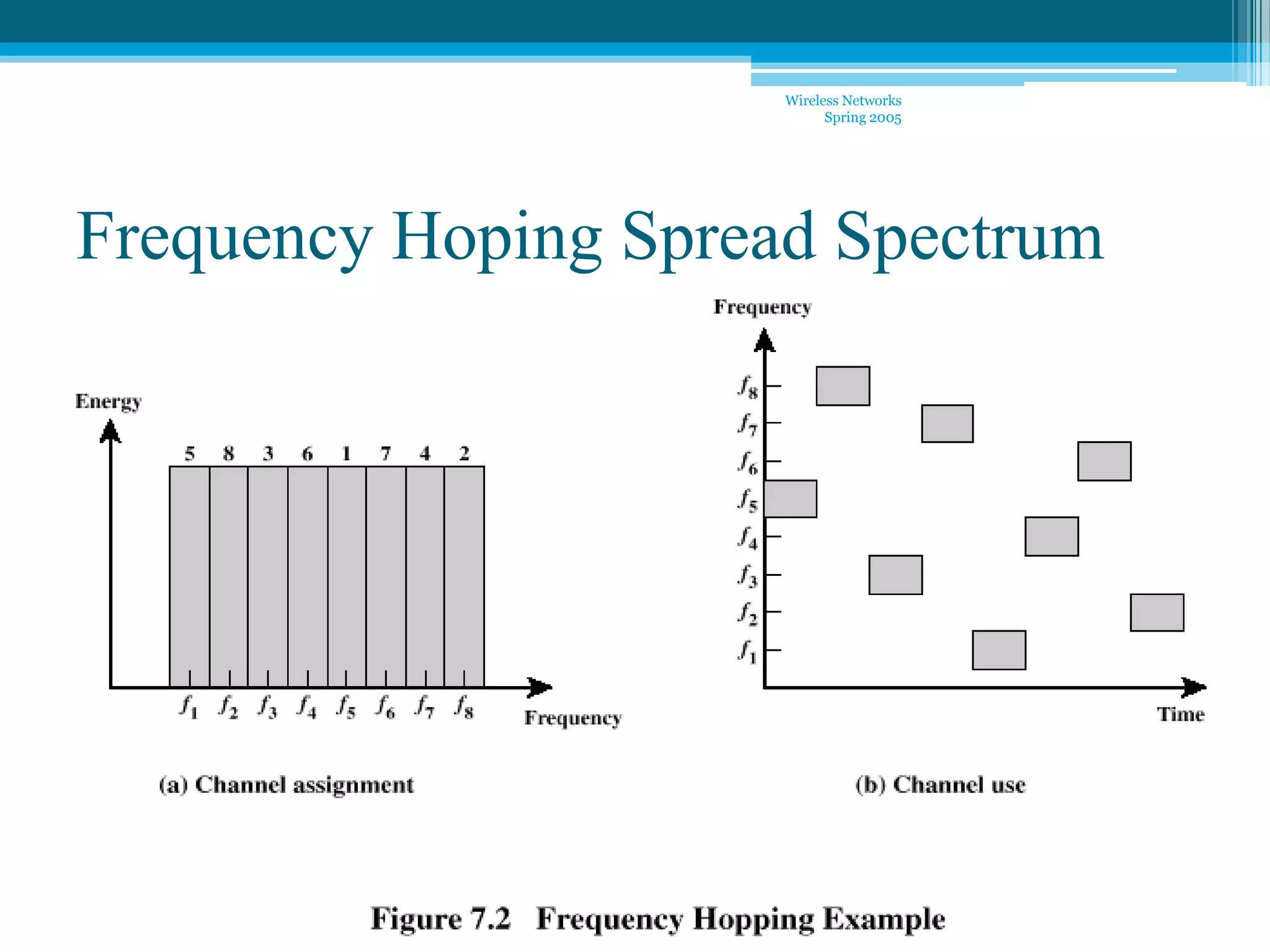
Wireless Networks
                            Spring 2005


Frequency Hoping Spread Spectrum
Frequency Hopping
the carrier frequency is 'hopping' according to a
unique sequence
APPLICATION
Motivation: radio channel availability
 • Radio-jamming is ever-present threat to radio channels
 • This is an attack on the availability of signals
    – Denial-of-Service (DoS) attack


                                RCVR


        XMTR                                  JMR


 • Traditional anti-jamming techniques rely on pre-shared
   secret codes (keys) to increase channel availability


                                                      22
Motivation: anti-jamming communication
 • Spread-Spectrum Techniques
   – FHSS (Frequency Hopping
     Spread Spectrum)
                                          PRNG                     PRNG
    energy


                                Hopping sequence (PRNG seed) must be known
                                to the sender and receiver but not the jammer.
                    frequency


   – DSSS (Direct-Sequence
     Spread Spectrum)

                                   PRNG                                PRNG
     energy


                                Spreading code (PRNG seed) must be known
                                to the sender and receiver but not the jammer.
                    frequency


                                                                      23
Wireless Environment


BLUETOOTH
                                 and Wireless LANs
                                                  24


                        • Universal framework to
                          integrate a diverse set of
            Bluetooth
            phone and
                          devices in a seamless, user-
            headset       friendly, efficient manner
                        • Devices must be able to
                          establish ad hoc
                          connections
Bluetooth               • Support for data and voice
printer
module
                        • Similar security as cables
                        • Simple, small, power-
                          efficient implementation
                        • Inexpensive!
Code Division Multiple Access
• Multiple Transmitters  1 Receiver

• Choice of unique sequences to spread the data
  bits

• Ability of receiver to distinguish between data
  streams
Advantages of Spread Spectrum

1.   Reduced crosstalk interference:
2.   Better voice quality/data integrity and less static noise
3.   Lowered susceptibility to multipath fading
4.   Inherent security:
5.   Co-existence:
6.   Longer operating distances
7.   Hard to detect:
8.   Hard to intercept or demodulate:
9.   Harder to jam
Conclusion
•            Spread spectrum promises several benefits such as
  higher capacity and ability to resist multipath propagation.
  Spread spectrum signals are difficult to intercept for an
  unauthorized person, they are easily hidden. For an
  unauthorized person, it is difficult to even detect their presence
  in many cases. They are resistant to jamming. They provide a
  measure of immunity to distortion due to multipath
  propagation. They have multiple access capability
• .
•              Spread spectrum is now finding widespread
  civilian and commercial applications such as cellular
  telephones, personal communications and position location.
  For example, DS/SS is used in electronic Industries
  Association’s Interim Standard IS-95 for cellular telephones, as
  well as wide range of position location systems such as the
  global position location and other vehicle location and
  messaging systems.
OVERVIEW

Spread spectrum

  • 1.
    SPREAD SPECTRUM COMMUNICATION PRESENTED BY: Manish Srivastava
  • 2.
    CONTENTS: • INTRODUCTION • WHYSPREAD SPECTRUM COMMUNICATION? • HOW IT WORKS • SPREAD SPECTRUM TECHNIQUES • APPLICATIONS • CONCLUSION
  • 3.
    INTRODUCTION TO SPREAD Wireless Networks Spring 2005 SPECTRUM COMMUNICATION Spread-spectrum radio communications is a favorite technology of the military because it resists jamming and is hard for an enemy to intercept, Just as they are unlikely to be intercepted by a military opponent
  • 4.
    4 Overview of SpreadSpectrum Communications • Spread Spectrum is a means of transmission in which the data sequence occupies a bandwidth in excess of the minimum bandwidth necessary to send it. ▫ Effectively the signal is mapped to a higher dimension signal space • Signal spreading is done before transmission by using a spreading sequence. The same sequence is used at the receiver to retrieve the signal • Spread Spectrum is most effective against interference (intentional or non-intentional) with fixed energy. • Main commercial applications in wireless and GPS.
  • 5.
    5 Spread Spectrum Background • Like the computer, the basic technology, spread spectrum, has no single specific inventor • As is often reported in popular press, Hedy Lamarr was awarded an early frequency hopping spread spectrum patent during WWII
  • 6.
    Wireless Environment and Wireless LANs 6 Why Spread Spectrum? • Spread spectrum signals are distributed over a wide range of frequencies and then collected back at the receiver ▫ These wideband signals are noise-like and hence difficult to detect or interfere with • Initially adopted in military applications, for its resistance to jamming and difficulty of interception • More recently, adopted in commercial wireless communications
  • 7.
    Wireless Environment and Wireless LANs 7 NEED FOR SPREAD SPECTRUM • Safeguards for physical security must be even greater in wireless communications • Encryption: intercepted communications must not be easily interpreted • Authentication: is the node who it claims to be?
  • 8.
    How Spread SpectrumWorks • Spread Spectrum uses wide band, noise-like signals. Because Spread Spectrum signals are noise-like, they are hard to detect. • Spread Spectrum signals are also hard to Intercept or demodulate. • Further, Spread Spectrum signals are harder to jam (interfere with) than narrowband signals. • These Low Probability of Intercept (LPI) and anti-jam (AJ) features are why the military has used Spread Spectrum for so many years. .
  • 9.
    9 Spreading Codes •A noise-like and random signal has to be generated at the transmitter. • The same signal must be generated at the receiver in synchronization. • We limit the complexity by specifying only one bit per sample, i.e., a binary sequence.
  • 10.
    • Spread Spectrumsignals use fast codes that run many times the information bandwidth or data rate. These special "Spreading" codes are called "Pseudo Random" or "Pseudo Noise" codes. They are called "Pseudo" because they are not real Gaussian noise.
  • 11.
    Wireless Networks Spring 2005 PN Sequences • PN generator produces periodic sequence that appears to be random • PN Sequences ▫ Generated by an algorithm using initial seed ▫ Sequence isn’t statistically random but will pass many test of randomness ▫ Sequences referred to as pseudorandom numbers or pseudonoise sequences ▫ Unless algorithm and seed are known, the sequence is impractical to predict
  • 12.
    Wireless Networks Spring 2005 Important PN Properties • Randomness ▫ Uniform distribution  Balance property  Run property ▫ Independence ▫ Correlation property • Unpredictability
  • 13.
    13 1953 MIT Lincoln Lab System • Developed by Paul Green as a thesis project • One of earliest PN systems • Technology of the day limited size
  • 14.
    SPREAD SPECTRUM TECHNIQUES • THE MAJOR SPREAD SPECTRUM TECHNIQUES ARE • DSSS • FHSS
  • 15.
    Wireless Environment and Wireless LANs Direct Sequence Spread Spectrum 15 (DSSS) 11010111010100100001101010010011111010100100111 Spreading code 11010111010100100001101010010011111010100100111 (…) User data Information after spreading 1101010010011 • Data signal is multiplied by a spreading code, and resulting signal occupies a much higher frequency band • Spreading code is a pseudo-random sequence
  • 16.
    Processing Gain (spreadingfactor) Period of one data bit PG = SF = Tb / Tc Period of one chip
  • 17.
    Wireless Environment and Wireless LANs 17 DSSS Example
  • 18.
    Frequency Hopping SpreadSpectrum Wireless Environment and Wireless LANs 18 (FHSS) • Data signal is modulated with a narrowband signal that hops from frequency band to frequency band, over time • The transmission frequencies are determined by a spreading, or hopping code (a pseudo-random sequence)
  • 19.
    Wireless Networks Spring 2005 Frequency Hoping Spread Spectrum
  • 20.
    Frequency Hopping the carrierfrequency is 'hopping' according to a unique sequence
  • 21.
  • 22.
    Motivation: radio channelavailability • Radio-jamming is ever-present threat to radio channels • This is an attack on the availability of signals – Denial-of-Service (DoS) attack RCVR XMTR JMR • Traditional anti-jamming techniques rely on pre-shared secret codes (keys) to increase channel availability 22
  • 23.
    Motivation: anti-jamming communication • Spread-Spectrum Techniques – FHSS (Frequency Hopping Spread Spectrum) PRNG PRNG energy Hopping sequence (PRNG seed) must be known to the sender and receiver but not the jammer. frequency – DSSS (Direct-Sequence Spread Spectrum) PRNG PRNG energy Spreading code (PRNG seed) must be known to the sender and receiver but not the jammer. frequency 23
  • 24.
    Wireless Environment BLUETOOTH and Wireless LANs 24 • Universal framework to integrate a diverse set of Bluetooth phone and devices in a seamless, user- headset friendly, efficient manner • Devices must be able to establish ad hoc connections Bluetooth • Support for data and voice printer module • Similar security as cables • Simple, small, power- efficient implementation • Inexpensive!
  • 25.
    Code Division MultipleAccess • Multiple Transmitters  1 Receiver • Choice of unique sequences to spread the data bits • Ability of receiver to distinguish between data streams
  • 26.
    Advantages of SpreadSpectrum 1. Reduced crosstalk interference: 2. Better voice quality/data integrity and less static noise 3. Lowered susceptibility to multipath fading 4. Inherent security: 5. Co-existence: 6. Longer operating distances 7. Hard to detect: 8. Hard to intercept or demodulate: 9. Harder to jam
  • 27.
    Conclusion • Spread spectrum promises several benefits such as higher capacity and ability to resist multipath propagation. Spread spectrum signals are difficult to intercept for an unauthorized person, they are easily hidden. For an unauthorized person, it is difficult to even detect their presence in many cases. They are resistant to jamming. They provide a measure of immunity to distortion due to multipath propagation. They have multiple access capability • . • Spread spectrum is now finding widespread civilian and commercial applications such as cellular telephones, personal communications and position location. For example, DS/SS is used in electronic Industries Association’s Interim Standard IS-95 for cellular telephones, as well as wide range of position location systems such as the global position location and other vehicle location and messaging systems.
  • 29.