Code Division Multiple Access Prepared by: Christina Chiu Mar 24, 2004
Outline Spread Spectrum Communications Multiple Access Technique Direct Sequence DS-CDMA CDMA standards CDMAOne (2G) – IS 95A, (2.5G) IS-95B CDMA 2000 and WCDMA (3G) – IMT2000 4G in the future Conclusions
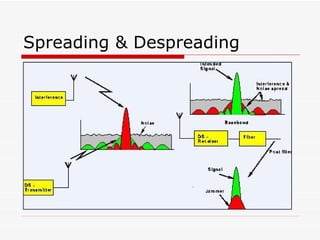
Spread Spectrum Technique Low power spectral density Rejection to jamming signal and interference Pseudorandom sequence Randomness and noise properties Walsh, M-sequence, Gold, Kasami, Z4 Provide signal privacy
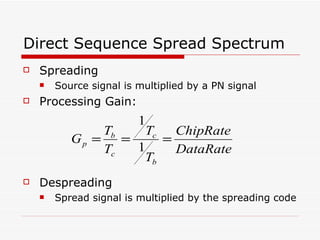
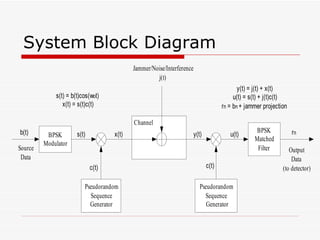
Direct Sequence Spread Spectrum  Spreading Source signal is multiplied by a PN signal Processing Gain: Despreading Spread signal is multiplied by the spreading code
System Block Diagram
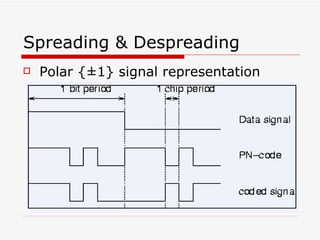
Spreading & Despreading Polar {±1} signal representation
Spreading & Despreading
CDMA Unique code to differentiate all users Sequence used for spreading have low cross-correlations  Allow many users to occupy all the frequency/bandwidth allocations at that same time Processing gain is the system capacity How many users the system can support
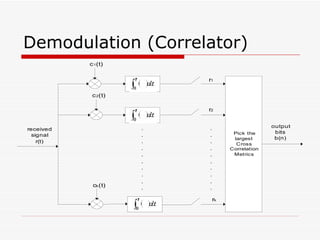
Demodulation (Correlator)
2G: IS-95A (1995) Known as CDMAOne Chip rate at 1.25Mbps Convolutional codes, Viterbi Decoding Downlink (Base station to mobile): Walsh code 64-bit for channel separation M-sequence 2 15  for cell separation Uplink (Mobile to base station): M-sequence 2 41  for channel and user separation
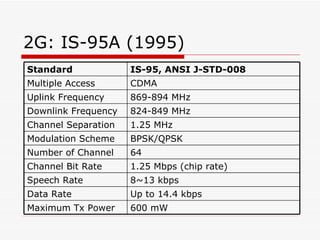
2G: IS-95A (1995) 8~13 kbps Speech Rate Up to 14.4 kbps Data Rate 1.25 Mbps (chip rate) Channel Bit Rate 600 mW Maximum Tx Power 64 Number of Channel BPSK/QPSK Modulation Scheme 1.25 MHz Channel Separation 824-849 MHz Downlink Frequency 869-894 MHz Uplink Frequency CDMA Multiple Access IS-95, ANSI J-STD-008 Standard
2.5G: IS-95B (1998) Increased data rate for internet applications Up to 115 kbps (8 times that of 2G) Support web browser format language Wireless Application Protocol (WAP)
3G Technology Ability to receive live music, interactive web sessions, voice and data with multimedia features Global Standard IMT-2000 CDMA 2000, proposed by TIA W-CDMA, proposed by ARIB/ETSI Issued by ITU (International Telecommunication Union)
3G Specficiations Excellent voice quality Data rate 144 kbps in high mobility 384 kbps in limited mobility 2 Mbps in door Frequency Band 1885-2025 MHz Convolutional Codes Turbo Codes for high data rates
3G: CDMA2000 (2000) CDMA 1xEV-DO peak data rate 2.4 Mbps supports mp3 transfer and video conferencing CDMA 1xEV-DV Integrated voice and high-speed data multimedia service up to 3.1 Mbps Channel Bandwidth:  1.25, 5, 10, 15 or 20 MHz Chip rate at 3.6864 Mbps Modulation Scheme QPSK in downlink  BPSK in uplink
3G: CDMA2000 Spreading Codes Downlink  Variable length orthogonal Walsh sequences for channel separation M-sequences 3x2 15  for cell separation (different phase shifts) Uplink Variable length orthogonal Walsh sequences for channel separation  M-sequences 2 41  for user separation (different phase shifts)
3G: W-CDMA (2000) Stands for “wideband” CDMA Channel Bandwidth:  5, 10 or 20 MHz Chip rate at 4.096 Mbps Modulation Scheme QPSK in downlink BPSK in uplink
3G: W-CDMA Spreading Codes  Downlink  Variable length orthogonal sequences for channel separation Gold sequences 2 18  for cell separation Uplink Variable length orthogonal sequences for channel separation Gold sequences 2 41  for user separation
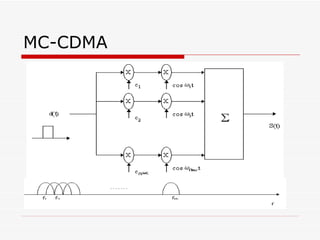
4G Technology (2010) High data rates => 100 Mbps Multimedia data up to ~10 2  Mbps IP-oriented network => Internet MIMO using Multiple Antennas Spreading code Non-binary sequences Multiple Access Technique MC-CDMA
MC-CDMA
Conclusions CDMA can increase the capacity of mobile system Goals of next generation cellular Further increase data rate Reduce interference among users Future research: Search for good non-binary sequences  Ideal 2-level autocorrelation Low cross correlations

Code division multiple access

  • 1.
    Code Division MultipleAccess Prepared by: Christina Chiu Mar 24, 2004
  • 2.
    Outline Spread SpectrumCommunications Multiple Access Technique Direct Sequence DS-CDMA CDMA standards CDMAOne (2G) – IS 95A, (2.5G) IS-95B CDMA 2000 and WCDMA (3G) – IMT2000 4G in the future Conclusions
  • 3.
    Spread Spectrum TechniqueLow power spectral density Rejection to jamming signal and interference Pseudorandom sequence Randomness and noise properties Walsh, M-sequence, Gold, Kasami, Z4 Provide signal privacy
  • 4.
    Direct Sequence SpreadSpectrum Spreading Source signal is multiplied by a PN signal Processing Gain: Despreading Spread signal is multiplied by the spreading code
  • 5.
  • 6.
    Spreading & DespreadingPolar {±1} signal representation
  • 7.
  • 8.
    CDMA Unique codeto differentiate all users Sequence used for spreading have low cross-correlations Allow many users to occupy all the frequency/bandwidth allocations at that same time Processing gain is the system capacity How many users the system can support
  • 9.
  • 10.
    2G: IS-95A (1995)Known as CDMAOne Chip rate at 1.25Mbps Convolutional codes, Viterbi Decoding Downlink (Base station to mobile): Walsh code 64-bit for channel separation M-sequence 2 15 for cell separation Uplink (Mobile to base station): M-sequence 2 41 for channel and user separation
  • 11.
    2G: IS-95A (1995)8~13 kbps Speech Rate Up to 14.4 kbps Data Rate 1.25 Mbps (chip rate) Channel Bit Rate 600 mW Maximum Tx Power 64 Number of Channel BPSK/QPSK Modulation Scheme 1.25 MHz Channel Separation 824-849 MHz Downlink Frequency 869-894 MHz Uplink Frequency CDMA Multiple Access IS-95, ANSI J-STD-008 Standard
  • 12.
    2.5G: IS-95B (1998)Increased data rate for internet applications Up to 115 kbps (8 times that of 2G) Support web browser format language Wireless Application Protocol (WAP)
  • 13.
    3G Technology Abilityto receive live music, interactive web sessions, voice and data with multimedia features Global Standard IMT-2000 CDMA 2000, proposed by TIA W-CDMA, proposed by ARIB/ETSI Issued by ITU (International Telecommunication Union)
  • 14.
    3G Specficiations Excellentvoice quality Data rate 144 kbps in high mobility 384 kbps in limited mobility 2 Mbps in door Frequency Band 1885-2025 MHz Convolutional Codes Turbo Codes for high data rates
  • 15.
    3G: CDMA2000 (2000)CDMA 1xEV-DO peak data rate 2.4 Mbps supports mp3 transfer and video conferencing CDMA 1xEV-DV Integrated voice and high-speed data multimedia service up to 3.1 Mbps Channel Bandwidth: 1.25, 5, 10, 15 or 20 MHz Chip rate at 3.6864 Mbps Modulation Scheme QPSK in downlink BPSK in uplink
  • 16.
    3G: CDMA2000 SpreadingCodes Downlink Variable length orthogonal Walsh sequences for channel separation M-sequences 3x2 15 for cell separation (different phase shifts) Uplink Variable length orthogonal Walsh sequences for channel separation M-sequences 2 41 for user separation (different phase shifts)
  • 17.
    3G: W-CDMA (2000)Stands for “wideband” CDMA Channel Bandwidth: 5, 10 or 20 MHz Chip rate at 4.096 Mbps Modulation Scheme QPSK in downlink BPSK in uplink
  • 18.
    3G: W-CDMA SpreadingCodes Downlink Variable length orthogonal sequences for channel separation Gold sequences 2 18 for cell separation Uplink Variable length orthogonal sequences for channel separation Gold sequences 2 41 for user separation
  • 19.
    4G Technology (2010)High data rates => 100 Mbps Multimedia data up to ~10 2 Mbps IP-oriented network => Internet MIMO using Multiple Antennas Spreading code Non-binary sequences Multiple Access Technique MC-CDMA
  • 20.
  • 21.
    Conclusions CDMA canincrease the capacity of mobile system Goals of next generation cellular Further increase data rate Reduce interference among users Future research: Search for good non-binary sequences Ideal 2-level autocorrelation Low cross correlations