Home
News
Industry
Technology
Applications
3G Devices
Events
Articles
FAQ
Resources
3G Jobs
History
Links
Downloads
Last Words
Contact Us
CDMA Overview
ACCESS SCHEMES
For radio systems there are two resources, frequency and time. Division by frequency, so that
each pair of communicators is allocated part of the spectrum for all of the time, results in
Frequency Division Multiple Access (FDMA). Division by time, so that each pair of
communicators is allocated all (or at least a large part) of the spectrum for part of the time
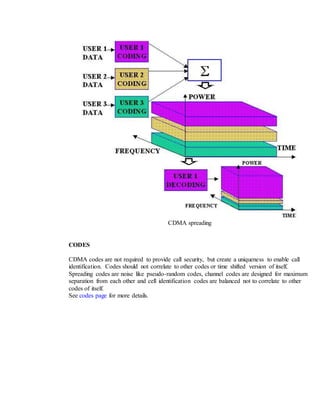
results in Time Division Multiple Access (TDMA). In Code Division Multiple Access
(CDMA), every communicator will be allocated the entire spectrum all of the time. CDMA uses
codes to identify connections.
Multiple Access Schemes
CODING
CDMA uses unique spreading codes to spread the baseband data before transmission. The
signal is transmitted in a channel, which is below noise level. The receiver then uses a
correlator to despread the wanted signal, which is passed through a narrow bandpass filter.
Unwanted signals will not be despread and will not pass through the filter. Codes take the form
of a carefully designed one/zero sequence produced at a much higher rate than that of the
baseband data. The rate of a spreading code is referred to as chip rate rather than bit rate.
See coding process page for more details.
CDMA spreading
CODES
CDMA codes are not required to provide call security, but create a uniqueness to enable call
identification. Codes should not correlate to other codes or time shifted version of itself.
Spreading codes are noise like pseudo-random codes, channel codes are designed for maximum
separation from each other and cell identification codes are balanced not to correlate to other
codes of itself.
See codes page for more details.
Example OVSF codes, used in channel coding
THE SPREADING PROCESS
WCDMA uses Direct Sequence spreading, where spreading process is done by directly
combining the baseband information to high chip rate binary code. The Spreading Factor is the
ratio of the chips (UMTS = 3.84Mchips/s) to baseband information rate. Spreading factors vary
from 4 to 512 in FDD UMTS. Spreading process gain can in expressed in dBs (Spreading factor
128 = 21dB gain).
See spreading page for more details.
CDMA spreading
POWER CONTROL
CDMA is interference limited multiple access system. Because all users transmit on the same
frequency, internal interference generated by the system is the most significant factor in
determining system capacity and call quality. The transmit power for each user must be reduced
to limit interference, however, the power should be enough to maintain the required Eb/No
(signal to noise ratio) for a satisfactory call quality. Maximum capacity is achieved when Eb/No
of every user is at the minimum level needed for the acceptable channel performance. As the MS
moves around, the RF environment continuously changes due to fast and slow fading, external
interference, shadowing , and other factors. The aim of the dynamic power control is to limit
transmitted power on both the links while maintaining link quality under all conditions.
Additional advantages are longer mobile battery life and longer life span of BTS power
amplifiers
See UMTS power control page for more details.
HANDOVER
Handover occurs when a call has to be passed from one cell to another as the user moves
between cells. In a traditional "hard" handover, the connection to the current cell is broken, and
then the connection to the new cell is made. This is known as a "break-before-make" handover.
Since all cells in CDMA use the same frequency, it is possible to make the connection to the new
cell before leaving the current cell. This is known as a "make-before-break" or "soft" handover.
Soft handovers require less power, which reduces interference and increases capacity. Mobile
can be connected to more that two BTS the handover. "Softer" handover is a special case of soft
handover where the radio links that are added and removed belong to the same Node B.
See Handover page for more details.
CDMA soft handover
MULTIPATH AND RAKE RECEIVERS
One of the main advantages of CDMA systems is the capability of using signals that arrive in the
receivers with different time delays. This phenomenon is called multipath. FDMA and TDMA,
which are narrow band systems, cannot discriminate between the multipath arrivals, and resort to
equalization to mitigate the negative effects of multipath. Due to its wide bandwidth and rake
receivers, CDMA uses the multipath signals and combines them to make an even stronger signal
at the receivers. CDMA subscriber units use rake receivers. This is essentially a set of several
receivers. One of the receivers (fingers) constantly searches for different multipaths and feeds the
information to the other three fingers. Each finger then demodulates the signal corresponding to
a strong multipath. The results are then combined together to make the signal stronger.
UMTS Network UMTS Frequencies UMTS Coding UMTS Link Budget
UMTS Security UMTS Codes Synchronisation Co-location
3G Data Speeds UTRA Time Slots UTRA Channels WCDMA Spreading
UMTS QoS Channel Coding Media Formats Compressed Mode
UMTS HSDPA UMTS Handovers Location Services UMTS Power Control
UMTS Overview Cell Search Random Access RCC States Iui Frame Structure
CDMA Overview Call Setup UTRAN Interfaces Paging Virtual Home Environment
| Advertise | Support Us | Contribute | Site Map | Legal | Privacy | About | Notes|
Copyright © 1999 - 2003 UMTSWorld.com
email: info@umtsworld.com
Generate orthogonal variable spreading factor (OVSF) code from set of orthogonal codes
Library
Spreading Codes
Description
The OVSF Code Generator block generates an OVSF code from a set of orthogonal codes. OVSF codes
were first introduced for 3G communication systems. OVSF codes are primarily used to preserve
orthogonality between different channels in a communication system.
OVSF codes are defined as the rows of an N-by-N matrix, CN, which is defined recursively as follows.
First, define C1 = [1]. Next, assume that CN is defined and let CN(k) denote the kth row of CN. Define C2N by
C2N
=

CN
(0)CN
(0)CN
(1)CN
(1)...CN
(N−1)CN
(N−1)CN
(0)−CN
(0)CN
(1)−CN
(1)...CN
(
N−1)−CN
(N−1)

Note that CN is only defined for N a power of 2. It follows by induction that the rows of CN are orthogonal.
The OVSF codes can also be defined recursively by a tree structure, as shown in the following figure.
If [C] is a code length 2r
at depth r in the tree, where the root has depth 0, the two branches leading out of
C are labeled by the sequences [C C] and [C -C], which have length 2r+1
. The codes at depth r in the tree
are the rows of the matrix CN, where N = 2r
.
Note that two OVSF codes are orthogonal if and only if neither code lies on the path from the other code
to the root. Since codes assigned to different users in the same cell must be orthogonal, this restricts the
number of available codes for a given cell. For example, if the code C41 in the tree is assigned to a user,
the codes C10, C20, C82, C83, and so on, cannot be assigned to any other user in the same cell.
Block Parameters
You specify the code the OVSF Code Generator block outputs by two parameters in the block's dialog:
the Spreading factor, which is the length of the code, and the Code index, which must be an integer in
the range [0, 1, ... , N - 1], where N is the spreading factor. If the code appears at depth r in the preceding
tree, the Spreading factor is 2r
. The Code index specifies how far down the column of the tree at depth r
the code appears, counting from 0 to N - 1. For CN, k in the preceding diagram, N is the Spreading
factor and k is theCode index.
You can recover the code from the Spreading factor and the Code index as follows. Convert the Code
index to the corresponding binary number, and then add 0s to the left, if necessary, so that the resulting
binary sequence x1 x2 ... xr has length r, where r is the logarithm base 2 of the Spreading factor. This
sequence describes the path from the root to the code. The path takes the upper branch from the code at
depth i if xi = 0, and the lower branch if xi = 1.
To reconstruct the code, recursively define a sequence of codes Ci for as follows. Let C0 be the root [1].
Assuming that Ci has been defined, for i < r, define Ci+1 by
Ci+1
=
{
Ci
Ci
Ci
(−Ci
)if xi
=0if xi
=1
The code CN has the specified Spreading factor and Code index.
For example, to find the code with Spreading factor 16 and Code index 6, do the following:
1. Convert 6 to the binary number 110.
2. Add one 0 to the left to obtain 0110, which has length 4 = log2 16.
3. Construct the sequences Ci according to the following table.
i xi Ci
0 C0 = [1]
1 0 C1 = C0 C0 = [1] [1]
2 1 C2 = C1 -C1 = [1 1] [-1 -1]
3 1 C3 = C2 -C2 = [1 1 -1 -1] [-1 -1 1 1]
4 0 C4 = C3 C3 = [1 1 -1 -1 -1 -1 1 1] [1 1 -1 -1 -1 -1 1 1]
The code C4 has Spreading factor 16 and Code index 6.
Dialog Box
Spreading factor
Positive integer that is a power of 2, specifying the length of the code.
Code index
Integer in the range [0, 1, ... , N - 1] specifying the code, where N is the Spreading factor.
Sample time
The time between each sample of the output signal. Specify as a nonnegative real scalar.
Samples per frame
The number of samples per frame in one column of the output signal. Specify as a positive
integer scalar.
Note: The time between output updates is equal to theproduct of Samples per frame and Sample time. For example, if Sample time and
second. If Samples perframe is increased to 10, then a 10-by-1 vector is output every 10 seconds. This ensures that the equivalent output r
Output data type
The output type of the block can be specified as an int8 or double. By default, the block sets
this to double.
Simulate using
Select the simulation mode.
Code generation
On the first model run, simulate and generate code. If the structure of the block does not change,
subsequent model runs do not regenerate the code.
If the simulation mode is Code generation, System objects corresponding to the blocks accept
a maximum of nine inputs.
Interpreted execution
Simulate model without generating code. This option results in faster start times but can slow
subsequent simulation performance.
In digital communications, a chip is a pulse of a direct-sequence spread spectrum (DSSS) code,
such as a Pseudo-random Noise (PN) code sequence used in direct-sequencecode division multiple
access (CDMA) channel access techniques.
In a binary direct-sequence system, each chip is typically a rectangular pulse of +1 or –1 amplitude,
which is multiplied by a data sequence (similarly +1 or –1 representing the message bits) and by a
carrier waveform to make the transmitted signal. The chips are therefore just the bit sequence out of
the code generator; they are called chips to avoid confusing them with message bits.[1]
The chip rate of a code is the number of pulses per second (chips per second) at which the code is
transmitted (or received). The chip rate is larger than the symbol rate, meaning that one symbol is
represented by multiple chips. The ratio is known as the spreading factor (SF) or processing gain:
Orthogonal variable spreading factor[edit]
OVSF code tree
Orthogonal variable spreading factor (OVSF) is an implementation of Code division multiple
access (CDMA) where before each signal is transmitted, the signal is spread over a wide
spectrum range through the use of a user's code. Users' codes are carefully chosen to be
mutually orthogonal to each other.
These codes are derived from an OVSF code tree, and each user is given a different code. An
OVSF code tree is a completebinary tree that reflects the construction of Hadamard matrices.
References[edit]
1. Jump up^ Gérard Maral and Michel Bousquet (2002). Satellite Communications Systems. John
Wiley and Sons. ISBN 0-471-49654-5.
External links[edit]

Wcdma

  • 1.
    Home News Industry Technology Applications 3G Devices Events Articles FAQ Resources 3G Jobs History Links Downloads LastWords Contact Us CDMA Overview ACCESS SCHEMES For radio systems there are two resources, frequency and time. Division by frequency, so that each pair of communicators is allocated part of the spectrum for all of the time, results in Frequency Division Multiple Access (FDMA). Division by time, so that each pair of communicators is allocated all (or at least a large part) of the spectrum for part of the time results in Time Division Multiple Access (TDMA). In Code Division Multiple Access (CDMA), every communicator will be allocated the entire spectrum all of the time. CDMA uses codes to identify connections. Multiple Access Schemes CODING CDMA uses unique spreading codes to spread the baseband data before transmission. The signal is transmitted in a channel, which is below noise level. The receiver then uses a correlator to despread the wanted signal, which is passed through a narrow bandpass filter. Unwanted signals will not be despread and will not pass through the filter. Codes take the form of a carefully designed one/zero sequence produced at a much higher rate than that of the baseband data. The rate of a spreading code is referred to as chip rate rather than bit rate. See coding process page for more details.
  • 2.
    CDMA spreading CODES CDMA codesare not required to provide call security, but create a uniqueness to enable call identification. Codes should not correlate to other codes or time shifted version of itself. Spreading codes are noise like pseudo-random codes, channel codes are designed for maximum separation from each other and cell identification codes are balanced not to correlate to other codes of itself. See codes page for more details.
  • 3.
    Example OVSF codes,used in channel coding THE SPREADING PROCESS WCDMA uses Direct Sequence spreading, where spreading process is done by directly combining the baseband information to high chip rate binary code. The Spreading Factor is the ratio of the chips (UMTS = 3.84Mchips/s) to baseband information rate. Spreading factors vary from 4 to 512 in FDD UMTS. Spreading process gain can in expressed in dBs (Spreading factor 128 = 21dB gain). See spreading page for more details. CDMA spreading POWER CONTROL CDMA is interference limited multiple access system. Because all users transmit on the same
  • 4.
    frequency, internal interferencegenerated by the system is the most significant factor in determining system capacity and call quality. The transmit power for each user must be reduced to limit interference, however, the power should be enough to maintain the required Eb/No (signal to noise ratio) for a satisfactory call quality. Maximum capacity is achieved when Eb/No of every user is at the minimum level needed for the acceptable channel performance. As the MS moves around, the RF environment continuously changes due to fast and slow fading, external interference, shadowing , and other factors. The aim of the dynamic power control is to limit transmitted power on both the links while maintaining link quality under all conditions. Additional advantages are longer mobile battery life and longer life span of BTS power amplifiers See UMTS power control page for more details. HANDOVER Handover occurs when a call has to be passed from one cell to another as the user moves between cells. In a traditional "hard" handover, the connection to the current cell is broken, and then the connection to the new cell is made. This is known as a "break-before-make" handover. Since all cells in CDMA use the same frequency, it is possible to make the connection to the new cell before leaving the current cell. This is known as a "make-before-break" or "soft" handover. Soft handovers require less power, which reduces interference and increases capacity. Mobile can be connected to more that two BTS the handover. "Softer" handover is a special case of soft handover where the radio links that are added and removed belong to the same Node B. See Handover page for more details. CDMA soft handover MULTIPATH AND RAKE RECEIVERS
  • 5.
    One of themain advantages of CDMA systems is the capability of using signals that arrive in the receivers with different time delays. This phenomenon is called multipath. FDMA and TDMA, which are narrow band systems, cannot discriminate between the multipath arrivals, and resort to equalization to mitigate the negative effects of multipath. Due to its wide bandwidth and rake receivers, CDMA uses the multipath signals and combines them to make an even stronger signal at the receivers. CDMA subscriber units use rake receivers. This is essentially a set of several receivers. One of the receivers (fingers) constantly searches for different multipaths and feeds the information to the other three fingers. Each finger then demodulates the signal corresponding to a strong multipath. The results are then combined together to make the signal stronger. UMTS Network UMTS Frequencies UMTS Coding UMTS Link Budget UMTS Security UMTS Codes Synchronisation Co-location 3G Data Speeds UTRA Time Slots UTRA Channels WCDMA Spreading UMTS QoS Channel Coding Media Formats Compressed Mode UMTS HSDPA UMTS Handovers Location Services UMTS Power Control UMTS Overview Cell Search Random Access RCC States Iui Frame Structure CDMA Overview Call Setup UTRAN Interfaces Paging Virtual Home Environment | Advertise | Support Us | Contribute | Site Map | Legal | Privacy | About | Notes| Copyright © 1999 - 2003 UMTSWorld.com email: info@umtsworld.com Generate orthogonal variable spreading factor (OVSF) code from set of orthogonal codes Library Spreading Codes Description The OVSF Code Generator block generates an OVSF code from a set of orthogonal codes. OVSF codes were first introduced for 3G communication systems. OVSF codes are primarily used to preserve orthogonality between different channels in a communication system. OVSF codes are defined as the rows of an N-by-N matrix, CN, which is defined recursively as follows. First, define C1 = [1]. Next, assume that CN is defined and let CN(k) denote the kth row of CN. Define C2N by C2N =  CN (0)CN (0)CN (1)CN (1)...CN (N−1)CN (N−1)CN (0)−CN (0)CN (1)−CN (1)...CN ( N−1)−CN (N−1)  Note that CN is only defined for N a power of 2. It follows by induction that the rows of CN are orthogonal.
  • 6.
    The OVSF codescan also be defined recursively by a tree structure, as shown in the following figure. If [C] is a code length 2r at depth r in the tree, where the root has depth 0, the two branches leading out of C are labeled by the sequences [C C] and [C -C], which have length 2r+1 . The codes at depth r in the tree are the rows of the matrix CN, where N = 2r . Note that two OVSF codes are orthogonal if and only if neither code lies on the path from the other code to the root. Since codes assigned to different users in the same cell must be orthogonal, this restricts the number of available codes for a given cell. For example, if the code C41 in the tree is assigned to a user, the codes C10, C20, C82, C83, and so on, cannot be assigned to any other user in the same cell. Block Parameters You specify the code the OVSF Code Generator block outputs by two parameters in the block's dialog: the Spreading factor, which is the length of the code, and the Code index, which must be an integer in the range [0, 1, ... , N - 1], where N is the spreading factor. If the code appears at depth r in the preceding tree, the Spreading factor is 2r . The Code index specifies how far down the column of the tree at depth r the code appears, counting from 0 to N - 1. For CN, k in the preceding diagram, N is the Spreading factor and k is theCode index. You can recover the code from the Spreading factor and the Code index as follows. Convert the Code index to the corresponding binary number, and then add 0s to the left, if necessary, so that the resulting binary sequence x1 x2 ... xr has length r, where r is the logarithm base 2 of the Spreading factor. This sequence describes the path from the root to the code. The path takes the upper branch from the code at depth i if xi = 0, and the lower branch if xi = 1.
  • 7.
    To reconstruct thecode, recursively define a sequence of codes Ci for as follows. Let C0 be the root [1]. Assuming that Ci has been defined, for i < r, define Ci+1 by Ci+1 = { Ci Ci Ci (−Ci )if xi =0if xi =1 The code CN has the specified Spreading factor and Code index. For example, to find the code with Spreading factor 16 and Code index 6, do the following: 1. Convert 6 to the binary number 110. 2. Add one 0 to the left to obtain 0110, which has length 4 = log2 16. 3. Construct the sequences Ci according to the following table. i xi Ci 0 C0 = [1] 1 0 C1 = C0 C0 = [1] [1] 2 1 C2 = C1 -C1 = [1 1] [-1 -1] 3 1 C3 = C2 -C2 = [1 1 -1 -1] [-1 -1 1 1] 4 0 C4 = C3 C3 = [1 1 -1 -1 -1 -1 1 1] [1 1 -1 -1 -1 -1 1 1] The code C4 has Spreading factor 16 and Code index 6. Dialog Box
  • 8.
    Spreading factor Positive integerthat is a power of 2, specifying the length of the code. Code index Integer in the range [0, 1, ... , N - 1] specifying the code, where N is the Spreading factor. Sample time The time between each sample of the output signal. Specify as a nonnegative real scalar. Samples per frame The number of samples per frame in one column of the output signal. Specify as a positive integer scalar. Note: The time between output updates is equal to theproduct of Samples per frame and Sample time. For example, if Sample time and second. If Samples perframe is increased to 10, then a 10-by-1 vector is output every 10 seconds. This ensures that the equivalent output r Output data type The output type of the block can be specified as an int8 or double. By default, the block sets this to double. Simulate using Select the simulation mode.
  • 9.
    Code generation On thefirst model run, simulate and generate code. If the structure of the block does not change, subsequent model runs do not regenerate the code. If the simulation mode is Code generation, System objects corresponding to the blocks accept a maximum of nine inputs. Interpreted execution Simulate model without generating code. This option results in faster start times but can slow subsequent simulation performance. In digital communications, a chip is a pulse of a direct-sequence spread spectrum (DSSS) code, such as a Pseudo-random Noise (PN) code sequence used in direct-sequencecode division multiple access (CDMA) channel access techniques. In a binary direct-sequence system, each chip is typically a rectangular pulse of +1 or –1 amplitude, which is multiplied by a data sequence (similarly +1 or –1 representing the message bits) and by a carrier waveform to make the transmitted signal. The chips are therefore just the bit sequence out of the code generator; they are called chips to avoid confusing them with message bits.[1] The chip rate of a code is the number of pulses per second (chips per second) at which the code is transmitted (or received). The chip rate is larger than the symbol rate, meaning that one symbol is represented by multiple chips. The ratio is known as the spreading factor (SF) or processing gain: Orthogonal variable spreading factor[edit] OVSF code tree Orthogonal variable spreading factor (OVSF) is an implementation of Code division multiple access (CDMA) where before each signal is transmitted, the signal is spread over a wide spectrum range through the use of a user's code. Users' codes are carefully chosen to be mutually orthogonal to each other.
  • 10.
    These codes arederived from an OVSF code tree, and each user is given a different code. An OVSF code tree is a completebinary tree that reflects the construction of Hadamard matrices. References[edit] 1. Jump up^ Gérard Maral and Michel Bousquet (2002). Satellite Communications Systems. John Wiley and Sons. ISBN 0-471-49654-5. External links[edit]