PRESENTED BY –
NAVEEN KADIAN
DEPT. OF PHARMACEUTICAL CHEMISTRY
KLES’S COLLEGE OF PHARMACY, BELGAUM
Clavulanic Acid
& Analogs
Contents
Introduction.
β- lactamase Inhibitors.
Clavulanic Acid.
Clavulanic Acid Analogs.
Reference.
Introduction
The discovery of the naturally occurring mechanism
based inhibitor clavulanic acid, which causes potent
& progressive inactivation of β- lactamases has
created renewed interest in β- lactam combination
therapy.
This interest has led to the design & synthesis of
additional mechanism based β- lactamase
Inhibitors, such as sulbactum & tazobactam, &
isolation of naturally occurring β- lactams such as
thienamycins, which both inhibit β- lactamases &
interact with PBP’s.
β- lactam Antibiotics
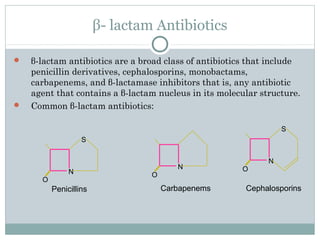
 β-lactam antibiotics are a broad class of antibiotics that include
penicillin derivatives, cephalosporins, monobactams,
carbapenems, and β-lactamase inhibitors that is, any antibiotic
agent that contains a β-lactam nucleus in its molecular structure.
 Common β-lactam antibiotics:
N
O
S
Penicillins
N
O
S
Cephalosporins
N
O
Carbapenems
Development of Resistance
Widespread use of β- lactams, the largest family of
antibiotics in current clinical use, has inevitably led
to the emergence of resistant bacteria.
The commonly encountered mechanism of
resistance is that attributable to production of β-
lactamases, a group of enzymes capable of
catalyzing the hydrolysis of the β- lactam ring.
The existence of these enzymes was recognized as
earlier as 1940 soon after the isolation of penicillin,
& fears relating to their plasmid-mediated spread
through out the bacterial population have been fully
realized.
FAILURE OF ANTIBIOTICS DUE TO
BETA-LACTAMASE
Current Rate of
Resistance
% increase in
Resistance
Vancomycin/enterococ
ci
25.9% 47%
Methicillin/S. aureus 54.5% 43%
Methicillin/Coagulase-
negative staphylococci
86.7% 2%
3rd
generation
Cephalosporin
Enterobacter spp
36.4% 3%
Imipenem/P.
aeruginosa
18.5% 35%
Quinolone/P.
aeruginosa
23.0% 49%
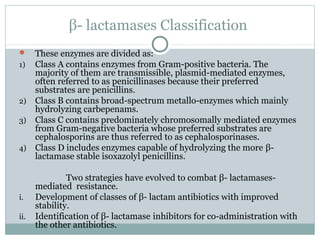
β- lactamases Classification
 These enzymes are divided as:
1) Class A contains enzymes from Gram-positive bacteria. The
majority of them are transmissible, plasmid-mediated enzymes,
often referred to as penicillinases because their preferred
substrates are penicillins.
2) Class B contains broad-spectrum metallo-enzymes which mainly
hydrolyzing carbepenams.
3) Class C contains predominately chromosomally mediated enzymes
from Gram-negative bacteria whose preferred substrates are
cephalosporins are thus referred to as cephalosporinases.
4) Class D includes enzymes capable of hydrolyzing the more β-
lactamase stable isoxazolyl penicillins.
Two strategies have evolved to combat β- lactamases-
mediated resistance.
i. Development of classes of β- lactam antibiotics with improved
stability.
ii. Identification of β- lactamase inhibitors for co-administration with
the other antibiotics.
β- lactamase Inhibitors
 Although they exhibit negligible antimicrobial
activity, they contain the beta-lactam ring.
 Their sole purpose is to prevent the inactivation of
beta-lactam antibiotics by binding the beta-
lactamases, and, as such, they are co-administered
with beta-lactam antibiotics.
1. clavulanic acid
2. tazobactam
3. sulbactam
Clavulanic Acid
 Systematic (IUPAC) name: (2R,5R,Z)-3-(2-hydroxyethylidene)-
7-oxo-4-oxa-1-aza-bicyclo[3.2.0] heptane-2-carboxylic acid
 Clavulanic acid can be considered as the most important & representive
among the inhibitors of β- lactamases.
 It is first clinically useful β- lactamase inhibitor was identified as a natural
product from a strain of Streptomyces clavuligerus.
 Structurally it is a 1-oxopenam lacking the 6-acyl amino side chain of
penicillins but possessing a 2-hydroxy ethylidene moiety at C-2
Clavulanic AcidClavulanate Potassium
Continue….
Clavulanic acid was invented around 1974/75 by
British scientists working at the drug company
Beecham.
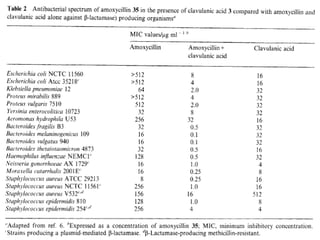
Clavulanic acid exhibits very weak antibacterial
activity, comparable with that of 6- amino penicillanic
acid therefore is not useful as an antibiotic.
It is however, a potent inhibitor of S. aureus β-
lactamase & plasmid-mediated β- lactamases
elaborated by Gram negative bacilli.
Mechanism of action
Clavulanic acid has negligible intrinsic antimicrobial
activity, despite sharing the β-lactam ring that is
characteristic of beta-lactam antibiotics.
However, the similarity in chemical structure allows
the molecule to act as a competitive inhibitor of beta-
lactamases secreted by certain bacteria to confer
resistance to beta-lactam antibiotics.
This inhibition restores the antimicrobial activity of
beta-lactam antibiotics against a lactamase-secreting
resistant bacteria.
Despite this, some bacterial strains have emerged that
are even resistant to such combinations.
Marketed Combinations
Most commonly, the potassium salt potassium
clavulanate is combined with amoxicillin (co-
amoxiclav) [brand name Augmentin]
Timetin (potassium clavulanate plus ticarcillin)
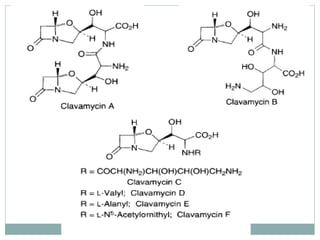
Clavulanic acid has also been isolated from
S. jumonjinensis the P-hydroxypropionyl
Derivative of clavulanic
acid was obtained (though only isolated as
its benzyl ester) from Streptomyces clavuligerus
Clavulanic Acid Analogs
clavaminic acid
Sulbactam
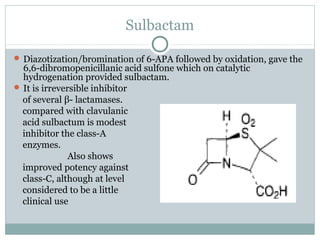
 Diazotization/bromination of 6-APA followed by oxidation, gave the
6,6-dibromopenicillanic acid sulfone which on catalytic
hydrogenation provided sulbactam.
 It is irreversible inhibitor
of several β- lactamases.
compared with clavulanic
acid sulbactum is modest
inhibitor the class-A
enzymes.
Also shows
improved potency against
class-C, although at level
considered to be a little
clinical use
Continue…..
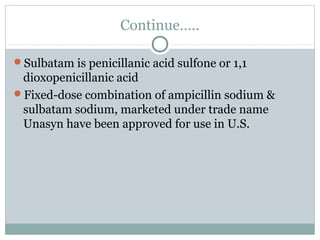
Sulbatam is penicillanic acid sulfone or 1,1
dioxopenicillanic acid
Fixed-dose combination of ampicillin sodium &
sulbatam sodium, marketed under trade name
Unasyn have been approved for use in U.S.
Tazobactam
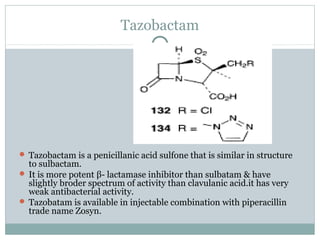
 Tazobactam is a penicillanic acid sulfone that is similar in structure
to sulbactam.
 It is more potent β- lactamase inhibitor than sulbatam & have
slightly broder spectrum of activity than clavulanic acid.it has very
weak antibacterial activity.
 Tazobatam is available in injectable combination with piperacillin
trade name Zosyn.
Interaction of sulbactam, clavulanic acid and tazobactam
with penicillin-binding proteins of imipenem-resistant
and -susceptible acinetobacter baumannii
 Carl Urban a b Eddie Go a Noriel Mariano a James J. Rahal a c a
Infectious Disease Section, Department of Medicine, The New York
Hospital Medical Center of Queens, 56-45 Main Street, Flushing, New
York 11355-5095, USA b Department of Microbiology, Cornell
University Medical College, New York, USA c Department of
Medicine, Cornell University Medical College, New York, USA
*Corresponding author. Tel: (718) 670-1525; Fax: (718) 3539819.
 ABSTRACT
AbstractWe have encountered clinical isolates of Acinetobacter baumannii
which are resistant to all available antibiotics used in hospitals except for
polymyxin B and the beta-lactamase inhibitor, sulbactam. To investigate the
mechanisms of this unique activity, affinities of sulbactam and other beta-
lactamase inhibitors for penicillin binding proteins were compared using
imipenem-resistant and imipenem-sensitive isolates. The results of competition
binding experiments indicate that all three beta-lactamase inhibitors bound to
imipenem-susceptible Acinetobacter. Binding of sulbactam was greater than that
of tazobactam and not detected with clavulanic acid to penicillin binding proteins
of the imipenem-resistant strain of Acinetobacter.
Effect of clavulanic acid, sulbactam and tazobactam on three
different ß-lactamases from Bacteroides uniformis,Clostridium
butyricwn and Fusobacterium nucleatum
 M. Hedberg, L. Lindqvist, K. Tunér and C.E. Nord* Department of
Microbiology, Huddinge University Hospital. Karolinska Institute S-141 86
Huddinge, Sweden and National Bacteriological Laboratory S-105 21 Stockholm,
Sweden
The effect of three ß-lactamase inhibitors clavulanic acid, sulbactam and
tazobactam used in clinical practice were compared for their activity against purified
ß-lactamases from Bacreroides uniformis, Clostridium butyricum and
Fusobacterium nucleatum. The enzymes from B. uniformis and C. butyricum were
produced in fermenters under controlled growth conditions and the enzyme from F.
nucleatum was produced in batch cultures. Purification of the ß-lactamases was
achieved by anion-exchange chromatography, gel filtration and FPLC-technique. The
degree of inactivation of ß-lactamase activity was determined spectrophotometrically
with nitrocefin as the substrate. The inhibitors in various concentrations were
preincubated at 30°C together with the enzyme for different time periods (0·5–120
min) before determination of the remaining ß-lactamase activity. The inhibitors all
decreased the activity of the ß-lactamases investigated. Clavulanic acid and
sulbactam were capable of reducing the enzyme activity of the B. uniformis ß-
lactamases more effectively than the C. butyricum and F. nucleatum ß-lactamases. All
ß-lactamases tested were more susceptible to tazobactam than to clavulanic acid
and sulbactam.
References
A.G. Brown‘Discovery and development of new β -lactam
antibiotics’ Beecham Pharmaceuticals Research Division, England.
Pure & App!. Chem.,Vol. 59, No. 3, pp. 475—484, 1987. Printed
in Great Britain.© 1987.
Keith H. Baggaley,Allan G. Brownb and Christopher J. Schofield
‘Chemistry and biosynthesis of clavulanic acid and other clavams’.
Principles of Medicinal Chemistry byWilliam O. Foye 3rd edition.
Medicinal Chemistry by Burger, 2nd
edition.
Organic Medical & P’ceutical Chemistry ByWilson & Gisvold’s
Textbook.
www.sciencedirect.com
Calvulanic acid and analoug

Calvulanic acid and analoug

  • 1.
    PRESENTED BY – NAVEENKADIAN DEPT. OF PHARMACEUTICAL CHEMISTRY KLES’S COLLEGE OF PHARMACY, BELGAUM Clavulanic Acid & Analogs
  • 2.
    Contents Introduction. β- lactamase Inhibitors. ClavulanicAcid. Clavulanic Acid Analogs. Reference.
  • 3.
    Introduction The discovery ofthe naturally occurring mechanism based inhibitor clavulanic acid, which causes potent & progressive inactivation of β- lactamases has created renewed interest in β- lactam combination therapy. This interest has led to the design & synthesis of additional mechanism based β- lactamase Inhibitors, such as sulbactum & tazobactam, & isolation of naturally occurring β- lactams such as thienamycins, which both inhibit β- lactamases & interact with PBP’s.
  • 4.
    β- lactam Antibiotics β-lactam antibiotics are a broad class of antibiotics that include penicillin derivatives, cephalosporins, monobactams, carbapenems, and β-lactamase inhibitors that is, any antibiotic agent that contains a β-lactam nucleus in its molecular structure.  Common β-lactam antibiotics: N O S Penicillins N O S Cephalosporins N O Carbapenems
  • 5.
    Development of Resistance Widespreaduse of β- lactams, the largest family of antibiotics in current clinical use, has inevitably led to the emergence of resistant bacteria. The commonly encountered mechanism of resistance is that attributable to production of β- lactamases, a group of enzymes capable of catalyzing the hydrolysis of the β- lactam ring. The existence of these enzymes was recognized as earlier as 1940 soon after the isolation of penicillin, & fears relating to their plasmid-mediated spread through out the bacterial population have been fully realized.
  • 6.
    FAILURE OF ANTIBIOTICSDUE TO BETA-LACTAMASE Current Rate of Resistance % increase in Resistance Vancomycin/enterococ ci 25.9% 47% Methicillin/S. aureus 54.5% 43% Methicillin/Coagulase- negative staphylococci 86.7% 2% 3rd generation Cephalosporin Enterobacter spp 36.4% 3% Imipenem/P. aeruginosa 18.5% 35% Quinolone/P. aeruginosa 23.0% 49%
  • 7.
    β- lactamases Classification These enzymes are divided as: 1) Class A contains enzymes from Gram-positive bacteria. The majority of them are transmissible, plasmid-mediated enzymes, often referred to as penicillinases because their preferred substrates are penicillins. 2) Class B contains broad-spectrum metallo-enzymes which mainly hydrolyzing carbepenams. 3) Class C contains predominately chromosomally mediated enzymes from Gram-negative bacteria whose preferred substrates are cephalosporins are thus referred to as cephalosporinases. 4) Class D includes enzymes capable of hydrolyzing the more β- lactamase stable isoxazolyl penicillins. Two strategies have evolved to combat β- lactamases- mediated resistance. i. Development of classes of β- lactam antibiotics with improved stability. ii. Identification of β- lactamase inhibitors for co-administration with the other antibiotics.
  • 8.
    β- lactamase Inhibitors Although they exhibit negligible antimicrobial activity, they contain the beta-lactam ring.  Their sole purpose is to prevent the inactivation of beta-lactam antibiotics by binding the beta- lactamases, and, as such, they are co-administered with beta-lactam antibiotics. 1. clavulanic acid 2. tazobactam 3. sulbactam
  • 9.
    Clavulanic Acid  Systematic(IUPAC) name: (2R,5R,Z)-3-(2-hydroxyethylidene)- 7-oxo-4-oxa-1-aza-bicyclo[3.2.0] heptane-2-carboxylic acid  Clavulanic acid can be considered as the most important & representive among the inhibitors of β- lactamases.  It is first clinically useful β- lactamase inhibitor was identified as a natural product from a strain of Streptomyces clavuligerus.  Structurally it is a 1-oxopenam lacking the 6-acyl amino side chain of penicillins but possessing a 2-hydroxy ethylidene moiety at C-2 Clavulanic AcidClavulanate Potassium
  • 10.
    Continue…. Clavulanic acid wasinvented around 1974/75 by British scientists working at the drug company Beecham. Clavulanic acid exhibits very weak antibacterial activity, comparable with that of 6- amino penicillanic acid therefore is not useful as an antibiotic. It is however, a potent inhibitor of S. aureus β- lactamase & plasmid-mediated β- lactamases elaborated by Gram negative bacilli.
  • 11.
    Mechanism of action Clavulanicacid has negligible intrinsic antimicrobial activity, despite sharing the β-lactam ring that is characteristic of beta-lactam antibiotics. However, the similarity in chemical structure allows the molecule to act as a competitive inhibitor of beta- lactamases secreted by certain bacteria to confer resistance to beta-lactam antibiotics. This inhibition restores the antimicrobial activity of beta-lactam antibiotics against a lactamase-secreting resistant bacteria. Despite this, some bacterial strains have emerged that are even resistant to such combinations.
  • 12.
    Marketed Combinations Most commonly,the potassium salt potassium clavulanate is combined with amoxicillin (co- amoxiclav) [brand name Augmentin] Timetin (potassium clavulanate plus ticarcillin)
  • 14.
    Clavulanic acid hasalso been isolated from S. jumonjinensis the P-hydroxypropionyl Derivative of clavulanic acid was obtained (though only isolated as its benzyl ester) from Streptomyces clavuligerus Clavulanic Acid Analogs clavaminic acid
  • 16.
    Sulbactam  Diazotization/bromination of6-APA followed by oxidation, gave the 6,6-dibromopenicillanic acid sulfone which on catalytic hydrogenation provided sulbactam.  It is irreversible inhibitor of several β- lactamases. compared with clavulanic acid sulbactum is modest inhibitor the class-A enzymes. Also shows improved potency against class-C, although at level considered to be a little clinical use
  • 17.
    Continue….. Sulbatam is penicillanicacid sulfone or 1,1 dioxopenicillanic acid Fixed-dose combination of ampicillin sodium & sulbatam sodium, marketed under trade name Unasyn have been approved for use in U.S.
  • 18.
    Tazobactam  Tazobactam isa penicillanic acid sulfone that is similar in structure to sulbactam.  It is more potent β- lactamase inhibitor than sulbatam & have slightly broder spectrum of activity than clavulanic acid.it has very weak antibacterial activity.  Tazobatam is available in injectable combination with piperacillin trade name Zosyn.
  • 19.
    Interaction of sulbactam,clavulanic acid and tazobactam with penicillin-binding proteins of imipenem-resistant and -susceptible acinetobacter baumannii  Carl Urban a b Eddie Go a Noriel Mariano a James J. Rahal a c a Infectious Disease Section, Department of Medicine, The New York Hospital Medical Center of Queens, 56-45 Main Street, Flushing, New York 11355-5095, USA b Department of Microbiology, Cornell University Medical College, New York, USA c Department of Medicine, Cornell University Medical College, New York, USA *Corresponding author. Tel: (718) 670-1525; Fax: (718) 3539819.  ABSTRACT AbstractWe have encountered clinical isolates of Acinetobacter baumannii which are resistant to all available antibiotics used in hospitals except for polymyxin B and the beta-lactamase inhibitor, sulbactam. To investigate the mechanisms of this unique activity, affinities of sulbactam and other beta- lactamase inhibitors for penicillin binding proteins were compared using imipenem-resistant and imipenem-sensitive isolates. The results of competition binding experiments indicate that all three beta-lactamase inhibitors bound to imipenem-susceptible Acinetobacter. Binding of sulbactam was greater than that of tazobactam and not detected with clavulanic acid to penicillin binding proteins of the imipenem-resistant strain of Acinetobacter.
  • 20.
    Effect of clavulanicacid, sulbactam and tazobactam on three different ß-lactamases from Bacteroides uniformis,Clostridium butyricwn and Fusobacterium nucleatum  M. Hedberg, L. Lindqvist, K. Tunér and C.E. Nord* Department of Microbiology, Huddinge University Hospital. Karolinska Institute S-141 86 Huddinge, Sweden and National Bacteriological Laboratory S-105 21 Stockholm, Sweden The effect of three ß-lactamase inhibitors clavulanic acid, sulbactam and tazobactam used in clinical practice were compared for their activity against purified ß-lactamases from Bacreroides uniformis, Clostridium butyricum and Fusobacterium nucleatum. The enzymes from B. uniformis and C. butyricum were produced in fermenters under controlled growth conditions and the enzyme from F. nucleatum was produced in batch cultures. Purification of the ß-lactamases was achieved by anion-exchange chromatography, gel filtration and FPLC-technique. The degree of inactivation of ß-lactamase activity was determined spectrophotometrically with nitrocefin as the substrate. The inhibitors in various concentrations were preincubated at 30°C together with the enzyme for different time periods (0·5–120 min) before determination of the remaining ß-lactamase activity. The inhibitors all decreased the activity of the ß-lactamases investigated. Clavulanic acid and sulbactam were capable of reducing the enzyme activity of the B. uniformis ß- lactamases more effectively than the C. butyricum and F. nucleatum ß-lactamases. All ß-lactamases tested were more susceptible to tazobactam than to clavulanic acid and sulbactam.
  • 21.
    References A.G. Brown‘Discovery anddevelopment of new β -lactam antibiotics’ Beecham Pharmaceuticals Research Division, England. Pure & App!. Chem.,Vol. 59, No. 3, pp. 475—484, 1987. Printed in Great Britain.© 1987. Keith H. Baggaley,Allan G. Brownb and Christopher J. Schofield ‘Chemistry and biosynthesis of clavulanic acid and other clavams’. Principles of Medicinal Chemistry byWilliam O. Foye 3rd edition. Medicinal Chemistry by Burger, 2nd edition. Organic Medical & P’ceutical Chemistry ByWilson & Gisvold’s Textbook. www.sciencedirect.com