DEPARTMENT OF PHAEMACEUTICALCHEMISTRY
SET’S COLLEGE OF PHARMACY
S.R NAGAR, DHARWAD-02
H1 AND H2 RECEPTOR ANTAGONIST
PRESENTED BY,
SANJAY GOPI,
1ST M PHARMACY (CHEMISTRY),
SET’S COLLEGE OF PHARMCY ,
DHARWAD.
CONTENTS:
 Brief introduction about Histamine.
 Antihistamine introduction and
classification.
 H1 receptors antagonist
 H2 receptor antagonist
 Reference books
INTRODUCTION:
Histamine is a chemical messenger which are
synthesized in the mast cells.
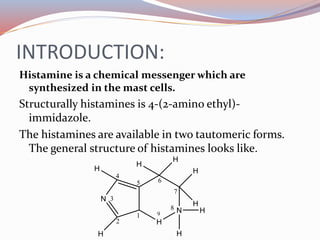
Structurally histamines is 4-(2-amino ethyl)-
immidazole.
The histamines are available in two tautomeric forms.
The general structure of histamines looks like.
Generally histamines are found in the animal tissue,
venoms of insect, bacteria and plant.
Pharmacologically histamine causes the vasodilatation
of capillaries and which increase the rate of flow
and this cause edema, increase heart rate,
stimulate gastric fluids and which lead to the
formation of ulcers.
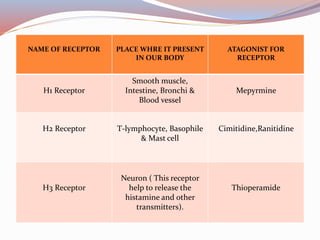
The human body contains histaminic receptor and are
divided into three different types upon their action.
1. H1-receptors
2. H2-receptors
3. H3-receptors
NAME OF RECEPTOR PLACE WHRE IT PRESENT
IN OUR BODY
ATAGONIST FOR
RECEPTOR
H1 Receptor
Smooth muscle,
Intestine, Bronchi &
Blood vessel
Mepyrmine
H2 Receptor T-lymphocyte, Basophile
& Mast cell
Cimitidine,Ranitidine
H3 Receptor
Neuron ( This receptor
help to release the
histamine and other
transmitters).
Thioperamide
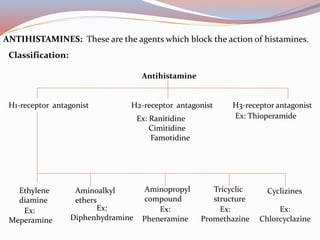
ANTIHISTAMINES: These are the agents which block the action of histamines.
Classification:
Antihistamine
H1-receptor antagonist H2-receptor antagonist H3-receptor antagonist
Ethylene
diamine
Aminoalkyl
ethers
Aminopropyl
compound
Tricyclic
structure
Cyclizines
Ex: Ranitidine
Cimitidine
Famotidine
Ex:
Meperamine
Ex:
Diphenhydramine
Ex:
Pheneramine
Ex:
Promethazine
Ex:
Chlorcyclazine
Ex: Thioperamide
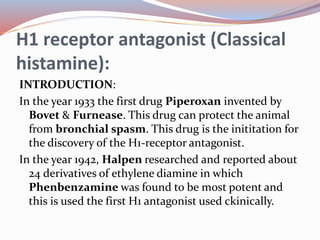
H1 receptor antagonist (Classical
histamine):
INTRODUCTION:
In the year 1933 the first drug Piperoxan invented by
Bovet & Furnease. This drug can protect the animal
from bronchial spasm. This drug is the inititation for
the discovery of the H1-receptor antagonist.
In the year 1942, Halpen researched and reported about
24 derivatives of ethylene diamine in which
Phenbenzamine was found to be most potent and
this is used the first H1 antagonist used ckinically.
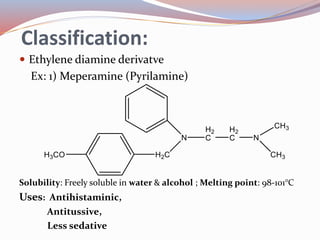
Classification:
 Ethylene diamine derivatve
Ex: 1) Meperamine (Pyrilamine)
Solubility: Freely soluble in water & alcohol ; Melting point: 98-101°C
Uses: Antihistaminic,
Antitussive,
Less sedative
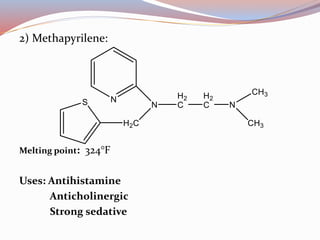
2) Methapyrilene:
Melting point: 324°F
Uses: Antihistamine
Anticholinergic
Strong sedative
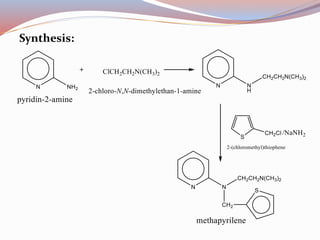
Synthesis:
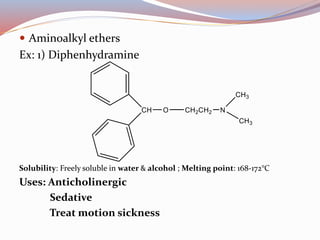
 Aminoalkyl ethers
Ex: 1) Diphenhydramine
Solubility: Freely soluble in water & alcohol ; Melting point: 168-172°C
Uses: Anticholinergic
Sedative
Treat motion sickness
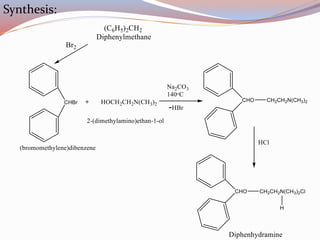
Synthesis:
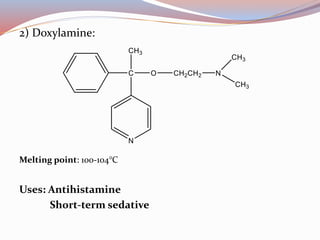
2) Doxylamine:
Melting point: 100-104°C
Uses: Antihistamine
Short-term sedative
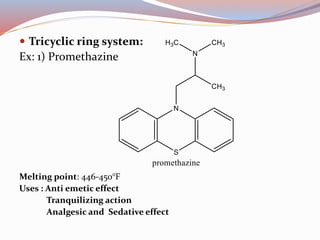
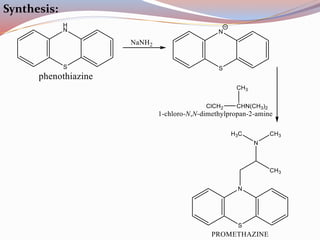
 Tricyclic ring system:
Ex: 1) Promethazine
Melting point: 446-450°F
Uses : Anti emetic effect
Tranquilizing action
Analgesic and Sedative effect
Synthesis:
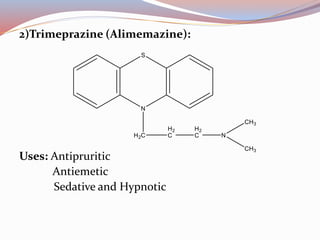
2)Trimeprazine (Alimemazine):
Uses: Antipruritic
Antiemetic
Sedative and Hypnotic
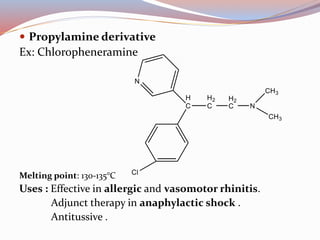
 Propylamine derivative
Ex: Chloropheneramine
Melting point: 130-135°C
Uses : Effective in allergic and vasomotor rhinitis.
Adjunct therapy in anaphylactic shock .
Antitussive .
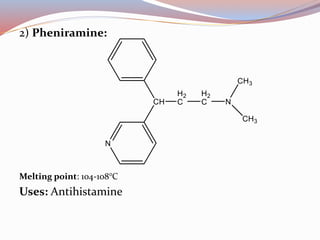
2) Pheniramine:
Melting point: 104-108°C
Uses: Antihistamine
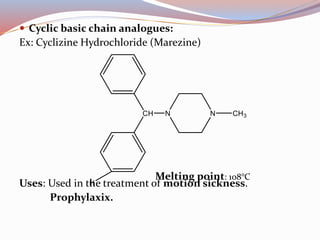
 Cyclic basic chain analogues:
Ex: Cyclizine Hydrochloride (Marezine)
Uses: Used in the treatment of motion sickness.
Prophylaxix.
Melting point: 108°C
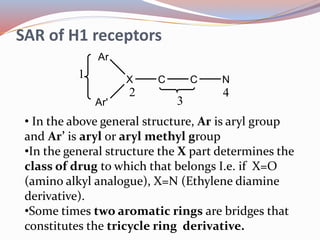
SAR of H1 receptors
• In the above general structure, Ar is aryl group
and Ar’ is aryl or aryl methyl group
•In the general structure the X part determines the
class of drug to which that belongs I.e. if X=O
(amino alkyl analogue), X=N (Ethylene diamine
derivative).
•Some times two aromatic rings are bridges that
constitutes the tricycle ring derivative.
•Most of the H1 antagonist have ethylene chain,
extension of this chain or branching of this chain
lead to reduce the activity of the compound.
•Homologation played to improve the drug like
tricyclic anti-depressents, neruroleptics .
•Due to the close resemblance of antihistamine
structure to the cholinergic blocking agent, most
of the antihistamines show the activity of anti-
cholinergic activity .
H2 receptor antagonist:
 Cimetidine
Uses: To treat ulcer
Used to treat gastroesophagel reflux disease
(GERD)
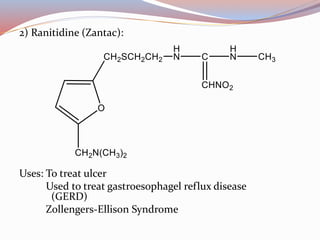
2) Ranitidine (Zantac):
Uses: To treat ulcer
Used to treat gastroesophagel reflux disease
(GERD)
Zollengers-Ellison Syndrome
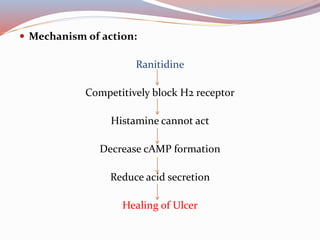
 Mechanism of action:
Ranitidine
Competitively block H2 receptor
Histamine cannot act
Decrease cAMP formation
Reduce acid secretion
Healing of Ulcer
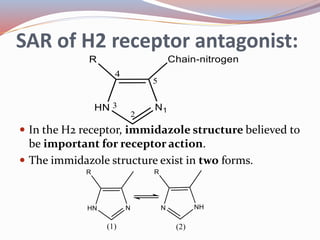
SAR of H2 receptor antagonist:
 In the H2 receptor, immidazole structure believed to
be important for receptor action.
 The immidazole structure exist in two forms.
 The form (1) seems to be necessary for maximal
H2-antagonist activity. Where the R is
substituted with CH3 the activity becomes
potent.
 Chain of four carbon atom is optional for the
activity, shorter chain drastically lowers the
activity. The presence of thioether (-S-) in the
methylene place (-CH3-) lead to more activity.
 The presence of terminal N group increase the
activity.
Reference:
 A text book of Medicinal chemistry (vol-1) by
Suresh N. Pandeya.
 Principles of Medicinal Chemistry (vol-2) by Kadam.
 Medicinal chemistry by Ashutosh Kar.
 Internet
H1and h2 receptors

H1and h2 receptors

  • 1.
    DEPARTMENT OF PHAEMACEUTICALCHEMISTRY SET’SCOLLEGE OF PHARMACY S.R NAGAR, DHARWAD-02 H1 AND H2 RECEPTOR ANTAGONIST PRESENTED BY, SANJAY GOPI, 1ST M PHARMACY (CHEMISTRY), SET’S COLLEGE OF PHARMCY , DHARWAD.
  • 2.
    CONTENTS:  Brief introductionabout Histamine.  Antihistamine introduction and classification.  H1 receptors antagonist  H2 receptor antagonist  Reference books
  • 3.
    INTRODUCTION: Histamine is achemical messenger which are synthesized in the mast cells. Structurally histamines is 4-(2-amino ethyl)- immidazole. The histamines are available in two tautomeric forms. The general structure of histamines looks like.
  • 4.
    Generally histamines arefound in the animal tissue, venoms of insect, bacteria and plant. Pharmacologically histamine causes the vasodilatation of capillaries and which increase the rate of flow and this cause edema, increase heart rate, stimulate gastric fluids and which lead to the formation of ulcers. The human body contains histaminic receptor and are divided into three different types upon their action. 1. H1-receptors 2. H2-receptors 3. H3-receptors
  • 5.
    NAME OF RECEPTORPLACE WHRE IT PRESENT IN OUR BODY ATAGONIST FOR RECEPTOR H1 Receptor Smooth muscle, Intestine, Bronchi & Blood vessel Mepyrmine H2 Receptor T-lymphocyte, Basophile & Mast cell Cimitidine,Ranitidine H3 Receptor Neuron ( This receptor help to release the histamine and other transmitters). Thioperamide
  • 6.
    ANTIHISTAMINES: These arethe agents which block the action of histamines. Classification: Antihistamine H1-receptor antagonist H2-receptor antagonist H3-receptor antagonist Ethylene diamine Aminoalkyl ethers Aminopropyl compound Tricyclic structure Cyclizines Ex: Ranitidine Cimitidine Famotidine Ex: Meperamine Ex: Diphenhydramine Ex: Pheneramine Ex: Promethazine Ex: Chlorcyclazine Ex: Thioperamide
  • 7.
    H1 receptor antagonist(Classical histamine): INTRODUCTION: In the year 1933 the first drug Piperoxan invented by Bovet & Furnease. This drug can protect the animal from bronchial spasm. This drug is the inititation for the discovery of the H1-receptor antagonist. In the year 1942, Halpen researched and reported about 24 derivatives of ethylene diamine in which Phenbenzamine was found to be most potent and this is used the first H1 antagonist used ckinically.
  • 8.
    Classification:  Ethylene diaminederivatve Ex: 1) Meperamine (Pyrilamine) Solubility: Freely soluble in water & alcohol ; Melting point: 98-101°C Uses: Antihistaminic, Antitussive, Less sedative
  • 9.
    2) Methapyrilene: Melting point:324°F Uses: Antihistamine Anticholinergic Strong sedative
  • 10.
  • 11.
     Aminoalkyl ethers Ex:1) Diphenhydramine Solubility: Freely soluble in water & alcohol ; Melting point: 168-172°C Uses: Anticholinergic Sedative Treat motion sickness
  • 12.
  • 13.
    2) Doxylamine: Melting point:100-104°C Uses: Antihistamine Short-term sedative
  • 14.
     Tricyclic ringsystem: Ex: 1) Promethazine Melting point: 446-450°F Uses : Anti emetic effect Tranquilizing action Analgesic and Sedative effect
  • 15.
  • 16.
  • 17.
     Propylamine derivative Ex:Chloropheneramine Melting point: 130-135°C Uses : Effective in allergic and vasomotor rhinitis. Adjunct therapy in anaphylactic shock . Antitussive .
  • 18.
    2) Pheniramine: Melting point:104-108°C Uses: Antihistamine
  • 19.
     Cyclic basicchain analogues: Ex: Cyclizine Hydrochloride (Marezine) Uses: Used in the treatment of motion sickness. Prophylaxix. Melting point: 108°C
  • 20.
    SAR of H1receptors • In the above general structure, Ar is aryl group and Ar’ is aryl or aryl methyl group •In the general structure the X part determines the class of drug to which that belongs I.e. if X=O (amino alkyl analogue), X=N (Ethylene diamine derivative). •Some times two aromatic rings are bridges that constitutes the tricycle ring derivative.
  • 21.
    •Most of theH1 antagonist have ethylene chain, extension of this chain or branching of this chain lead to reduce the activity of the compound. •Homologation played to improve the drug like tricyclic anti-depressents, neruroleptics . •Due to the close resemblance of antihistamine structure to the cholinergic blocking agent, most of the antihistamines show the activity of anti- cholinergic activity .
  • 22.
    H2 receptor antagonist: Cimetidine Uses: To treat ulcer Used to treat gastroesophagel reflux disease (GERD)
  • 23.
    2) Ranitidine (Zantac): Uses:To treat ulcer Used to treat gastroesophagel reflux disease (GERD) Zollengers-Ellison Syndrome
  • 24.
     Mechanism ofaction: Ranitidine Competitively block H2 receptor Histamine cannot act Decrease cAMP formation Reduce acid secretion Healing of Ulcer
  • 25.
    SAR of H2receptor antagonist:  In the H2 receptor, immidazole structure believed to be important for receptor action.  The immidazole structure exist in two forms.
  • 26.
     The form(1) seems to be necessary for maximal H2-antagonist activity. Where the R is substituted with CH3 the activity becomes potent.  Chain of four carbon atom is optional for the activity, shorter chain drastically lowers the activity. The presence of thioether (-S-) in the methylene place (-CH3-) lead to more activity.  The presence of terminal N group increase the activity.
  • 27.
    Reference:  A textbook of Medicinal chemistry (vol-1) by Suresh N. Pandeya.  Principles of Medicinal Chemistry (vol-2) by Kadam.  Medicinal chemistry by Ashutosh Kar.  Internet