H2-receptor antagonists
Domina Petric, MD
Pharmacokinetics
Cimetidine, ranitidine, famotidine and nizatidine.
All four agents are rapidly absorbed from the intestine.
Cimetidine, ranitidine and famotidine undergo first-pass
hepatic metabolism resulting in a bioavailability of
approximately 50%.
Nazitidine has little first-pass metabolism.
Pharmacokinetics
• The serum half-lives range from 1,1 to 4 hours.
• Duration of action depends on the dose given
to the patient.
• H2 antagonists are cleared by a combination of
hepatic metabolism, glomerular filtration and
renal tubular secretion.
• Dose reduction is required in patients with
moderate to severe renal and hepatic
insufficiency.
• In the elderly, there is a decline of up to 50% in
drug clearance as well as a significant
reduction in volume of distribution.
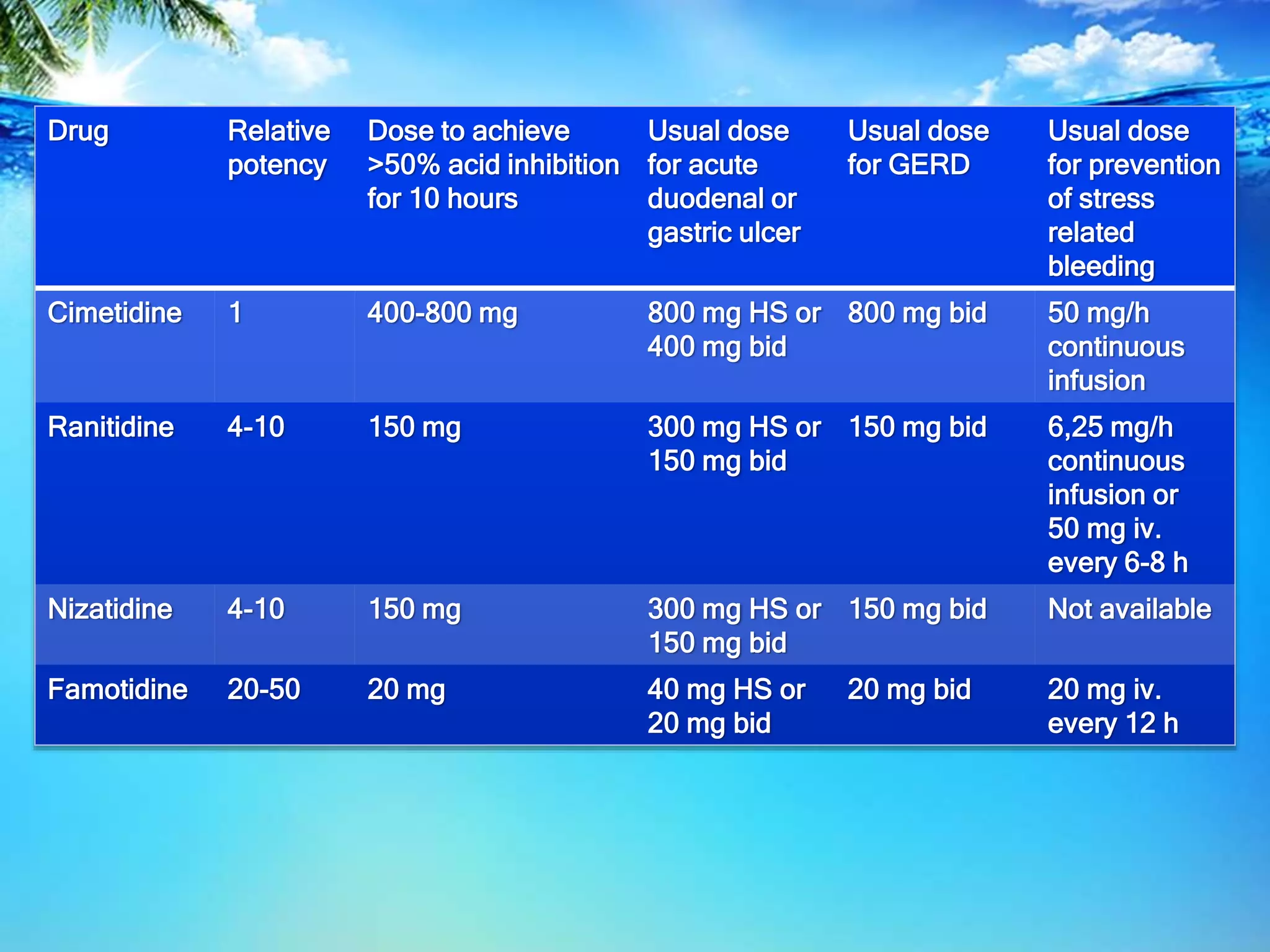
Drug Relative
potency
Dose to achieve
>50% acid inhibition
for 10 hours
Usual dose
for acute
duodenal or
gastric ulcer
Usual dose
for GERD
Usual dose
for prevention
of stress
related
bleeding
Cimetidine 1 400-800 mg 800 mg HS or
400 mg bid
800 mg bid 50 mg/h
continuous
infusion
Ranitidine 4-10 150 mg 300 mg HS or
150 mg bid
150 mg bid 6,25 mg/h
continuous
infusion or
50 mg iv.
every 6-8 h
Nizatidine 4-10 150 mg 300 mg HS or
150 mg bid
150 mg bid Not available
Famotidine 20-50 20 mg 40 mg HS or
20 mg bid
20 mg bid 20 mg iv.
every 12 h
Pharmacodynamics
These drugs exhibit
competitive inhibition at the
parietal cell H2 receptor and
suppress basal and meal-
stimulated acid secretion in a
linear, dose-dependent
manner.
Pharmacodynamics
• They are highly selective and
do not affect H1 or H3
receptors.
• The volume of gastric secretion
and the concentration of pepsin
are also reduced.
Mechanisms of action
• Histamine released from ECL cells by
gastrin or vagal stimulation is blocked
from binding to the parietal cell H2
receptor.
• Direct stimulation of the parietal cell by
gastrin or acetylcholine has a
diminished effect on acid secretion in
the presence of H2-receptor blockade.
Pharmacodynamics
• When given in usual prescription
doses all inhibit 60-70% of total
24-hour acid secretion.
• H2 antagonists are very effective
at inhibiting nocturnal acid
secretion which depends largely
on histamine.
Pharmacodynamics
• H2 antagonists have a
modest impact on meal-
stimulated acid secretion
which is stimulated by
gastrin and acetylcholine,
as well as histamine.
Pharmacodynamics
• Nocturnal and fasting intragastric pH
is raised to 4-5, but the impact on the
daytime, meal-stimulated pH profile
is less.
• Recommended prescription doses
maintain greater than 50% acid
inhibition for 10 hours.
Pharmacodynamics
These drugs are
given twice daily.
CLINICAL USE
GERD (gastroesophageal
reflux disease)
• Patients with infrequent heartburn or
dyspepsia (<3 times per week) may
take either antacids or intermittent H2
antagonists.
• Antacids provide faster symptom
relief, but with short-lived effect (1-2
hours) in comparisson to H2
antagonists (6-10 hours).
GERD
• H2 antagonists may be taken
prophylactically before meals.
• Frequent heartburn is better treated
with twice-daily H2 antagonists or
proton pump inhibitors.
• Proton pump inhibitors are preferred
in patients with erosive esophagitis.
Peptic ulcer disease
• Proton pump inhibitors are
preffered in this indication.
• Nocturnal acid suppression by H2
antagonists affords effective
ulcer healing in most patients
with uncomplicated gastric and
duodenal ulcers.
Peptic ulcer disease
H2 antagonist,
administered once daily at
bedtime, results in ulcer
healing rates of more than
80-90% after 6-8 weeks of
therapy.
Peptic ulcer disease
• In cases of patients that have to take
NSAID, proton pump inhibitors are
preferred, as well as in the case of
Helicobacter pylori infection.
• H2 antagonists may be given daily at
bedtime in half of the usual ulcer
therapeutic dose to prevent ulcer
recurrence.
Nonulcer dyspepsia
• H2 antagonists are commonly
used as over-the-counter
agents and prescription
agents for treatment of
intermittent dyspepsia not
caused by peptic ulcer.
Prevention of bleeding from
stress-related gastritis
• Clinically important bleeding from
upper gastrointestinal erosions or
ulcers occurs in 1-5% of critically
ill patients as a result of impaired
mucosal defense mechanisms
caused by poor perfusion.
Prevention of bleeding from
stress-related gastritis
• Agents that increase intragastric pH
reduce the incidence of clinically
significant bleeding.
• For patients without a nasoenteric
tube or with significant ileus, H2
antagonists in continuous infusion
are preferred.
Adverse effects
• Diarrhea, headache, fatigue,
myalgias and constipation in <3% of
the patients.
• Iv. H2 antagonists may increase the
risk of nosocomial pneumonia in
critically ill patients, as well as mental
status changes: confusion,
hallucinations, agitation.
Adverse effects
Cimetidine inhibits binding of
dihydrotestosterone to androgen receptors,
inhibits metabolism of estradiol and
increases serum prolactin levels.
In the case of long-term use or in high
doses, it may cause gynecomastia or
impotence in men and galactorrhea in
women.
Adverse effects
• H2 antagonists cross the placenta
so they should not be
administered to pregnant women,
unless absolutely necessary.
• These agents are also secreted
into breast milk and may affect
nursing infants.
Adverse effects
• H2 antagonists may rarely cause
blood dyscrasias.
• Blockade of cardiac H2 receptors may
cause bradycardia and hypotension,
especially if given in rapid iv.
infusion.
• Iv. injections should be given over 30
minutes.
Drug interactions
• Cimetidine interferes with P450
drug metabolism pathways:
CYP1A2, CYP2C9, CYP2D6 and
CYP3A4.
• The half-lives of drugs
metabolized by these pathways
may be prolonged.
Drug interactions
• Ranitidine binds 4-10 times less
avidly than cimetidine to
cytochrome P450.
• H2 antagonists compete with
creatinine and certain drugs
(procainamide) for renal tubular
secretion.
Drug interactions
All of these
agents, except
famotidine, inhibit
gastric first-pass
metabolism of
ethanol, especially
in women.
Literature
• Katzung, Masters, Trevor.
Basic and clinical
pharmacology.

H2 receptor antagonists

  • 1.
  • 2.
    Pharmacokinetics Cimetidine, ranitidine, famotidineand nizatidine. All four agents are rapidly absorbed from the intestine. Cimetidine, ranitidine and famotidine undergo first-pass hepatic metabolism resulting in a bioavailability of approximately 50%. Nazitidine has little first-pass metabolism.
  • 3.
    Pharmacokinetics • The serumhalf-lives range from 1,1 to 4 hours. • Duration of action depends on the dose given to the patient. • H2 antagonists are cleared by a combination of hepatic metabolism, glomerular filtration and renal tubular secretion. • Dose reduction is required in patients with moderate to severe renal and hepatic insufficiency. • In the elderly, there is a decline of up to 50% in drug clearance as well as a significant reduction in volume of distribution.
  • 4.
    Drug Relative potency Dose toachieve >50% acid inhibition for 10 hours Usual dose for acute duodenal or gastric ulcer Usual dose for GERD Usual dose for prevention of stress related bleeding Cimetidine 1 400-800 mg 800 mg HS or 400 mg bid 800 mg bid 50 mg/h continuous infusion Ranitidine 4-10 150 mg 300 mg HS or 150 mg bid 150 mg bid 6,25 mg/h continuous infusion or 50 mg iv. every 6-8 h Nizatidine 4-10 150 mg 300 mg HS or 150 mg bid 150 mg bid Not available Famotidine 20-50 20 mg 40 mg HS or 20 mg bid 20 mg bid 20 mg iv. every 12 h
  • 5.
    Pharmacodynamics These drugs exhibit competitiveinhibition at the parietal cell H2 receptor and suppress basal and meal- stimulated acid secretion in a linear, dose-dependent manner.
  • 6.
    Pharmacodynamics • They arehighly selective and do not affect H1 or H3 receptors. • The volume of gastric secretion and the concentration of pepsin are also reduced.
  • 7.
    Mechanisms of action •Histamine released from ECL cells by gastrin or vagal stimulation is blocked from binding to the parietal cell H2 receptor. • Direct stimulation of the parietal cell by gastrin or acetylcholine has a diminished effect on acid secretion in the presence of H2-receptor blockade.
  • 8.
    Pharmacodynamics • When givenin usual prescription doses all inhibit 60-70% of total 24-hour acid secretion. • H2 antagonists are very effective at inhibiting nocturnal acid secretion which depends largely on histamine.
  • 9.
    Pharmacodynamics • H2 antagonistshave a modest impact on meal- stimulated acid secretion which is stimulated by gastrin and acetylcholine, as well as histamine.
  • 10.
    Pharmacodynamics • Nocturnal andfasting intragastric pH is raised to 4-5, but the impact on the daytime, meal-stimulated pH profile is less. • Recommended prescription doses maintain greater than 50% acid inhibition for 10 hours.
  • 11.
  • 12.
  • 13.
    GERD (gastroesophageal reflux disease) •Patients with infrequent heartburn or dyspepsia (<3 times per week) may take either antacids or intermittent H2 antagonists. • Antacids provide faster symptom relief, but with short-lived effect (1-2 hours) in comparisson to H2 antagonists (6-10 hours).
  • 14.
    GERD • H2 antagonistsmay be taken prophylactically before meals. • Frequent heartburn is better treated with twice-daily H2 antagonists or proton pump inhibitors. • Proton pump inhibitors are preferred in patients with erosive esophagitis.
  • 15.
    Peptic ulcer disease •Proton pump inhibitors are preffered in this indication. • Nocturnal acid suppression by H2 antagonists affords effective ulcer healing in most patients with uncomplicated gastric and duodenal ulcers.
  • 16.
    Peptic ulcer disease H2antagonist, administered once daily at bedtime, results in ulcer healing rates of more than 80-90% after 6-8 weeks of therapy.
  • 17.
    Peptic ulcer disease •In cases of patients that have to take NSAID, proton pump inhibitors are preferred, as well as in the case of Helicobacter pylori infection. • H2 antagonists may be given daily at bedtime in half of the usual ulcer therapeutic dose to prevent ulcer recurrence.
  • 18.
    Nonulcer dyspepsia • H2antagonists are commonly used as over-the-counter agents and prescription agents for treatment of intermittent dyspepsia not caused by peptic ulcer.
  • 19.
    Prevention of bleedingfrom stress-related gastritis • Clinically important bleeding from upper gastrointestinal erosions or ulcers occurs in 1-5% of critically ill patients as a result of impaired mucosal defense mechanisms caused by poor perfusion.
  • 20.
    Prevention of bleedingfrom stress-related gastritis • Agents that increase intragastric pH reduce the incidence of clinically significant bleeding. • For patients without a nasoenteric tube or with significant ileus, H2 antagonists in continuous infusion are preferred.
  • 21.
    Adverse effects • Diarrhea,headache, fatigue, myalgias and constipation in <3% of the patients. • Iv. H2 antagonists may increase the risk of nosocomial pneumonia in critically ill patients, as well as mental status changes: confusion, hallucinations, agitation.
  • 22.
    Adverse effects Cimetidine inhibitsbinding of dihydrotestosterone to androgen receptors, inhibits metabolism of estradiol and increases serum prolactin levels. In the case of long-term use or in high doses, it may cause gynecomastia or impotence in men and galactorrhea in women.
  • 23.
    Adverse effects • H2antagonists cross the placenta so they should not be administered to pregnant women, unless absolutely necessary. • These agents are also secreted into breast milk and may affect nursing infants.
  • 24.
    Adverse effects • H2antagonists may rarely cause blood dyscrasias. • Blockade of cardiac H2 receptors may cause bradycardia and hypotension, especially if given in rapid iv. infusion. • Iv. injections should be given over 30 minutes.
  • 25.
    Drug interactions • Cimetidineinterferes with P450 drug metabolism pathways: CYP1A2, CYP2C9, CYP2D6 and CYP3A4. • The half-lives of drugs metabolized by these pathways may be prolonged.
  • 26.
    Drug interactions • Ranitidinebinds 4-10 times less avidly than cimetidine to cytochrome P450. • H2 antagonists compete with creatinine and certain drugs (procainamide) for renal tubular secretion.
  • 27.
    Drug interactions All ofthese agents, except famotidine, inhibit gastric first-pass metabolism of ethanol, especially in women.
  • 28.
    Literature • Katzung, Masters,Trevor. Basic and clinical pharmacology.