Abdul Waheed
M pharm-Pharmacology
Department of pharmacology
Amity University, Noida
1
INTRODUCTION
• Obtained from soil actinimycetes.
• Introduced in 1948 by Benjamin Minge Duggar
(chlortetracycline, aureomycin).
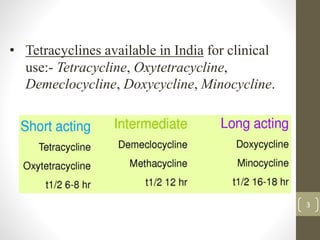
• Tetracyclines is broad spectrum antibiotic having four
cyclic ring nucleus.
• All tetracyclines are slightly bitter solids, weakly water
soluble, their hydrochlorides are more soluble.
• Aqueous solutions are unstable.
2
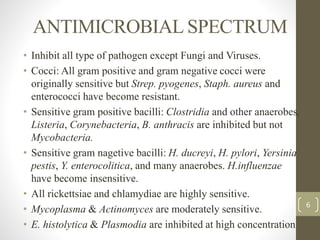
• Tetracyclines available in India for clinical
use:- Tetracycline, Oxytetracycline,
Demeclocycline, Doxycycline, Minocycline.
3
MECHANISM OF ACTION
• Tetracyclines are primarily bacteriostatic.
• Inhibit protein synthesis by binding to 30s
ribosome in susceptable organism.
• Inhibit binding of aminoacyl tRNA to the
acceptor site of mRNA peptide chain fails to
grow.
4
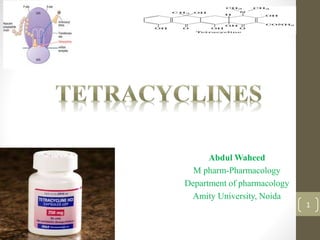
TRANSPORT OF
TETRACYCLINES
• Sensitive organism have active transport process
which concentrate tetracyclines intracellularly.
• In gram negative bacteria tetracyclines diffuse
through “Porin” channel.
• Some lipid soluble member (Doxycycline and
Minocycline) enter by passive diffusion.
5
ANTIMICROBIAL SPECTRUM
• Inhibit all type of pathogen except Fungi and Viruses.
• Cocci: All gram positive and gram negative cocci were
originally sensitive but Strep. pyogenes, Staph. aureus and
enterococci have become resistant.
• Sensitive gram positive bacilli: Clostridia and other anaerobes,
Listeria, Corynebacteria, B. anthracis are inhibited but not
Mycobacteria.
• Sensitive gram nagetive bacilli: H. ducreyi, H. pylori, Yersinia
pestis, Y. enterocolitica, and many anaerobes. H.influenzae
have become insensitive.
• All rickettsiae and chlamydiae are highly sensitive.
• Mycoplasma & Actinomyces are moderately sensitive.
• E. histolytica & Plasmodia are inhibited at high concentration
6
RESISTANCE
• Tetracyclines concentrating mechanism become
less effective.
• Bacteria acquire capacity to pump tetracyclines
out.
• Plasmid mediated synthesis of a “Protection”
protein which protects the ribosomal binding site
from tetracyclines.
7
PHARMACOKINETICS
• Incompletely absorbed by g.i.t.
• Absorption is better if taken in empty stomach.
• Doxycycline & Minocycline are completely absorbed
irrespective of food.
• Tetracyclines have chelating property with calcium
and other metals forms insoluble and unabsorbable
complexes.
• Milk, iron preparation, nonsystemic antacids and
sucralfate reduces their absorption.
• Concentrated in liver and spleen and bind to the
connective tissue in bone and teeth.
8
Continue…
• Widely distributed in body
• Variable degree of protein binding: high
(Demeclocycline, Doxycycline, & Minocycline,)
moderate (tetracycline) low (Oxytetracycline)
• Primarily excreted in urine by glomerular
filtration.
• They are secreted in milk and affect the infant.
9
ADMINISTRATION
• Most commonly used dosage form- Oral capsule.
• The capsule should be taken 1/2hr before or 2hr
after food .
• Tetracyclines are not recommended by i.m. route.
(painful & poor absorption).
• i.v. injection may be given in sever cases.
• Topical preparation are available but should not
be used because of high risk of sensitization.
10
ADVERSE EFFECT
• Epigastric pain, nausea, vomiting and diarrhoea
by their irritant property.
• Liver damage and jaundice occurs occasionally.
• All Tetracyclines except Doxycycline accumulate
and enhance renal failure.
• Tetracyclines have chelating property and affect
the teeth and bones.
• Reduces protein synthesis and induces negative
nitrogen balances increase blood urea.
11
PRECAUTION
• Should not be used during pregnancy, lactation
and in children.
• Should be avoided in patients on diuretics
increases blood urea.
• Do not mix injectable Tetracyclines with
Penicillin causes inactivation.
• Do not inject Tetracyclines intrathecally.
12
USE
• Broad spectrum antibiotics
• Atypical pneumonia
• Cholera
• Brucellosis
• Plague
• Rickettsial infection
13
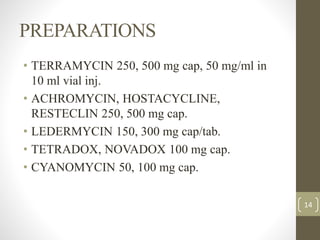
PREPARATIONS
• TERRAMYCIN 250, 500 mg cap, 50 mg/ml in
10 ml vial inj.
• ACHROMYCIN, HOSTACYCLINE,
RESTECLIN 250, 500 mg cap.
• LEDERMYCIN 150, 300 mg cap/tab.
• TETRADOX, NOVADOX 100 mg cap.
• CYANOMYCIN 50, 100 mg cap.
14
Reference
• Tripathi KD, Essentials of Medical Pharmacology, Jaypee
Publishers, New Delhi.
• Sharma HL, Sharma KK, Principles of Pharmacology, Paras
Medical Publishers, New Delhi
15
16

Tetracyclines

  • 1.
    Abdul Waheed M pharm-Pharmacology Departmentof pharmacology Amity University, Noida 1
  • 2.
    INTRODUCTION • Obtained fromsoil actinimycetes. • Introduced in 1948 by Benjamin Minge Duggar (chlortetracycline, aureomycin). • Tetracyclines is broad spectrum antibiotic having four cyclic ring nucleus. • All tetracyclines are slightly bitter solids, weakly water soluble, their hydrochlorides are more soluble. • Aqueous solutions are unstable. 2
  • 3.
    • Tetracyclines availablein India for clinical use:- Tetracycline, Oxytetracycline, Demeclocycline, Doxycycline, Minocycline. 3
  • 4.
    MECHANISM OF ACTION •Tetracyclines are primarily bacteriostatic. • Inhibit protein synthesis by binding to 30s ribosome in susceptable organism. • Inhibit binding of aminoacyl tRNA to the acceptor site of mRNA peptide chain fails to grow. 4
  • 5.
    TRANSPORT OF TETRACYCLINES • Sensitiveorganism have active transport process which concentrate tetracyclines intracellularly. • In gram negative bacteria tetracyclines diffuse through “Porin” channel. • Some lipid soluble member (Doxycycline and Minocycline) enter by passive diffusion. 5
  • 6.
    ANTIMICROBIAL SPECTRUM • Inhibitall type of pathogen except Fungi and Viruses. • Cocci: All gram positive and gram negative cocci were originally sensitive but Strep. pyogenes, Staph. aureus and enterococci have become resistant. • Sensitive gram positive bacilli: Clostridia and other anaerobes, Listeria, Corynebacteria, B. anthracis are inhibited but not Mycobacteria. • Sensitive gram nagetive bacilli: H. ducreyi, H. pylori, Yersinia pestis, Y. enterocolitica, and many anaerobes. H.influenzae have become insensitive. • All rickettsiae and chlamydiae are highly sensitive. • Mycoplasma & Actinomyces are moderately sensitive. • E. histolytica & Plasmodia are inhibited at high concentration 6
  • 7.
    RESISTANCE • Tetracyclines concentratingmechanism become less effective. • Bacteria acquire capacity to pump tetracyclines out. • Plasmid mediated synthesis of a “Protection” protein which protects the ribosomal binding site from tetracyclines. 7
  • 8.
    PHARMACOKINETICS • Incompletely absorbedby g.i.t. • Absorption is better if taken in empty stomach. • Doxycycline & Minocycline are completely absorbed irrespective of food. • Tetracyclines have chelating property with calcium and other metals forms insoluble and unabsorbable complexes. • Milk, iron preparation, nonsystemic antacids and sucralfate reduces their absorption. • Concentrated in liver and spleen and bind to the connective tissue in bone and teeth. 8
  • 9.
    Continue… • Widely distributedin body • Variable degree of protein binding: high (Demeclocycline, Doxycycline, & Minocycline,) moderate (tetracycline) low (Oxytetracycline) • Primarily excreted in urine by glomerular filtration. • They are secreted in milk and affect the infant. 9
  • 10.
    ADMINISTRATION • Most commonlyused dosage form- Oral capsule. • The capsule should be taken 1/2hr before or 2hr after food . • Tetracyclines are not recommended by i.m. route. (painful & poor absorption). • i.v. injection may be given in sever cases. • Topical preparation are available but should not be used because of high risk of sensitization. 10
  • 11.
    ADVERSE EFFECT • Epigastricpain, nausea, vomiting and diarrhoea by their irritant property. • Liver damage and jaundice occurs occasionally. • All Tetracyclines except Doxycycline accumulate and enhance renal failure. • Tetracyclines have chelating property and affect the teeth and bones. • Reduces protein synthesis and induces negative nitrogen balances increase blood urea. 11
  • 12.
    PRECAUTION • Should notbe used during pregnancy, lactation and in children. • Should be avoided in patients on diuretics increases blood urea. • Do not mix injectable Tetracyclines with Penicillin causes inactivation. • Do not inject Tetracyclines intrathecally. 12
  • 13.
    USE • Broad spectrumantibiotics • Atypical pneumonia • Cholera • Brucellosis • Plague • Rickettsial infection 13
  • 14.
    PREPARATIONS • TERRAMYCIN 250,500 mg cap, 50 mg/ml in 10 ml vial inj. • ACHROMYCIN, HOSTACYCLINE, RESTECLIN 250, 500 mg cap. • LEDERMYCIN 150, 300 mg cap/tab. • TETRADOX, NOVADOX 100 mg cap. • CYANOMYCIN 50, 100 mg cap. 14
  • 15.
    Reference • Tripathi KD,Essentials of Medical Pharmacology, Jaypee Publishers, New Delhi. • Sharma HL, Sharma KK, Principles of Pharmacology, Paras Medical Publishers, New Delhi 15
  • 16.