Penicillin
Submitted to: Mr Neeraj Kumar
Singh
Submitted by: Amjad Hussain
Contents
• β-lactum Antiobiotics
• History
• Introduction
• Chemistry
• Classification
• Mechanism of Action
• Resistance of Penicillin
• Natural Penicillin
• Semi-synthetic Penicillin
 Acid Resistant
 Penicillinase Resistance Penicillins
 Extended Spectrum Penicillins
• β-lactamase Inhibitors
β-lactum Antiobiotics
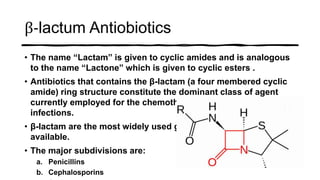
• The name “Lactam” is given to cyclic amides and is analogous
to the name “Lactone” which is given to cyclic esters .
• Antibiotics that contains the β-lactam (a four membered cyclic
amide) ring structure constitute the dominant class of agent
currently employed for the chemotherapy of bacterial
infections.
• β-lactam are the most widely used group of antibiotics
available.
• The major subdivisions are:
a. Penicillins
b. Cephalosporins
History
• The penicillin's were the first antibiotics discovered as
natural products from the mold Penicillium.
• 1928 - Sir Alexander Fleming, professor of bacteriology at
St. Mary's Hospital in London, was culturing
Staphylococcus aureus. He noticed zones of inhibition
where mold spores were growing. He named the mold
Penicillium rubrum. It was determined that a secretion of
the mold was effective against Gram-positive bacteria.
• It was isolated from fungus Penicillium notatum.
Introduction
• Penicillin is the 1st
antibiotic obtain from
Penicillium notatum
(fungus), discovered by
Alexander Fleming in
1928.
• β-lactam antibiotics.
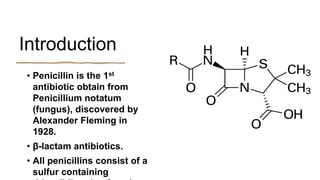
• All penicillins consist of a
sulfur containing
Chemistry
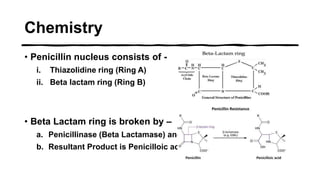
• Penicillin nucleus consists of -
i. Thiazolidine ring (Ring A)
ii. Beta lactam ring (Ring B)
• Beta Lactam ring is broken by –
a. Penicillinase (Beta Lactamase) and by gastric acid.
b. Resultant Product is Penicilloic acid
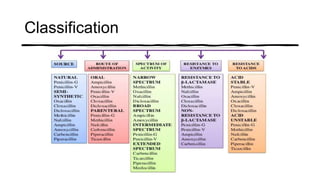
Classification
MOA
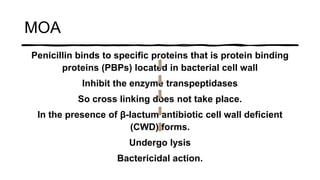
Penicillin binds to specific proteins that is protein binding
proteins (PBPs) located in bacterial cell wall
Inhibit the enzyme transpeptidases
So cross linking does not take place.
In the presence of β-lactum antibiotic cell wall deficient
(CWD) forms.
Undergo lysis
Bactericidal action.
Resistance of Penicillin
• Production of β-lactamase (Penicillinase).
• Decreases penetration into the cell.
• Altered PBPs site.
Natural Penicillin
• 1. Benzyl Penicillin (Penicillin G)
• Benzyl penicillin is a natural penicillin obtain from Penicillium
crysogenum.
• Narrow spectrum antibiotic.
• Pharmacokinetics
 Acid labile (Oral absorption is poor)
 Probenacid prolongs the duration of action of penicillin.
• ADRs
• Hypersensitivity
• Jarish-Herxheimer reaction
Acid-Resistant
• Penicillin V (Also known as phenoxy methyl penicillin).
 It is differ from penicillin-G only it is acid stable, so oral
absorption is better.
 Anti- bacterial spectrum of penicillin-V is identical to penicillin-G,
but it is less active against gonococci and other gram – ve
bacteria.
• Uses :
 Streptococcal pharyngitis
 Sinusitis
 Prophylaxis of rheumatic fever
Penicillinase Resistance Penicillins
• Some of the staphylococci produce an enzyme called
penicillinase which destroys penicillin and make the drug
inactive against them.
• Several semisynthetic penicillin's have been developed which
are penicillinase resistant and are effective even against such
organisms.
• Antistaphylococcal penicillin's
• These penicillin's are resistant to staphylococcal β- lactamases
• These congeners have side chains that protect the beta lactam
ring from attack by staphylococcal penicillinase
• Indicated in infections caused by penicillinase producing
staphylococci (drugs of choice, except in MRSA) – Methicillin,
Extended Spectrum Penicillins
• These drugs retain the antibacterial spectrum of penicillin
and have improved activity against gram-negative
organisms.
• Like penicillin, however, they are relatively susceptible to
hydrolysis by β-lactamases.
• Ex: Ampicillin, Bacampicillin, Pivampicillin, Talampicillin,
Amoxicillin
• Ampicillins :
 Active against all organisms sensitive to PnG; in addition, many
gram-negative bacilli.
 Pharmacokinetics:
 Acid resistant
 Oral absorption is incomplete but adequate
 Primary excretion is kidney, partly enterohepatic circulation occurs
 Plasma half life is 1hr
• Uses : UTI, RTI, Typhoid fever
• ADR: Diarrhoea
• Amoxcillin
 Close congener of Ampicillin
 Faster oral absorption, no food interference, lesser diarrhoea,
more sustained effect and higher plasma conc.
 Less effective against H. influenzae
 Effective against Penicillin resistant Strep. Pneumoniae
• Uses: Bronchitis, UTI, SABE and gonorrhoea, H. pylori
β-lactamase Inhibitors
• Clavulanic acid, Sulbactam and Tazobactam
• They contain beta-lactam ring but themselves, do not have
significant antibacterial activity.
• Inactivate bacterial beta-lactamases and are used to
enhance the antibacterial actions of beta-lactam antibiotics
• Clavulanic acid
 Obtained from Streptomyces clavuligerus.
 It has beta lactam ring but no antibacterial activity of its own.
 Called a suicide inhibitor, it gets inactivated after binding to
enzyme.
• Pharmacokinetics
 Rapid oral absorption.
 Bioavailability – 60% • t ½ = 1 hr
• Sulbactam
 Semisynthetic beta-lactamase inhibitor.
 Related chemically as well as in activity to clavulanic acid.
 It is also a progressive inhibitor.
 Combined with ampicillin.
 On the weight basis , it is less potent than clavunic acid for most
type of enzymes, but the same level of inhibition can be obtained
at the higher concentration achieved clinically.
 Oral absorption of sulbactam is inconsistent.
 Therefore , it is preferably given parentally.
• Tazobactam
 Similar to Sulbactam
• Pharmacokinetics matches with Piperacillin with which it is
used for used in severe infections like which it is used for
used in severe infections like peritonitis,
pelvic/urinary/respiratory infections.
• However, the combination is not effective against
piperacillin-resistant Pseudomonas
Penicillin

Penicillin

  • 1.
    Penicillin Submitted to: MrNeeraj Kumar Singh Submitted by: Amjad Hussain
  • 2.
    Contents • β-lactum Antiobiotics •History • Introduction • Chemistry • Classification • Mechanism of Action • Resistance of Penicillin • Natural Penicillin • Semi-synthetic Penicillin  Acid Resistant  Penicillinase Resistance Penicillins  Extended Spectrum Penicillins • β-lactamase Inhibitors
  • 3.
    β-lactum Antiobiotics • Thename “Lactam” is given to cyclic amides and is analogous to the name “Lactone” which is given to cyclic esters . • Antibiotics that contains the β-lactam (a four membered cyclic amide) ring structure constitute the dominant class of agent currently employed for the chemotherapy of bacterial infections. • β-lactam are the most widely used group of antibiotics available. • The major subdivisions are: a. Penicillins b. Cephalosporins
  • 4.
    History • The penicillin'swere the first antibiotics discovered as natural products from the mold Penicillium. • 1928 - Sir Alexander Fleming, professor of bacteriology at St. Mary's Hospital in London, was culturing Staphylococcus aureus. He noticed zones of inhibition where mold spores were growing. He named the mold Penicillium rubrum. It was determined that a secretion of the mold was effective against Gram-positive bacteria. • It was isolated from fungus Penicillium notatum.
  • 5.
    Introduction • Penicillin isthe 1st antibiotic obtain from Penicillium notatum (fungus), discovered by Alexander Fleming in 1928. • β-lactam antibiotics. • All penicillins consist of a sulfur containing
  • 6.
    Chemistry • Penicillin nucleusconsists of - i. Thiazolidine ring (Ring A) ii. Beta lactam ring (Ring B) • Beta Lactam ring is broken by – a. Penicillinase (Beta Lactamase) and by gastric acid. b. Resultant Product is Penicilloic acid
  • 7.
  • 8.
    MOA Penicillin binds tospecific proteins that is protein binding proteins (PBPs) located in bacterial cell wall Inhibit the enzyme transpeptidases So cross linking does not take place. In the presence of β-lactum antibiotic cell wall deficient (CWD) forms. Undergo lysis Bactericidal action.
  • 9.
    Resistance of Penicillin •Production of β-lactamase (Penicillinase). • Decreases penetration into the cell. • Altered PBPs site.
  • 10.
    Natural Penicillin • 1.Benzyl Penicillin (Penicillin G) • Benzyl penicillin is a natural penicillin obtain from Penicillium crysogenum. • Narrow spectrum antibiotic. • Pharmacokinetics  Acid labile (Oral absorption is poor)  Probenacid prolongs the duration of action of penicillin. • ADRs • Hypersensitivity • Jarish-Herxheimer reaction
  • 11.
    Acid-Resistant • Penicillin V(Also known as phenoxy methyl penicillin).  It is differ from penicillin-G only it is acid stable, so oral absorption is better.  Anti- bacterial spectrum of penicillin-V is identical to penicillin-G, but it is less active against gonococci and other gram – ve bacteria. • Uses :  Streptococcal pharyngitis  Sinusitis  Prophylaxis of rheumatic fever
  • 12.
    Penicillinase Resistance Penicillins •Some of the staphylococci produce an enzyme called penicillinase which destroys penicillin and make the drug inactive against them. • Several semisynthetic penicillin's have been developed which are penicillinase resistant and are effective even against such organisms. • Antistaphylococcal penicillin's • These penicillin's are resistant to staphylococcal β- lactamases • These congeners have side chains that protect the beta lactam ring from attack by staphylococcal penicillinase • Indicated in infections caused by penicillinase producing staphylococci (drugs of choice, except in MRSA) – Methicillin,
  • 13.
    Extended Spectrum Penicillins •These drugs retain the antibacterial spectrum of penicillin and have improved activity against gram-negative organisms. • Like penicillin, however, they are relatively susceptible to hydrolysis by β-lactamases. • Ex: Ampicillin, Bacampicillin, Pivampicillin, Talampicillin, Amoxicillin
  • 14.
    • Ampicillins : Active against all organisms sensitive to PnG; in addition, many gram-negative bacilli.  Pharmacokinetics:  Acid resistant  Oral absorption is incomplete but adequate  Primary excretion is kidney, partly enterohepatic circulation occurs  Plasma half life is 1hr • Uses : UTI, RTI, Typhoid fever • ADR: Diarrhoea
  • 15.
    • Amoxcillin  Closecongener of Ampicillin  Faster oral absorption, no food interference, lesser diarrhoea, more sustained effect and higher plasma conc.  Less effective against H. influenzae  Effective against Penicillin resistant Strep. Pneumoniae • Uses: Bronchitis, UTI, SABE and gonorrhoea, H. pylori
  • 16.
    β-lactamase Inhibitors • Clavulanicacid, Sulbactam and Tazobactam • They contain beta-lactam ring but themselves, do not have significant antibacterial activity. • Inactivate bacterial beta-lactamases and are used to enhance the antibacterial actions of beta-lactam antibiotics
  • 17.
    • Clavulanic acid Obtained from Streptomyces clavuligerus.  It has beta lactam ring but no antibacterial activity of its own.  Called a suicide inhibitor, it gets inactivated after binding to enzyme. • Pharmacokinetics  Rapid oral absorption.  Bioavailability – 60% • t ½ = 1 hr
  • 18.
    • Sulbactam  Semisyntheticbeta-lactamase inhibitor.  Related chemically as well as in activity to clavulanic acid.  It is also a progressive inhibitor.  Combined with ampicillin.  On the weight basis , it is less potent than clavunic acid for most type of enzymes, but the same level of inhibition can be obtained at the higher concentration achieved clinically.  Oral absorption of sulbactam is inconsistent.  Therefore , it is preferably given parentally.
  • 19.
    • Tazobactam  Similarto Sulbactam • Pharmacokinetics matches with Piperacillin with which it is used for used in severe infections like which it is used for used in severe infections like peritonitis, pelvic/urinary/respiratory infections. • However, the combination is not effective against piperacillin-resistant Pseudomonas