DRUGS ACTING
ON
CELL WALL
Site and Mechanism of action of
Antibiotics
• Inside bacterial cell is much concentration of
ions and metabolites
• It is required for cells to function normally :
• to generate energy
• Synthesize macromolecules
• grow and divide

• It cause high osmotic pressure
Antibiotics
affecting cell wall

Source

Therapeutic application

Penicillin

Pencillium chrysogenum
Pencillin notatum

Gram +ve coccal infections, syphilis,
gonorrhoea, meningo coccal
meningitis

Cephalosporin

Cephalosporium spp

Allergic to penicillin

Cycloserine

Streptomyces

TB caused by resistance bacilli

Bacitracin

Bacillus licheniformis

Sterilization of gut before surgery,
topical application

Vancomycin

Streptomyces orientalis

Staphylococcal infection resistant to
other drugs

Fofsomycin

Active against +Ve, G-ve.
Peptidoglycan synthesis
Cytoplasm

Cell Membrane

Cell wall

undecaprenol
sugar

UDP-M, UDP-G
amino
acid

Disaccharide pentapeptide

5
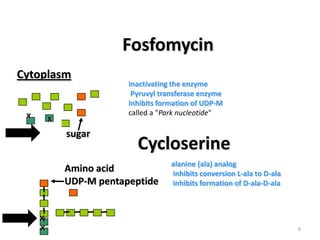
Fosfomycin
Cytoplasm

X

X

sugar

Inactivating the enzyme
Pyruvyl transferase enzyme
Inhibits formation of UDP-M
called a "Park nucleotide"

Cycloserine

Amino acid
UDP-M pentapeptide

X
X

alanine (ala) analog
inhibits conversion L-ala to D-ala
inhibits formation of D-ala-D-ala

6
TRANSPORT OF PEPTIGOGLYCAN
SUBUNIT ACROSS MEMBRANE
Cell membrane

Cell wall

undecaprenol

P

P

7
TRANSPORT OF PEPTIGOGLYCAN
SUBUNIT ACROSS MEMBRANE
Cell membrane

Cell wall

undecaprenol

P
P

8
TRANSPORT OF PEPTIGOGLYCAN
SUBUNIT ACROSS MEMBRANE
Cell membrane
undecaprenol

P
P

Cell wall
TRANSPORT OF PEPTIGOGLYCAN
SUBUNIT ACROSS MEMBRANE
Cell wall

Cell membrane
undecaprenol

P
P
TRANSPORT OF PEPTIGOGLYCAN
SUBUNIT ACROSS MEMBRANE
Cell membrane

Cell wall

undecaprenol
P

P
TRANSPORT OF
PEPTIGOGLYCAN SUBUNIT
ACROSS MEMBRANE

Cell membrane
undecaprenol

P

BACITRACIN

Cell wall
Vancomycin
Cell wall
Vancomycin ( binds to D-alanyl-D- alanine protion
of terminal end of peptidoglycan pentapeptide
Makes transglycolase enzyme ineffectual
cause inhibition of elongation
Beta lactam antibiotics
• penicillins
• Cephalosporins/cephamycins
• monobactams
Beta lactams
•inhibit penicillin binding proteins(Transpeptidase)

Cell wall

•stop cross-linking
•Activate autolysin enzyme
There functions are diverse: catalyze the
transpeptidase reaction, maintain shape, forms
septums during division, Inhibit autolytic
enzymes.

Penicillin binding protein
BETA LACTAM ANTIBIOTICS
• Clinically useful families of beta-lactam

compounds include the
– Penicillins,
– Cephalosporins,
– Monobactams
– Carbapenems
History
• The penicillins were the first antibiotics discovered as natural

products from the mold Penicillium.
• In 1928, Sir Alexander Fleming, professor of bacteriology at St.
Mary's Hospital in London, was culturing Staphylococcus aureus.

• He noticed zones of inhibition where mold spores were growing.
• He named the mold Penicillium rubrum.
• It was determined that a secretion of the mold was effective against
Gram-positive bacteria.
CHEMISTRY AND PROPERTIES
• 1-THIOZOLIDINE RING
• 2-BETA LACTAM RING
O
S
C

NH CH

CH
2

O

C

CH3
C
CH3

1

N

•Beta lactamase
• Gastric acid

CH

COOH

•Penicillanic acid
• The penicillin nucleus itself is the chief
structural requirement for biological activity;
• Metabolic transformation or chemical

alteration of this portion of the molecule
causes loss of all significant antibacterial

activity
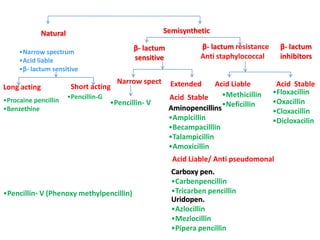
Semisynthetic

Natural

β- lactum
sensitive

•Narrow spectrum
•Acid liable
•β- lactum sensitive

Long acting
•Procaine pencillin
•Benzethine

Short acting
•Pencillin-G

Narrow spect

•Pencillin- V

β- lactum resistance
Anti staphylococcal

Extended

Acid Liable
•Methicillin
Acid Stable
Aminopencillins •Neficillin
•Ampicillin
•Becampacilllin
•Talampicillin
•Amoxicillin

β- lactum
inhibitors

Acid Stable
•Floxacillin
•Oxacillin
•Cloxacillin
•Dicloxacilin

Acid Liable/ Anti pseudomonal

•Pencillin- V (Phenoxy methylpencillin)

Carboxy pen.
•Carbenpencillin
•Tricarben pencillin
Uridopen.
•Azlocillin
•Mezlocillin
•Pipera pencillin
Antimicrobial spectrum: Penicillin G
Pharmacokinetics
Oral administration of Penicillin G:
• Acid labile –destroyed by gastric acid
• About one-third of an orally administered dose of penicillin G is
absorbed from the intestinal tract under favorable conditions.
• Gastric juice at pH 2 rapidly destroys the antibiotic.
Parenteral Administration of Penicillin G:
• From im site absorption is rapid and complete

• Peak plasma levels attained in 30min
Pharmacokinetics
•

Cont…

Penicillin G is distributed widely throughout the body, but the concentrations
in various fluids and tissues differ widely.

•

Approximately 60% of the penicillin G in plasma is reversibly bound to
albumin.

•

Significant amounts appear in liver, bile, kidney, semen, joint fluid, lymph, and
intestine

•

Cerebrospinal Fluid. Penicillin does not readily enter the CSF when the
meninges are normal. However, when the meninges are acutely inflamed,
penicillin penetrates into the CSF more easily.

•

Little metabolized because rapid excretion
Pharmacokinetics

Cont…

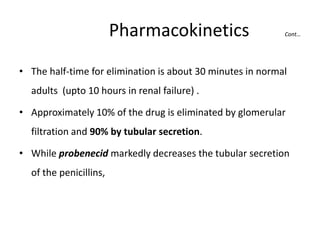
• The half-time for elimination is about 30 minutes in normal

adults (upto 10 hours in renal failure) .
• Approximately 10% of the drug is eliminated by glomerular
filtration and 90% by tubular secretion.
• While probenecid markedly decreases the tubular secretion
of the penicillins,
Preparations and dose
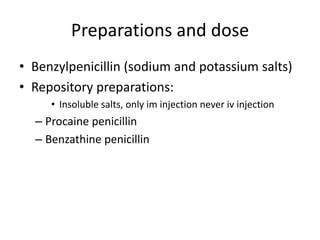
• Benzylpenicillin (sodium and potassium salts)
• Repository preparations:
• Insoluble salts, only im injection never iv injection

– Procaine penicillin
– Benzathine penicillin
Unitage of Penicillin
 1 U OF CRYSTALLINE SOD. BENZYL PENICILLIN
=0.6 µg OF THE STANDARD PREPARATION
1GM =1.6 MILLION UNITS
1 MU = 0.6 GM
Resistance mechansims
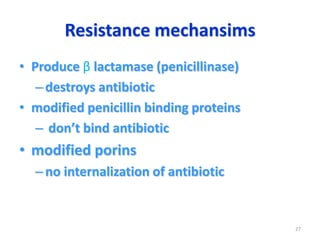
• Produce β lactamase (penicillinase)
– destroys antibiotic
• modified penicillin binding proteins
– don’t bind antibiotic

• modified porins
– no internalization of antibiotic

27
Adverse effects
• Hypersensitivity Reactions. Hypersensitivity reactions are most
common adverse effects noted with the penicillins, and these
agents probably are the most common cause of drug allergy.

• The basis of which is the fact that degradation products of
penicillin combine with host protein and become antigenic.
(Penicilloic acid)
Adverse effects

Cont…

• In approximate order of decreasing frequency, manifestations
of allergy to penicillins include maculopapular rash, urticarial
rash, fever, bronchospasm, vasculitis, serum sickness,

exfoliative dermatitis, Stevens-Johnson syndrome, and
anaphylaxis
• The overall incidence of such reactions to the penicillins varies

from 0.7% to 10% in different studies.
Adverse effects
• Very high doses of penicillin G can cause
seizures in kidney failure.
• Pain at im injection site
• Nausea on oral ingestion
• Thromboplebitis of injected vein

Cont…
Penicillin V
• Orally active
• Used for the treatment of bacteremia and oral

infections
• Higher minimum bactericidal concentration
• The major draw backs of benzylpenicillin are:
– Inactivation by gastric acid
– Short duration of action
– Poor penetration into the CSF
– Narrow spectrum of activity
– Susceptibility to Penicillinase
– Development of resistance
– Possibility of anaphylaxis
Penicillinase-resistant penicillins
(antistaphylococcal penicillins)

• These congeners have side chains that protect the beta
lactam ring from attack by staphylococcal penicillinase
• Indicated in infections caused by penicillinase producing
staphylococci (drugs of choice, except in MRSA)
– Methicillin, Cloxacillin
– Oxacillin, Nafcillin, Dicloxacillin
Extended spectrum penicillins
• Active against a variety of gram-negative bacilli as well

• Can be grouped according to their spectrum of activity
1. Aminopenicillins:
Ampicillins:
• Active against all organisms sensitive to PnG; in addition, many
gram-negative bacilli
Extended spectrum penicillins

Cont…
Extended spectrum penicillins

Cont…

Pharmacokinetics:

• Acid resistant
• Oral absorption is incomplete but adequate
• Primary excretion is kidney, partly enterohepatic circulation occurs

• Plasma half life is 1hr
Uses:
• UTI, RTI, Meningitis, Gonorrhoea, typhoid fever, bacillary dysentery,
Cholisystitis, Subacute bacterial endocarditis and Septicemias
Extended spectrum penicillins

Cont…

Adverse effects:

• Diarrhoea
• Rashes
• Hypersensitivity
Interactions:
• Hydrocortisone –inactivates ampicillin if mixed in the iv solution
• OC –failure of oral contraception
• Probenecid –retards renal excretion
Extended spectrum penicillins

Cont…

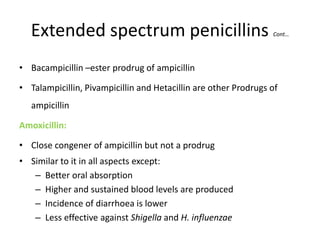
• Bacampicillin –ester prodrug of ampicillin

• Talampicillin, Pivampicillin and Hetacillin are other Prodrugs of
ampicillin
Amoxicillin:

• Close congener of ampicillin but not a prodrug
• Similar to it in all aspects except:
– Better oral absorption
– Higher and sustained blood levels are produced
– Incidence of diarrhoea is lower
– Less effective against Shigella and H. influenzae
Extended spectrum penicillins
2. Carboxypenicillins (Carbenicillin, Ticarcillin)
and

3. Ureidopenicillins (Piperacillin)

Cont…
Extended spectrum penicillins

Cont…

• These are called antipseudomonal penicillins

• Piperacillin is more potent among these
• Carbenicillin is less effective against Salmonella, E. Coli and
enterobacter but not active against Klebshiella and gram-positive
cocci
• Piperacillin has good activity against Klebshiella, and is used mainly
in neutropenic/ immunocompromised patients having serious
gram-negative infections and in burns
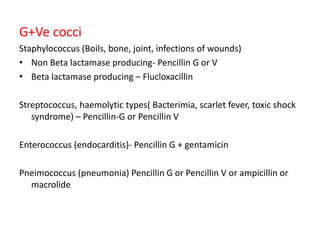
G+Ve cocci
Staphylococcus (Boils, bone, joint, infections of wounds)
• Non Beta lactamase producing- Pencillin G or V
• Beta lactamase producing – Flucloxacillin
Streptococcus, haemolytic types( Bacterimia, scarlet fever, toxic shock
syndrome) – Pencillin-G or Pencillin V
Enterococcus (endocarditis)- Pencillin G + gentamicin
Pneimococcus (pneumonia) Pencillin G or Pencillin V or ampicillin or
macrolide
G –ve cocci
• Morasella catarrhalis(Sinusitis) amoxicillin+clavunic acid
• Neisseria gonorrhoeae (gonorrhoea) amoxicillin+clavunic acid

G+ve rods
• Clostridium (tetanus, gangrene)- Pencillin G
• Listeria monocytogenes (Rarely cause meningitis) Amocillin±aminoglycoside
G-ve rods
• Haemophilius influenzae (R.T.I, ear, sinuses, meningitis)
Ampicillin or cefuroxime
• Pasterurella multocida (wound infection, abcess)
Amoxicillin+ calvulanic acid
• H. pylori Metroindazole + amoxicillin+ Ranitidine

Other
• Oropharyngeal infection- Pencillin G
• Rheumatic fever - Prophylactic
Spirochaetes
• Treponema (syphillis, yaws)- Pencillin G
• Leptospira (weil’s disease) - Pencillin G
• Actinomyces (abscesses) - Benzylpencillin
2nd line drug for
•
•
•
•
•
•

Corynebacterium (diphtheria)- Macrolide- Pencillin G
UTIextend spectrum pencillins(Amoxicillin)
Shigella (dysentery) – Q -ampicillin
Salmonella (typhoid)- Quinolone- amoxicillin
Whooping cough – Macrolide - Ampicillin
Borella recurrentis (relapsing fever)- Benzylpencillin
Beta-lactamase inhibitors
• Clavulanic acid, Sulbactam and

Tazobactam
• They contain beta-lactam ring but
themselves, do not have
significant antibacterial activity
Beta-lactamase inhibitors
Clavulanic acid:

•

Obtained from Streptomyces clavuligerus

•

Called a suicide inhibitor

•

Pharmacokinetics matches amoxicillin with which it is used

Sulbactam:
•

Semisynthetic beta-lactamase inhibitor

•

Related chemically as well as in activity to clavulanic acid

•

It is also a progressive inhibitor

•

Combined with ampicillin

Cont…
Beta-lactamase inhibitors

Cont…

Tazobactam:
• Similar to Sulbactam
• Pharmacokinetics matches with Piperacillin with which it is used for used

in severe infections like peritonitis, pelvic/urinary/respiratory infections
• However, the combination is not effective against piperacillin-resistant
Pseudomonas
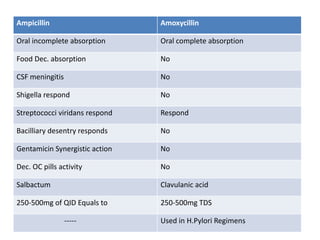
Ampicillin

Amoxycillin

Oral incomplete absorption

Oral complete absorption

Food Dec. absorption

No

CSF meningitis

No

Shigella respond

No

Streptococci viridans respond

Respond

Bacilliary desentry responds

No

Gentamicin Synergistic action

No

Dec. OC pills activity

No

Salbactum

Clavulanic acid

250-500mg of QID Equals to

250-500mg TDS

-----

Used in H.Pylori Regimens
3. pencillin

3. pencillin

  • 1.
  • 2.
    Site and Mechanismof action of Antibiotics
  • 3.
    • Inside bacterialcell is much concentration of ions and metabolites • It is required for cells to function normally : • to generate energy • Synthesize macromolecules • grow and divide • It cause high osmotic pressure
  • 4.
    Antibiotics affecting cell wall Source Therapeuticapplication Penicillin Pencillium chrysogenum Pencillin notatum Gram +ve coccal infections, syphilis, gonorrhoea, meningo coccal meningitis Cephalosporin Cephalosporium spp Allergic to penicillin Cycloserine Streptomyces TB caused by resistance bacilli Bacitracin Bacillus licheniformis Sterilization of gut before surgery, topical application Vancomycin Streptomyces orientalis Staphylococcal infection resistant to other drugs Fofsomycin Active against +Ve, G-ve.
  • 5.
    Peptidoglycan synthesis Cytoplasm Cell Membrane Cellwall undecaprenol sugar UDP-M, UDP-G amino acid Disaccharide pentapeptide 5
  • 6.
    Fosfomycin Cytoplasm X X sugar Inactivating the enzyme Pyruvyltransferase enzyme Inhibits formation of UDP-M called a "Park nucleotide" Cycloserine Amino acid UDP-M pentapeptide X X alanine (ala) analog inhibits conversion L-ala to D-ala inhibits formation of D-ala-D-ala 6
  • 7.
    TRANSPORT OF PEPTIGOGLYCAN SUBUNITACROSS MEMBRANE Cell membrane Cell wall undecaprenol P P 7
  • 8.
    TRANSPORT OF PEPTIGOGLYCAN SUBUNITACROSS MEMBRANE Cell membrane Cell wall undecaprenol P P 8
  • 9.
    TRANSPORT OF PEPTIGOGLYCAN SUBUNITACROSS MEMBRANE Cell membrane undecaprenol P P Cell wall
  • 10.
    TRANSPORT OF PEPTIGOGLYCAN SUBUNITACROSS MEMBRANE Cell wall Cell membrane undecaprenol P P
  • 11.
    TRANSPORT OF PEPTIGOGLYCAN SUBUNITACROSS MEMBRANE Cell membrane Cell wall undecaprenol P P
  • 12.
    TRANSPORT OF PEPTIGOGLYCAN SUBUNIT ACROSSMEMBRANE Cell membrane undecaprenol P BACITRACIN Cell wall
  • 13.
    Vancomycin Cell wall Vancomycin (binds to D-alanyl-D- alanine protion of terminal end of peptidoglycan pentapeptide Makes transglycolase enzyme ineffectual cause inhibition of elongation
  • 14.
    Beta lactam antibiotics •penicillins • Cephalosporins/cephamycins • monobactams
  • 15.
    Beta lactams •inhibit penicillinbinding proteins(Transpeptidase) Cell wall •stop cross-linking •Activate autolysin enzyme There functions are diverse: catalyze the transpeptidase reaction, maintain shape, forms septums during division, Inhibit autolytic enzymes. Penicillin binding protein
  • 16.
    BETA LACTAM ANTIBIOTICS •Clinically useful families of beta-lactam compounds include the – Penicillins, – Cephalosporins, – Monobactams – Carbapenems
  • 17.
    History • The penicillinswere the first antibiotics discovered as natural products from the mold Penicillium. • In 1928, Sir Alexander Fleming, professor of bacteriology at St. Mary's Hospital in London, was culturing Staphylococcus aureus. • He noticed zones of inhibition where mold spores were growing. • He named the mold Penicillium rubrum. • It was determined that a secretion of the mold was effective against Gram-positive bacteria.
  • 18.
    CHEMISTRY AND PROPERTIES •1-THIOZOLIDINE RING • 2-BETA LACTAM RING O S C NH CH CH 2 O C CH3 C CH3 1 N •Beta lactamase • Gastric acid CH COOH •Penicillanic acid
  • 19.
    • The penicillinnucleus itself is the chief structural requirement for biological activity; • Metabolic transformation or chemical alteration of this portion of the molecule causes loss of all significant antibacterial activity
  • 20.
    Semisynthetic Natural β- lactum sensitive •Narrow spectrum •Acidliable •β- lactum sensitive Long acting •Procaine pencillin •Benzethine Short acting •Pencillin-G Narrow spect •Pencillin- V β- lactum resistance Anti staphylococcal Extended Acid Liable •Methicillin Acid Stable Aminopencillins •Neficillin •Ampicillin •Becampacilllin •Talampicillin •Amoxicillin β- lactum inhibitors Acid Stable •Floxacillin •Oxacillin •Cloxacillin •Dicloxacilin Acid Liable/ Anti pseudomonal •Pencillin- V (Phenoxy methylpencillin) Carboxy pen. •Carbenpencillin •Tricarben pencillin Uridopen. •Azlocillin •Mezlocillin •Pipera pencillin
  • 21.
  • 22.
    Pharmacokinetics Oral administration ofPenicillin G: • Acid labile –destroyed by gastric acid • About one-third of an orally administered dose of penicillin G is absorbed from the intestinal tract under favorable conditions. • Gastric juice at pH 2 rapidly destroys the antibiotic. Parenteral Administration of Penicillin G: • From im site absorption is rapid and complete • Peak plasma levels attained in 30min
  • 23.
    Pharmacokinetics • Cont… Penicillin G isdistributed widely throughout the body, but the concentrations in various fluids and tissues differ widely. • Approximately 60% of the penicillin G in plasma is reversibly bound to albumin. • Significant amounts appear in liver, bile, kidney, semen, joint fluid, lymph, and intestine • Cerebrospinal Fluid. Penicillin does not readily enter the CSF when the meninges are normal. However, when the meninges are acutely inflamed, penicillin penetrates into the CSF more easily. • Little metabolized because rapid excretion
  • 24.
    Pharmacokinetics Cont… • The half-timefor elimination is about 30 minutes in normal adults (upto 10 hours in renal failure) . • Approximately 10% of the drug is eliminated by glomerular filtration and 90% by tubular secretion. • While probenecid markedly decreases the tubular secretion of the penicillins,
  • 25.
    Preparations and dose •Benzylpenicillin (sodium and potassium salts) • Repository preparations: • Insoluble salts, only im injection never iv injection – Procaine penicillin – Benzathine penicillin
  • 26.
    Unitage of Penicillin 1 U OF CRYSTALLINE SOD. BENZYL PENICILLIN =0.6 µg OF THE STANDARD PREPARATION 1GM =1.6 MILLION UNITS 1 MU = 0.6 GM
  • 27.
    Resistance mechansims • Produceβ lactamase (penicillinase) – destroys antibiotic • modified penicillin binding proteins – don’t bind antibiotic • modified porins – no internalization of antibiotic 27
  • 28.
    Adverse effects • HypersensitivityReactions. Hypersensitivity reactions are most common adverse effects noted with the penicillins, and these agents probably are the most common cause of drug allergy. • The basis of which is the fact that degradation products of penicillin combine with host protein and become antigenic. (Penicilloic acid)
  • 29.
    Adverse effects Cont… • Inapproximate order of decreasing frequency, manifestations of allergy to penicillins include maculopapular rash, urticarial rash, fever, bronchospasm, vasculitis, serum sickness, exfoliative dermatitis, Stevens-Johnson syndrome, and anaphylaxis • The overall incidence of such reactions to the penicillins varies from 0.7% to 10% in different studies.
  • 30.
    Adverse effects • Veryhigh doses of penicillin G can cause seizures in kidney failure. • Pain at im injection site • Nausea on oral ingestion • Thromboplebitis of injected vein Cont…
  • 31.
    Penicillin V • Orallyactive • Used for the treatment of bacteremia and oral infections • Higher minimum bactericidal concentration
  • 32.
    • The majordraw backs of benzylpenicillin are: – Inactivation by gastric acid – Short duration of action – Poor penetration into the CSF – Narrow spectrum of activity – Susceptibility to Penicillinase – Development of resistance – Possibility of anaphylaxis
  • 33.
    Penicillinase-resistant penicillins (antistaphylococcal penicillins) •These congeners have side chains that protect the beta lactam ring from attack by staphylococcal penicillinase • Indicated in infections caused by penicillinase producing staphylococci (drugs of choice, except in MRSA) – Methicillin, Cloxacillin – Oxacillin, Nafcillin, Dicloxacillin
  • 34.
    Extended spectrum penicillins •Active against a variety of gram-negative bacilli as well • Can be grouped according to their spectrum of activity 1. Aminopenicillins: Ampicillins: • Active against all organisms sensitive to PnG; in addition, many gram-negative bacilli
  • 35.
  • 36.
    Extended spectrum penicillins Cont… Pharmacokinetics: •Acid resistant • Oral absorption is incomplete but adequate • Primary excretion is kidney, partly enterohepatic circulation occurs • Plasma half life is 1hr Uses: • UTI, RTI, Meningitis, Gonorrhoea, typhoid fever, bacillary dysentery, Cholisystitis, Subacute bacterial endocarditis and Septicemias
  • 37.
    Extended spectrum penicillins Cont… Adverseeffects: • Diarrhoea • Rashes • Hypersensitivity Interactions: • Hydrocortisone –inactivates ampicillin if mixed in the iv solution • OC –failure of oral contraception • Probenecid –retards renal excretion
  • 38.
    Extended spectrum penicillins Cont… •Bacampicillin –ester prodrug of ampicillin • Talampicillin, Pivampicillin and Hetacillin are other Prodrugs of ampicillin Amoxicillin: • Close congener of ampicillin but not a prodrug • Similar to it in all aspects except: – Better oral absorption – Higher and sustained blood levels are produced – Incidence of diarrhoea is lower – Less effective against Shigella and H. influenzae
  • 39.
    Extended spectrum penicillins 2.Carboxypenicillins (Carbenicillin, Ticarcillin) and 3. Ureidopenicillins (Piperacillin) Cont…
  • 40.
    Extended spectrum penicillins Cont… •These are called antipseudomonal penicillins • Piperacillin is more potent among these • Carbenicillin is less effective against Salmonella, E. Coli and enterobacter but not active against Klebshiella and gram-positive cocci • Piperacillin has good activity against Klebshiella, and is used mainly in neutropenic/ immunocompromised patients having serious gram-negative infections and in burns
  • 41.
    G+Ve cocci Staphylococcus (Boils,bone, joint, infections of wounds) • Non Beta lactamase producing- Pencillin G or V • Beta lactamase producing – Flucloxacillin Streptococcus, haemolytic types( Bacterimia, scarlet fever, toxic shock syndrome) – Pencillin-G or Pencillin V Enterococcus (endocarditis)- Pencillin G + gentamicin Pneimococcus (pneumonia) Pencillin G or Pencillin V or ampicillin or macrolide
  • 42.
    G –ve cocci •Morasella catarrhalis(Sinusitis) amoxicillin+clavunic acid • Neisseria gonorrhoeae (gonorrhoea) amoxicillin+clavunic acid G+ve rods • Clostridium (tetanus, gangrene)- Pencillin G • Listeria monocytogenes (Rarely cause meningitis) Amocillin±aminoglycoside
  • 43.
    G-ve rods • Haemophiliusinfluenzae (R.T.I, ear, sinuses, meningitis) Ampicillin or cefuroxime • Pasterurella multocida (wound infection, abcess) Amoxicillin+ calvulanic acid • H. pylori Metroindazole + amoxicillin+ Ranitidine Other • Oropharyngeal infection- Pencillin G • Rheumatic fever - Prophylactic
  • 44.
    Spirochaetes • Treponema (syphillis,yaws)- Pencillin G • Leptospira (weil’s disease) - Pencillin G • Actinomyces (abscesses) - Benzylpencillin
  • 45.
    2nd line drugfor • • • • • • Corynebacterium (diphtheria)- Macrolide- Pencillin G UTIextend spectrum pencillins(Amoxicillin) Shigella (dysentery) – Q -ampicillin Salmonella (typhoid)- Quinolone- amoxicillin Whooping cough – Macrolide - Ampicillin Borella recurrentis (relapsing fever)- Benzylpencillin
  • 46.
    Beta-lactamase inhibitors • Clavulanicacid, Sulbactam and Tazobactam • They contain beta-lactam ring but themselves, do not have significant antibacterial activity
  • 47.
    Beta-lactamase inhibitors Clavulanic acid: • Obtainedfrom Streptomyces clavuligerus • Called a suicide inhibitor • Pharmacokinetics matches amoxicillin with which it is used Sulbactam: • Semisynthetic beta-lactamase inhibitor • Related chemically as well as in activity to clavulanic acid • It is also a progressive inhibitor • Combined with ampicillin Cont…
  • 48.
    Beta-lactamase inhibitors Cont… Tazobactam: • Similarto Sulbactam • Pharmacokinetics matches with Piperacillin with which it is used for used in severe infections like peritonitis, pelvic/urinary/respiratory infections • However, the combination is not effective against piperacillin-resistant Pseudomonas
  • 49.
    Ampicillin Amoxycillin Oral incomplete absorption Oralcomplete absorption Food Dec. absorption No CSF meningitis No Shigella respond No Streptococci viridans respond Respond Bacilliary desentry responds No Gentamicin Synergistic action No Dec. OC pills activity No Salbactum Clavulanic acid 250-500mg of QID Equals to 250-500mg TDS ----- Used in H.Pylori Regimens