PRESENTED BY-
NAVEEN KADIAN
DEPARTMENT OF PHARMACEUTICAL CHEMISTRY
K.L.E’S COLLEGE OF PHARMACY
BELGAUM-10
CONTENTS
• Introduction
• Epidemiology of PD
• Causes of Parkinsonism
• Risk factors of PD
• Clinical features of PD
• Treatment
• Reference
Definition
• Neurodegenerative disease is a condition which affects
brain function. Neurodegenerative diseases result from
deterioration of neurons.
• They are divided into two groups:
– conditions causing problems with movements
– conditions affecting memory and conditions related to
dementia.
– Examples:
• Alzheimer’s
• Parkinson’s
• Huntington’s
• Creutzfeldt-Jakob disease
• Multiple Sclerosis
• Amyotrophic Lateral Sclerosis (ALS or Lou Gehrig's
Disease)
Risk Factors
• Known
– Certain genetic
polymorphisms
– Increasing age
Possible
Gender
Poor education
Endocrine conditions
Oxidative stress
Inflammation
Stroke
Hypertension
Diabetes
Head trauma
Depression
Infection
Tumors
Vitamin deficiencies
Immune and metabolic
conditions
Chemical exposure
Smoking??
PARKINSON`S DISEASE is movement
disorder of unknown etiology due to
degeneration of neurons in the nigrostrial
dopamine system.
History:
First described in 1817 by an English physician,
James Parkinson, in “An Essay on the Shaking
Palsy.”
The famous French neurologist, Charcot, further
described the syndrome in the late 1800s.
Epidemiology of PD
The most common movement disorder
affecting 1-2 % of the general population over
the age of 65 years.
The second most common neurodegenerative
disorder after Alzheimer s disease (AD).
Causes of Parkinsonism
• Impaired release of dopamine- Idiopathic
parkinsonism.
• Drug depleting dopamine store-reserpine,
tetrabenzine.
• Toxin damaging dopaminergic neuron.
• Viral infection- Encephalitis ,Japanese encephalitis
• Trauma-repeated head injury[punch drunk syndrome]
• Miscellaneus-wilson disease,huntingtion,s disease
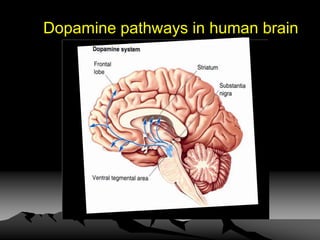
Dopamine pathways in human brain
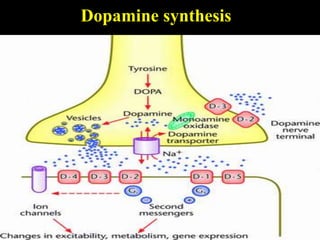
Dopamine synthesis
Risk factors of PD
 Age - the most important risk factor
 Positive family history
 Male gender
 Environmental exposure: Herbicide and pesticide
exposure, metals (manganese, iron), well water, farming,
rural residence, wood pulp mills; and steel alloy
industries
 Race
 Life experiences (trauma, emotional stress, personality
traits such as shyness and depressiveness)?
 An inverse correlation between cigarette smoking and
caffeine intake in case-control studies.
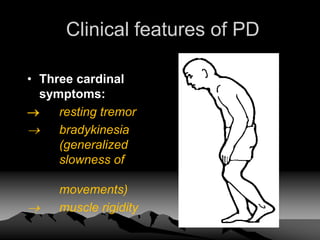
Clinical features of PD
• Three cardinal
symptoms:
 resting tremor
 bradykinesia
(generalized
slowness of
movements)
 muscle rigidity
CLINICAL FEATURE
• TREMORS(4-6hz):
• tremors[pill rolling] at rest, decreases on action.
Usually first in finger/thumb.
• Coarse flexion/extension of finger[pill rolling &
drum beating]
• RIGIDITY-
• Cog wheel type especially in upper limb
{stiffness in all direction of movement}.
• Plastic type {lead type} mostly appreciated in
legs. In trunk rigidity manifest by flexed& stooped
posture
Hypokinesis
• Charactrized by poverty & slowness of
movement. Slowness in initiating
movement. Handwriting micrographia.
• GAIT-patient walk with short step , with a
tendency to run{as they are catching their
own centre of gravity}-festinating gait
• General-expressionless face with staring
look with infrequent blinking. Monotonus
speech. Dementia & Depression in
advance stage
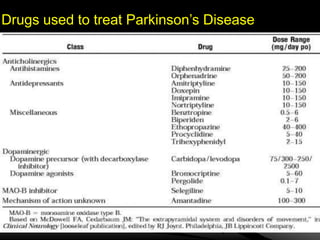
Drugs used to treat Parkinson’s Disease
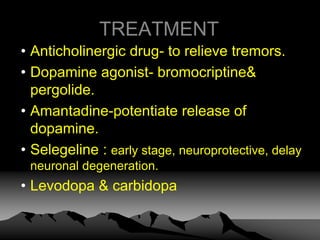
TREATMENT
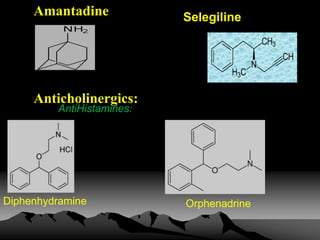
• Anticholinergic drug- to relieve tremors.
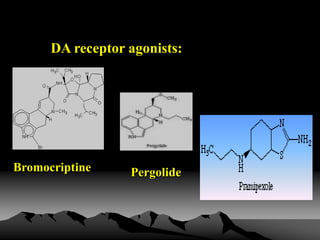
• Dopamine agonist- bromocriptine&
pergolide.
• Amantadine-potentiate release of
dopamine.
• Selegeline : early stage, neuroprotective, delay
neuronal degeneration.
• Levodopa & carbidopa
Therapy of PD: levodopa
 Late 1950s: L-dihydroxyphenylalanine (L-DOPA;
levodopa), a precursor of DA that crosses the blood-brain
barrier, could restore brain DA levels and motor
functions in animals treated with catecholamine depleting
drug (reserpine).
 First treatment attempts in PD patients with levodopa
resulted in dramatic but short-term improvements; took
years before it become an established and succesfull
treatment.
 Still today, levodopa cornerstone of PD treatment;
virtually all the patients benefit.
Therapy of PD: limitations of levodopa
 Efficacy tends to decrease as the disease progresses.
 Chronic treatment associated with adverse events
(motor fluctuations, dyskinesias and
neuropsychiatric problems).
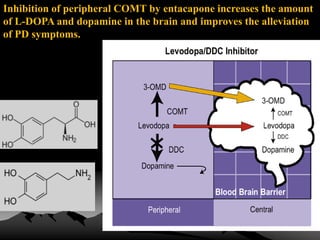
Inhibition of peripheral COMT by entacapone increases the amount
of L-DOPA and dopamine in the brain and improves the alleviation
of PD symptoms.
Therapy of PD: limitations of levodopa
 Does not prevent the continuous degeneration
of nerve cells in the subtantia nigra, the
treatment being therefore symptomatic.
Therapy of PD: Other treatments
DA receptor agonists:
Bromocriptine Pergolide
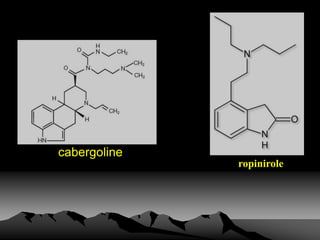
ropinirole
cabergoline
Anticholinergics:
Amantadine
AntiHistamines:
Diphenhydramine Orphenadrine
Selegiline
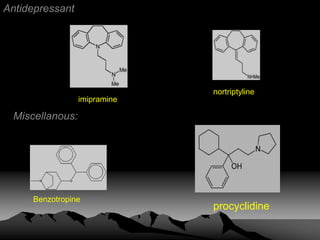
Antidepressant
Miscellanous:
imipramine
nortriptyline
Benzotropine
procyclidine
References
 BURGER’S Medicinal Chemistry & Drug discovery,6th
Edn,vol-1, Wiley-interscience publication
 CORWIN HANSCH, Comprehensive Medicinal
Chemistry,vol –IV 2008,Pregamon press
 Principles of Medicinal Chemistry by William O.Foye
 Medicinal Pharmacology by K.D Triphati.
 http:// www.cpharm.ucsf.edu/ kuntz/doct.html
 http:// www.bmm.icnet.uk/ ftdock/ftdoc.html
 www. Wikepedia.com
 www. Google.com
 www. Ipasp . com
Parkinson diseases

Parkinson diseases

  • 1.
    PRESENTED BY- NAVEEN KADIAN DEPARTMENTOF PHARMACEUTICAL CHEMISTRY K.L.E’S COLLEGE OF PHARMACY BELGAUM-10
  • 2.
    CONTENTS • Introduction • Epidemiologyof PD • Causes of Parkinsonism • Risk factors of PD • Clinical features of PD • Treatment • Reference
  • 3.
    Definition • Neurodegenerative diseaseis a condition which affects brain function. Neurodegenerative diseases result from deterioration of neurons. • They are divided into two groups: – conditions causing problems with movements – conditions affecting memory and conditions related to dementia. – Examples: • Alzheimer’s • Parkinson’s • Huntington’s • Creutzfeldt-Jakob disease • Multiple Sclerosis • Amyotrophic Lateral Sclerosis (ALS or Lou Gehrig's Disease)
  • 4.
    Risk Factors • Known –Certain genetic polymorphisms – Increasing age Possible Gender Poor education Endocrine conditions Oxidative stress Inflammation Stroke Hypertension Diabetes Head trauma Depression Infection Tumors Vitamin deficiencies Immune and metabolic conditions Chemical exposure Smoking??
  • 5.
    PARKINSON`S DISEASE ismovement disorder of unknown etiology due to degeneration of neurons in the nigrostrial dopamine system. History: First described in 1817 by an English physician, James Parkinson, in “An Essay on the Shaking Palsy.” The famous French neurologist, Charcot, further described the syndrome in the late 1800s.
  • 6.
    Epidemiology of PD Themost common movement disorder affecting 1-2 % of the general population over the age of 65 years. The second most common neurodegenerative disorder after Alzheimer s disease (AD).
  • 7.
    Causes of Parkinsonism •Impaired release of dopamine- Idiopathic parkinsonism. • Drug depleting dopamine store-reserpine, tetrabenzine. • Toxin damaging dopaminergic neuron. • Viral infection- Encephalitis ,Japanese encephalitis • Trauma-repeated head injury[punch drunk syndrome] • Miscellaneus-wilson disease,huntingtion,s disease
  • 8.
  • 9.
  • 10.
    Risk factors ofPD  Age - the most important risk factor  Positive family history  Male gender  Environmental exposure: Herbicide and pesticide exposure, metals (manganese, iron), well water, farming, rural residence, wood pulp mills; and steel alloy industries  Race  Life experiences (trauma, emotional stress, personality traits such as shyness and depressiveness)?  An inverse correlation between cigarette smoking and caffeine intake in case-control studies.
  • 11.
    Clinical features ofPD • Three cardinal symptoms:  resting tremor  bradykinesia (generalized slowness of movements)  muscle rigidity
  • 12.
    CLINICAL FEATURE • TREMORS(4-6hz): •tremors[pill rolling] at rest, decreases on action. Usually first in finger/thumb. • Coarse flexion/extension of finger[pill rolling & drum beating] • RIGIDITY- • Cog wheel type especially in upper limb {stiffness in all direction of movement}. • Plastic type {lead type} mostly appreciated in legs. In trunk rigidity manifest by flexed& stooped posture
  • 13.
    Hypokinesis • Charactrized bypoverty & slowness of movement. Slowness in initiating movement. Handwriting micrographia. • GAIT-patient walk with short step , with a tendency to run{as they are catching their own centre of gravity}-festinating gait • General-expressionless face with staring look with infrequent blinking. Monotonus speech. Dementia & Depression in advance stage
  • 14.
    Drugs used totreat Parkinson’s Disease
  • 15.
    TREATMENT • Anticholinergic drug-to relieve tremors. • Dopamine agonist- bromocriptine& pergolide. • Amantadine-potentiate release of dopamine. • Selegeline : early stage, neuroprotective, delay neuronal degeneration. • Levodopa & carbidopa
  • 16.
    Therapy of PD:levodopa  Late 1950s: L-dihydroxyphenylalanine (L-DOPA; levodopa), a precursor of DA that crosses the blood-brain barrier, could restore brain DA levels and motor functions in animals treated with catecholamine depleting drug (reserpine).  First treatment attempts in PD patients with levodopa resulted in dramatic but short-term improvements; took years before it become an established and succesfull treatment.  Still today, levodopa cornerstone of PD treatment; virtually all the patients benefit.
  • 17.
    Therapy of PD:limitations of levodopa  Efficacy tends to decrease as the disease progresses.  Chronic treatment associated with adverse events (motor fluctuations, dyskinesias and neuropsychiatric problems).
  • 18.
    Inhibition of peripheralCOMT by entacapone increases the amount of L-DOPA and dopamine in the brain and improves the alleviation of PD symptoms.
  • 19.
    Therapy of PD:limitations of levodopa  Does not prevent the continuous degeneration of nerve cells in the subtantia nigra, the treatment being therefore symptomatic.
  • 20.
    Therapy of PD:Other treatments DA receptor agonists: Bromocriptine Pergolide
  • 21.
  • 22.
  • 23.
  • 24.
    References  BURGER’S MedicinalChemistry & Drug discovery,6th Edn,vol-1, Wiley-interscience publication  CORWIN HANSCH, Comprehensive Medicinal Chemistry,vol –IV 2008,Pregamon press  Principles of Medicinal Chemistry by William O.Foye  Medicinal Pharmacology by K.D Triphati.  http:// www.cpharm.ucsf.edu/ kuntz/doct.html  http:// www.bmm.icnet.uk/ ftdock/ftdoc.html  www. Wikepedia.com  www. Google.com  www. Ipasp . com