Beta Lactam antibiotics-1
(Penicillins)
Dr Naser Ashraf Tadvi
Associate Professor
Department of Pharmacology
Ayaan Institute of Medical Sciences
Beta Lactum antibiotics
• Penicillins
• Cephalosporins
• Monobactum:
– Aztreonam
• Carbapenems:
– Imipenem, merpenem, ertapenem, doripenem
History of penicillins
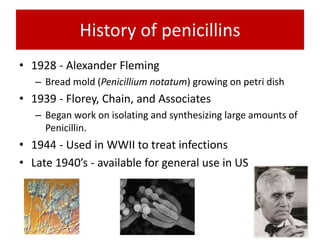
• 1928 - Alexander Fleming
– Bread mold (Penicillium notatum) growing on petri dish
• 1939 - Florey, Chain, and Associates
– Began work on isolating and synthesizing large amounts of
Penicillin.
• 1944 - Used in WWII to treat infections
• Late 1940’s - available for general use in US
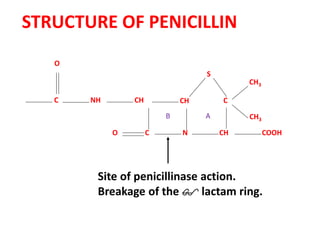
Site of penicillinase action.
Breakage of the  lactam ring.
STRUCTURE OF PENICILLIN
C NH CH CH C
O
O C N CH
CH3
CH3
COOH
S
AB
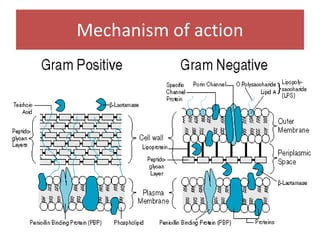
Mechanism of action
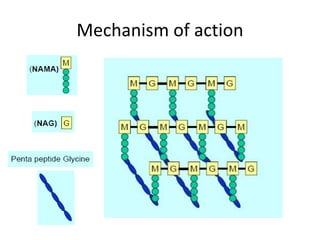
Mechanism of action
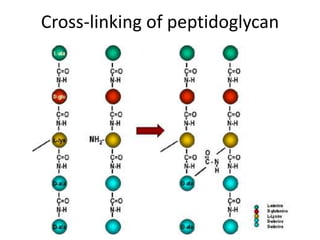
Cross-linking of peptidoglycan
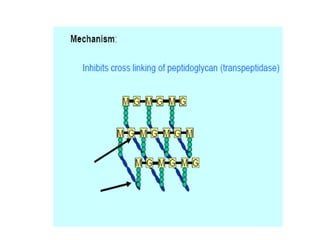
Mechanism of action
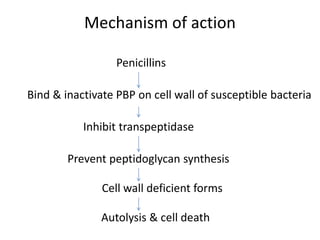
Penicillins
Bind & inactivate PBP on cell wall of susceptible bacteria
Inhibit transpeptidase
Autolysis & cell death
Prevent peptidoglycan synthesis
Cell wall deficient forms
Mechanism of bacterial resistance
• Beta lactamases hydrolyse & inactivate β-lactum ring
• Altered PBP
• ↓ penetration of drug to its site of action
• Activation of efflux mechanisms
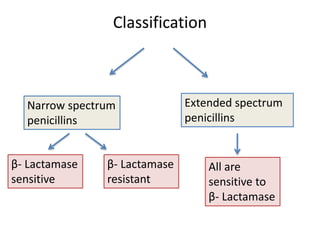
Classification
Narrow spectrum
penicillins
Extended spectrum
penicillins
β- Lactamase
sensitive
β- Lactamase
resistant
All are
sensitive to
β- Lactamase
Narrow spectrum penicillins
β- Lactamase sensitive β- Lactamase resistant
Oral
• Cloxacillin
• Dicloxacillin
• Flucloxacillin
Parenteral
•Methicillin
• Nafcillin
•Penicillin G
•Procaine penicillin G
•Benzathine penicillin G
•Penicillin V (Oral)
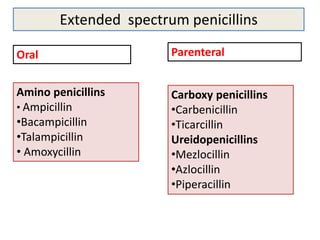
Extended spectrum penicillins
Oral Parenteral
Carboxy penicillins
•Carbenicillin
•Ticarcillin
Ureidopenicillins
•Mezlocillin
•Azlocillin
•Piperacillin
Amino penicillins
• Ampicillin
•Bacampicillin
•Talampicillin
• Amoxycillin
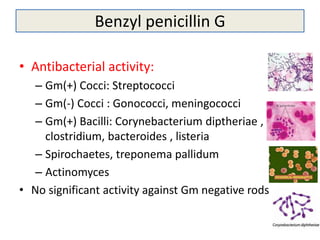
Benzyl penicillin G
• Antibacterial activity:
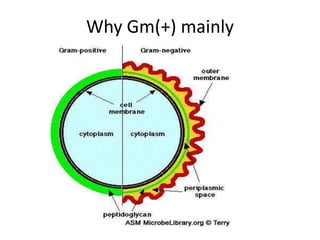
– Gm(+) Cocci: Streptococci
– Gm(-) Cocci : Gonococci, meningococci
– Gm(+) Bacilli: Corynebacterium diptheriae ,
clostridium, bacteroides , listeria
– Spirochaetes, treponema pallidum
– Actinomyces
• No significant activity against Gm negative rods
Why Gm(+) mainly
Pharmacokinetics
• Acid labile hence given IM/IV
• Duration of action:4-6 hrs, Elimination t½ = 30 min
• Excreted 80 -85% tubular secretion & 10-15%
glomerular filtration
• Always prepare fresh solution
• Renal failure prolongs half life of penicillins
• Nafcillin,cloxacillin, dicloxacillin excreted by biliary
route
Repository preparations of Penicillin G
• Procaine penicillin G:
– DOA = 12-24 hrs
– Moderate plasma concentration
– Used in mild to moderate infections
– Less painful injection
• Benzathine penicillin G:
– DOA= 3-4 weeks
– Slow onset but longest DOA
– Used in syphilis , rheumatic fever prophylaxis
Therapeutic uses of Penicillin G
• Streptococcal infections
– Pharyngitis, sinusitis, otitis, rheumatic fever
– Procaine penicillin G : 6 lac units IM OD
• Pneumococcal infections
– Pneumococcal pneumonia, meningitis
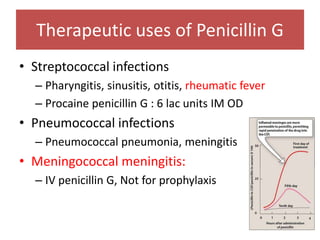
• Meningococcal meningitis:
– IV penicillin G, Not for prophylaxis
Therapeutic uses of Penicillin G
• Gonococcal infections: Unreliable now
• Syphilis
• Leptospirosis
• Diptheria
• Clostridial infections: Tetanus & gas gangrene
• Anthrax: Benzyl penicillin DOC 8-10 days
• listeria, trench mouth
• Actinomycosis:
Prophylactic uses
• Rheumatic fever
– Benzathine penicillin 1.2 million units IM every 4
weeks
• Bacterial endocarditis
– Valvular lesion patients before surgery
– Should be given 1 hr before the surgery
Adverse effects of Penicillins
• Local irritation and direct toxicity
– IV penicillin G : thrombophlebitis
– Procaine penicillin G: anxiety seizures
– Intrathecal penicillin G: arachidonitis, convulsions
• Hypersensitivity reactions
• Jarisch herxheimer reaction
Precautions with penicillin
• Always take history of allergies & drug therapy
• Perform skin sensitivity test before
administering penicillin G & its preparations
– 0.02 ml of penicillin G
– Drop of 10000 units on skin
– 0.05 ml penicilloyl polylysine
• Keep adrenaline ready in emergency tray
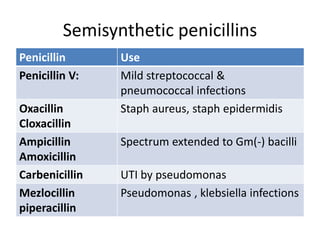
Semisynthetic penicillins
Penicillin Use
Penicillin V: Mild streptococcal &
pneumococcal infections
Oxacillin
Cloxacillin
Staph aureus, staph epidermidis
Ampicillin
Amoxicillin
Spectrum extended to Gm(-) bacilli
Carbenicillin UTI by pseudomonas
Mezlocillin
piperacillin
Pseudomonas , klebsiella infections
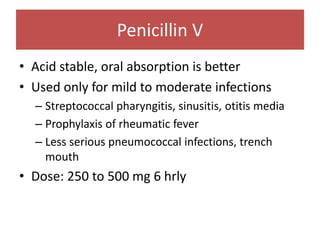
Penicillin V
• Acid stable, oral absorption is better
• Used only for mild to moderate infections
– Streptococcal pharyngitis, sinusitis, otitis media
– Prophylaxis of rheumatic fever
– Less serious pneumococcal infections, trench
mouth
• Dose: 250 to 500 mg 6 hrly
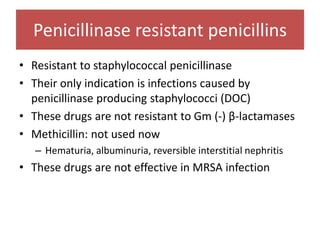
Penicillinase resistant penicillins
• Resistant to staphylococcal penicillinase
• Their only indication is infections caused by
penicillinase producing staphylococci (DOC)
• These drugs are not resistant to Gm (-) β-lactamases
• Methicillin: not used now
– Hematuria, albuminuria, reversible interstitial nephritis
• These drugs are not effective in MRSA infection
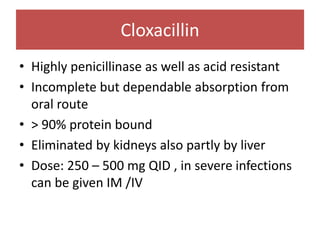
Cloxacillin
• Highly penicillinase as well as acid resistant
• Incomplete but dependable absorption from
oral route
• > 90% protein bound
• Eliminated by kidneys also partly by liver
• Dose: 250 – 500 mg QID , in severe infections
can be given IM /IV
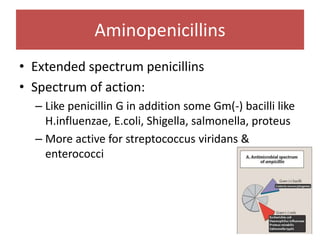
Aminopenicillins
• Extended spectrum penicillins
• Spectrum of action:
– Like penicillin G in addition some Gm(-) bacilli like
H.influenzae, E.coli, Shigella, salmonella, proteus
– More active for streptococcus viridans &
enterococci
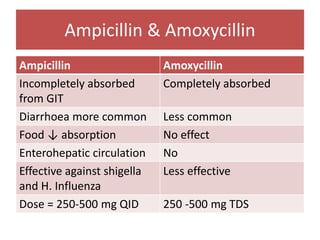
Ampicillin & Amoxycillin
Ampicillin Amoxycillin
Incompletely absorbed
from GIT
Completely absorbed
Diarrhoea more common Less common
Food ↓ absorption No effect
Enterohepatic circulation No
Effective against shigella
and H. Influenza
Less effective
Dose = 250-500 mg QID 250 -500 mg TDS
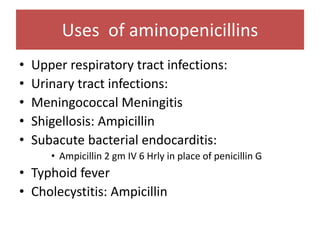
Uses of aminopenicillins
• Upper respiratory tract infections:
• Urinary tract infections:
• Meningococcal Meningitis
• Shigellosis: Ampicillin
• Subacute bacterial endocarditis:
• Ampicillin 2 gm IV 6 Hrly in place of penicillin G
• Typhoid fever
• Cholecystitis: Ampicillin
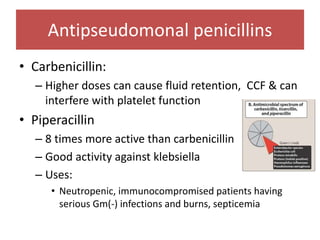
Antipseudomonal penicillins
• Carbenicillin:
– Higher doses can cause fluid retention, CCF & can
interfere with platelet function
• Piperacillin
– 8 times more active than carbenicillin
– Good activity against klebsiella
– Uses:
• Neutropenic, immunocompromised patients having
serious Gm(-) infections and burns, septicemia
Reverse spectrum penicillins
• Mecillinam , pivmecillinam
• More stable to β-lactamases degeneration
than ampicillin
• Acid stable but poorly absorbed
• Act by inhibiting PBP-2, prevent cell
elongation causing spherical forms
• Reverse spectrum?
– Mainly effective against Gm(-) bacilli- E.coli.
Enterobacter, salmonella, klebsiella
β-lactamase inhibitors
• Clavulanic Acid
• Sulbactum
• Tazobactum
Also called as suicide inhibitors
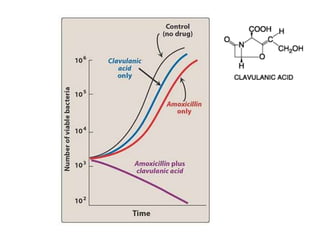
Clavulinic acid
• Isolated from Streptomyces clavuligerus
• Inhibits β lactamases produced by variety of Gm(+) &
Gm(-) bacteria
• Rapid oral absorption, 60 % bioavailable
• Elimination half life & tissue distribution matches
with amoxycillin
• Use: infections caused by β lactamase producing
strains of S.aureus, E.coli, H.influenzae, proteus
Sulbactum
• Semisynthetic β-lactamase inhibitor
• 2-3 times less potent than clavulanic acid
• Oral absorption inconsistent
• Uses:
– PPNG gonorrhoea
– Mixed aerobic-anaerobic infections
• Combined with ampicillin for IV/IM
administration
Tazobactum
• More potent than sulbactum
• Pharmacokinetics matches with piperacillin
• Available in combination with piperacillin
• Uses:
– Severe infection like peritonitis, , pelvic, urinary,
respiratory infections caused by β-lactamase
producing bacteria