β-Lactam antibiotics
Mr. Sarang D. Kulkarni
Asst Prof
Pharmaceutical Chemistry
Siddhi College of Pharmacy Pune
Introduction
• The name “Lactam” is given to cyclic amides and is analogous to
the name “Lactone” which is given to cyclic esters .
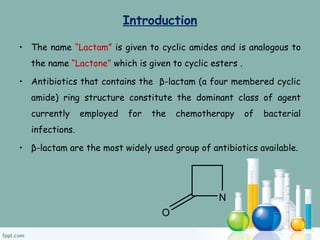
• Antibiotics that contains the β-lactam (a four membered cyclic
amide) ring structure constitute the dominant class of agent
currently employed for the chemotherapy of bacterial
infections.
• β-lactam are the most widely used group of antibiotics available.
N
O
HISTROICAL BACKGROUND
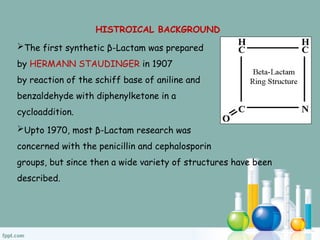
The first synthetic β-Lactam was prepared
by HERMANN STAUDINGER in 1907
by reaction of the schiff base of aniline and
benzaldehyde with diphenylketone in a
cycloaddition.
Upto 1970, most β-Lactam research was
concerned with the penicillin and cephalosporin
groups, but since then a wide variety of structures have been
described.
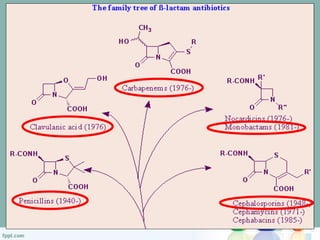
BETA-LACTAM ANTIBIOTICS
(inhibitors of cell wall synthesis)
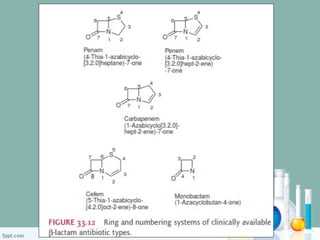
• Their structure contains a beta-lactam ring.
The major subdivisions are:
(a) penicillins whose official names usually include or end in “cillin”
(b) cephalosporins which are recognized by the inclusion of “cef” or
“ceph” in their official names.
(c) carbapenems (e.g. meropenem, imipenem)
(d) monobactams (e.g. aztreonam)
(e) beta-lactamase inhibitors (e.g. clavulanic acid, sulbactam).
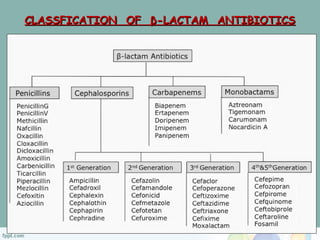
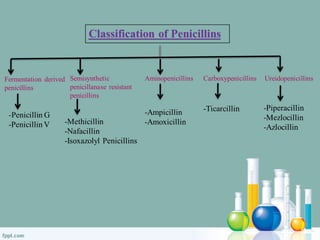
CLASSFICATION OF β-LACTAM ANTIBIOTICS
PENICILLINS
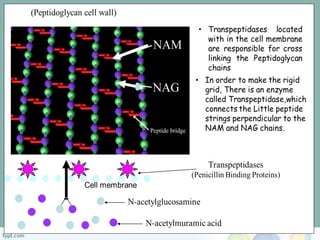
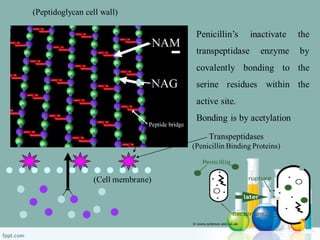
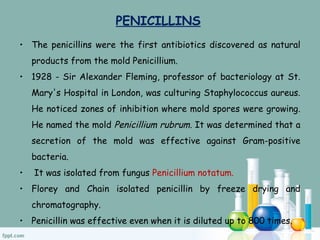
• The penicillins were the first antibiotics discovered as natural
products from the mold Penicillium.
• 1928 - Sir Alexander Fleming, professor of bacteriology at St.
Mary's Hospital in London, was culturing Staphylococcus aureus.
He noticed zones of inhibition where mold spores were growing.
He named the mold Penicillium rubrum. It was determined that a
secretion of the mold was effective against Gram-positive
bacteria.
• It was isolated from fungus Penicillium notatum.
• Florey and Chain isolated penicillin by freeze drying and
chromatography.
• Penicillin was effective even when it is diluted up to 800 times.
Chemistry
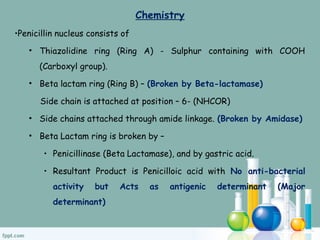
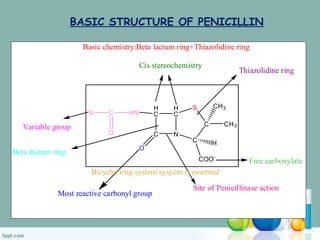
•Penicillin nucleus consists of
• Thiazolidine ring (Ring A) - Sulphur containing with COOH
(Carboxyl group).
• Beta lactam ring (Ring B) – (Broken by Beta-lactamase)
Side chain is attached at position – 6- (NHCOR)
• Side chains attached through amide linkage. (Broken by Amidase)
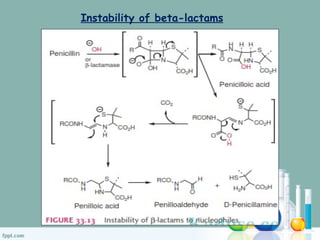
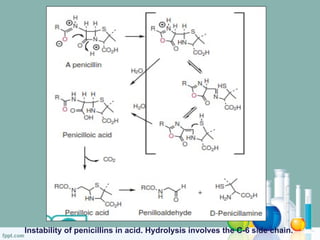
• Beta Lactam ring is broken by –
• Penicillinase (Beta Lactamase), and by gastric acid.
• Resultant Product is Penicilloic acid with No anti-bacterial
activity but Acts as antigenic determinant (Major
determinant)
Instability of beta-lactams
Instability of penicillins in acid. Hydrolysis involves the C-6 side chain.
H
C
C N
H
C
C
C
S
O
CH3
CH3
COO-
H
HN
C
R
O
Free carboxylate
Cis stereochemistry
Most reactive carbonyl group
Site of Penicillinase action
Basic chemistry:Beta lactum ring+Thiazolidine ring
Bicyclic ring system sysyem is essential
Variable group
Beta lactum ring
Thiazolidine ring
BASIC STRUCTURE OF PENICILLIN
PENICILLIN DERIVATIVES
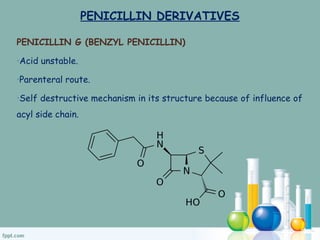
PENICILLIN G (BENZYL PENICILLIN)
•Acid unstable.
•Parenteral route.
•Self destructive mechanism in its structure because of influence of
acyl side chain.
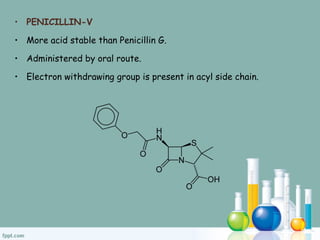
• PENICILLIN-V
• More acid stable than Penicillin G.
• Administered by oral route.
• Electron withdrawing group is present in acyl side chain.
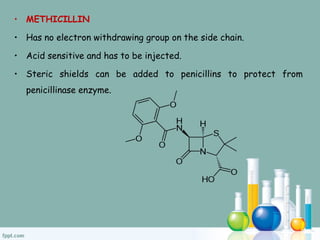
• METHICILLIN
• Has no electron withdrawing group on the side chain.
• Acid sensitive and has to be injected.
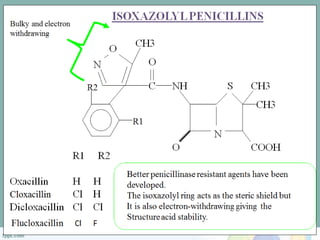
• Steric shields can be added to penicillins to protect from
penicillinase enzyme.
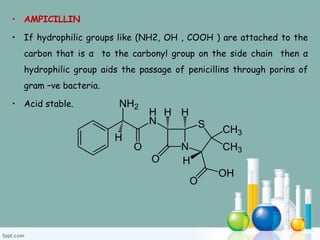
• AMPICILLIN
• If hydrophilic groups like (NH2, OH , COOH ) are attached to the
carbon that is α to the carbonyl group on the side chain then α
hydrophilic group aids the passage of penicillins through porins of
gram –ve bacteria.
• Acid stable.
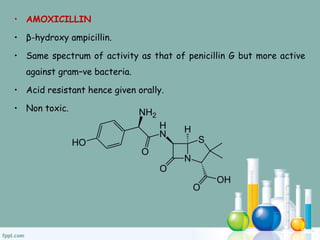
• AMOXICILLIN
• β-hydroxy ampicillin.
• Same spectrum of activity as that of penicillin G but more active
against gram–ve bacteria.
• Acid resistant hence given orally.
• Non toxic.
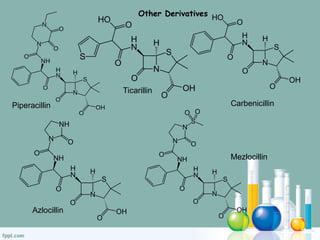
Piperacillin
Ticarillin
Azlocillin
Mezlocillin
Carbenicillin
Other Derivatives
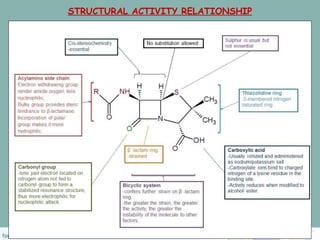
STRUCTURAL ACTIVITY RELATIONSHIP
Resistance against Penicillin
•Natural
•Target enzymes and PBPs are deeply located (Lipoprotein barrier in –ve)
•PBPs of organisms have low affinity for penicillin
•Acquired
•Production of Penicillinase (Beta-Lactamase) enzyme, (>300 subtypes).
Common organisms producing Beta-Lactamase are
•Staphylococcus
•Bacillus subtilis
•Gonococci
•E. coli
•Enterococci
•Haemophilus influenza
•Loss or alteration of Porin channels in gram negative
•Modification of penicillin binding proteins (PBPs)- having low affinity .
•Activation of antibiotic efflux mechanism- Some gram negative bacteria
Adverse effects
General
•Hypersensitivity reactions (including Anaphylaxis)
•More with procaine penicillin,
•Intradermal Skin sensitivity test
•Major Determinant (Penicilloyl moiety in terms of amount) is responsible for
hypersensitivity other than anaphylaxis
•Minor determinants( Penicillamine and Penicillenate) are responsible for
anaphylaxis.
• The Penicilloyl moiety or major determinant results from reaction of beta-
lactam ring with endogenous proteins. The Beta lactam ring spontaneously
opens in the body forming a hapten-protein complex, the most abundant but
not necessarily most immunogenic.
• Super infections (Ampicillin)
• Nephrotoxicity (Methicillin causing interstitial nephritis)
• Increase in Prothrombin time leading to bleeding
• Jarisch -Herxheimer Reaction-
 Common in secondary syphilis,
 Release of Spirochetal lytic products (Heat stable proteins,
endotoxins)
 Characterized by fever, myalgia, exacerbation of lesions,
 Usually occurs within 2 hours of first dose
 Treatment- NSAIDs and Corticosteroids
 Also in Borelliosis, Leptospirosis, and Brucelosis
 Adolf Jarisch an Austrian and Karl Herxheimer a German
dermatologist
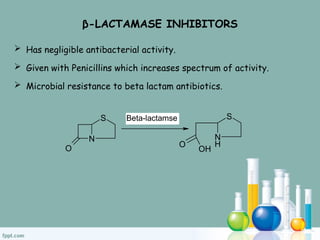
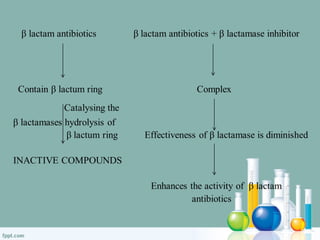
β-LACTAMASE INHIBITORS
 Has negligible antibacterial activity.
 Given with Penicillins which increases spectrum of activity.
 Microbial resistance to beta lactam antibiotics.
S
N
O
N
H
S
OH
O
Beta-lactamse
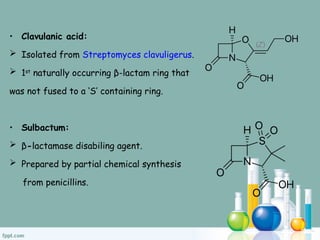
• Clavulanic acid:
 Isolated from Streptomyces clavuligerus.
 1st
naturally occurring β-lactam ring that
was not fused to a ‘S’ containing ring.
• Sulbactum:
 β-lactamase disabiling agent.
 Prepared by partial chemical synthesis
from penicillins.
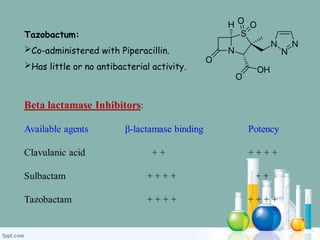
Tazobactum:
Co-administered with Piperacillin.
Has little or no antibacterial activity.
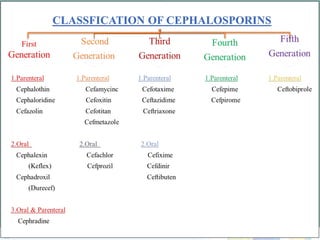
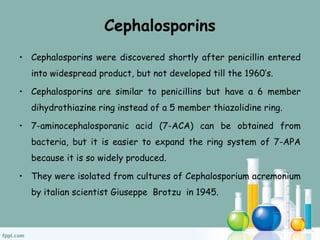
Cephalosporins
• Cephalosporins were discovered shortly after penicillin entered
into widespread product, but not developed till the 1960’s.
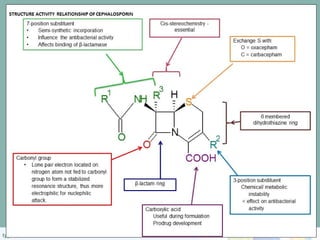
• Cephalosporins are similar to penicillins but have a 6 member
dihydrothiazine ring instead of a 5 member thiazolidine ring.
• 7-aminocephalosporanic acid (7-ACA) can be obtained from
bacteria, but it is easier to expand the ring system of 7-APA
because it is so widely produced.
• They were isolated from cultures of Cephalosporium acremonium
by italian scientist Giuseppe Brotzu in 1945.
• In 1948, Abraham and his colleagues have isolated three principle
antibiotic components from cultures of fungus.
• 1964 ,the first semi synthetic cephalosporin i.e. cefalothin was
launched in the Market by Eli Lilly and company.
• Unlike penicillin, cephalosporins have two side chains which can be
easily modified. Cephalosporins are also more difficult for β-
lactamases to hydrolyze.
Cephalosporin P
Cephalosporin N
Cephalosporin C
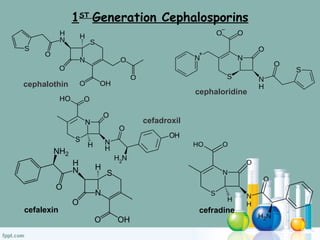
1ST
Generation Cephalosporins
cephaloridine
cephalothin
cefalexin cefradine
cefadroxil
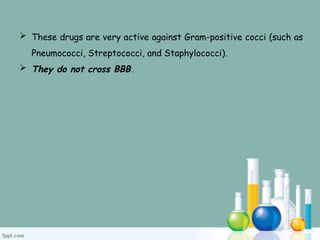
 These drugs are very active against Gram-positive cocci (such as
Pneumococci, Streptococci, and Staphylococci).
 They do not cross BBB.
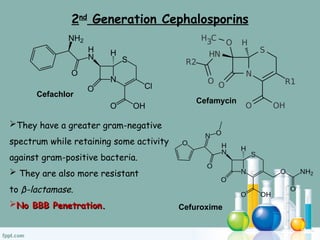
2nd
Generation Cephalosporins
They have a greater gram-negative
spectrum while retaining some activity
against gram-positive bacteria.
 They are also more resistant
to β-lactamase.
No BBB Penetration.
No BBB Penetration.
Cefachlor
Cefamycin
Cefuroxime
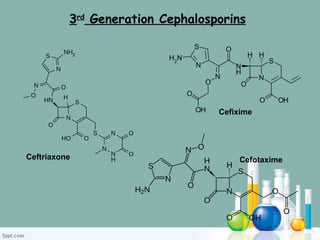
3rd
Generation Cephalosporins
Ceftriaxone
Cefixime
Cefotaxime
Third-generation drugs exhibit the lest activity against gram-positive
bacteria, but most potent activity against gram-negative bacteria :
(a) Extended antibacterial spectrum, include Pseud. aeruginosa;
(b) Less activity on gram-positive bacteria than first and second
generation;
(c) Most active on gram-negative bacteria;
(d) High stability with β-lactamase;
(e) Easy penetrate to different tissues, and then have broad
distribution;
(f) Little kidney toxicity.
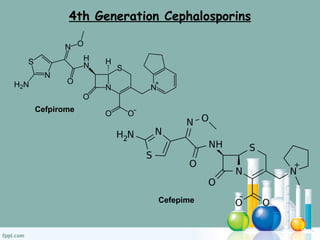
4th Generation Cephalosporins
Cefpirome
Cefepime
 Zwitterionic compounds.
 Good affinity for the transpeptidase enzyme.
 Low affinity for some β-lactamases.
 Cross BBB and effective in meningitis.
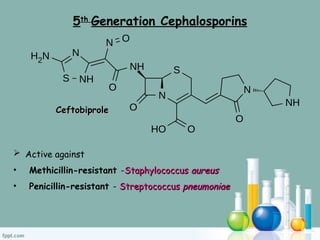
5th
Generation Cephalosporins
Ceftobiprole
Ceftobiprole
 Active against
• Methicillin-resistant -Staphylococcus
Staphylococcus aureus
aureus
• P
Penicillin-resistant - Streptococcus
Streptococcus pneumoniae
pneumoniae
Cephalosporins advantages over penicillins
 Increased acid stability compare to penicillins.
 Most of the drugs have better absorption than penicillins.
 Broad antimicrobial spectrum.
 Increased activity against resistant microorganisms.
 Decreased allergenicity.
 Increased tolerence than penicillins.
Carbapenam
• Introduction
 Carbapenems are a class of β-lactam antibiotics with a broad
spectrum of antibacterial activity.
 They have a structure that renders them highly resistant to most
β-lactamases.
 Carbapenem antibiotics were originally developed from the
carbapenem thienamycin, a naturally derived product of
Streptomyces cattleya
Examples: Imipenem, Meropenem, Ertapenem
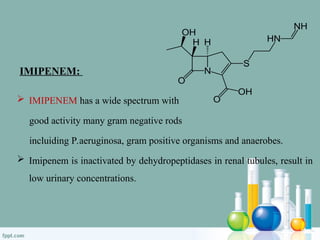
IMIPENEM:
 IMIPENEM has a wide spectrum with
good activity many gram negative rods
incluiding P.aeruginosa, gram positive organisms and anaerobes.
 Imipenem is inactivated by dehydropeptidases in renal tubules, result in
low urinary concentrations.
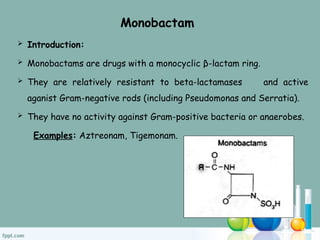
Monobactam
 Introduction:
 Monobactams are drugs with a monocyclic β-lactam ring.
 They are relatively resistant to beta-lactamases and active
aganist Gram-negative rods (including Pseudomonas and Serratia).
 They have no activity against Gram-positive bacteria or anaerobes.
Examples: Aztreonam, Tigemonam.
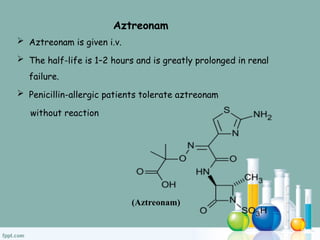
 Aztreonam is given i.v.
 The half-life is 1–2 hours and is greatly prolonged in renal
failure.
 Penicillin-allergic patients tolerate aztreonam
without reaction
(Aztreonam)
Aztreonam
 William O. Foye.,Textbook of Medicinal Chemistry, Pg. no: 1089 -1106
 Sriram., Medicinal Chemistry, Pg. no: 295-309.
 Kadam., Textbook of Medicinal Chemistry, Pg. no: 68-82.
 Ilango., Principles of Medicinal chemistry(vol.1), Pg. no: 121-143.
 Good man And GilMan’s; The Pharmacology Basis Of Therapeutics Tenth
Edition, pg. no 1189-1225.
 JH Block & JM Beale., Wilson & Giswold’s Textbook of Organic Medicinal
Chemistry & pharmaceutical chemistry 12th
Edition, 2011, pg. No. 260-294.
Reference

B Lactam antibiotcs Definition classification.ppt

  • 1.
    β-Lactam antibiotics Mr. SarangD. Kulkarni Asst Prof Pharmaceutical Chemistry Siddhi College of Pharmacy Pune
  • 2.
    Introduction • The name“Lactam” is given to cyclic amides and is analogous to the name “Lactone” which is given to cyclic esters . • Antibiotics that contains the β-lactam (a four membered cyclic amide) ring structure constitute the dominant class of agent currently employed for the chemotherapy of bacterial infections. • β-lactam are the most widely used group of antibiotics available. N O
  • 3.
    HISTROICAL BACKGROUND The firstsynthetic β-Lactam was prepared by HERMANN STAUDINGER in 1907 by reaction of the schiff base of aniline and benzaldehyde with diphenylketone in a cycloaddition. Upto 1970, most β-Lactam research was concerned with the penicillin and cephalosporin groups, but since then a wide variety of structures have been described.
  • 4.
    BETA-LACTAM ANTIBIOTICS (inhibitors ofcell wall synthesis) • Their structure contains a beta-lactam ring. The major subdivisions are: (a) penicillins whose official names usually include or end in “cillin” (b) cephalosporins which are recognized by the inclusion of “cef” or “ceph” in their official names. (c) carbapenems (e.g. meropenem, imipenem) (d) monobactams (e.g. aztreonam) (e) beta-lactamase inhibitors (e.g. clavulanic acid, sulbactam).
  • 7.
    CLASSFICATION OF β-LACTAMANTIBIOTICS CLASSFICATION OF β-LACTAM ANTIBIOTICS
  • 11.
    PENICILLINS • The penicillinswere the first antibiotics discovered as natural products from the mold Penicillium. • 1928 - Sir Alexander Fleming, professor of bacteriology at St. Mary's Hospital in London, was culturing Staphylococcus aureus. He noticed zones of inhibition where mold spores were growing. He named the mold Penicillium rubrum. It was determined that a secretion of the mold was effective against Gram-positive bacteria. • It was isolated from fungus Penicillium notatum. • Florey and Chain isolated penicillin by freeze drying and chromatography. • Penicillin was effective even when it is diluted up to 800 times.
  • 12.
    Chemistry •Penicillin nucleus consistsof • Thiazolidine ring (Ring A) - Sulphur containing with COOH (Carboxyl group). • Beta lactam ring (Ring B) – (Broken by Beta-lactamase) Side chain is attached at position – 6- (NHCOR) • Side chains attached through amide linkage. (Broken by Amidase) • Beta Lactam ring is broken by – • Penicillinase (Beta Lactamase), and by gastric acid. • Resultant Product is Penicilloic acid with No anti-bacterial activity but Acts as antigenic determinant (Major determinant)
  • 13.
  • 14.
    Instability of penicillinsin acid. Hydrolysis involves the C-6 side chain.
  • 15.
    H C C N H C C C S O CH3 CH3 COO- H HN C R O Free carboxylate Cisstereochemistry Most reactive carbonyl group Site of Penicillinase action Basic chemistry:Beta lactum ring+Thiazolidine ring Bicyclic ring system sysyem is essential Variable group Beta lactum ring Thiazolidine ring BASIC STRUCTURE OF PENICILLIN
  • 17.
    PENICILLIN DERIVATIVES PENICILLIN G(BENZYL PENICILLIN) •Acid unstable. •Parenteral route. •Self destructive mechanism in its structure because of influence of acyl side chain.
  • 18.
    • PENICILLIN-V • Moreacid stable than Penicillin G. • Administered by oral route. • Electron withdrawing group is present in acyl side chain.
  • 19.
    • METHICILLIN • Hasno electron withdrawing group on the side chain. • Acid sensitive and has to be injected. • Steric shields can be added to penicillins to protect from penicillinase enzyme.
  • 21.
    • AMPICILLIN • Ifhydrophilic groups like (NH2, OH , COOH ) are attached to the carbon that is α to the carbonyl group on the side chain then α hydrophilic group aids the passage of penicillins through porins of gram –ve bacteria. • Acid stable.
  • 22.
    • AMOXICILLIN • β-hydroxyampicillin. • Same spectrum of activity as that of penicillin G but more active against gram–ve bacteria. • Acid resistant hence given orally. • Non toxic.
  • 23.
  • 24.
  • 25.
    Resistance against Penicillin •Natural •Targetenzymes and PBPs are deeply located (Lipoprotein barrier in –ve) •PBPs of organisms have low affinity for penicillin •Acquired •Production of Penicillinase (Beta-Lactamase) enzyme, (>300 subtypes). Common organisms producing Beta-Lactamase are •Staphylococcus •Bacillus subtilis •Gonococci •E. coli •Enterococci •Haemophilus influenza •Loss or alteration of Porin channels in gram negative •Modification of penicillin binding proteins (PBPs)- having low affinity . •Activation of antibiotic efflux mechanism- Some gram negative bacteria
  • 26.
    Adverse effects General •Hypersensitivity reactions(including Anaphylaxis) •More with procaine penicillin, •Intradermal Skin sensitivity test •Major Determinant (Penicilloyl moiety in terms of amount) is responsible for hypersensitivity other than anaphylaxis •Minor determinants( Penicillamine and Penicillenate) are responsible for anaphylaxis. • The Penicilloyl moiety or major determinant results from reaction of beta- lactam ring with endogenous proteins. The Beta lactam ring spontaneously opens in the body forming a hapten-protein complex, the most abundant but not necessarily most immunogenic.
  • 27.
    • Super infections(Ampicillin) • Nephrotoxicity (Methicillin causing interstitial nephritis) • Increase in Prothrombin time leading to bleeding • Jarisch -Herxheimer Reaction-  Common in secondary syphilis,  Release of Spirochetal lytic products (Heat stable proteins, endotoxins)  Characterized by fever, myalgia, exacerbation of lesions,  Usually occurs within 2 hours of first dose  Treatment- NSAIDs and Corticosteroids  Also in Borelliosis, Leptospirosis, and Brucelosis  Adolf Jarisch an Austrian and Karl Herxheimer a German dermatologist
  • 28.
    β-LACTAMASE INHIBITORS  Hasnegligible antibacterial activity.  Given with Penicillins which increases spectrum of activity.  Microbial resistance to beta lactam antibiotics. S N O N H S OH O Beta-lactamse
  • 30.
    • Clavulanic acid: Isolated from Streptomyces clavuligerus.  1st naturally occurring β-lactam ring that was not fused to a ‘S’ containing ring. • Sulbactum:  β-lactamase disabiling agent.  Prepared by partial chemical synthesis from penicillins.
  • 31.
  • 32.
    Cephalosporins • Cephalosporins werediscovered shortly after penicillin entered into widespread product, but not developed till the 1960’s. • Cephalosporins are similar to penicillins but have a 6 member dihydrothiazine ring instead of a 5 member thiazolidine ring. • 7-aminocephalosporanic acid (7-ACA) can be obtained from bacteria, but it is easier to expand the ring system of 7-APA because it is so widely produced. • They were isolated from cultures of Cephalosporium acremonium by italian scientist Giuseppe Brotzu in 1945.
  • 33.
    • In 1948,Abraham and his colleagues have isolated three principle antibiotic components from cultures of fungus. • 1964 ,the first semi synthetic cephalosporin i.e. cefalothin was launched in the Market by Eli Lilly and company. • Unlike penicillin, cephalosporins have two side chains which can be easily modified. Cephalosporins are also more difficult for β- lactamases to hydrolyze. Cephalosporin P Cephalosporin N Cephalosporin C
  • 35.
  • 36.
     These drugsare very active against Gram-positive cocci (such as Pneumococci, Streptococci, and Staphylococci).  They do not cross BBB.
  • 37.
    2nd Generation Cephalosporins They havea greater gram-negative spectrum while retaining some activity against gram-positive bacteria.  They are also more resistant to β-lactamase. No BBB Penetration. No BBB Penetration. Cefachlor Cefamycin Cefuroxime
  • 38.
  • 39.
    Third-generation drugs exhibitthe lest activity against gram-positive bacteria, but most potent activity against gram-negative bacteria : (a) Extended antibacterial spectrum, include Pseud. aeruginosa; (b) Less activity on gram-positive bacteria than first and second generation; (c) Most active on gram-negative bacteria; (d) High stability with β-lactamase; (e) Easy penetrate to different tissues, and then have broad distribution; (f) Little kidney toxicity.
  • 40.
  • 41.
     Zwitterionic compounds. Good affinity for the transpeptidase enzyme.  Low affinity for some β-lactamases.  Cross BBB and effective in meningitis.
  • 42.
    5th Generation Cephalosporins Ceftobiprole Ceftobiprole  Activeagainst • Methicillin-resistant -Staphylococcus Staphylococcus aureus aureus • P Penicillin-resistant - Streptococcus Streptococcus pneumoniae pneumoniae
  • 44.
    Cephalosporins advantages overpenicillins  Increased acid stability compare to penicillins.  Most of the drugs have better absorption than penicillins.  Broad antimicrobial spectrum.  Increased activity against resistant microorganisms.  Decreased allergenicity.  Increased tolerence than penicillins.
  • 45.
    Carbapenam • Introduction  Carbapenemsare a class of β-lactam antibiotics with a broad spectrum of antibacterial activity.  They have a structure that renders them highly resistant to most β-lactamases.  Carbapenem antibiotics were originally developed from the carbapenem thienamycin, a naturally derived product of Streptomyces cattleya Examples: Imipenem, Meropenem, Ertapenem
  • 46.
    IMIPENEM:  IMIPENEM hasa wide spectrum with good activity many gram negative rods incluiding P.aeruginosa, gram positive organisms and anaerobes.  Imipenem is inactivated by dehydropeptidases in renal tubules, result in low urinary concentrations.
  • 47.
    Monobactam  Introduction:  Monobactamsare drugs with a monocyclic β-lactam ring.  They are relatively resistant to beta-lactamases and active aganist Gram-negative rods (including Pseudomonas and Serratia).  They have no activity against Gram-positive bacteria or anaerobes. Examples: Aztreonam, Tigemonam.
  • 48.
     Aztreonam isgiven i.v.  The half-life is 1–2 hours and is greatly prolonged in renal failure.  Penicillin-allergic patients tolerate aztreonam without reaction (Aztreonam) Aztreonam
  • 49.
     William O.Foye.,Textbook of Medicinal Chemistry, Pg. no: 1089 -1106  Sriram., Medicinal Chemistry, Pg. no: 295-309.  Kadam., Textbook of Medicinal Chemistry, Pg. no: 68-82.  Ilango., Principles of Medicinal chemistry(vol.1), Pg. no: 121-143.  Good man And GilMan’s; The Pharmacology Basis Of Therapeutics Tenth Edition, pg. no 1189-1225.  JH Block & JM Beale., Wilson & Giswold’s Textbook of Organic Medicinal Chemistry & pharmaceutical chemistry 12th Edition, 2011, pg. No. 260-294. Reference