Business Model Canvas
    The 9 Building Blocks
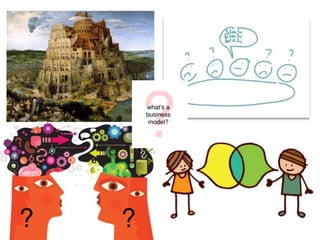
The 100 Million
Rupiahs question


    how do you search for the
      right business model?
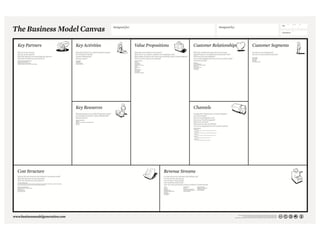
Business Model Canvas


• to describe, challenge, design, and invent
  business models more systematically
• using a 9 building blocks method
1. Customer Segments
customers comprise the heart of any business model
the Customer Segments
         building block
• defines the different groups of people or
  organizations an enterprise aims to reach & serve.
• targeting profitable customers
how to segment customer?
•   their needs require and justify a distinct offer

•   they are reached through different Distribution
    Channels

•   they require different types of relationships

•   they have substantially different profitabilities

•   they are willing to pay for different aspects of the
    offer
Types of Customer Segments
• Mass market : focus on one large group of
  customers with broadly similar needs/problems
• Niche market : specific requirements
• Segmented : slightly different needs/problems
• Diversified : very different needs/problems
• Multi-sided platforms (or multi-sided
  markets) : serve 2 or more interdependent
  customer segments
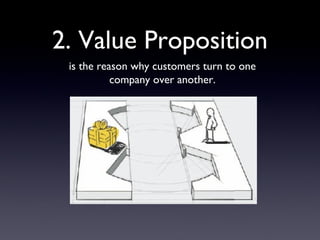
2. Value Proposition
 is the reason why customers turn to one
           company over another.
the Value Proposition
        building block

• describes the bundle of products and
  services that create value for a specific
  Customer Segment.
• it solves a customer problem or satisfies a
  customer needs.
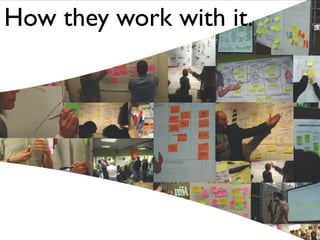
how to check value proposition

 • what value do we deliver to the customer?
 • which one of our customer’s problems are we
   helping to solve?
 • which customer needs are we satisfying?
 • what bundles of products & services are we
   offering to each Customer Segment?
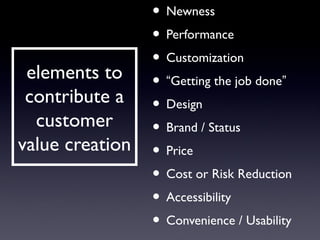
• Newness
               • Performance
               • Customization
 elements to • “Getting the job done”
 contribute a • Design
  customer     • Brand / Status
value creation • Price
               • Cost or Risk Reduction
               • Accessibility
               • Convenience / Usability
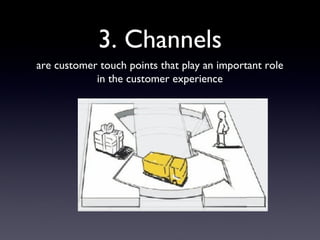
3. Channels
are customer touch points that play an important role
            in the customer experience
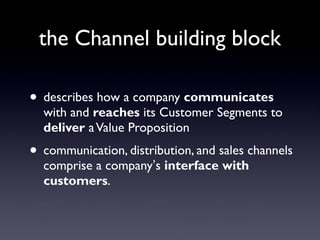
the Channel building block

• describes how a company communicates
  with and reaches its Customer Segments to
  deliver a Value Proposition
• communication, distribution, and sales channels
  comprise a company’s interface with
  customers.
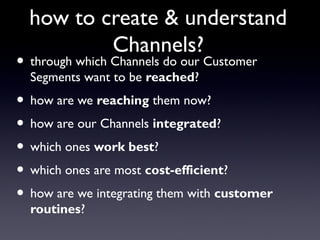
how to create & understand
          Channels?
• through which Channels do our Customer
  Segments want to be reached?
• how are we reaching them now?
• how are our Channels integrated?
• which ones work best?
• which ones are most cost-efficient?
• how are we integrating them with customer
  routines?
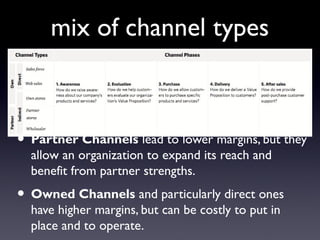
mix of channel types


• Partner Channels lead to lower margins, but they
  allow an organization to expand its reach and
  benefit from partner strengths.
• Owned Channels and particularly direct ones
  have higher margins, but can be costly to put in
  place and to operate.
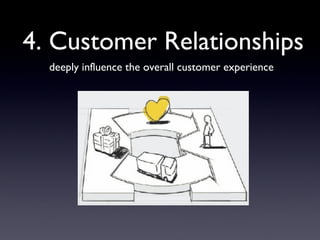
4. Customer Relationships
  deeply influence the overall customer experience
the Customer Relationships
       building block
• describes the types of relationships a company
  establishes with specific Customer Segments
• relationship can range from personal to
  automated
• driven by motivations : customer acquisition,
  customer retention, and boosting sales (upselling)
how to build relationship with
        Customer Segment?
• what type of relationship does each of our
  Customer Segments expect us to establish and
  maintain with them?
• which ones have we established?
• how costly are they?
• how are they integrated with the rest of our
  business model?
Categories of Customer
       Relationships
• personal assistance
• dedicated personal assistance
• self-service
• automated services
• communities
• co-creation
5. Revenue Streams
For what value is each Customer Segment truly
                 willing to pay?
the Revenues Streams
          building block
• represents the cash a company generates from
  each Customer Segment (costs must be
  subtracted from revenues to create earnings)
• the firm generate one or more Revenue Streams
  from each Customer Segment.
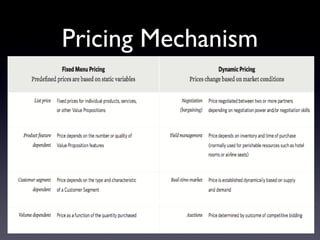
• Each Revenue Stream may have different pricing
  mechanisms.
two different types of
  Revenue Streams
• Transaction revenues resulting from
  one-time customer payments
• Recurring revenues resulting from
  ongoing payments to either deliver a Value
  Proposition to customers or provide post-
  purchase customer support
how to understand Revenue
                 Streams?
• For what value are our customers really willing to
  pay?
• For what do they currently pay?
• How are they currently paying?
• How would they prefer to pay?
• How much does each Revenue Stream contribute
  to overall revenues?
several ways to generate
    Revenue Streams
         • Asset sale
         • Usage fee
         • Subscription fees
         • Lending/Renting/Leasing
         • Licensing
         • Brokerage fees
         • Advertising
Pricing Mechanism
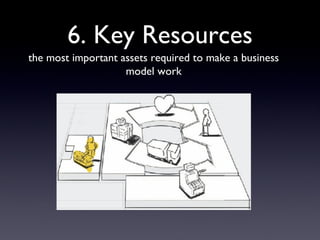
6. Key Resources
the most important assets required to make a business
                    model work
the Key Resources
          building block
• These resources allow an enterprise to create
  and offer a Value Proposition, reach markets,
  maintain relationships with Customer Segments,
  and earn Revenues
• Key resources can be physical, financial,
  intellectual, or human.
• Key resources can be owned or leased by the
  company or acquired from key partners.
what is the Key Resources
    in your business?
 • What Key Resources do our Value Propositions
   require?
 • Our Distribution Channels?
 • Customer Relationships?
 • Revenue Streams?
The category...

• Physical Assets
• Intellectual
• Human
• Financial
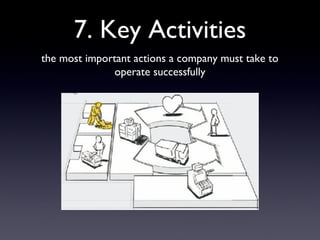
7. Key Activities
the most important actions a company must take to
               operate successfully
the Key Activities
            building block
• describes the most important things a company
  must do to make its business model work
• Key Resources required to create and offer a
  Value Proposition, reach markets, maintain
  Customer Relationships, and earn Revenues.
• Key Activities differ depending on business model
  type
What Key Activities do?

• What Key Activities do our Value
  Propositions require?
• Our Distribution Channels?
• Customer Relationships?
• Revenue streams?
Category...
• Production : designing, making & delivering a
  product in substantial qty or superior quality
• Problem solving : coming up with new solutions
  to individual customer problems.
• Platform/network : dominated by platform or
  network-related Key activities (networks, software,
  brands, etc)
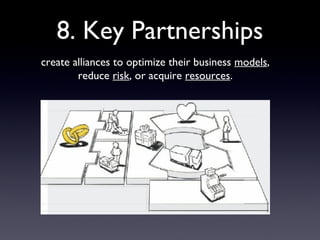
8. Key Partnerships
create alliances to optimize their business models,
        reduce risk, or acquire resources.
the Key Partnerships building block
•describes the network of suppliers and partners that
 make the business model work
•Four different types of partnerships:
1. Strategic alliances between non-competitors
2. Coopetition: strategic partnerships between
 competitors
3. Joint ventures to develop new businesses
4. Buyer-supplier relationships to assure reliable
 supplies
Who & which...

• Who are our Key Partners?
• Who are our key suppliers?
• Which Key Resources are we acquiring
  from partners?
• Which Key Activities do partners perform?
3 motivations for
creating partnerships:
1. Optimization and economy of scale
2. Reduction of risk and uncertainty
3. Acquisition of particular resources and
   activities
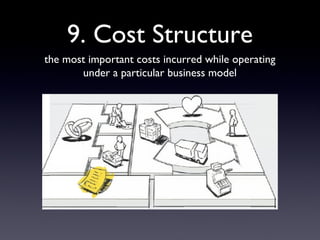
9. Cost Structure
the most important costs incurred while operating
       under a particular business model
the Cost Structure
            building block
• describes all costs incurred to operate a
  business model
• Creating and delivering value, maintaining
  Customer Relationships, and generating revenue
  all incur costs.
• Such costs can be calculated relatively easily after
  defining Key Resources, Key Activities, and Key
  Partnerships.
How to measure costs?
• What are the most important costs inherent in
  our business model?
• Which Key Resources are most expensive?
• Which Key Activities are most expensive?
• Two broad classes of business model Cost
  Structures: cost-driven and value-driven
  (many business models fall in between these two
  extremes)
classes of business model Cost
           Structures
•   Cost Driven (focus on minimizing costs wherever
    possible)

•   Value Driven (instead focus on value creation):
     1.   Fixed Costs (Costs that remain the same despite the volume of goods or services
          produced)

     2.   Variable Costs (Costs that vary proportionally with the volume of goods or
          services produced)

     3.   Economies of Scale (Cost advantages that a business enjoys as its output
          expands.)

     4.   Economies of Scope (Cost advantages that a business enjoys due to a larger
          scope of operations.)
How they work with it.
How to do it?
Apple iPod/iTunes
 Business Model
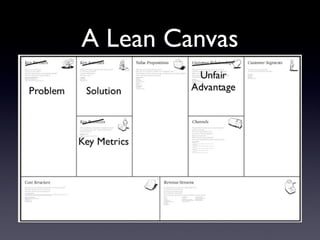
A Lean Canvas
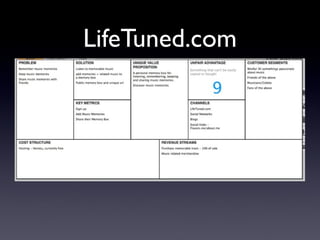
LifeTuned.com
Thank You

Business model canvas building blocks complete

  • 1.
    Business Model Canvas The 9 Building Blocks
  • 2.
    The 100 Million Rupiahsquestion how do you search for the right business model?
  • 4.
    Business Model Canvas •to describe, challenge, design, and invent business models more systematically • using a 9 building blocks method
  • 6.
    1. Customer Segments customerscomprise the heart of any business model
  • 7.
    the Customer Segments building block • defines the different groups of people or organizations an enterprise aims to reach & serve. • targeting profitable customers
  • 8.
    how to segmentcustomer? • their needs require and justify a distinct offer • they are reached through different Distribution Channels • they require different types of relationships • they have substantially different profitabilities • they are willing to pay for different aspects of the offer
  • 9.
    Types of CustomerSegments • Mass market : focus on one large group of customers with broadly similar needs/problems • Niche market : specific requirements • Segmented : slightly different needs/problems • Diversified : very different needs/problems • Multi-sided platforms (or multi-sided markets) : serve 2 or more interdependent customer segments
  • 10.
    2. Value Proposition is the reason why customers turn to one company over another.
  • 11.
    the Value Proposition building block • describes the bundle of products and services that create value for a specific Customer Segment. • it solves a customer problem or satisfies a customer needs.
  • 12.
    how to checkvalue proposition • what value do we deliver to the customer? • which one of our customer’s problems are we helping to solve? • which customer needs are we satisfying? • what bundles of products & services are we offering to each Customer Segment?
  • 13.
    • Newness • Performance • Customization elements to • “Getting the job done” contribute a • Design customer • Brand / Status value creation • Price • Cost or Risk Reduction • Accessibility • Convenience / Usability
  • 14.
    3. Channels are customertouch points that play an important role in the customer experience
  • 15.
    the Channel buildingblock • describes how a company communicates with and reaches its Customer Segments to deliver a Value Proposition • communication, distribution, and sales channels comprise a company’s interface with customers.
  • 16.
    how to create& understand Channels? • through which Channels do our Customer Segments want to be reached? • how are we reaching them now? • how are our Channels integrated? • which ones work best? • which ones are most cost-efficient? • how are we integrating them with customer routines?
  • 17.
    mix of channeltypes • Partner Channels lead to lower margins, but they allow an organization to expand its reach and benefit from partner strengths. • Owned Channels and particularly direct ones have higher margins, but can be costly to put in place and to operate.
  • 18.
    4. Customer Relationships deeply influence the overall customer experience
  • 19.
    the Customer Relationships building block • describes the types of relationships a company establishes with specific Customer Segments • relationship can range from personal to automated • driven by motivations : customer acquisition, customer retention, and boosting sales (upselling)
  • 20.
    how to buildrelationship with Customer Segment? • what type of relationship does each of our Customer Segments expect us to establish and maintain with them? • which ones have we established? • how costly are they? • how are they integrated with the rest of our business model?
  • 21.
    Categories of Customer Relationships • personal assistance • dedicated personal assistance • self-service • automated services • communities • co-creation
  • 22.
    5. Revenue Streams Forwhat value is each Customer Segment truly willing to pay?
  • 23.
    the Revenues Streams building block • represents the cash a company generates from each Customer Segment (costs must be subtracted from revenues to create earnings) • the firm generate one or more Revenue Streams from each Customer Segment. • Each Revenue Stream may have different pricing mechanisms.
  • 24.
    two different typesof Revenue Streams • Transaction revenues resulting from one-time customer payments • Recurring revenues resulting from ongoing payments to either deliver a Value Proposition to customers or provide post- purchase customer support
  • 25.
    how to understandRevenue Streams? • For what value are our customers really willing to pay? • For what do they currently pay? • How are they currently paying? • How would they prefer to pay? • How much does each Revenue Stream contribute to overall revenues?
  • 26.
    several ways togenerate Revenue Streams • Asset sale • Usage fee • Subscription fees • Lending/Renting/Leasing • Licensing • Brokerage fees • Advertising
  • 27.
  • 28.
    6. Key Resources themost important assets required to make a business model work
  • 29.
    the Key Resources building block • These resources allow an enterprise to create and offer a Value Proposition, reach markets, maintain relationships with Customer Segments, and earn Revenues • Key resources can be physical, financial, intellectual, or human. • Key resources can be owned or leased by the company or acquired from key partners.
  • 30.
    what is theKey Resources in your business? • What Key Resources do our Value Propositions require? • Our Distribution Channels? • Customer Relationships? • Revenue Streams?
  • 31.
    The category... • PhysicalAssets • Intellectual • Human • Financial
  • 32.
    7. Key Activities themost important actions a company must take to operate successfully
  • 33.
    the Key Activities building block • describes the most important things a company must do to make its business model work • Key Resources required to create and offer a Value Proposition, reach markets, maintain Customer Relationships, and earn Revenues. • Key Activities differ depending on business model type
  • 34.
    What Key Activitiesdo? • What Key Activities do our Value Propositions require? • Our Distribution Channels? • Customer Relationships? • Revenue streams?
  • 35.
    Category... • Production :designing, making & delivering a product in substantial qty or superior quality • Problem solving : coming up with new solutions to individual customer problems. • Platform/network : dominated by platform or network-related Key activities (networks, software, brands, etc)
  • 36.
    8. Key Partnerships createalliances to optimize their business models, reduce risk, or acquire resources.
  • 37.
    the Key Partnershipsbuilding block •describes the network of suppliers and partners that make the business model work •Four different types of partnerships: 1. Strategic alliances between non-competitors 2. Coopetition: strategic partnerships between competitors 3. Joint ventures to develop new businesses 4. Buyer-supplier relationships to assure reliable supplies
  • 38.
    Who & which... •Who are our Key Partners? • Who are our key suppliers? • Which Key Resources are we acquiring from partners? • Which Key Activities do partners perform?
  • 39.
    3 motivations for creatingpartnerships: 1. Optimization and economy of scale 2. Reduction of risk and uncertainty 3. Acquisition of particular resources and activities
  • 40.
    9. Cost Structure themost important costs incurred while operating under a particular business model
  • 41.
    the Cost Structure building block • describes all costs incurred to operate a business model • Creating and delivering value, maintaining Customer Relationships, and generating revenue all incur costs. • Such costs can be calculated relatively easily after defining Key Resources, Key Activities, and Key Partnerships.
  • 42.
    How to measurecosts? • What are the most important costs inherent in our business model? • Which Key Resources are most expensive? • Which Key Activities are most expensive? • Two broad classes of business model Cost Structures: cost-driven and value-driven (many business models fall in between these two extremes)
  • 43.
    classes of businessmodel Cost Structures • Cost Driven (focus on minimizing costs wherever possible) • Value Driven (instead focus on value creation): 1. Fixed Costs (Costs that remain the same despite the volume of goods or services produced) 2. Variable Costs (Costs that vary proportionally with the volume of goods or services produced) 3. Economies of Scale (Cost advantages that a business enjoys as its output expands.) 4. Economies of Scope (Cost advantages that a business enjoys due to a larger scope of operations.)
  • 44.
    How they workwith it.
  • 45.
  • 47.
  • 48.
  • 49.
  • 50.

Editor's Notes

  • #10 mass market: FMCG niche market: supplier-buyer relationship segmented: offering from banking diversified: amazon.com sell retail business + cloud computing services (online storage space & on demand server usage) multi-sided: credit card company works with merchants.
  • #14 values may be quantitative (e.g. price, speed of service) or qualitative (e.g. design, customer experience)
  • #18 The trick is to find the right balance between the different types of Channels, to integrate them in a way to create a great customer experience, and to maximize revenues.
  • #20 When the market became saturated , operators switched to focusing on customer retention and increasing average revenue per customer.
  • #24 Each Revenue Stream may have different pricing mechanisms, such as fixed list prices, bargaining, auctioning, market dependent, volume dependent, or yield management.
  • #25 Each Revenue Stream might have different pricing mechanisms. The type of pricing mechanism chosen can make a big difference in terms of revenues generated. There are two main types of pricing mechanism: fixed and dynamic pricing.
  • #27 ASSET SALES: derives from selling ownership rights to a physical product. Amazon.com sells books, music, consumer electronics, and more online. Fiat sells automobiles, which buyers are free to drive, resell, or even destroy. USAGE FEE: telecom operator for minute usage and hotel per night usage SUBSCRIPTION FEES: a gym, web-based games: war-craft, Nokia music LENDING: LICENSING: use patent of tech, or in media industry BROKERAGE FEES: credit card, real estates ADVERTISING: fee for ads a particular product, service, or brand
  • #28 Each Revenue Stream might have different pricing mechanisms. The type of pricing mechanism chosen can make a big difference in terms of revenues generated. There are two main types of pricing mechanism: fixed and dynamic pricing.
  • #30 Different Key Resources are needed depending on the type of business model. A microchip manufacturer requires capital-intensive production facilities, whereas a microchip designer focuses more on human resources.
  • #32 PHYSICAL: physical assets such as manufacturing facilities, buildings, vehicles, machines, systems, point-of-sales systems, and distribution networks. exp: Wal-Mart and Amazon.com INTELLECTUAL: such as brands, proprietary knowledge, patents and copyrights, partnerships, and customer databases