Business Model Generation Part1: Canvas Hekovnik, 23. 6. 2011 Petra Oseli
Stanford University  Steve Blank Business Model Foundry 4 Steps to Epiphany Bussines Model Generation Startup Genome Report
business model generation - the book www.businessmodelgeneration.com/book
business model  “ ... describes the rationale of how an organization creates, delivers, and captures value”
business model generation - topics CANVAS PATTERNS (MODELS) DESIGN STRATEGY PROCESS
1 - canvas
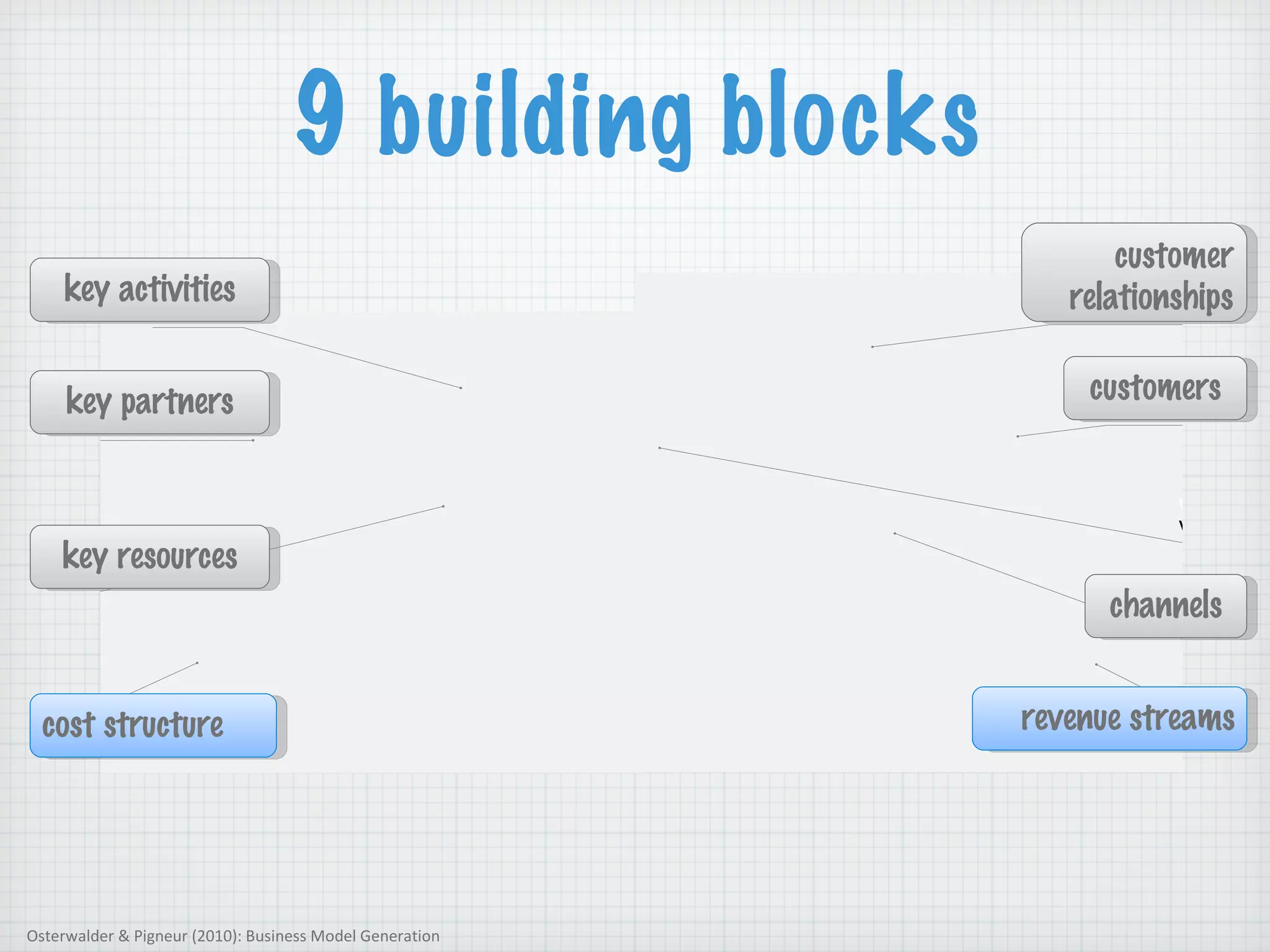
9 building blocks Osterwalder & Pigneur (2010): Business Model Generation key activities key partners key resources cost structure revenue streams channels customer relationships customers
market type Existing market  (faster/better) Existing   market  (niche/cheaper)    Resegmented market New market  (new class of product/market / innovative/never existed) Q: Which market type are you in?
types of internet startups The Automizer The Social Transformer The Integrator The Challenger Q: Which type is your startup? http://startupgenome.cc/
the Automizer self-service  customer acquisition consumer  focused product  centric fast  execution often  automize  a manual process technology heavy  founding teams perform better biggest market  existing markets need the least capital
the Social Transformer self-service  customer acquisition critical mass runaway user growth winner takes all market complex ux network effects create  new ways  people to  interact need 50% longer than Automizer to reach scale stage business heavy  and  balanced   teams  perform better new markets, big markets need more capital large team growth, large user growth
the Integrator lead generation with  inside sales rep high certainty product  centric early monetization,  high percentage  SME focused smaller markets take innovation from consumer internet , rebuild for SB business heavy  and  balanced   teams  perform better existing markets  (cheaper product) small teams  even when they scale
the Challenger enterprise sales,  repeatable sales processes   high customer dependancy complex and rigid markets longest time  to reach  scale stage biggest markets business heavy   teams  perform better existing markets  (better product) or  new markets  pivot a lot or not at all large team growth  at scaling stage significantly more capital high percentage user monetization
the startup *  lifecycle Discovery Validation Efficiency Scale Profit Maximization Renewal http://startupgenome.cc/ * valid for web startups Q: Do you move through these stages / in order? 6 Marmer stages milestones/thresholds avg. 18 months avg. 42 months
discovery/validation
know your typical customer market-segments value proposition customer relationships channels
customer segments
segmented multi-sided diversified niche market mass market
iPod market segment Q: For whom are you creating value?
value proposition
value proposition Newness Performance Customization Getting the job done Design Brand/Status Price  Cost reduction  Risk reduction  Accessibility Convenience/Usability
iPod value proposition Q: What value do you deliver? Which problems are you helping to solve/which needs are you satisfying?
channels
channels
iPod channels Q: Through which channels do your customer segments want to be reached? How are you reaching them now?
customer relationships
customer relationships Personal assistance Dedicated personal assistance Self-service Automated services Communities Co-creation
iPod customer relationships Q: What type of relationship do your segments expect to establish with them? Which ones have you established?
9 building blocks Osterwalder & Pigneur (2010): Business Model Generation key activities key partners key resources cost structure revenue streams channels customer relationships customers
key resources
key resources Physical Intellectual Human Financial
iPod key resources Q: What key resources does your value proposition require?
key activities
key activities Production  Problem solving Platform/Network
iPod key activities Q: What key activities does your value proposition require?
key partnerships
key partnerships Motivations for creating partnerships: Optimization and economy of scale Reduction of risk and uncertainty Acquisition of particular resources and activities
iPod key partnerships Q: Who are your key partners/suppliers?
efficiency vs. value left canvas EFFICIENCY right canvas VALUE
9 building blocks Osterwalder & Pigneur (2010): Business Model Generation key activities key partners key resources cost structure revenue streams channels customer relationships customers
revenue streams Asset sale Usage fee Subscription fee Lending/Renting/Leasing Licensing  Brokerage fees Advertising cost structure Cost-driven  Value-driven Fixed costs Variable costs Economies of scale Economies of scope
iPod canvas
how to use this model? (testimonials) Translate your business plans into the business processes I used the canvas to do a reality check for my new startup Allowed me to establish a common language and framework with colleagues Assists me to remind the teams to think holistically
 
questions For whom are you creating value? Who are your most important customers? What value do you deliver? Which problems are you helping to solve/which needs are you satisfying? What type of relationship do your segments expect to establish with them? Which ones have you established?  Through which channels do your customer segments want to be reached? How are you reaching them now? What key activities does your value proposition require?  What key resources does your value proposition require? Who are your key partners/suppliers? For what value are your customers really willing to pay? How are they currently paying? What are your most important costs? Which key resources/activities are most expensive?

Business Model Generation - Part1: Canvas

  • 1.
    Business Model GenerationPart1: Canvas Hekovnik, 23. 6. 2011 Petra Oseli
  • 2.
    Stanford University Steve Blank Business Model Foundry 4 Steps to Epiphany Bussines Model Generation Startup Genome Report
  • 3.
    business model generation- the book www.businessmodelgeneration.com/book
  • 4.
    business model “ ... describes the rationale of how an organization creates, delivers, and captures value”
  • 5.
    business model generation- topics CANVAS PATTERNS (MODELS) DESIGN STRATEGY PROCESS
  • 6.
  • 7.
    9 building blocksOsterwalder & Pigneur (2010): Business Model Generation key activities key partners key resources cost structure revenue streams channels customer relationships customers
  • 8.
    market type Existingmarket (faster/better) Existing market (niche/cheaper)  Resegmented market New market (new class of product/market / innovative/never existed) Q: Which market type are you in?
  • 9.
    types of internetstartups The Automizer The Social Transformer The Integrator The Challenger Q: Which type is your startup? http://startupgenome.cc/
  • 10.
    the Automizer self-service customer acquisition consumer focused product centric fast execution often automize a manual process technology heavy founding teams perform better biggest market existing markets need the least capital
  • 11.
    the Social Transformerself-service customer acquisition critical mass runaway user growth winner takes all market complex ux network effects create new ways people to interact need 50% longer than Automizer to reach scale stage business heavy and balanced teams perform better new markets, big markets need more capital large team growth, large user growth
  • 12.
    the Integrator leadgeneration with inside sales rep high certainty product centric early monetization, high percentage SME focused smaller markets take innovation from consumer internet , rebuild for SB business heavy and balanced teams perform better existing markets (cheaper product) small teams even when they scale
  • 13.
    the Challenger enterprisesales, repeatable sales processes high customer dependancy complex and rigid markets longest time to reach scale stage biggest markets business heavy teams perform better existing markets (better product) or new markets pivot a lot or not at all large team growth at scaling stage significantly more capital high percentage user monetization
  • 14.
    the startup * lifecycle Discovery Validation Efficiency Scale Profit Maximization Renewal http://startupgenome.cc/ * valid for web startups Q: Do you move through these stages / in order? 6 Marmer stages milestones/thresholds avg. 18 months avg. 42 months
  • 15.
  • 16.
    know your typicalcustomer market-segments value proposition customer relationships channels
  • 17.
  • 18.
    segmented multi-sided diversifiedniche market mass market
  • 19.
    iPod market segmentQ: For whom are you creating value?
  • 20.
  • 21.
    value proposition NewnessPerformance Customization Getting the job done Design Brand/Status Price Cost reduction Risk reduction Accessibility Convenience/Usability
  • 22.
    iPod value propositionQ: What value do you deliver? Which problems are you helping to solve/which needs are you satisfying?
  • 23.
  • 24.
  • 25.
    iPod channels Q:Through which channels do your customer segments want to be reached? How are you reaching them now?
  • 26.
  • 27.
    customer relationships Personalassistance Dedicated personal assistance Self-service Automated services Communities Co-creation
  • 28.
    iPod customer relationshipsQ: What type of relationship do your segments expect to establish with them? Which ones have you established?
  • 29.
    9 building blocksOsterwalder & Pigneur (2010): Business Model Generation key activities key partners key resources cost structure revenue streams channels customer relationships customers
  • 30.
  • 31.
    key resources PhysicalIntellectual Human Financial
  • 32.
    iPod key resourcesQ: What key resources does your value proposition require?
  • 33.
  • 34.
    key activities Production Problem solving Platform/Network
  • 35.
    iPod key activitiesQ: What key activities does your value proposition require?
  • 36.
  • 37.
    key partnerships Motivationsfor creating partnerships: Optimization and economy of scale Reduction of risk and uncertainty Acquisition of particular resources and activities
  • 38.
    iPod key partnershipsQ: Who are your key partners/suppliers?
  • 39.
    efficiency vs. valueleft canvas EFFICIENCY right canvas VALUE
  • 40.
    9 building blocksOsterwalder & Pigneur (2010): Business Model Generation key activities key partners key resources cost structure revenue streams channels customer relationships customers
  • 41.
    revenue streams Assetsale Usage fee Subscription fee Lending/Renting/Leasing Licensing Brokerage fees Advertising cost structure Cost-driven Value-driven Fixed costs Variable costs Economies of scale Economies of scope
  • 42.
  • 43.
    how to usethis model? (testimonials) Translate your business plans into the business processes I used the canvas to do a reality check for my new startup Allowed me to establish a common language and framework with colleagues Assists me to remind the teams to think holistically
  • 44.
  • 45.
    questions For whomare you creating value? Who are your most important customers? What value do you deliver? Which problems are you helping to solve/which needs are you satisfying? What type of relationship do your segments expect to establish with them? Which ones have you established? Through which channels do your customer segments want to be reached? How are you reaching them now? What key activities does your value proposition require? What key resources does your value proposition require? Who are your key partners/suppliers? For what value are your customers really willing to pay? How are they currently paying? What are your most important costs? Which key resources/activities are most expensive?

Editor's Notes

  • #6 v knjigi pri business modelih uporabljajo izraz patterns
  • #9 povezala sem delitev iz CD (existing, resegmented, new) in BMG (existing-better, existing-niche, existing-cheaper, new)
  • #16 Discovery = know your market and customer, define your value proposition
  • #17 v fazi discovery/validation raziskujemo svoj trg in tipično stranko (uporabnika). kdo je, kakšen je, kakšne navade ima, kaj je njegov pain, kako ga rešiti. kakšna je njegova kupna moč in vrednotenje paina in koliko bo pripravljen plačati za našo rešitev/kakšno vrednost mu naša rešitev predstavlja.
  • #19 najti moramo svoj segment strank in s tem tudi ugotovimo, na katerem trgu smo ter za koga ustvarjamo vrednost
  • #22 Which problems are you helping to solve/which needs are you satisfying? ko najdemo in raziščemo svoj segment strank, lahko opredelimo našo vrednost - value proposition mora reševati pain naše tipične stranke - tako, da tudi ona ceni vrednost naše rešitve.
  • #25 preko kanalov dosegamo stranke in stopamo v stik z njimi. izbira kanalov je odvisna of faze, v kateri je naš odnos s strankami (ustvarjanje zavedanja/prepoznavnosti, vrednotenje naše vrednosti, nakupni proces, “ delivery ” , poprodajne aktivnosti) kanali so lahko “ fizični ” ali “ virtualni ” in se lahko dopolnjujejo; web startupi imajo večinoma online-only kanale
  • #28 s strankami moramo vzpostaviti razmerje. način, kako stopamo v odnos z njimi, je odvisen od našega produkta in trga. web startupi pogosteje vzpostavljajo odnos z “ automated services ” , digitalni kanali jim omogočajo online/virtual communities ipd., manj pa personal assistance
  • #32 katere vire potrebujemo za ustvarjanje vrednosti?
  • #35 s katerimi aktivnostmi ustvarjamo vrednost? web startupi večinoma s “ platformo ” . Activities pa ni le “produkcija”, so tudi ostale aktivnosti, s katerimi vrednost komuniciramo in zagotavljamo (preko kanalov) – marketing, prodaja/distribucija ...