
Car for hire business case Uber - Business Model Canvas
•
173 likes•41,159 views

Case Uber Business Model Canvas Strategy case study Uber business case

Recommended
More Related Content
What's hot
What's hot (20)
Viewers also liked
Viewers also liked (19)
Similar to Car for hire business case Uber - Business Model Canvas
Similar to Car for hire business case Uber - Business Model Canvas (20)
Recently uploaded
Recently uploaded (20)
Car for hire business case Uber - Business Model Canvas
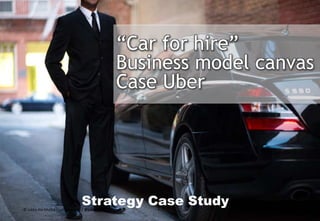
- 1. “Car for hire” Business model canvas Case Uber Strategy Case Study1 Image: Uber website © Jukka Ala-Mutka / jukkaam.com / @jukkaam
- 2. Taxis, whose business model has hardly changed since the invention of the tax meter in the 1940s, have a lot to worry about… 2 James A. Bacon, “Bacon: Innovation Uber alles”, The Washington Times, February 2, 2012 © Jukka Ala-Mutka / jukkaam.com / @jukkaam
- 3. Case: Uber • Case description based on analysis of Uber, but the rules of the strategy can be applied to mass participation platforms in general • Uber is a platform which connects passengers to drivers of available “for hire” car services. The mobile app sends an electronic hail for a car based on the person’s location. This service is convenient and reliable because it is a guaranteed ride, and all transactions are automatically billed to the passenger’s on filed credit card by Uber, not driver. 3© Jukka Ala-Mutka / jukkaam.com / @jukkaam
- 4. Uber is not a transportation provider. 4 https://www.uber.com/cities/san-francisco# Image: Uber website© Jukka Ala-Mutka / jukkaam.com / @jukkaam
- 5. Uber users are spending over $100 a month on average on the service — an astonishing figure compared to the minuscule purchases most apps encourage. 5 http://fortune.com/2012/02/02/the-trials-of-uber/ © Jukka Ala-Mutka / jukkaam.com / @jukkaam
- 6. Target customers • End users: • Upper class • Business • Technology • Urban Middle-class • Suppliers: • Drivers 6© Jukka Ala-Mutka / jukkaam.com / @jukkaam
- 7. Value proposition • Value proposition for both sides: • End users: • Secure, trustworthy and guaranteed ride with shorter waiting • Drivers: • Busier and efficient days for drivers 7© Jukka Ala-Mutka / jukkaam.com / @jukkaam
- 8. Regulators part 1 • Problem: • “Because Uber was allegedly running and marketing itself as a cab service but without a permit, the company was threatened with fines, including $5,000 for every transaction it made.” • Solution: • “The next day, the startup dropped the word “cab” from its name. So far, that has appeased local regulators.” 8 http://fortune.com/2012/02/02/the-trials-of-uber/ © Jukka Ala-Mutka / jukkaam.com / @jukkaam
- 9. Regulators part 2 • Problem: • Local “taxi” or “cab” business is regulated • Solution: • the definition of limousine — “motor vehicle carrying passengers for hire in the District, designed to carry fewer than nine (9) passengers, excluding the driver, with three (3) or more doors, other than a taxicab, coach, or wheelchair accessible van, and not permitted to accept street hails from prospective passengers in the street.” 9 http://www.washingtonpost.com/blogs/mike-debonis/post/uber-car-service-runs-afoul-of-dc-taxi-commission/2012/01/11/gIQAxH3UrP_blog.html © Jukka Ala-Mutka / jukkaam.com / @jukkaam
- 10. Regulators part 3 • Problem: • Qualifications of employed drivers • Solution: • “Uber does not employ cars and drivers; it operates a system that connects riders via smartphone with limousine companies that have contracts with Uber but are otherwise independent businesses. Those companies and their drivers, he said, are required by contract to have all the requisite licenses, registrations and insurance limo drivers are required to have.” 10 http://www.washingtonpost.com/blogs/mike-debonis/post/uber-car-service-runs-afoul-of-dc-taxi-commission/2012/01/11/gIQAxH3UrP_blog.html © Jukka Ala-Mutka / jukkaam.com / @jukkaam
- 11. Key Problems • Security and trust are challenges in general during usage of the service • Pricing have been the problem and also it is also for Uber • Waiting especially when in hurry. • Transportation industry is heavily regulated 11© Jukka Ala-Mutka / jukkaam.com / @jukkaam
- 12. Everyone’s private driver 12 http://www.bizjournals.com/sanfrancisco/print-edition/2012/02/03/rider-seeking-taxi-driver.html © Jukka Ala-Mutka / jukkaam.com / @jukkaam
- 13. Two-sided mass participation market • Uber is a platform which connects passengers to drivers of available “for hire” car services. Become a driver (suppliers) Signup for Uber (customers) http://www.uber.com 13© Jukka Ala-Mutka / jukkaam.com / @jukkaam
- 14. Location based electronic hail • The mobile app sends an electronic hail for a car based on the person’s location http://www.uber.com 14© Jukka Ala-Mutka / jukkaam.com / @jukkaam
- 15. Notifications • Arriving driver • Surge pricing alarms http://www.uber.com 15© Jukka Ala-Mutka / jukkaam.com / @jukkaam
- 16. Comfortable billing system • All transactions are automatically billed to the passenger’s on filed credit card • No transactions with driver • Tip included in price http://www.uber.com 16© Jukka Ala-Mutka / jukkaam.com / @jukkaam
- 17. Must-win battle #1 Technology for two-sided markets 17 1 © Jukka Ala-Mutka / jukkaam.com / @jukkaam
- 18. …made by many. It is open, participatory, and peer-driven. 18 http://www.fastcompany.com/3039042/ubers-new-power-failure © Jukka Ala-Mutka / jukkaam.com / @jukkaam
- 19. Must-win battle #2 Mass participation for suppliers 19 2 © Jukka Ala-Mutka / jukkaam.com / @jukkaam
- 20. Service is convenient and reliable because it is a guaranteed ride. 20© Jukka Ala-Mutka / jukkaam.com / @jukkaam
- 21. Product quality • Standardization of the service https://www.uber.com/cities/san-francisco# http://www.uber.com21© Jukka Ala-Mutka / jukkaam.com / @jukkaam
- 22. Culture of quality • Metrics for service quality • Rating of the service from both sides – driver & rider http://www.businessinsider.com/uber-drivers-rate-passengers-2013-8?IR=T https://play.google.com/store/apps/details?id=com.ubercab&hl=en_GB22© Jukka Ala-Mutka / jukkaam.com / @jukkaam
- 23. Must-win battle #3 Feed-in loop for drivers & riders 23 3 © Jukka Ala-Mutka / jukkaam.com / @jukkaam
- 24. Must-win battle #4 Participation culture & lock-in 24 4 © Jukka Ala-Mutka / jukkaam.com / @jukkaam
- 25. The Must-Win Battles 25 1 2 3 4 © Jukka Ala-Mutka / jukkaam.com / @jukkaam
- 26. The whole New BMC Model 26© Jukka Ala-Mutka / jukkaam.com / @jukkaam
- 27. Methodology of the Analysis • The structure of the analysis is based on so called Business Model Canvas and strategy as a visual model • The Business Model Canvas is a strategic management template for developing new or documenting existing business models. It is a visual chart with elements describing a firm's value proposition, infrastructure, customers, and finances[1]. • It assists firms in aligning their activities by illustrating potential trade- offs. The Business Model Canvas was initially proposed by Alexander Osterwalder[2] based on his earlier work on Business Model Ontology.[3] • See more from Wikipedia Business Model Canvas. • See creative commons license from http://www.businessmodelgeneration.com • Used canvas is further modified, but include all building blocks as original. 27© Jukka Ala-Mutka / jukkaam.com / @jukkaam
- 28. Customer-driven approach to business modeling 1.2.3. 4. 5. 6. 7. 8.9. 1. Customers 2. Value Proposition 3. Activities 4. Resources 5. Partners 6. Customer Relationships 7. Channels 8. Revenue Streams 9. Cost Structure 28© Jukka Ala-Mutka / jukkaam.com / @jukkaam
- 29. Author @jukkaam 29 Contact: https://jukkaam.com/businesscard Serial entrepreneur, speaker, scientist and consultant Contact me for assignments: • Consulting & Training • Keynote Speaker • Board Member • Co-Founder © Jukka Ala-Mutka / jukkaam.com / @jukkaam
Editor's Notes
- UberX: The least expensive Uber service. Drivers use their own everyday cars to give you a ride. Seats 4 riders.UberXL: Seats at least 6 passengers. An UberXL car will be an SUV or a MiniVan. Higher fare price than UberX UberPlus: Also for groups of 5-7 riders, but the vehicle standards and fares are higher. Black Car: Uber’s ‘executive’ luxury service. Your driver will be a licensed livery driver and pick you up in a luxury sedan or SUV. Higher fare price than UberPlus More about UberX UberX is the “ride sharing” service that matches riders with independent drivers who use their own personal vehicle. UberX drivers are not professional livery drivers and a commercial license is not required, although some UberX drivers might have one. UberX drivers must be 21 or older with a clean driving record. Related: More about UberX driving requirements. UberX cars must be model year 2006 or newer and pass an independent vehicle inspection. When you request an UberX, you’ll probably be picked up in a Honda Accord, Toyota Camry, Mazda3, Ford Escape, Ford Escort, etc. UberX drivers drive “regular” cars that typically aren’t luxury sedans or SUVs. UberX prices are the lowest of all three services. Check Uber.com to see the fare prices in your area. You’ll find that they are much cheaper than cab fare, and very similar in price to Lyft. Want to drive for UberX? It’s easy to apply and you’ll know if you’re hired only a few days after you apply. Apply now with my link and you may be eligible for a signing bonus. More about UberXL UberPlus is very similar to UberX, but the vehicles are larger and the fare price is higher. An UberPlus car can hold 6 passengers. The driver requirements are the same as UberX, and the vehicles are ordinary minivans and SUV’s. Think Honda Pilot, Dodge Caravan, GMC Acadia, etc. If you’re looking for the cheapest Uber option for a large group, UberXL is the right choice. More about UberPlus UberPlus is similar to UberXL — the vehicles seat 6 passengers. The vehicle standards are higher for UberPlus, so expect a leather interior in your UberPlus. If you want a nice ride for a large group but you don’t want to pay for Black Car service, UberPlus is a good option. More about Uber Black Car Black car is the livery service that has given Uber a high-end reputation in the business world. The vehicle standards and driver standards are much higher for Black Car: Your Black Car driver will be a licensed livery driver and their vehicle will have a leather interior and should be impeccably clean. There are two options in the Black Car service: Choose a Black Car luxury sedan that seats for, or an SUV that seats 6 or more. Naturally, the fare for Black Car is higher than UberX and Uber Plus. It caters to wealthier users, business people, celebrities, and Uber users who are willing to spend a little extra for a special occasion.
- UberX: The least expensive Uber service. Drivers use their own everyday cars to give you a ride. Seats 4 riders.UberXL: Seats at least 6 passengers. An UberXL car will be an SUV or a MiniVan. Higher fare price than UberX UberPlus: Also for groups of 5-7 riders, but the vehicle standards and fares are higher. Black Car: Uber’s ‘executive’ luxury service. Your driver will be a licensed livery driver and pick you up in a luxury sedan or SUV. Higher fare price than UberPlus More about UberX UberX is the “ride sharing” service that matches riders with independent drivers who use their own personal vehicle. UberX drivers are not professional livery drivers and a commercial license is not required, although some UberX drivers might have one. UberX drivers must be 21 or older with a clean driving record. Related: More about UberX driving requirements. UberX cars must be model year 2006 or newer and pass an independent vehicle inspection. When you request an UberX, you’ll probably be picked up in a Honda Accord, Toyota Camry, Mazda3, Ford Escape, Ford Escort, etc. UberX drivers drive “regular” cars that typically aren’t luxury sedans or SUVs. UberX prices are the lowest of all three services. Check Uber.com to see the fare prices in your area. You’ll find that they are much cheaper than cab fare, and very similar in price to Lyft. Want to drive for UberX? It’s easy to apply and you’ll know if you’re hired only a few days after you apply. Apply now with my link and you may be eligible for a signing bonus. More about UberXL UberPlus is very similar to UberX, but the vehicles are larger and the fare price is higher. An UberPlus car can hold 6 passengers. The driver requirements are the same as UberX, and the vehicles are ordinary minivans and SUV’s. Think Honda Pilot, Dodge Caravan, GMC Acadia, etc. If you’re looking for the cheapest Uber option for a large group, UberXL is the right choice. More about UberPlus UberPlus is similar to UberXL — the vehicles seat 6 passengers. The vehicle standards are higher for UberPlus, so expect a leather interior in your UberPlus. If you want a nice ride for a large group but you don’t want to pay for Black Car service, UberPlus is a good option. More about Uber Black Car Black car is the livery service that has given Uber a high-end reputation in the business world. The vehicle standards and driver standards are much higher for Black Car: Your Black Car driver will be a licensed livery driver and their vehicle will have a leather interior and should be impeccably clean. There are two options in the Black Car service: Choose a Black Car luxury sedan that seats for, or an SUV that seats 6 or more. Naturally, the fare for Black Car is higher than UberX and Uber Plus. It caters to wealthier users, business people, celebrities, and Uber users who are willing to spend a little extra for a special occasion.
- UberX: The least expensive Uber service. Drivers use their own everyday cars to give you a ride. Seats 4 riders.UberXL: Seats at least 6 passengers. An UberXL car will be an SUV or a MiniVan. Higher fare price than UberX UberPlus: Also for groups of 5-7 riders, but the vehicle standards and fares are higher. Black Car: Uber’s ‘executive’ luxury service. Your driver will be a licensed livery driver and pick you up in a luxury sedan or SUV. Higher fare price than UberPlus More about UberX UberX is the “ride sharing” service that matches riders with independent drivers who use their own personal vehicle. UberX drivers are not professional livery drivers and a commercial license is not required, although some UberX drivers might have one. UberX drivers must be 21 or older with a clean driving record. Related: More about UberX driving requirements. UberX cars must be model year 2006 or newer and pass an independent vehicle inspection. When you request an UberX, you’ll probably be picked up in a Honda Accord, Toyota Camry, Mazda3, Ford Escape, Ford Escort, etc. UberX drivers drive “regular” cars that typically aren’t luxury sedans or SUVs. UberX prices are the lowest of all three services. Check Uber.com to see the fare prices in your area. You’ll find that they are much cheaper than cab fare, and very similar in price to Lyft. Want to drive for UberX? It’s easy to apply and you’ll know if you’re hired only a few days after you apply. Apply now with my link and you may be eligible for a signing bonus. More about UberXL UberPlus is very similar to UberX, but the vehicles are larger and the fare price is higher. An UberPlus car can hold 6 passengers. The driver requirements are the same as UberX, and the vehicles are ordinary minivans and SUV’s. Think Honda Pilot, Dodge Caravan, GMC Acadia, etc. If you’re looking for the cheapest Uber option for a large group, UberXL is the right choice. More about UberPlus UberPlus is similar to UberXL — the vehicles seat 6 passengers. The vehicle standards are higher for UberPlus, so expect a leather interior in your UberPlus. If you want a nice ride for a large group but you don’t want to pay for Black Car service, UberPlus is a good option. More about Uber Black Car Black car is the livery service that has given Uber a high-end reputation in the business world. The vehicle standards and driver standards are much higher for Black Car: Your Black Car driver will be a licensed livery driver and their vehicle will have a leather interior and should be impeccably clean. There are two options in the Black Car service: Choose a Black Car luxury sedan that seats for, or an SUV that seats 6 or more. Naturally, the fare for Black Car is higher than UberX and Uber Plus. It caters to wealthier users, business people, celebrities, and Uber users who are willing to spend a little extra for a special occasion.