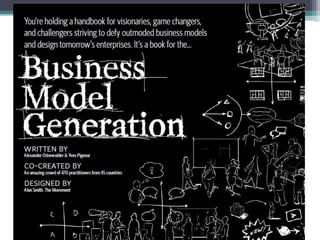
Workshop
“Business Model Generation”
Preview SPM E-Class
LPIK ITB | 23 Maret 2012

Panji Prabowo | @panjiprabowo
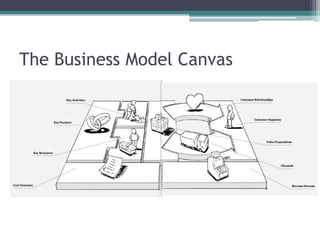
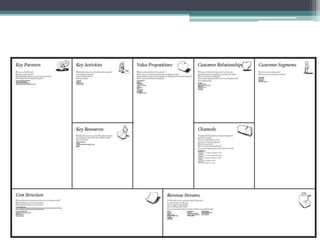
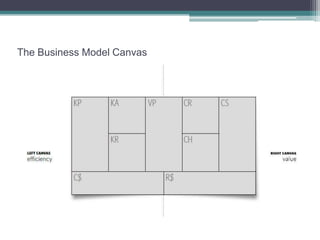
The Business Model Canvas
8


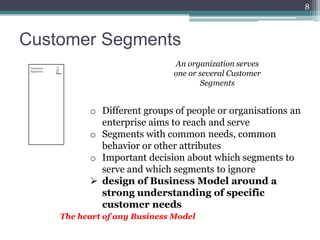
Customer Segments
                              An organization serves
                              one or several Customer
                                      Segments


          o Different groups of people or organisations an
            enterprise aims to reach and serve
          o Segments with common needs, common
            behavior or other attributes
          o Important decision about which segments to
            serve and which segments to ignore
           design of Business Model around a
            strong understanding of specific
            customer needs
    The heart of any Business Model
9


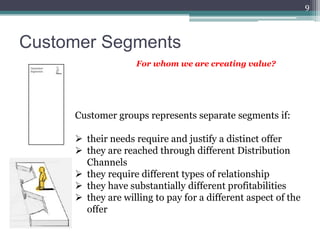
Customer Segments
                   For whom we are creating value?


     Customer groups represents separate segments if:

      their needs require and justify a distinct offer
      they are reached through different Distribution
       Channels
      they require different types of relationship
      they have substantially different profitabilities
      they are willing to pay for a different aspect of the
       offer
10


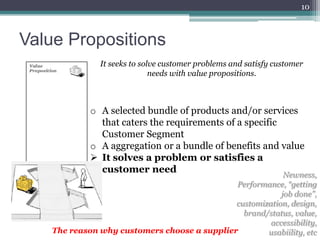
Value Propositions
               It seeks to solve customer problems and satisfy customer
                              needs with value propositions.


             o A selected bundle of products and/or services
               that caters the requirements of a specific
               Customer Segment
             o A aggregation or a bundle of benefits and value
              It solves a problem or satisfies a
               customer need
                                                           Newness,
                                              Performance, “getting
                                                          job done”,
                                              customization, design,
                                                brand/status, value,
                                                       accessibility,
    The reason why customers choose a supplier        usabiility, etc
11


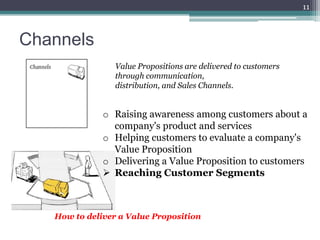
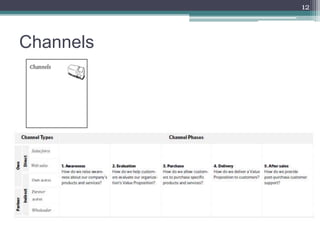
Channels
                 Value Propositions are delivered to customers
                 through communication,
                 distribution, and Sales Channels.


              o Raising awareness among customers about a
                company's product and services
              o Helping customers to evaluate a company's
                Value Proposition
              o Delivering a Value Proposition to customers
               Reaching Customer Segments


   How to deliver a Value Proposition
12


Channels
13


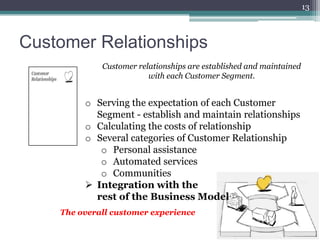
Customer Relationships
             Customer relationships are established and maintained
                         with each Customer Segment.


         o Serving the expectation of each Customer
           Segment - establish and maintain relationships
         o Calculating the costs of relationship
         o Several categories of Customer Relationship
            o Personal assistance
            o Automated services
            o Communities
          Integration with the
           rest of the Business Model
    The overall customer experience
14


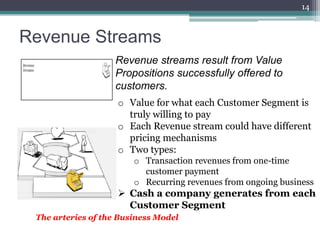
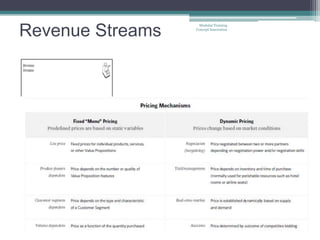
Revenue Streams
                   Revenue streams result from Value
                   Propositions successfully offered to
                   customers.
                    o Value for what each Customer Segment is
                      truly willing to pay
                    o Each Revenue stream could have different
                      pricing mechanisms
                    o Two types:
                        o Transaction revenues from one-time
                          customer payment
                        o Recurring revenues from ongoing business
                     Cash a company generates from each
                      Customer Segment
 The arteries of the Business Model
Modular Training

Revenue Streams   Concept Innovation
16


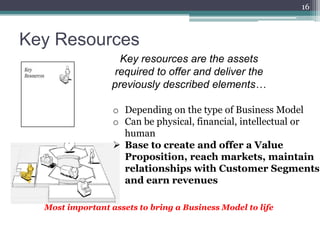
Key Resources
                    Key resources are the assets
                  required to offer and deliver the
                  previously described elements…

                  o Depending on the type of Business Model
                  o Can be physical, financial, intellectual or
                    human
                   Base to create and offer a Value
                    Proposition, reach markets, maintain
                    relationships with Customer Segments
                    and earn revenues

  Most important assets to bring a Business Model to life
17


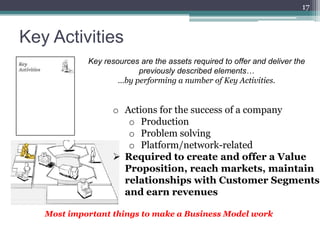
Key Activities
            Key resources are the assets required to offer and deliver the
                         previously described elements…
                    …by performing a number of Key Activities.


                   o Actions for the success of a company
                      o Production
                      o Problem solving
                      o Platform/network-related
                    Required to create and offer a Value
                     Proposition, reach markets, maintain
                     relationships with Customer Segments
                     and earn revenues

   Most important things to make a Business Model work
18


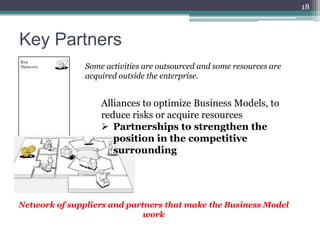
Key Partners
               Some activities are outsourced and some resources are
               acquired outside the enterprise.


                   Alliances to optimize Business Models, to
                   reduce risks or acquire resources
                    Partnerships to strengthen the
                      position in the competitive
                      surrounding


Network of suppliers and partners that make the Business Model
                             work
19


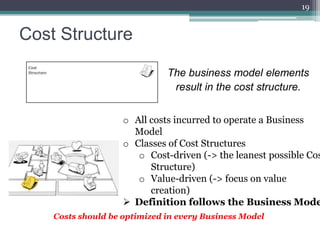
Cost Structure

                              The business model elements
                               result in the cost structure.


                    o All costs incurred to operate a Business
                      Model
                    o Classes of Cost Structures
                       o Cost-driven (-> the leanest possible Cos
                          Structure)
                       o Value-driven (-> focus on value
                          creation)
                     Definition follows the Business Mode
    Costs should be optimized in every Business Model
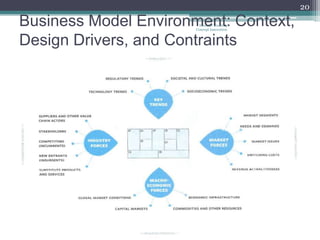
20

Business Model Environment: Context,
                        Modular Training
                       Concept Innovation


Design Drivers, and Contraints
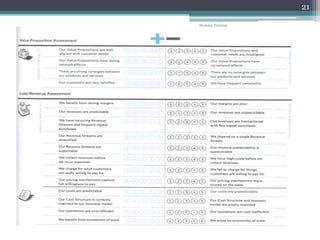
21

 Modular Training
Concept Innovation
22


Apple iPod/iTunes Business Model
23


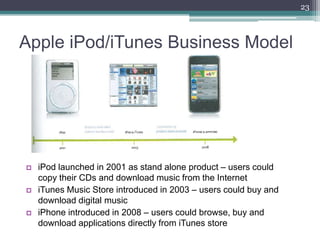
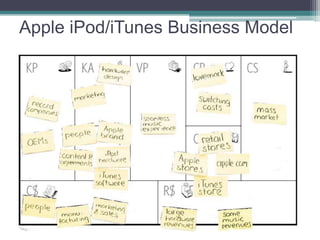
Apple iPod/iTunes Business Model


   iPod launched in 2001 as stand alone product – users could
    copy their CDs and download music from the Internet
   iTunes Music Store introduced in 2003 – users could buy and
    download digital music
   iPhone introduced in 2008 – users could browse, buy and
    download applications directly from iTunes store
24


Apple iPod/iTunes Business Model
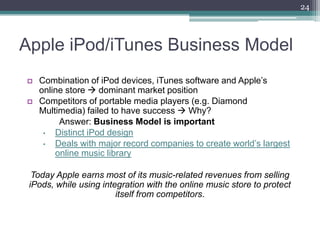
   Combination of iPod devices, iTunes software and Apple’s
    online store  dominant market position
   Competitors of portable media players (e.g. Diamond
    Multimedia) failed to have success  Why?
         Answer: Business Model is important
     •  Distinct iPod design
     •  Deals with major record companies to create world’s largest
        online music library

  Today Apple earns most of its music-related revenues from selling
 iPods, while using integration with the online music store to protect
                        itself from competitors.
Apple iPod/iTunes Business Model
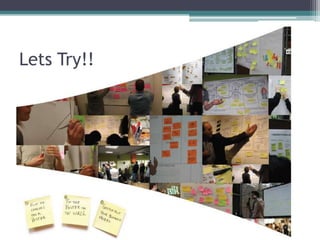
Lets Try!!
Bentuk 3 Kelompok lalu...
• Buat model bisnis yang CS-nya mahasiswa ITB!
• Buat model bisnis yang VP-nya GRATIS!
• Buat model bisnis apa saja terserah anda!
28

                     Modular Training
                    Concept Innovation


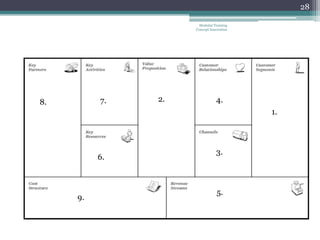
8.        7.   2.              4.
                                         1.


                               3.
          6.


                               5.
     9.

Workshop Business Model Generation

  • 1.
    Workshop “Business Model Generation” PreviewSPM E-Class LPIK ITB | 23 Maret 2012 Panji Prabowo | @panjiprabowo
  • 4.
  • 6.
  • 7.
  • 8.
    8 Customer Segments An organization serves one or several Customer Segments o Different groups of people or organisations an enterprise aims to reach and serve o Segments with common needs, common behavior or other attributes o Important decision about which segments to serve and which segments to ignore  design of Business Model around a strong understanding of specific customer needs The heart of any Business Model
  • 9.
    9 Customer Segments For whom we are creating value? Customer groups represents separate segments if:  their needs require and justify a distinct offer  they are reached through different Distribution Channels  they require different types of relationship  they have substantially different profitabilities  they are willing to pay for a different aspect of the offer
  • 10.
    10 Value Propositions It seeks to solve customer problems and satisfy customer needs with value propositions. o A selected bundle of products and/or services that caters the requirements of a specific Customer Segment o A aggregation or a bundle of benefits and value  It solves a problem or satisfies a customer need Newness, Performance, “getting job done”, customization, design, brand/status, value, accessibility, The reason why customers choose a supplier usabiility, etc
  • 11.
    11 Channels Value Propositions are delivered to customers through communication, distribution, and Sales Channels. o Raising awareness among customers about a company's product and services o Helping customers to evaluate a company's Value Proposition o Delivering a Value Proposition to customers  Reaching Customer Segments How to deliver a Value Proposition
  • 12.
  • 13.
    13 Customer Relationships Customer relationships are established and maintained with each Customer Segment. o Serving the expectation of each Customer Segment - establish and maintain relationships o Calculating the costs of relationship o Several categories of Customer Relationship o Personal assistance o Automated services o Communities  Integration with the rest of the Business Model The overall customer experience
  • 14.
    14 Revenue Streams Revenue streams result from Value Propositions successfully offered to customers. o Value for what each Customer Segment is truly willing to pay o Each Revenue stream could have different pricing mechanisms o Two types: o Transaction revenues from one-time customer payment o Recurring revenues from ongoing business  Cash a company generates from each Customer Segment The arteries of the Business Model
  • 15.
  • 16.
    16 Key Resources Key resources are the assets required to offer and deliver the previously described elements… o Depending on the type of Business Model o Can be physical, financial, intellectual or human  Base to create and offer a Value Proposition, reach markets, maintain relationships with Customer Segments and earn revenues Most important assets to bring a Business Model to life
  • 17.
    17 Key Activities Key resources are the assets required to offer and deliver the previously described elements… …by performing a number of Key Activities. o Actions for the success of a company o Production o Problem solving o Platform/network-related  Required to create and offer a Value Proposition, reach markets, maintain relationships with Customer Segments and earn revenues Most important things to make a Business Model work
  • 18.
    18 Key Partners Some activities are outsourced and some resources are acquired outside the enterprise. Alliances to optimize Business Models, to reduce risks or acquire resources  Partnerships to strengthen the position in the competitive surrounding Network of suppliers and partners that make the Business Model work
  • 19.
    19 Cost Structure The business model elements result in the cost structure. o All costs incurred to operate a Business Model o Classes of Cost Structures o Cost-driven (-> the leanest possible Cos Structure) o Value-driven (-> focus on value creation)  Definition follows the Business Mode Costs should be optimized in every Business Model
  • 20.
    20 Business Model Environment:Context, Modular Training Concept Innovation Design Drivers, and Contraints
  • 21.
  • 22.
  • 23.
    23 Apple iPod/iTunes BusinessModel  iPod launched in 2001 as stand alone product – users could copy their CDs and download music from the Internet  iTunes Music Store introduced in 2003 – users could buy and download digital music  iPhone introduced in 2008 – users could browse, buy and download applications directly from iTunes store
  • 24.
    24 Apple iPod/iTunes BusinessModel  Combination of iPod devices, iTunes software and Apple’s online store  dominant market position  Competitors of portable media players (e.g. Diamond Multimedia) failed to have success  Why? Answer: Business Model is important • Distinct iPod design • Deals with major record companies to create world’s largest online music library Today Apple earns most of its music-related revenues from selling iPods, while using integration with the online music store to protect itself from competitors.
  • 25.
  • 26.
  • 27.
    Bentuk 3 Kelompoklalu... • Buat model bisnis yang CS-nya mahasiswa ITB! • Buat model bisnis yang VP-nya GRATIS! • Buat model bisnis apa saja terserah anda!
  • 28.
    28 Modular Training Concept Innovation 8. 7. 2. 4. 1. 3. 6. 5. 9.