BUSINESS
MODEL
CANVAS
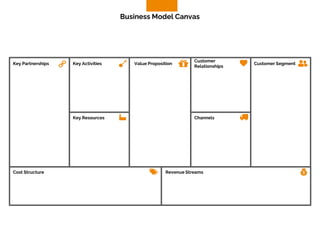
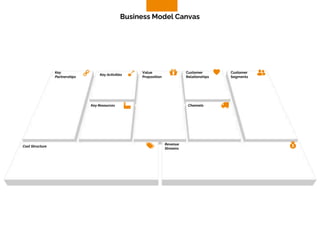
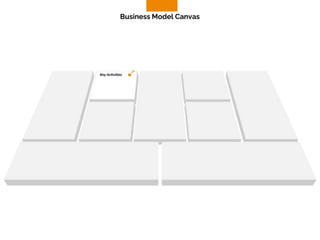
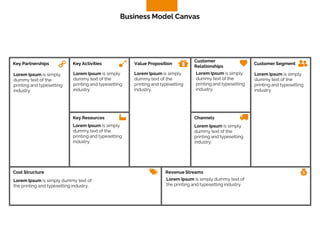
Key Partnerships Key Activities Value Proposition
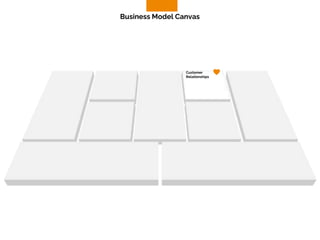
Customer
Relationships
Customer Segment
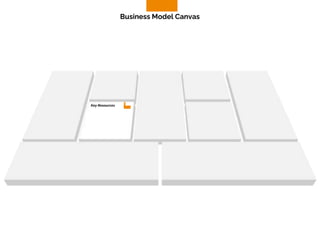
Key Resources Channels
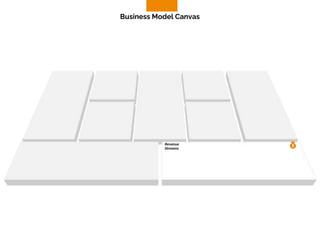
Cost Structure Revenue Streams
Business Model Canvas
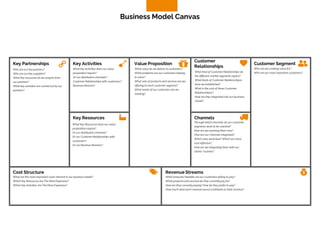
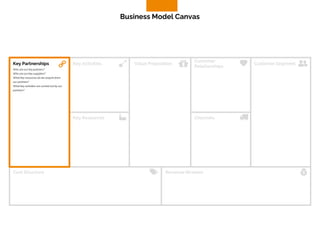
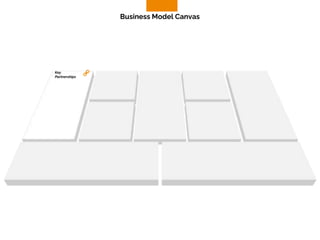
Who are our key partners?
Who are our key suppliers?
What key resources do we acquire from
our partners?
What key activities are carried out by our
partners?
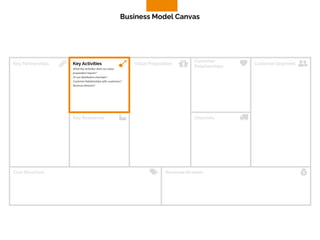
What key activities does our value
proposition require?
Or our distribution channels?
Customer Relationships with customers?
Revenue Streams?
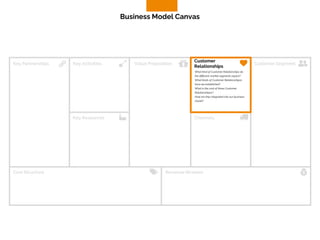
What kind of Customer Relationships do
the different market segments expect?
What kinds of Customer Relationshipss
have we established?
What is the cost of these Customer
Relationshipss?
How are they integrated into our business
model?
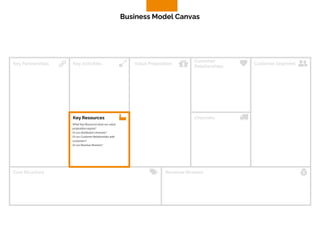
What Key Resources does our value
proposition require?
Or our distribution channels?
Or our Customer Relationships with
customers?
Or our Revenue Streams?
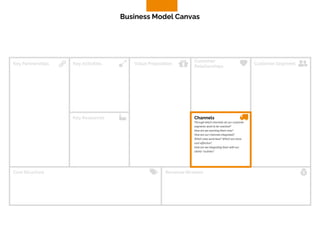
Through which channels do our customer
segments want to be reached?
How are we reaching them now?
How are our channels integrated?
Which ones work best? Which are more
cost-effective?
How are we integrating them with our
clients' routines?
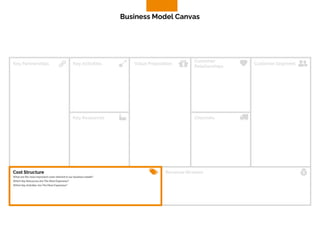
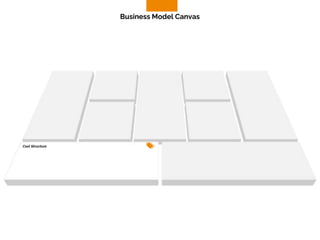
What are the most important costs inherent in our business model?
Which Key Resources Are The Most Expensive?
Which Key Activities Are The Most Expensive?
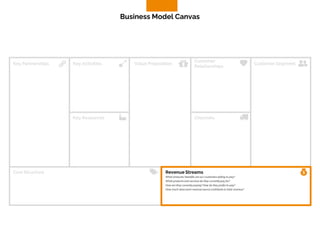
What amounts/benefits are our customers willing to pay?
What products and services do they currently pay for?
How are they currently paying? How do they prefer to pay?
How much does each revenue source contribute to total revenue?
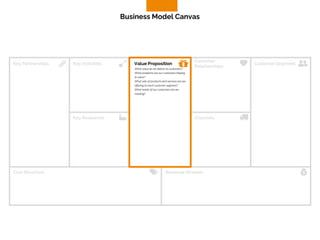
What value do we deliver to customers?
What problems are our customers helping
to solve?
What sets of products and services are we
offering to each customer segment?
What needs of our customers are we
meeting?
Who are we creating value for?
Who are our most important customers?
Key Partnerships Key Activities Value Proposition
Customer
Relationships
Customer Segment
Key Resources Channels
Cost Structure Revenue Streams
Business Model Canvas
Key Partnerships Key Activities Value Proposition
Customer
Relationships
Customer Segment
Key Resources Channels
Cost Structure Revenue Streams
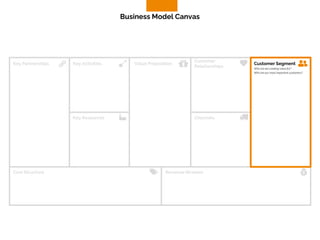
Who are we creating value for?
Who are our most important customers?
Business Model Canvas
What value do we deliver to customers?
What problems are our customers helping
to solve?
What sets of products and services are we
offering to each customer segment?
What needs of our customers are we
meeting?
Key Partnerships Key Activities Value Proposition
Customer
Relationships
Customer Segment
Key Resources Channels
Cost Structure Revenue Streams
Business Model Canvas
Key Partnerships Key Activities Value Proposition
Customer
Relationships
Customer Segment
Key Resources Channels
Cost Structure Revenue Streams
Through which channels do our customer
segments want to be reached?
How are we reaching them now?
How are our channels integrated?
Which ones work best? Which are more
cost-effective?
How are we integrating them with our
clients' routines?
Business Model Canvas
Key Partnerships Key Activities Value Proposition
Customer
Relationships
Customer Segment
Key Resources Channels
Cost Structure Revenue Streams
What kind of Customer Relationships do
the different market segments expect?
What kinds of Customer Relationshipss
have we established?
What is the cost of these Customer
Relationshipss?
How are they integrated into our business
model?
Business Model Canvas
What amounts/benefits are our customers willing to pay?
What products and services do they currently pay for?
How are they currently paying? How do they prefer to pay?
How much does each revenue source contribute to total revenue?
Revenue Streams
Key Partnerships Key Activities Value Proposition
Customer
Relationships
Customer Segment
Key Resources Channels
Cost Structure
Business Model Canvas
Key Partnerships Key Activities Value Proposition
Customer
Relationships
Customer Segment
Key Resources Channels
Cost Structure
What Key Resources does our value
proposition require?
Or our distribution channels?
Or our Customer Relationships with
customers?
Or our Revenue Streams?
Revenue Streams
Business Model Canvas
What key activities does our value
proposition require?
Or our distribution channels?
Customer Relationships with customers?
Revenue Streams?
Key Partnerships Key Activities Value Proposition
Customer
Relationships
Customer Segment
Key Resources Channels
Cost Structure Revenue Streams
Business Model Canvas
Key Activities Value Proposition
Customer
Relationships
Customer Segment
Key Resources Channels
Cost Structure Revenue Streams
Who are our key partners?
Who are our key suppliers?
What key resources do we acquire from
our partners?
What key activities are carried out by our
partners?
Key Partnerships
Business Model Canvas
What are the most important costs inherent in our business model?
Which Key Resources Are The Most Expensive?
Which Key Activities Are The Most Expensive?
Key Partnerships Key Activities Value Proposition
Customer
Relationships
Customer Segment
Key Resources Channels
Cost Structure Revenue Streams
Business Model Canvas
Key
Partnerships
Key Activities
Value
Proposition
Customer
Relationships
Key Resources
Customer
Segments
Channels
Cost Structure
Revenue
Streams
Business Model Canvas
Customer
Segments
Business Model Canvas
Value
Proposition
Business Model Canvas
Channels
Business Model Canvas
Customer
Relationships
Business Model Canvas
Revenue
Streams
Business Model Canvas
Key Resources
Business Model Canvas
Key Activities
Business Model Canvas
Key
Partnerships
Business Model Canvas
Cost Structure
Business Model Canvas
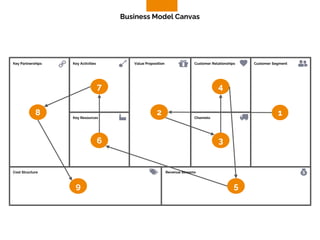
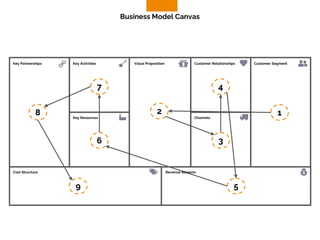
Sequence
8
7
1
4
2
9 5
6 3
Key Partnerships Key Activities Value Proposition Customer Relationships Customer Segment
Key Resources Channels
Cost Structure Revenue Streams
Business Model Canvas
8
7
1
4
2
9 5
6 3
Key Partnerships Key Activities Value Proposition Customer Relationships Customer Segment
Key Resources Channels
Cost Structure Revenue Streams
Business Model Canvas
Building Blocks
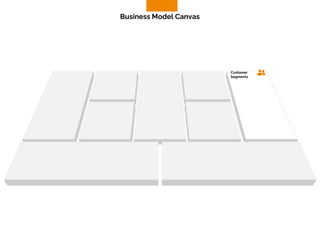
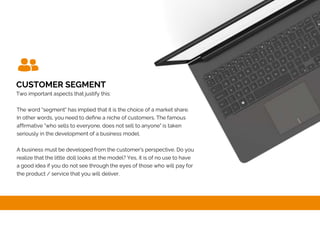
CUSTOMER SEGMENT
Two important aspects that justify this:
The word "segment" has implied that it is the choice of a market share.
In other words, you need to define a niche of customers. The famous
affirmative "who sells to everyone, does not sell to anyone" is taken
seriously in the development of a business model.
A business must be developed from the customer's perspective. Do you
realize that the little doll looks at the model? Yes, it is of no use to have
a good idea if you do not see through the eyes of those who will pay for
the product / service that you will deliver.
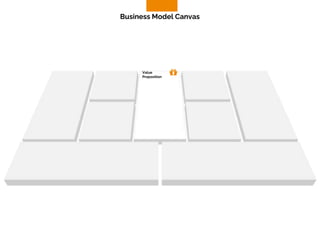
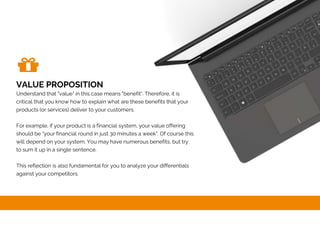
VALUE PROPOSITION
Understand that "value" in this case means "benefit". Therefore, it is
critical that you know how to explain what are these benefits that your
products (or services) deliver to your customers.
For example, if your product is a financial system, your value offering
should be "your financial round in just 30 minutes a week". Of course this
will depend on your system. You may have numerous benefits, but try
to sum it up in a single sentence.
This reflection is also fundamental for you to analyze your differentials
against your competitors.
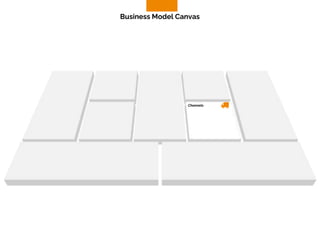
CHANNELS
Channels describe which paths the company communicates and
delivers value to the customer. We can say that from the perspective of
the old marketing (the 4 Ps), channels represents the "P" of Square and
the "P" promotion.
Channels can be communication, sales and distribution of the product.
That is, any type of interface of the company with the client. They serve
so that the defined segment can become aware and evaluate the value
proposition of the product, make the purchase and use of the same.
It is very important to verify that this block graphically demonstrates the
importance of strategic fitting into a business model.
CUSTOMER RELATIONSHIPS
The Customer Relationships block describes strategies that prevent
your customers from going to the competitor for issues such as "lower
price." Defining good Customer Relationships strategies is difficult, but
critical for customer retention.
Many start-up companies adopt a Customer Relationships based on
"self-service", whereby the customer solves almost everything on their
own. However, some companies have already realized that investing in
a high level of service ensures prominence and greater profitability.
REVENUE SOURCES
Revenue sources is the block that determines how the customer will
pay for the benefits received.
There are a number of recipe templates that can be adopted. Some
examples are: product sales, subscription, rental, license, auction, etc.
Revenue flow is currently one of the major sources of innovation. For
example, numerous companies are transforming their markets by
charging for subscription rather than per night and some restaurants
have started charging for on-call rather than charging per dish or per
kilo.
KEY RESOURCES
These are the key assets to make the Business Model work. In fact, the
entire left side is related to the operational part of the business.
This block should be limited to describing what really matters within
your company's assets. For example, in a steel mill the key resources
are the oven (boiler) and the laminator.
Some examples of resources are: physical assets, such as machines or
facilities, intellectuals, such as patents, virtual, such as technology
platforms, human resources, as a team of programmers or service, etc.
KEY ACTIVITIES
In addition to key resources, activities must address the most important
activities that the company must do constantly in order for the Business
Model to function properly. If a company has a web platform as a key

resource, it will most likely have as key activity the maintenance of this
platform.
Some examples of activities are: Goods Production, Problem Solving,
Platform Management, Consultative Sales, Product Development, etc.
KEY PARTNERSHIPS
Key partners in a business model primarily refers to outsourcing
(suppliers). As stated earlier, the left side deals with operational
issues, so block partnerships list other companies that help your
business deliver value supply.
Any type of essential task or raw material provided by another
company and that ensures the operation of the Business Model
must be listed in this block.
COST STRUCTURE
All major costs that have weight in the financial and are derived from the
operationalization of the Business Model.
They will probably come from the resource blocks, activities and key
partnerships. However, it will also be possible for channel costs to be
considered, such as sales commission.
Fill in
Key Partnerships Key Activities Value Proposition
Customer
Relationships
Customer Segment
Key Resources Channels
Cost Structure Revenue Streams
Business Model Canvas
Partnerships
Activity 1
Activity 2
Client
Customer
Relationships Client 1
Client 2
Channel 1
Channel 2
Revenue Source
Cost 1
Cost 2
Resource 1
Resource 2
● Item
● Lorem Ipsum
● Lorem
● Item
● Lorem Ipsum
● Lorem
● Item
● Lorem Ipsum
● Lorem
● Item
● Lorem Ipsum
● Lorem
● Item
● Lorem Ipsum
● Lorem
● Item
● Lorem Ipsum
● Lorem
● Item
● Lorem Ipsum
● Lorem
● Item
● Lorem Ipsum
● Lorem
● Item
● Lorem Ipsum
● Lorem
● Item
● Lorem Ipsum
● Lorem
● Item
● Lorem Ipsum
● Lorem
Key Partnerships Key Activities Value Proposition
Customer
Relationships
Customer Segment
Key Resources Channels
Cost Structure Revenue Streams
Business Model Canvas
Lorem Ipsum is simply
dummy text of the
printing and typesetting
industry.
Lorem Ipsum is simply
dummy text of the
printing and typesetting
industry.
Lorem Ipsum is simply
dummy text of the
printing and typesetting
industry.
Lorem Ipsum is simply
dummy text of the
printing and typesetting
industry.
Lorem Ipsum is simply
dummy text of the
printing and typesetting
industry.
Lorem Ipsum is simply
dummy text of the
printing and typesetting
industry.
Lorem Ipsum is simply
dummy text of the
printing and typesetting
industry.
Lorem Ipsum is simply dummy text of
the printing and typesetting industry.
Lorem Ipsum is simply dummy text of
the printing and typesetting industry.
Key Partnerships Key Activities Value Proposition
Customer
Relationships
Customer Segment
Key Resources Channels
Cost Structure Revenue Streams
Business Model Canvas
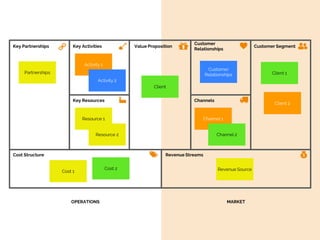
Partnerships
Activity 1
Activity 2
Client
Customer
Relationships Client 1
Client 2
Channel 1
Channel 2
Revenue Source
Cost 1
Cost 2
Feature 1
Key Partnerships Key Activities
Feature 2
Value Proposition
Customer
Relationships
Key Resources Channels
Cost Structure Revenue Streams
Customer Segment
OPERATIONS MARKET
Partnerships
Activity 1
Activity 2
Client
Customer
Relationships Client 1
Client 2
Channel 1
Channel 2
Revenue Source
Cost 1
Cost 2
Resource 1
Resource 2
Key Partnerships Key Activities Value Proposition
Customer
Relationships
Customer Segment
Key Resources Channels
Cost Structure Revenue Streams

Business Model Canvas (BMC) template.pptx

  • 1.
  • 2.
    Key Partnerships KeyActivities Value Proposition Customer Relationships Customer Segment Key Resources Channels Cost Structure Revenue Streams Business Model Canvas
  • 3.
    Who are ourkey partners? Who are our key suppliers? What key resources do we acquire from our partners? What key activities are carried out by our partners? What key activities does our value proposition require? Or our distribution channels? Customer Relationships with customers? Revenue Streams? What kind of Customer Relationships do the different market segments expect? What kinds of Customer Relationshipss have we established? What is the cost of these Customer Relationshipss? How are they integrated into our business model? What Key Resources does our value proposition require? Or our distribution channels? Or our Customer Relationships with customers? Or our Revenue Streams? Through which channels do our customer segments want to be reached? How are we reaching them now? How are our channels integrated? Which ones work best? Which are more cost-effective? How are we integrating them with our clients' routines? What are the most important costs inherent in our business model? Which Key Resources Are The Most Expensive? Which Key Activities Are The Most Expensive? What amounts/benefits are our customers willing to pay? What products and services do they currently pay for? How are they currently paying? How do they prefer to pay? How much does each revenue source contribute to total revenue? What value do we deliver to customers? What problems are our customers helping to solve? What sets of products and services are we offering to each customer segment? What needs of our customers are we meeting? Who are we creating value for? Who are our most important customers? Key Partnerships Key Activities Value Proposition Customer Relationships Customer Segment Key Resources Channels Cost Structure Revenue Streams Business Model Canvas
  • 4.
    Key Partnerships KeyActivities Value Proposition Customer Relationships Customer Segment Key Resources Channels Cost Structure Revenue Streams Who are we creating value for? Who are our most important customers? Business Model Canvas
  • 5.
    What value dowe deliver to customers? What problems are our customers helping to solve? What sets of products and services are we offering to each customer segment? What needs of our customers are we meeting? Key Partnerships Key Activities Value Proposition Customer Relationships Customer Segment Key Resources Channels Cost Structure Revenue Streams Business Model Canvas
  • 6.
    Key Partnerships KeyActivities Value Proposition Customer Relationships Customer Segment Key Resources Channels Cost Structure Revenue Streams Through which channels do our customer segments want to be reached? How are we reaching them now? How are our channels integrated? Which ones work best? Which are more cost-effective? How are we integrating them with our clients' routines? Business Model Canvas
  • 7.
    Key Partnerships KeyActivities Value Proposition Customer Relationships Customer Segment Key Resources Channels Cost Structure Revenue Streams What kind of Customer Relationships do the different market segments expect? What kinds of Customer Relationshipss have we established? What is the cost of these Customer Relationshipss? How are they integrated into our business model? Business Model Canvas
  • 8.
    What amounts/benefits areour customers willing to pay? What products and services do they currently pay for? How are they currently paying? How do they prefer to pay? How much does each revenue source contribute to total revenue? Revenue Streams Key Partnerships Key Activities Value Proposition Customer Relationships Customer Segment Key Resources Channels Cost Structure Business Model Canvas
  • 9.
    Key Partnerships KeyActivities Value Proposition Customer Relationships Customer Segment Key Resources Channels Cost Structure What Key Resources does our value proposition require? Or our distribution channels? Or our Customer Relationships with customers? Or our Revenue Streams? Revenue Streams Business Model Canvas
  • 10.
    What key activitiesdoes our value proposition require? Or our distribution channels? Customer Relationships with customers? Revenue Streams? Key Partnerships Key Activities Value Proposition Customer Relationships Customer Segment Key Resources Channels Cost Structure Revenue Streams Business Model Canvas
  • 11.
    Key Activities ValueProposition Customer Relationships Customer Segment Key Resources Channels Cost Structure Revenue Streams Who are our key partners? Who are our key suppliers? What key resources do we acquire from our partners? What key activities are carried out by our partners? Key Partnerships Business Model Canvas
  • 12.
    What are themost important costs inherent in our business model? Which Key Resources Are The Most Expensive? Which Key Activities Are The Most Expensive? Key Partnerships Key Activities Value Proposition Customer Relationships Customer Segment Key Resources Channels Cost Structure Revenue Streams Business Model Canvas
  • 13.
  • 14.
  • 15.
  • 16.
  • 17.
  • 18.
  • 19.
  • 20.
  • 21.
  • 22.
  • 23.
  • 24.
    8 7 1 4 2 9 5 6 3 KeyPartnerships Key Activities Value Proposition Customer Relationships Customer Segment Key Resources Channels Cost Structure Revenue Streams Business Model Canvas
  • 25.
    8 7 1 4 2 9 5 6 3 KeyPartnerships Key Activities Value Proposition Customer Relationships Customer Segment Key Resources Channels Cost Structure Revenue Streams Business Model Canvas
  • 26.
  • 27.
    CUSTOMER SEGMENT Two importantaspects that justify this: The word "segment" has implied that it is the choice of a market share. In other words, you need to define a niche of customers. The famous affirmative "who sells to everyone, does not sell to anyone" is taken seriously in the development of a business model. A business must be developed from the customer's perspective. Do you realize that the little doll looks at the model? Yes, it is of no use to have a good idea if you do not see through the eyes of those who will pay for the product / service that you will deliver.
  • 28.
    VALUE PROPOSITION Understand that"value" in this case means "benefit". Therefore, it is critical that you know how to explain what are these benefits that your products (or services) deliver to your customers. For example, if your product is a financial system, your value offering should be "your financial round in just 30 minutes a week". Of course this will depend on your system. You may have numerous benefits, but try to sum it up in a single sentence. This reflection is also fundamental for you to analyze your differentials against your competitors.
  • 29.
    CHANNELS Channels describe whichpaths the company communicates and delivers value to the customer. We can say that from the perspective of the old marketing (the 4 Ps), channels represents the "P" of Square and the "P" promotion. Channels can be communication, sales and distribution of the product. That is, any type of interface of the company with the client. They serve so that the defined segment can become aware and evaluate the value proposition of the product, make the purchase and use of the same. It is very important to verify that this block graphically demonstrates the importance of strategic fitting into a business model.
  • 30.
    CUSTOMER RELATIONSHIPS The CustomerRelationships block describes strategies that prevent your customers from going to the competitor for issues such as "lower price." Defining good Customer Relationships strategies is difficult, but critical for customer retention. Many start-up companies adopt a Customer Relationships based on "self-service", whereby the customer solves almost everything on their own. However, some companies have already realized that investing in a high level of service ensures prominence and greater profitability.
  • 31.
    REVENUE SOURCES Revenue sourcesis the block that determines how the customer will pay for the benefits received. There are a number of recipe templates that can be adopted. Some examples are: product sales, subscription, rental, license, auction, etc. Revenue flow is currently one of the major sources of innovation. For example, numerous companies are transforming their markets by charging for subscription rather than per night and some restaurants have started charging for on-call rather than charging per dish or per kilo.
  • 32.
    KEY RESOURCES These arethe key assets to make the Business Model work. In fact, the entire left side is related to the operational part of the business. This block should be limited to describing what really matters within your company's assets. For example, in a steel mill the key resources are the oven (boiler) and the laminator. Some examples of resources are: physical assets, such as machines or facilities, intellectuals, such as patents, virtual, such as technology platforms, human resources, as a team of programmers or service, etc.
  • 33.
    KEY ACTIVITIES In additionto key resources, activities must address the most important activities that the company must do constantly in order for the Business Model to function properly. If a company has a web platform as a key resource, it will most likely have as key activity the maintenance of this platform. Some examples of activities are: Goods Production, Problem Solving, Platform Management, Consultative Sales, Product Development, etc.
  • 34.
    KEY PARTNERSHIPS Key partnersin a business model primarily refers to outsourcing (suppliers). As stated earlier, the left side deals with operational issues, so block partnerships list other companies that help your business deliver value supply. Any type of essential task or raw material provided by another company and that ensures the operation of the Business Model must be listed in this block.
  • 35.
    COST STRUCTURE All majorcosts that have weight in the financial and are derived from the operationalization of the Business Model. They will probably come from the resource blocks, activities and key partnerships. However, it will also be possible for channel costs to be considered, such as sales commission.
  • 36.
  • 37.
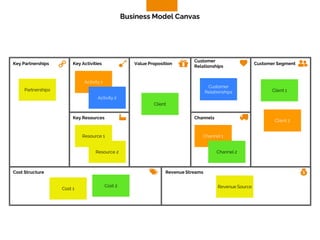
    Key Partnerships KeyActivities Value Proposition Customer Relationships Customer Segment Key Resources Channels Cost Structure Revenue Streams Business Model Canvas Partnerships Activity 1 Activity 2 Client Customer Relationships Client 1 Client 2 Channel 1 Channel 2 Revenue Source Cost 1 Cost 2 Resource 1 Resource 2
  • 38.
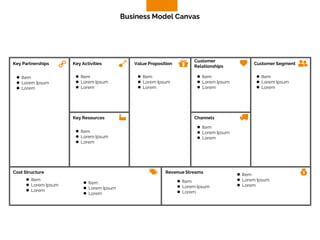
    ● Item ● LoremIpsum ● Lorem ● Item ● Lorem Ipsum ● Lorem ● Item ● Lorem Ipsum ● Lorem ● Item ● Lorem Ipsum ● Lorem ● Item ● Lorem Ipsum ● Lorem ● Item ● Lorem Ipsum ● Lorem ● Item ● Lorem Ipsum ● Lorem ● Item ● Lorem Ipsum ● Lorem ● Item ● Lorem Ipsum ● Lorem ● Item ● Lorem Ipsum ● Lorem ● Item ● Lorem Ipsum ● Lorem Key Partnerships Key Activities Value Proposition Customer Relationships Customer Segment Key Resources Channels Cost Structure Revenue Streams Business Model Canvas
  • 39.
    Lorem Ipsum issimply dummy text of the printing and typesetting industry. Lorem Ipsum is simply dummy text of the printing and typesetting industry. Lorem Ipsum is simply dummy text of the printing and typesetting industry. Lorem Ipsum is simply dummy text of the printing and typesetting industry. Lorem Ipsum is simply dummy text of the printing and typesetting industry. Lorem Ipsum is simply dummy text of the printing and typesetting industry. Lorem Ipsum is simply dummy text of the printing and typesetting industry. Lorem Ipsum is simply dummy text of the printing and typesetting industry. Lorem Ipsum is simply dummy text of the printing and typesetting industry. Key Partnerships Key Activities Value Proposition Customer Relationships Customer Segment Key Resources Channels Cost Structure Revenue Streams Business Model Canvas
  • 42.
    Partnerships Activity 1 Activity 2 Client Customer RelationshipsClient 1 Client 2 Channel 1 Channel 2 Revenue Source Cost 1 Cost 2 Feature 1 Key Partnerships Key Activities Feature 2 Value Proposition Customer Relationships Key Resources Channels Cost Structure Revenue Streams Customer Segment
  • 43.
    OPERATIONS MARKET Partnerships Activity 1 Activity2 Client Customer Relationships Client 1 Client 2 Channel 1 Channel 2 Revenue Source Cost 1 Cost 2 Resource 1 Resource 2 Key Partnerships Key Activities Value Proposition Customer Relationships Customer Segment Key Resources Channels Cost Structure Revenue Streams