

Service Product Development Group III- Arjun, Deepa, Jeev, Saanwin & Sonia
Service is an act or performance that one party can offer to another that is essentially intangible and does not result in the ownership of anything. - Philip Kotler What is a Service?
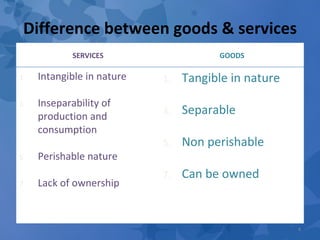
Difference between goods & services SERVICES GOODS Intangible in nature Inseparability of production and consumption Perishable nature Lack of ownership Tangible in nature Separable Non perishable Can be owned
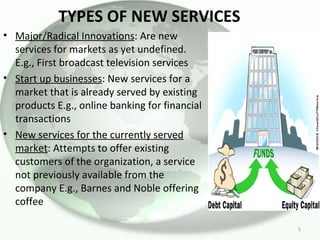
TYPES OF NEW SERVICES Major/Radical Innovations : Are new services for markets as yet undefined. E.g., First broadcast television services Start up businesses : New services for a market that is already served by existing products E.g., online banking for financial transactions New services for the currently served market : Attempts to offer existing customers of the organization, a service not previously available from the company E.g., Barnes and Noble offering coffee
Service line extensions : augmentation of the existing service line. E.g., restaurant adding new menu items, an airline offering new routes Service improvements : changes in features of service that are already offered. E.g., extended hours of service (24x7),added amenities in a hotel room. Style changes : the most modest service innovations, which have a significant effect on customer perception, emotion and attitude. E.g., changing the color scheme, revising the logo
SERVICE PRODUCT DEVELOPMENT Research suggests that products that are designed and introduced in a structured planning framework have a greater likelihood of ultimate success than those not developed within a framework.
Characteristics given by Lynn Shostack:- It must be objective and not subjective-  based on customer perceptions, market needs & feasibility It must be precise and not vague It must be fact driven and not opinion driven It must be methodological and not philosophical. Employees and customers should be  involved in the new service development. Ex: Metropolitan Life Insurance, Marriott Corporation.
NEW SERVICE DEVELOPMENT PROCESS
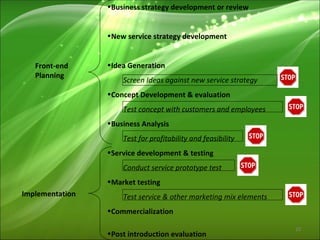
Business strategy development or review New service strategy development Idea Generation Screen Ideas against new service strategy Concept Development & evaluation Test concept with customers and employees Business Analysis Test for profitability and feasibility Service development & testing Conduct service prototype test Market testing Test service & other marketing mix elements Commercialization Post introduction evaluation Front-end Planning Implementation
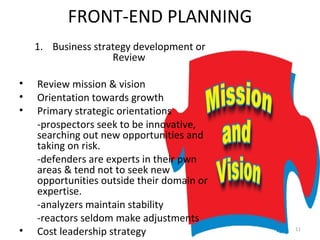
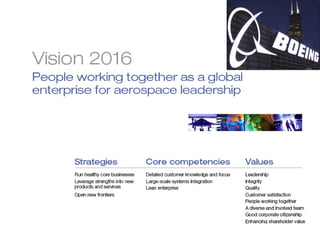
FRONT-END PLANNING Business strategy development or Review Review mission & vision Orientation towards growth Primary strategic orientations -prospectors seek to be innovative, searching out new opportunities and taking on risk. -defenders are experts in their pwn areas & tend not to seek new opportunities outside their domain or expertise. -analyzers maintain stability -reactors seldom make adjustments Cost leadership strategy
Our promise is to help people feel close to what is important to them
 
2. New Service Strategy Development  By Defining a new service strategy, the organization will be in a better position to begin generating specific ideas One way to begin is to use the framework The other one is to use the matrix
3. Idea Generation   Ideas generated at this phase can be passed through the new service strategy screen. many methods and avenues are available for searching out new service ideas. Methods:- Interacting with others Creativity techniques   -
4.Concept Development and Evaluation  Who is the target market and who is the decision maker in the purchasing process. What features must the product incorporate. What benefits will the service provide to the customer  and to the organization. How will client react to the service.  How the service can be delivered most cost effectively. What will be the cost to deliver the service.
Evaluation by employees and customers on  -whether they understand the idea of the   proposed service, -whether they are favorable to the     concept, and  -whether they feel it satisfies an unmet   need.
5. Business Analysis Marketing Assessment Financial Assessment
A. Marketing Assessment Target market Forecasting of sales volume Indication of product positioning Competitor reaction Specification of new product development
B. Financial Assessment Sales volume and value Variable cost of production Incremental fixed cost Contribution and profitability of the new service
Implementation “ The Beauty of Every Idea Lies in How We Implement it…”
Implementation Stages Once the new service concept has passed all the front-end planning hurdles, it is ready for the implementation stage process. Service Development & Testing Market Testing Commercialization Post-Introduction Evaluation
6. Service Development & Testing The intangibility presents unique challenges. The stage should involve all who have a stake in the new service. The concepts are refined to the point at which a detailed service blueprint can be constructed.
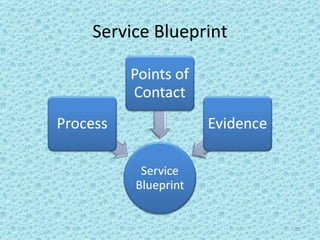
Service Blueprint Picture or map that accurately portrays the service system. Helps different people involved to understand and deal with it objectively. Displays the service by simultaneously depicting the process of delivery, the points of customer contact, the roles of customers and employees, and the visible elements of service.
Service Blueprint
The final step is to transform the blueprint into specific implementation plans for its part of service delivery process. All parties involved in any aspect of the new service need to work together to delineate the details of the new service.
7. Market Testing Difficult to test in isolated markets.   e.g. Hospital has only one point of delivery. The new service may be offered to the employees and their families for assessing responses. An alternate is to test variations in pricing and promotions in a less realistic context by presenting customers with hypothetical mixes and getting  their responses in terms of intentions to try the service under different conditions.
It is also important to do a pilot run of the service to check the smoothness in the functioning of operations.
8. Commercialization Service goes live & is introduced at the market space. The stage has 2 objectives Built & maintain acceptance of new service among large number of service delivery personnel responsible for service quality. Monitor all aspects of service during introduction and through the complete service cycle. Every detail of the service is assessed. Operating efficiency and costs are tracked.
9. Post-Introduction Evaluation The information gathered during commercialization of service is reviewed and changes are made in Delivery process Staffing Service mix No service will stay same. Services are exposed to deliberate or unplanned changes. This calls for formalizing the review process to enhance quality and understand customer perceptions.
Achieving success in New service development Unlike in the development of a product, in developing a service, the product core is of only secondary importance. Quality of the total service offering & of the marketing support that goes with it.
Three factors contributing most to success are,  Market synergy Organizational factors Market research factors
Saintgits Institute of Management

Service Product Development

  • 1.
    Service Product DevelopmentGroup III- Arjun, Deepa, Jeev, Saanwin & Sonia
  • 2.
    Service is anact or performance that one party can offer to another that is essentially intangible and does not result in the ownership of anything. - Philip Kotler What is a Service?
  • 4.
    Difference between goods& services SERVICES GOODS Intangible in nature Inseparability of production and consumption Perishable nature Lack of ownership Tangible in nature Separable Non perishable Can be owned
  • 5.
    TYPES OF NEWSERVICES Major/Radical Innovations : Are new services for markets as yet undefined. E.g., First broadcast television services Start up businesses : New services for a market that is already served by existing products E.g., online banking for financial transactions New services for the currently served market : Attempts to offer existing customers of the organization, a service not previously available from the company E.g., Barnes and Noble offering coffee
  • 6.
    Service line extensions: augmentation of the existing service line. E.g., restaurant adding new menu items, an airline offering new routes Service improvements : changes in features of service that are already offered. E.g., extended hours of service (24x7),added amenities in a hotel room. Style changes : the most modest service innovations, which have a significant effect on customer perception, emotion and attitude. E.g., changing the color scheme, revising the logo
  • 7.
    SERVICE PRODUCT DEVELOPMENTResearch suggests that products that are designed and introduced in a structured planning framework have a greater likelihood of ultimate success than those not developed within a framework.
  • 8.
    Characteristics given byLynn Shostack:- It must be objective and not subjective- based on customer perceptions, market needs & feasibility It must be precise and not vague It must be fact driven and not opinion driven It must be methodological and not philosophical. Employees and customers should be involved in the new service development. Ex: Metropolitan Life Insurance, Marriott Corporation.
  • 9.
  • 10.
    Business strategy developmentor review New service strategy development Idea Generation Screen Ideas against new service strategy Concept Development & evaluation Test concept with customers and employees Business Analysis Test for profitability and feasibility Service development & testing Conduct service prototype test Market testing Test service & other marketing mix elements Commercialization Post introduction evaluation Front-end Planning Implementation
  • 11.
    FRONT-END PLANNING Businessstrategy development or Review Review mission & vision Orientation towards growth Primary strategic orientations -prospectors seek to be innovative, searching out new opportunities and taking on risk. -defenders are experts in their pwn areas & tend not to seek new opportunities outside their domain or expertise. -analyzers maintain stability -reactors seldom make adjustments Cost leadership strategy
  • 12.
    Our promise isto help people feel close to what is important to them
  • 13.
  • 14.
    2. New ServiceStrategy Development By Defining a new service strategy, the organization will be in a better position to begin generating specific ideas One way to begin is to use the framework The other one is to use the matrix
  • 15.
    3. Idea Generation Ideas generated at this phase can be passed through the new service strategy screen. many methods and avenues are available for searching out new service ideas. Methods:- Interacting with others Creativity techniques -
  • 16.
    4.Concept Development andEvaluation Who is the target market and who is the decision maker in the purchasing process. What features must the product incorporate. What benefits will the service provide to the customer and to the organization. How will client react to the service. How the service can be delivered most cost effectively. What will be the cost to deliver the service.
  • 17.
    Evaluation by employeesand customers on -whether they understand the idea of the proposed service, -whether they are favorable to the concept, and -whether they feel it satisfies an unmet need.
  • 18.
    5. Business AnalysisMarketing Assessment Financial Assessment
  • 19.
    A. Marketing AssessmentTarget market Forecasting of sales volume Indication of product positioning Competitor reaction Specification of new product development
  • 20.
    B. Financial AssessmentSales volume and value Variable cost of production Incremental fixed cost Contribution and profitability of the new service
  • 21.
    Implementation “ TheBeauty of Every Idea Lies in How We Implement it…”
  • 22.
    Implementation Stages Oncethe new service concept has passed all the front-end planning hurdles, it is ready for the implementation stage process. Service Development & Testing Market Testing Commercialization Post-Introduction Evaluation
  • 23.
    6. Service Development& Testing The intangibility presents unique challenges. The stage should involve all who have a stake in the new service. The concepts are refined to the point at which a detailed service blueprint can be constructed.
  • 24.
    Service Blueprint Pictureor map that accurately portrays the service system. Helps different people involved to understand and deal with it objectively. Displays the service by simultaneously depicting the process of delivery, the points of customer contact, the roles of customers and employees, and the visible elements of service.
  • 25.
  • 26.
    The final stepis to transform the blueprint into specific implementation plans for its part of service delivery process. All parties involved in any aspect of the new service need to work together to delineate the details of the new service.
  • 27.
    7. Market TestingDifficult to test in isolated markets. e.g. Hospital has only one point of delivery. The new service may be offered to the employees and their families for assessing responses. An alternate is to test variations in pricing and promotions in a less realistic context by presenting customers with hypothetical mixes and getting their responses in terms of intentions to try the service under different conditions.
  • 28.
    It is alsoimportant to do a pilot run of the service to check the smoothness in the functioning of operations.
  • 29.
    8. Commercialization Servicegoes live & is introduced at the market space. The stage has 2 objectives Built & maintain acceptance of new service among large number of service delivery personnel responsible for service quality. Monitor all aspects of service during introduction and through the complete service cycle. Every detail of the service is assessed. Operating efficiency and costs are tracked.
  • 30.
    9. Post-Introduction EvaluationThe information gathered during commercialization of service is reviewed and changes are made in Delivery process Staffing Service mix No service will stay same. Services are exposed to deliberate or unplanned changes. This calls for formalizing the review process to enhance quality and understand customer perceptions.
  • 31.
    Achieving success inNew service development Unlike in the development of a product, in developing a service, the product core is of only secondary importance. Quality of the total service offering & of the marketing support that goes with it.
  • 32.
    Three factors contributingmost to success are, Market synergy Organizational factors Market research factors
  • 33.