Copyright © 2008 Pearson Education Canada Services Marketing, Canadian Edition Chapter 8- 1
Chapter 8
Designing and
Managing Service
Processes
Copyright © 2008 Pearson Education Canada Services Marketing, Canadian Edition Chapter 8- 2
Learning Objectives - Chapter 8
 Discover how blueprinting creates satisfied customers and
productive operations
 Explore how service process redesign improves quality and
productivity
 Analyse the role of customer as co-producer
 Determine customer acceptance of self-service
technologies (SST)
 Control of uncooperative or abusive customers
Copyright © 2008 Pearson Education Canada Services Marketing, Canadian Edition Chapter 8- 3
Blueprinting Services to
Create Valued Experiences and
Productive Operations
Copyright © 2008 Pearson Education Canada Services Marketing, Canadian Edition Chapter 8- 4
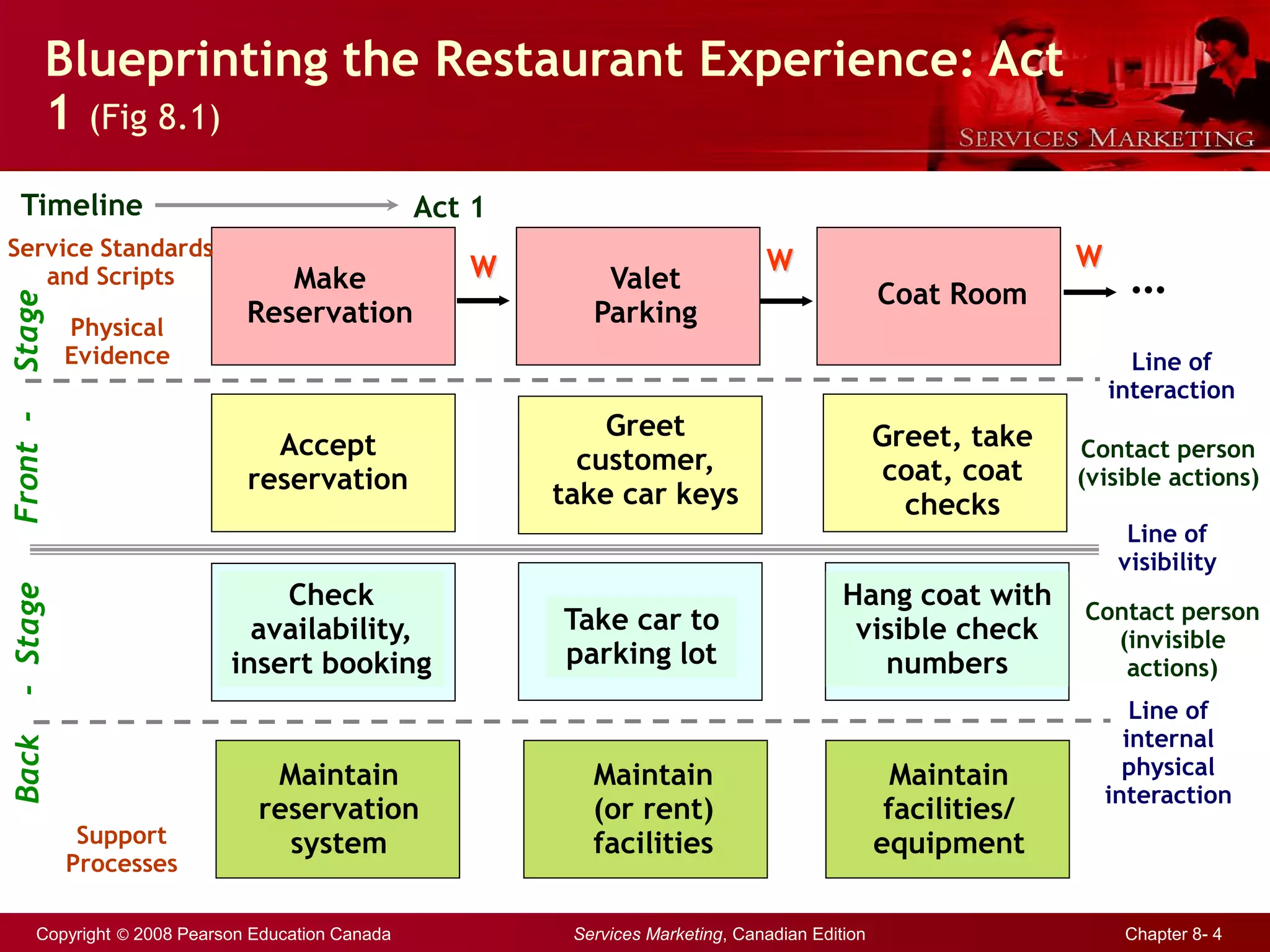
Blueprinting the Restaurant Experience: Act
1 (Fig 8.1)
Make
Reservation
Coat Room
Valet
Parking
Accept
reservation
Greet
customer,
take car keys
Greet, take
coat, coat
checks
Check
availability,
insert booking
Take car to
parking lot
Hang coat with
visible check
numbers
Maintain
reservation
system
Maintain
(or rent)
facilities
Maintain
facilities/
equipment
Line of
interaction
Line of
visibility
Line of
internal
physical
interaction
Contact person
(visible actions)
Contact person
(invisible
actions)
Front
-
Stage
Back
-
Stage
…
Timeline Act 1
Physical
Evidence
Service Standards
and Scripts
Support
Processes
W W W
Copyright © 2008 Pearson Education Canada Services Marketing, Canadian Edition Chapter 8- 5
Developing a Blueprint
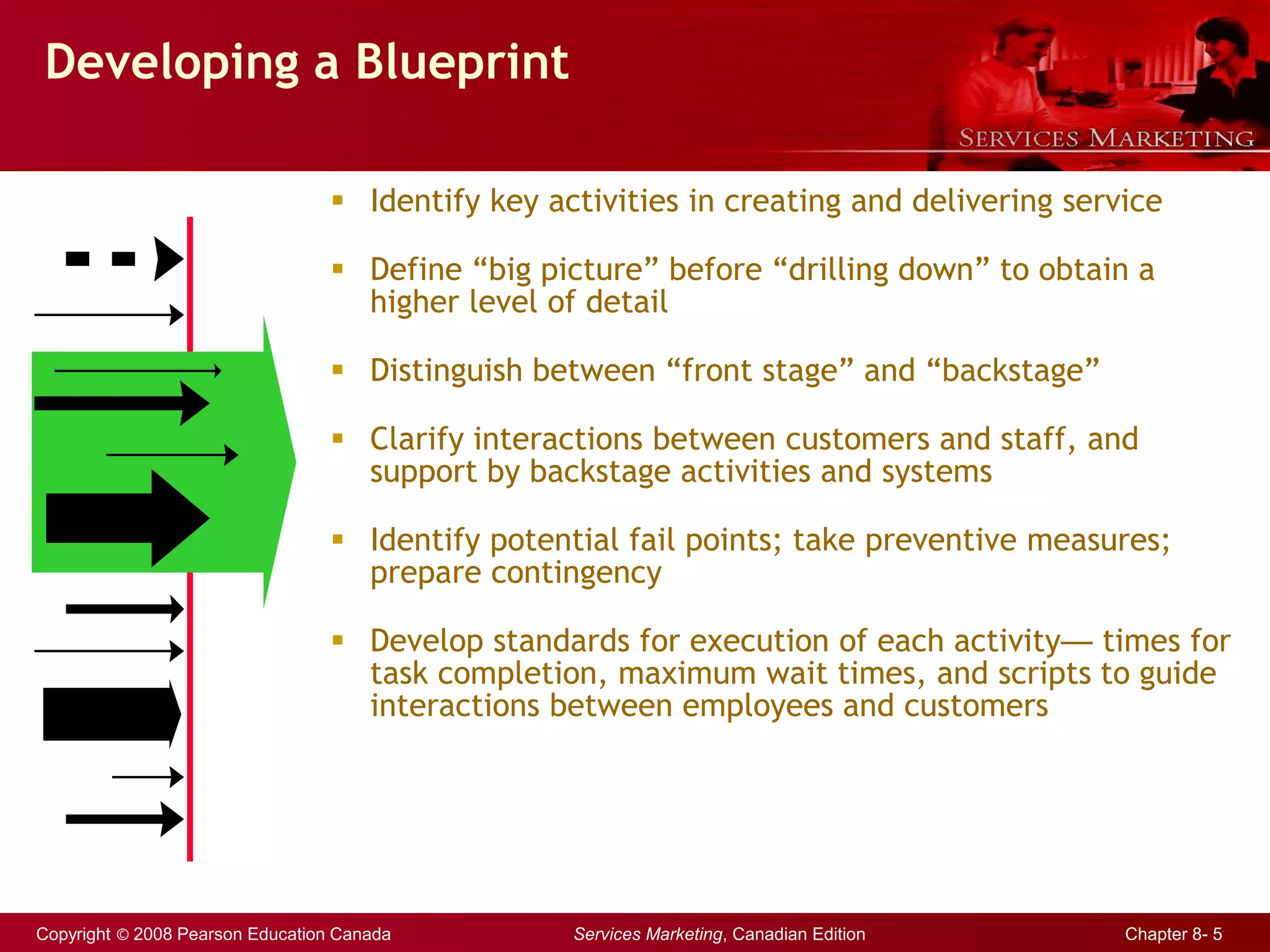
 Identify key activities in creating and delivering service
 Define “big picture” before “drilling down” to obtain a
higher level of detail
 Distinguish between “front stage” and “backstage”
 Clarify interactions between customers and staff, and
support by backstage activities and systems
 Identify potential fail points; take preventive measures;
prepare contingency
 Develop standards for execution of each activity— times for
task completion, maximum wait times, and scripts to guide
interactions between employees and customers
Copyright © 2008 Pearson Education Canada Services Marketing, Canadian Edition Chapter 8- 6
Key Components of a Service Blueprint
1. Define standards for front-stage activities
2. Specify physical evidence
3. Identify principal customer actions
4. Line of interaction (customers and front-stage personnel)
5. Front-stage actions by customer-contact personnel
6. Line of visibility (between front stage and backstage)
7. Backstage actions by customer contact personnel
8. Support processes involving other service personnel
9. Support processes involving IT
- Identify fail points and risks of excessive waits
- Set service standards and do failure-proofing
Copyright © 2008 Pearson Education Canada Services Marketing, Canadian Edition Chapter 8- 7
Blueprinting the Restaurant
Experience: A Three Act Performance
 Act 1: Prologue and Introductory Scenes
 Act 2: Delivery of Core Product
 Cocktails, seating, order food and wine, wine service
 Potential fail points: Menu information complete? Menu intelligible?
Everything on the menu actually available?
 Mistakes in transmitting information a common cause of quality failure—
e.g. bad handwriting; poor verbal communication
 Customers may not only evaluate quality of food and drink, but how
promptly it is served, serving staff attitudes, or style of service
 Act 3: The Drama Concludes
 Remaining actions should move quickly and smoothly, with no surprises at
the end
 Customer expectations: Accurate, intelligible and prompt bill, payment
handled politely, guest are thanked for their patronage
Copyright © 2008 Pearson Education Canada Services Marketing, Canadian Edition Chapter 8- 8
OTSU – Opportunity to Screw Up
 Consists of fail points and waiting times
 Fail points result in failure to access the core service
product
 Waiting times are the possibilities of delays between
specific actions requiring the customer to wait
Identify all OTSU’s to create a delivery system designed to
avoid the problems
Copyright © 2008 Pearson Education Canada Services Marketing, Canadian Edition Chapter 8- 9
Improving Reliability by Failure
Proofing
 Analysis reveals opportunities for failure proofing
 Need fail-safe methods for both employees and customers
 Errors include treatment errors and tangible errors
 Goal of fail-safe procedures is to prevent errors such as:
 Performing tasks incorrectly, in the wrong order, too slowly
 Doing work that wasn’t requested in the first place
 See Service Perspectives 8.1 – Poka Yokes
Copyright © 2008 Pearson Education Canada Services Marketing, Canadian Edition Chapter 8- 10
Setting Service Standards
 Design high standards for each step to satisfy and delight
 Time parameters, correct performance, prescriptions for style and
demeanor
 First impressions affects customer’s evaluations of quality during later
stages of service delivery
 Customer perceptions of service experiences tend to be cumulative
 For low-contact service, a single failure committed front stage is
relatively more serious than in high-contact service
Copyright © 2008 Pearson Education Canada Services Marketing, Canadian Edition Chapter 8- 11
Redesigning Service Processes
Copyright © 2008 Pearson Education Canada Services Marketing, Canadian Edition Chapter 8- 12
Mitchell T. Rabkin MD,
formerly president of
Boston’s Beth Israel Hospital
Why Redesign? (1)
“Institutions are like steel beams—they tend to rust.
What was once smooth and shiny and nice
tends to become rusty.”
Copyright © 2008 Pearson Education Canada Services Marketing, Canadian Edition Chapter 8- 13
Why Redesign? (2)
 Revitalizes process that has become outdated
 Changes in external environment make existing practices obsolete and
require redesign of underlying processes
 Rusting occurs internally
 Opportunities exist to achieve a quantum leap in productivity and
service quality
Key Measurements
1.Reduce service failures
2.Reduce cycle time
3.Enhance productivity
4.Increase customer satisfaction
Copyright © 2008 Pearson Education Canada Services Marketing, Canadian Edition Chapter 8- 14
Approaches and Potential Benefits (Table 8.1)
Service process redesign encompasses reconstitution,
rearrangement, or substitution of service processes as
categorized below:
 Eliminating non-value-adding steps
 Delivering direct service
 Shifting to self-service
 Delivering direct service
 Bundling services
 Redesigning the physical aspects of service processes
Copyright © 2008 Pearson Education Canada Services Marketing, Canadian Edition Chapter 8- 15
The Customer as Co-Producer
Copyright © 2008 Pearson Education Canada Services Marketing, Canadian Edition Chapter 8- 16
Levels of Customer Participation
 Customer participation is the actions and resources supplied
by customers during service production and/or delivery
 Three Levels
 Low—Employees and systems do all the work
 Medium—Customer inputs required to assist provider
 High—Customer works actively with provider to co-produce the service
Copyright © 2008 Pearson Education Canada Services Marketing, Canadian Edition Chapter 8- 17
Self-Service Technologies (SSTs)
 Customers undertake specific activities using facilities or
systems provided by service supplier
 Customer’s time and effort replace those of employees
 Information-based services lend selves particularly well to
SSTs
 Used in both supplementary services and delivery of core product
 Organizations seek to divert customers from employee contact to
Internet-based self-service
 Economic trade-off between declining cost of these self-service
systems and rising cost of labour
Challenge:
Getting customers to use new technology
Copyright © 2008 Pearson Education Canada Services Marketing, Canadian Edition Chapter 8- 18
Customer Co-production Using SSTs
 Productivity gains and cost savings result when customers take over
work previously performed by employees
 Lower prices, reflecting lower costs, induce customer to use SSTs
 Research shows that customers tend to take credit for successful
outcomes, but not blame for unsuccessful ones
 Critical to understand how consumers decide between using an SST
option versus relying on a human provider
 SSTs present both advantages and disadvantages
 Benefits: Time and cost savings, flexibility, convenience of location, greater
control over service delivery, and a higher perceived level of customization
 Disadvantages: Anxiety and stress experienced by customers who are
uncomfortable with using them
Copyright © 2008 Pearson Education Canada Services Marketing, Canadian Edition Chapter 8- 19
What Aspects of SSTs Please or Annoy
Customers?
 People love SSTs when…
 SST machines are conveniently located and accessible 24/7
 Obtaining detailed information and completing transactions can be
done faster than through face-to-face or telephone contact
 People hate SSTs when…
 SSTs fail—system is down, PIN numbers not accepted, etc
 They forget passwords, fail to provide information as requested,
simply hit wrong buttons
 Key weakness of SSTs: Too few incorporate service recovery
systems
 Customers still forced to make telephone calls or personal visits
 Blame service provider for not providing more user-friendly system
Copyright © 2008 Pearson Education Canada Services Marketing, Canadian Edition Chapter 8- 20
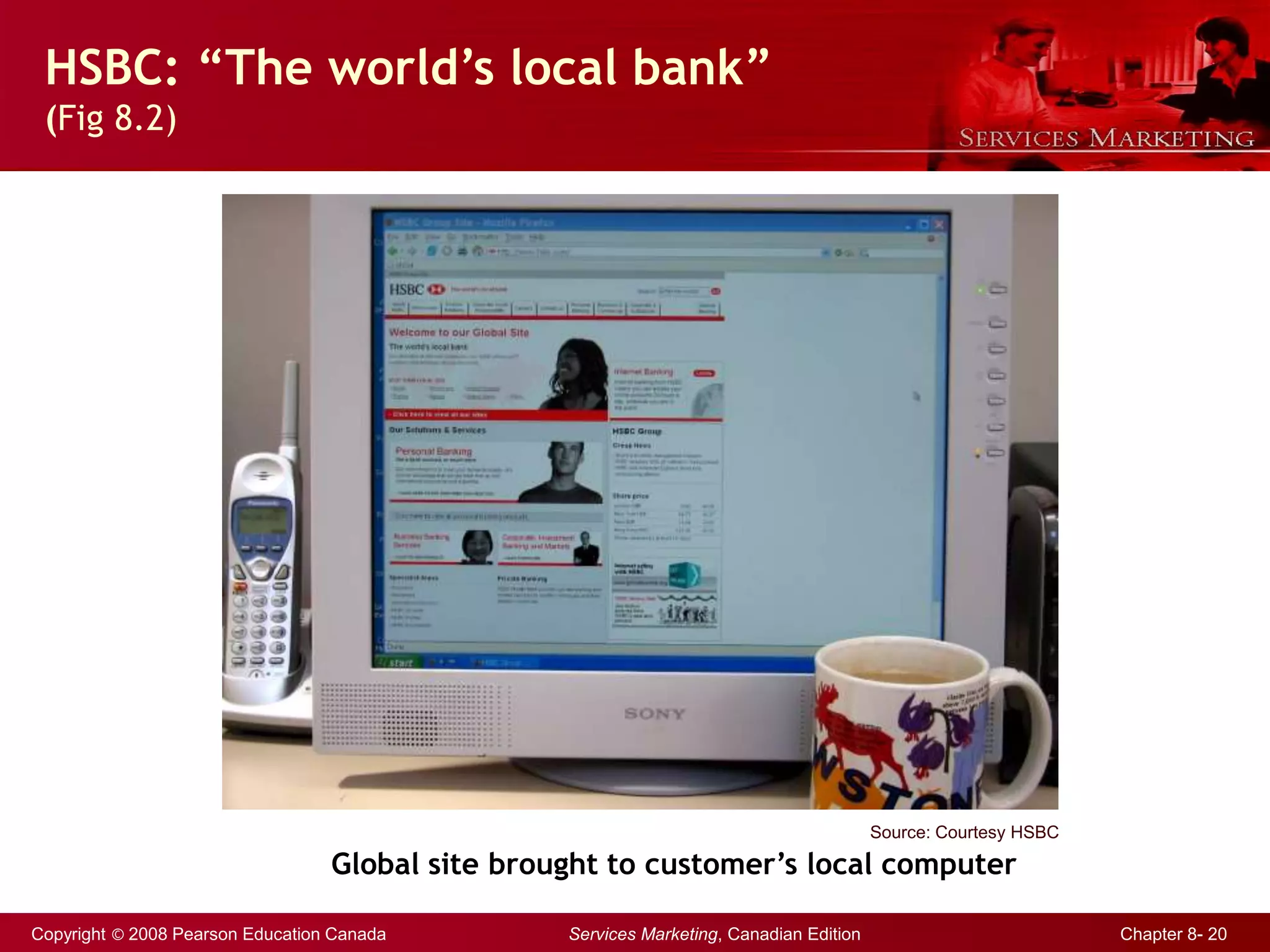
HSBC: “The world’s local bank”
(Fig 8.2)
Source: Courtesy HSBC
Global site brought to customer’s local computer
Copyright © 2008 Pearson Education Canada Services Marketing, Canadian Edition Chapter 8- 21
Putting SSTs to Test by
Asking a Few Simple Questions
 Does the SST work reliably?
 Firms must ensure that SSTs are dependable and
user-friendly
 Is the SST better than interpersonal alternatives?
 Customers will stick to conventional methods if SST
doesn’t create benefits for them
 If it fails, what systems are in place to recover?
 Always provide systems, structures, and technologies
that will enable prompt service recovery when things
go wrong
Copyright © 2008 Pearson Education Canada Services Marketing, Canadian Edition Chapter 8- 22
Customers as Partial Employees
 Customers influence productivity and quality of service processes and
outputs
 Customers who are offered opportunities to participate at active level
are more likely to be satisfied
 However, customers cause one-third of all service problems
 Difficult to recover from instances of customer failure
 Focus on preventing customer failure by collecting data on problem
occurrence, analyzing root causes, and establishing preventive solutions
 Managing customers as employees helps to avoid customer failures
 Conduct “job analysis” of customer’s present role in business—compare
against role that firm would like customers to play
 Educate customers on how expected to perform and skills needed
 Motivate customers by ensuring that rewarded if they perform well
 Appraise customers’ performance regularly
Copyright © 2008 Pearson Education Canada Services Marketing, Canadian Edition Chapter 8- 23
Dysfunctional Customer Behaviour
Disrupts Service Process
Copyright © 2008 Pearson Education Canada Services Marketing, Canadian Edition Chapter 8- 24
Addressing the Challenge of
Jaycustomers
 A customer who behaves in a thoughtless or
abusive fashion, causing problems for the firm, its
employees, and other customers
 No organization wants an ongoing relationship
with an abusive customer
 Divergent views on jaycustomers
 Six types:
 The Thief
 The Rule-Breaker
 The Belligerent
 The Family Feuders
 The Vandal
Copyright © 2008 Pearson Education Canada Services Marketing, Canadian Edition Chapter 8- 25
Consequences of Dysfunctional
Customer Behaviour
 Consequences for staff working front stage
 Abused employees may find their emotions negatively affected and/or
suffer long-term psychological damage
 Productivity and quality may suffer
 Consequences for customers can be both negative and positive
 Exposure to unpleasant incidents can spoil consumption experience; Bad
behaviour can be contagious
 But customers may rally to support of abused employee
 Consequences for organization
 Unmotivated employees may work less effectively
 Abused employees may take medical leave
 Direct financial costs of restoring damaged property, legal fees, paying
fraudulent claims
Copyright © 2008 Pearson Education Canada Services Marketing, Canadian Edition Chapter 8- 26
Summary – Chapter 8
 Blueprinting is a fundamental tool used for service design and re-
design
 Service process redesign should:
 Reduce service failures
 Reduce cycle time
 Enhance productivity
 Increase customer satisfaction
 Ensure that when a customer as a co-producer that they are well
educated and supported in their “job”
 Customers will accept SSTs if they are accessible and easy to use
 Companies need approaches for handling Jaycustomer behaviour

Designing and Managing Service Processes.ppt

  • 1.
    Copyright © 2008Pearson Education Canada Services Marketing, Canadian Edition Chapter 8- 1 Chapter 8 Designing and Managing Service Processes
  • 2.
    Copyright © 2008Pearson Education Canada Services Marketing, Canadian Edition Chapter 8- 2 Learning Objectives - Chapter 8  Discover how blueprinting creates satisfied customers and productive operations  Explore how service process redesign improves quality and productivity  Analyse the role of customer as co-producer  Determine customer acceptance of self-service technologies (SST)  Control of uncooperative or abusive customers
  • 3.
    Copyright © 2008Pearson Education Canada Services Marketing, Canadian Edition Chapter 8- 3 Blueprinting Services to Create Valued Experiences and Productive Operations
  • 4.
    Copyright © 2008Pearson Education Canada Services Marketing, Canadian Edition Chapter 8- 4 Blueprinting the Restaurant Experience: Act 1 (Fig 8.1) Make Reservation Coat Room Valet Parking Accept reservation Greet customer, take car keys Greet, take coat, coat checks Check availability, insert booking Take car to parking lot Hang coat with visible check numbers Maintain reservation system Maintain (or rent) facilities Maintain facilities/ equipment Line of interaction Line of visibility Line of internal physical interaction Contact person (visible actions) Contact person (invisible actions) Front - Stage Back - Stage … Timeline Act 1 Physical Evidence Service Standards and Scripts Support Processes W W W
  • 5.
    Copyright © 2008Pearson Education Canada Services Marketing, Canadian Edition Chapter 8- 5 Developing a Blueprint  Identify key activities in creating and delivering service  Define “big picture” before “drilling down” to obtain a higher level of detail  Distinguish between “front stage” and “backstage”  Clarify interactions between customers and staff, and support by backstage activities and systems  Identify potential fail points; take preventive measures; prepare contingency  Develop standards for execution of each activity— times for task completion, maximum wait times, and scripts to guide interactions between employees and customers
  • 6.
    Copyright © 2008Pearson Education Canada Services Marketing, Canadian Edition Chapter 8- 6 Key Components of a Service Blueprint 1. Define standards for front-stage activities 2. Specify physical evidence 3. Identify principal customer actions 4. Line of interaction (customers and front-stage personnel) 5. Front-stage actions by customer-contact personnel 6. Line of visibility (between front stage and backstage) 7. Backstage actions by customer contact personnel 8. Support processes involving other service personnel 9. Support processes involving IT - Identify fail points and risks of excessive waits - Set service standards and do failure-proofing
  • 7.
    Copyright © 2008Pearson Education Canada Services Marketing, Canadian Edition Chapter 8- 7 Blueprinting the Restaurant Experience: A Three Act Performance  Act 1: Prologue and Introductory Scenes  Act 2: Delivery of Core Product  Cocktails, seating, order food and wine, wine service  Potential fail points: Menu information complete? Menu intelligible? Everything on the menu actually available?  Mistakes in transmitting information a common cause of quality failure— e.g. bad handwriting; poor verbal communication  Customers may not only evaluate quality of food and drink, but how promptly it is served, serving staff attitudes, or style of service  Act 3: The Drama Concludes  Remaining actions should move quickly and smoothly, with no surprises at the end  Customer expectations: Accurate, intelligible and prompt bill, payment handled politely, guest are thanked for their patronage
  • 8.
    Copyright © 2008Pearson Education Canada Services Marketing, Canadian Edition Chapter 8- 8 OTSU – Opportunity to Screw Up  Consists of fail points and waiting times  Fail points result in failure to access the core service product  Waiting times are the possibilities of delays between specific actions requiring the customer to wait Identify all OTSU’s to create a delivery system designed to avoid the problems
  • 9.
    Copyright © 2008Pearson Education Canada Services Marketing, Canadian Edition Chapter 8- 9 Improving Reliability by Failure Proofing  Analysis reveals opportunities for failure proofing  Need fail-safe methods for both employees and customers  Errors include treatment errors and tangible errors  Goal of fail-safe procedures is to prevent errors such as:  Performing tasks incorrectly, in the wrong order, too slowly  Doing work that wasn’t requested in the first place  See Service Perspectives 8.1 – Poka Yokes
  • 10.
    Copyright © 2008Pearson Education Canada Services Marketing, Canadian Edition Chapter 8- 10 Setting Service Standards  Design high standards for each step to satisfy and delight  Time parameters, correct performance, prescriptions for style and demeanor  First impressions affects customer’s evaluations of quality during later stages of service delivery  Customer perceptions of service experiences tend to be cumulative  For low-contact service, a single failure committed front stage is relatively more serious than in high-contact service
  • 11.
    Copyright © 2008Pearson Education Canada Services Marketing, Canadian Edition Chapter 8- 11 Redesigning Service Processes
  • 12.
    Copyright © 2008Pearson Education Canada Services Marketing, Canadian Edition Chapter 8- 12 Mitchell T. Rabkin MD, formerly president of Boston’s Beth Israel Hospital Why Redesign? (1) “Institutions are like steel beams—they tend to rust. What was once smooth and shiny and nice tends to become rusty.”
  • 13.
    Copyright © 2008Pearson Education Canada Services Marketing, Canadian Edition Chapter 8- 13 Why Redesign? (2)  Revitalizes process that has become outdated  Changes in external environment make existing practices obsolete and require redesign of underlying processes  Rusting occurs internally  Opportunities exist to achieve a quantum leap in productivity and service quality Key Measurements 1.Reduce service failures 2.Reduce cycle time 3.Enhance productivity 4.Increase customer satisfaction
  • 14.
    Copyright © 2008Pearson Education Canada Services Marketing, Canadian Edition Chapter 8- 14 Approaches and Potential Benefits (Table 8.1) Service process redesign encompasses reconstitution, rearrangement, or substitution of service processes as categorized below:  Eliminating non-value-adding steps  Delivering direct service  Shifting to self-service  Delivering direct service  Bundling services  Redesigning the physical aspects of service processes
  • 15.
    Copyright © 2008Pearson Education Canada Services Marketing, Canadian Edition Chapter 8- 15 The Customer as Co-Producer
  • 16.
    Copyright © 2008Pearson Education Canada Services Marketing, Canadian Edition Chapter 8- 16 Levels of Customer Participation  Customer participation is the actions and resources supplied by customers during service production and/or delivery  Three Levels  Low—Employees and systems do all the work  Medium—Customer inputs required to assist provider  High—Customer works actively with provider to co-produce the service
  • 17.
    Copyright © 2008Pearson Education Canada Services Marketing, Canadian Edition Chapter 8- 17 Self-Service Technologies (SSTs)  Customers undertake specific activities using facilities or systems provided by service supplier  Customer’s time and effort replace those of employees  Information-based services lend selves particularly well to SSTs  Used in both supplementary services and delivery of core product  Organizations seek to divert customers from employee contact to Internet-based self-service  Economic trade-off between declining cost of these self-service systems and rising cost of labour Challenge: Getting customers to use new technology
  • 18.
    Copyright © 2008Pearson Education Canada Services Marketing, Canadian Edition Chapter 8- 18 Customer Co-production Using SSTs  Productivity gains and cost savings result when customers take over work previously performed by employees  Lower prices, reflecting lower costs, induce customer to use SSTs  Research shows that customers tend to take credit for successful outcomes, but not blame for unsuccessful ones  Critical to understand how consumers decide between using an SST option versus relying on a human provider  SSTs present both advantages and disadvantages  Benefits: Time and cost savings, flexibility, convenience of location, greater control over service delivery, and a higher perceived level of customization  Disadvantages: Anxiety and stress experienced by customers who are uncomfortable with using them
  • 19.
    Copyright © 2008Pearson Education Canada Services Marketing, Canadian Edition Chapter 8- 19 What Aspects of SSTs Please or Annoy Customers?  People love SSTs when…  SST machines are conveniently located and accessible 24/7  Obtaining detailed information and completing transactions can be done faster than through face-to-face or telephone contact  People hate SSTs when…  SSTs fail—system is down, PIN numbers not accepted, etc  They forget passwords, fail to provide information as requested, simply hit wrong buttons  Key weakness of SSTs: Too few incorporate service recovery systems  Customers still forced to make telephone calls or personal visits  Blame service provider for not providing more user-friendly system
  • 20.
    Copyright © 2008Pearson Education Canada Services Marketing, Canadian Edition Chapter 8- 20 HSBC: “The world’s local bank” (Fig 8.2) Source: Courtesy HSBC Global site brought to customer’s local computer
  • 21.
    Copyright © 2008Pearson Education Canada Services Marketing, Canadian Edition Chapter 8- 21 Putting SSTs to Test by Asking a Few Simple Questions  Does the SST work reliably?  Firms must ensure that SSTs are dependable and user-friendly  Is the SST better than interpersonal alternatives?  Customers will stick to conventional methods if SST doesn’t create benefits for them  If it fails, what systems are in place to recover?  Always provide systems, structures, and technologies that will enable prompt service recovery when things go wrong
  • 22.
    Copyright © 2008Pearson Education Canada Services Marketing, Canadian Edition Chapter 8- 22 Customers as Partial Employees  Customers influence productivity and quality of service processes and outputs  Customers who are offered opportunities to participate at active level are more likely to be satisfied  However, customers cause one-third of all service problems  Difficult to recover from instances of customer failure  Focus on preventing customer failure by collecting data on problem occurrence, analyzing root causes, and establishing preventive solutions  Managing customers as employees helps to avoid customer failures  Conduct “job analysis” of customer’s present role in business—compare against role that firm would like customers to play  Educate customers on how expected to perform and skills needed  Motivate customers by ensuring that rewarded if they perform well  Appraise customers’ performance regularly
  • 23.
    Copyright © 2008Pearson Education Canada Services Marketing, Canadian Edition Chapter 8- 23 Dysfunctional Customer Behaviour Disrupts Service Process
  • 24.
    Copyright © 2008Pearson Education Canada Services Marketing, Canadian Edition Chapter 8- 24 Addressing the Challenge of Jaycustomers  A customer who behaves in a thoughtless or abusive fashion, causing problems for the firm, its employees, and other customers  No organization wants an ongoing relationship with an abusive customer  Divergent views on jaycustomers  Six types:  The Thief  The Rule-Breaker  The Belligerent  The Family Feuders  The Vandal
  • 25.
    Copyright © 2008Pearson Education Canada Services Marketing, Canadian Edition Chapter 8- 25 Consequences of Dysfunctional Customer Behaviour  Consequences for staff working front stage  Abused employees may find their emotions negatively affected and/or suffer long-term psychological damage  Productivity and quality may suffer  Consequences for customers can be both negative and positive  Exposure to unpleasant incidents can spoil consumption experience; Bad behaviour can be contagious  But customers may rally to support of abused employee  Consequences for organization  Unmotivated employees may work less effectively  Abused employees may take medical leave  Direct financial costs of restoring damaged property, legal fees, paying fraudulent claims
  • 26.
    Copyright © 2008Pearson Education Canada Services Marketing, Canadian Edition Chapter 8- 26 Summary – Chapter 8  Blueprinting is a fundamental tool used for service design and re- design  Service process redesign should:  Reduce service failures  Reduce cycle time  Enhance productivity  Increase customer satisfaction  Ensure that when a customer as a co-producer that they are well educated and supported in their “job”  Customers will accept SSTs if they are accessible and easy to use  Companies need approaches for handling Jaycustomer behaviour