Channels

   Nature and importance of channels

 Channel behavior & organization

 Channel design decisions

 Channel Management decisions
Nature and importance of channels

Most businesses use third parties or intermediaries to bring their products to
market.

They try to forge a "distribution channel" which can be defined as “All the
organizations through which a product must pass between its point of
production and consumption“

Why does a business give the job of selling its products to intermediaries?

The answer lies in efficiency of distribution costs. Intermediaries are specialists
in selling. They have the contacts, experience and scale of operation which
means that greater sales can be achieved than if the producing business tried to
run a sales operation itself.
Channel behavior and Organization

  For example,

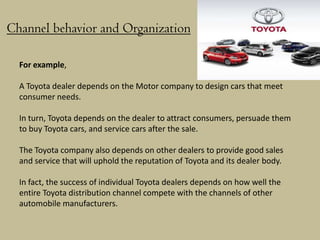
  A Toyota dealer depends on the Motor company to design cars that meet
  consumer needs.

  In turn, Toyota depends on the dealer to attract consumers, persuade them
  to buy Toyota cars, and service cars after the sale.

  The Toyota company also depends on other dealers to provide good sales
  and service that will uphold the reputation of Toyota and its dealer body.

  In fact, the success of individual Toyota dealers depends on how well the
  entire Toyota distribution channel compete with the channels of other
  automobile manufacturers.
Channel Conflicts  Horizontal and Vertical


Horizontal conflicts occurs among firms at the same level of the channel.

 For example, some Ford dealers in Chicago complained about other
dealers in the city who stole sales from them by being too aggressive in
their pricing and advertising or by selling outside their assigned territories.

Vertical conflicts refers to conflicts between different levels of the same
channel.

 For example, General Motors came into conflict with its dealer some
years ago by trying to enforce service, pricing, and advertising policies.

Solution : “For ensuring good performance of the channel, each channel
member’s role must be specified and channel conflict must be managed.”
Channel design decisions
 Analyzing customer needs

(a) Lot size (b) Waiting and delivery time (c) Spatial convenience
(d) Product variety (e) Service backup

 Establishing channel objectives

Channel objectives should be stated in terms of targeted service output levels.
Channel design must take into account the strengths and weaknesses of different
types of intermediaries.

 Identifying major channel alternatives

A channel alternative is described by three elements : (a)the types of available
business intermediaries, (b) the number of intermediaries needed, (c) and the terms
and responsibilities of each channel member.

 Evaluating major channel alternatives
Analyzing customer needs
(a) Lot size :

 In buying cars for its fleet, Hertz prefers a channel from which it can buy a
  large lot size.
 A Household wants a channel that permits buying a lot size of one.
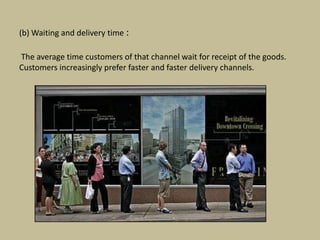
(b) Waiting and delivery time :

The average time customers of that channel wait for receipt of the goods.
Customers increasingly prefer faster and faster delivery channels.
(c) Spatial convenience :
 The degree to which the marketing channel makes it easy for customers to purchase
the product.

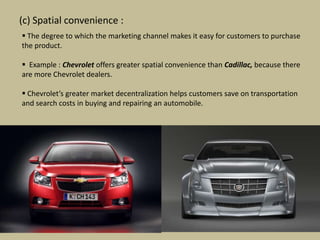
 Example : Chevrolet offers greater spatial convenience than Cadillac, because there
are more Chevrolet dealers.

 Chevrolet’s greater market decentralization helps customers save on transportation
and search costs in buying and repairing an automobile.
(d) Product variety :
  The assortment breadth provided by the marketing channel.

  Normally, customers prefer a greater assortment because more choices
 increase the chance of finding what they need.

       United Spirits Limited (USL) is the largest spirits company in the
      world by volume, selling 114 million cases for the fiscal ending March
      21, 2011.
(e) Service backup :
 • The add-on services are the credit, delivery, installation, repairs and
 others provided by the channel. The greater the service backup, the greater
 the work provided by the channel.
Establishing channel objectives

 Channel objectives are a part of and result from the company‘s marketing
objectives that need to be stated in terms of targeted service output levels.

 Profit considerations and asset utilization must be reflected in channel objectives
and the resultant design.

 It should be the Endeavour of the channel members to minimize the total channel
costs and still provide with the desired level of service outputs.

 For example,
1. Perishable products require more direct marketing because of the dangers
    associated with delays and repeated handling.
2. Products requiring installation and/or maintenance services are usually sold and
    maintained by the company or exclusively branches dealers.
3. Custom-built machinery and specialized business forms are sold directly by
    company sales representatives because middlemen lack the requisite
    knowledge.
Identifying major channel alternatives

 Companies can choose from a wide variety of channels for reaching customers
from sales forces to agents, distributors, dealers, direct mail, telemarketing, and
the internet.

   Three Elements of Channel Alternatives :

   1. The type of business intermediaries  Company Sales force, prospects
      in the area, Manufacture’s Agency, Industrial Distributors..

   2. The number of intermediaries  Intensive Distribution & Exclusive
      Distribution.

   3. Terms and responsibilities of each channel participants  price
      policies, conditions of sale, territorial rights and specific service to be
      performed by each party.
Evaluating major channel alternatives


 Economic criteria :- Each channel alternative will produce a different level of sales and cost.
 Example : Company sales representatives are better trained to sell the company’s products..
 A Sales agency could comically sell more than a company sales force due to more sales guys
and better knowledge of the geographical area..

 Control criteria :- Channel evolution has to include control issues. Using a sales agency poses
a control problem.
 Example : The agent might not master the technical details of the company’s product or handle
its promotion materials effectively.

 Adaptive Criteria :- Each channel involves some duration of commitment and loss of
flexibility.
 Example : A manufactures seeking a sales agency might have to offer a five year contact. During
this period, other means of selling such as direct mail might become more effective, but the
manufactures is not free to drop the sales agency
Channel Management decisions
Channel management warrants :

 Selecting channel members :
   characteristics of intermediaries  channel member’s length of business,
  other lines carried, growth and profit record, cooperativeness and
  reputation.

 Motivating individual channel members :
  Positive motivators  higher margins, special deals, premium, cooperative
  advertising allowances, display allowances and sales contests.
  Negative motivators  threatening to reduce margins, to slow down
  delivery, or to end the relationship altogether.

 Evaluating their performance over time :
   Evaluating standards  sales quotas, average inventory levels, customer
  delivery time, treatment of damaged and lost goods, cooperation in company
  promotion and training programs and customer service.
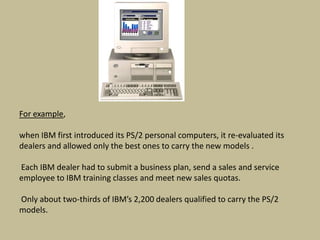
For example,

when IBM first introduced its PS/2 personal computers, it re-evaluated its
dealers and allowed only the best ones to carry the new models .

Each IBM dealer had to submit a business plan, send a sales and service
employee to IBM training classes and meet new sales quotas.

Only about two-thirds of IBM’s 2,200 dealers qualified to carry the PS/2
models.
Presented by Group 1

Members :

1.   Prithvi
2.   Praveen Kumar
3.   Jeevitha Raju
4.   Sai Prathusha
5.   Ganesh
6.   Naveen Kumar

Distribution channels marketing management ppt

  • 1.
    Channels  Nature and importance of channels  Channel behavior & organization  Channel design decisions  Channel Management decisions
  • 2.
    Nature and importanceof channels Most businesses use third parties or intermediaries to bring their products to market. They try to forge a "distribution channel" which can be defined as “All the organizations through which a product must pass between its point of production and consumption“ Why does a business give the job of selling its products to intermediaries? The answer lies in efficiency of distribution costs. Intermediaries are specialists in selling. They have the contacts, experience and scale of operation which means that greater sales can be achieved than if the producing business tried to run a sales operation itself.
  • 3.
    Channel behavior andOrganization For example, A Toyota dealer depends on the Motor company to design cars that meet consumer needs. In turn, Toyota depends on the dealer to attract consumers, persuade them to buy Toyota cars, and service cars after the sale. The Toyota company also depends on other dealers to provide good sales and service that will uphold the reputation of Toyota and its dealer body. In fact, the success of individual Toyota dealers depends on how well the entire Toyota distribution channel compete with the channels of other automobile manufacturers.
  • 4.
    Channel Conflicts Horizontal and Vertical Horizontal conflicts occurs among firms at the same level of the channel.  For example, some Ford dealers in Chicago complained about other dealers in the city who stole sales from them by being too aggressive in their pricing and advertising or by selling outside their assigned territories. Vertical conflicts refers to conflicts between different levels of the same channel.  For example, General Motors came into conflict with its dealer some years ago by trying to enforce service, pricing, and advertising policies. Solution : “For ensuring good performance of the channel, each channel member’s role must be specified and channel conflict must be managed.”
  • 5.
    Channel design decisions Analyzing customer needs (a) Lot size (b) Waiting and delivery time (c) Spatial convenience (d) Product variety (e) Service backup  Establishing channel objectives Channel objectives should be stated in terms of targeted service output levels. Channel design must take into account the strengths and weaknesses of different types of intermediaries.  Identifying major channel alternatives A channel alternative is described by three elements : (a)the types of available business intermediaries, (b) the number of intermediaries needed, (c) and the terms and responsibilities of each channel member.  Evaluating major channel alternatives
  • 6.
    Analyzing customer needs (a)Lot size :  In buying cars for its fleet, Hertz prefers a channel from which it can buy a large lot size.  A Household wants a channel that permits buying a lot size of one.
  • 7.
    (b) Waiting anddelivery time : The average time customers of that channel wait for receipt of the goods. Customers increasingly prefer faster and faster delivery channels.
  • 8.
    (c) Spatial convenience:  The degree to which the marketing channel makes it easy for customers to purchase the product.  Example : Chevrolet offers greater spatial convenience than Cadillac, because there are more Chevrolet dealers.  Chevrolet’s greater market decentralization helps customers save on transportation and search costs in buying and repairing an automobile.
  • 9.
    (d) Product variety:  The assortment breadth provided by the marketing channel.  Normally, customers prefer a greater assortment because more choices increase the chance of finding what they need.  United Spirits Limited (USL) is the largest spirits company in the world by volume, selling 114 million cases for the fiscal ending March 21, 2011.
  • 10.
    (e) Service backup: • The add-on services are the credit, delivery, installation, repairs and others provided by the channel. The greater the service backup, the greater the work provided by the channel.
  • 11.
    Establishing channel objectives Channel objectives are a part of and result from the company‘s marketing objectives that need to be stated in terms of targeted service output levels.  Profit considerations and asset utilization must be reflected in channel objectives and the resultant design.  It should be the Endeavour of the channel members to minimize the total channel costs and still provide with the desired level of service outputs.  For example, 1. Perishable products require more direct marketing because of the dangers associated with delays and repeated handling. 2. Products requiring installation and/or maintenance services are usually sold and maintained by the company or exclusively branches dealers. 3. Custom-built machinery and specialized business forms are sold directly by company sales representatives because middlemen lack the requisite knowledge.
  • 12.
    Identifying major channelalternatives  Companies can choose from a wide variety of channels for reaching customers from sales forces to agents, distributors, dealers, direct mail, telemarketing, and the internet. Three Elements of Channel Alternatives : 1. The type of business intermediaries  Company Sales force, prospects in the area, Manufacture’s Agency, Industrial Distributors.. 2. The number of intermediaries  Intensive Distribution & Exclusive Distribution. 3. Terms and responsibilities of each channel participants  price policies, conditions of sale, territorial rights and specific service to be performed by each party.
  • 13.
    Evaluating major channelalternatives  Economic criteria :- Each channel alternative will produce a different level of sales and cost.  Example : Company sales representatives are better trained to sell the company’s products..  A Sales agency could comically sell more than a company sales force due to more sales guys and better knowledge of the geographical area..  Control criteria :- Channel evolution has to include control issues. Using a sales agency poses a control problem.  Example : The agent might not master the technical details of the company’s product or handle its promotion materials effectively.  Adaptive Criteria :- Each channel involves some duration of commitment and loss of flexibility.  Example : A manufactures seeking a sales agency might have to offer a five year contact. During this period, other means of selling such as direct mail might become more effective, but the manufactures is not free to drop the sales agency
  • 14.
    Channel Management decisions Channelmanagement warrants :  Selecting channel members : characteristics of intermediaries  channel member’s length of business, other lines carried, growth and profit record, cooperativeness and reputation.  Motivating individual channel members : Positive motivators  higher margins, special deals, premium, cooperative advertising allowances, display allowances and sales contests. Negative motivators  threatening to reduce margins, to slow down delivery, or to end the relationship altogether.  Evaluating their performance over time : Evaluating standards  sales quotas, average inventory levels, customer delivery time, treatment of damaged and lost goods, cooperation in company promotion and training programs and customer service.
  • 15.
    For example, when IBMfirst introduced its PS/2 personal computers, it re-evaluated its dealers and allowed only the best ones to carry the new models . Each IBM dealer had to submit a business plan, send a sales and service employee to IBM training classes and meet new sales quotas. Only about two-thirds of IBM’s 2,200 dealers qualified to carry the PS/2 models.
  • 16.
    Presented by Group1 Members : 1. Prithvi 2. Praveen Kumar 3. Jeevitha Raju 4. Sai Prathusha 5. Ganesh 6. Naveen Kumar