Welcome
An Introduction to
Business Model Canvas
Catherine Duggan
Monday 23 May 2016
About Me
Aim
Aim:
• To introduce the Business Model Canvas Tool
Objectives:
1. Define a Business Model
2. Show a real life example
3. Explore the 9 Building Blocks
of the Business Model Canvas
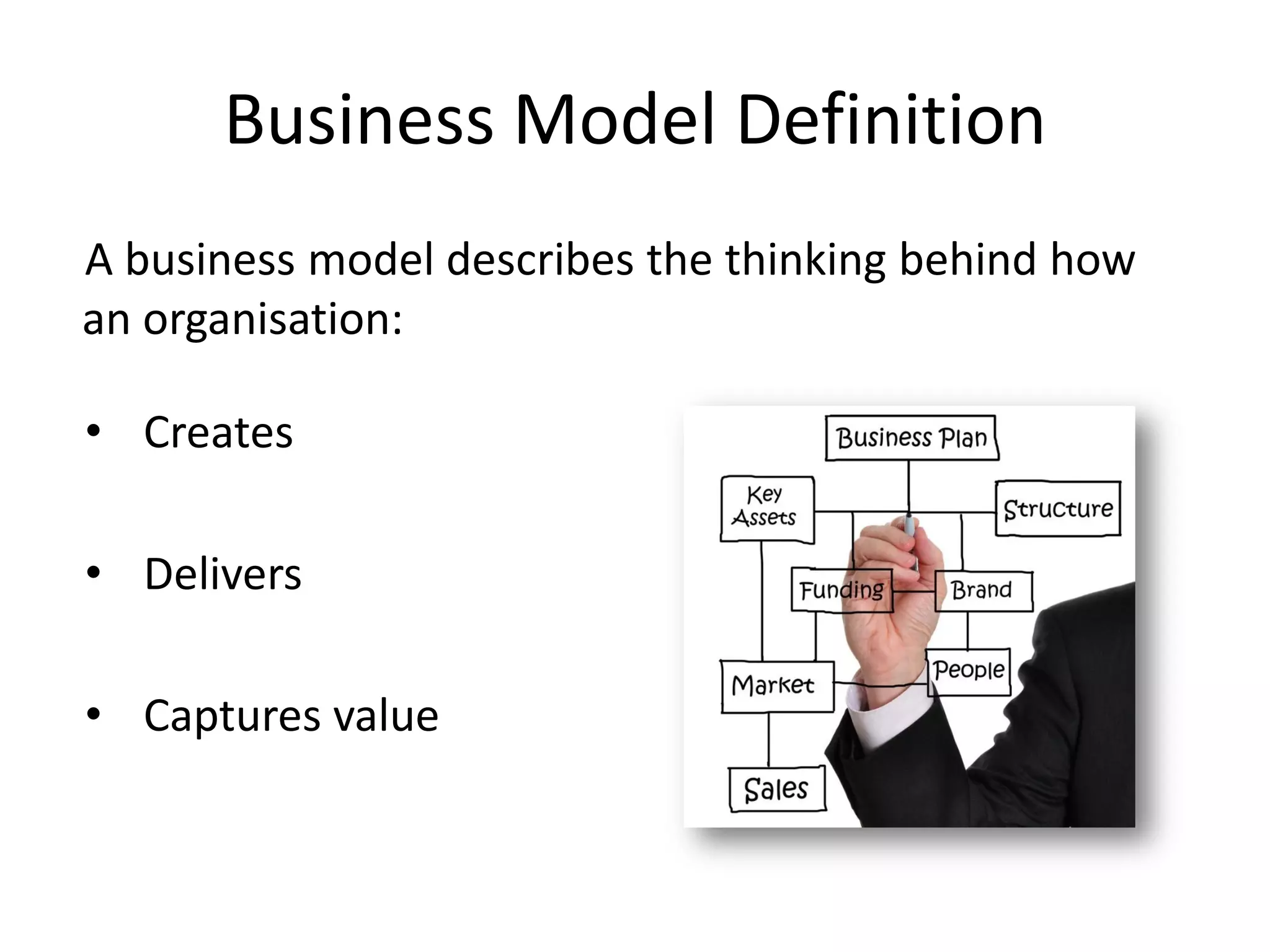
Business Model Definition
A business model describes the thinking behind how
an organisation:
• Creates
• Delivers
• Captures value
Future based:
• Predictions
• Estimations
• Timings
Traditional Business Plan
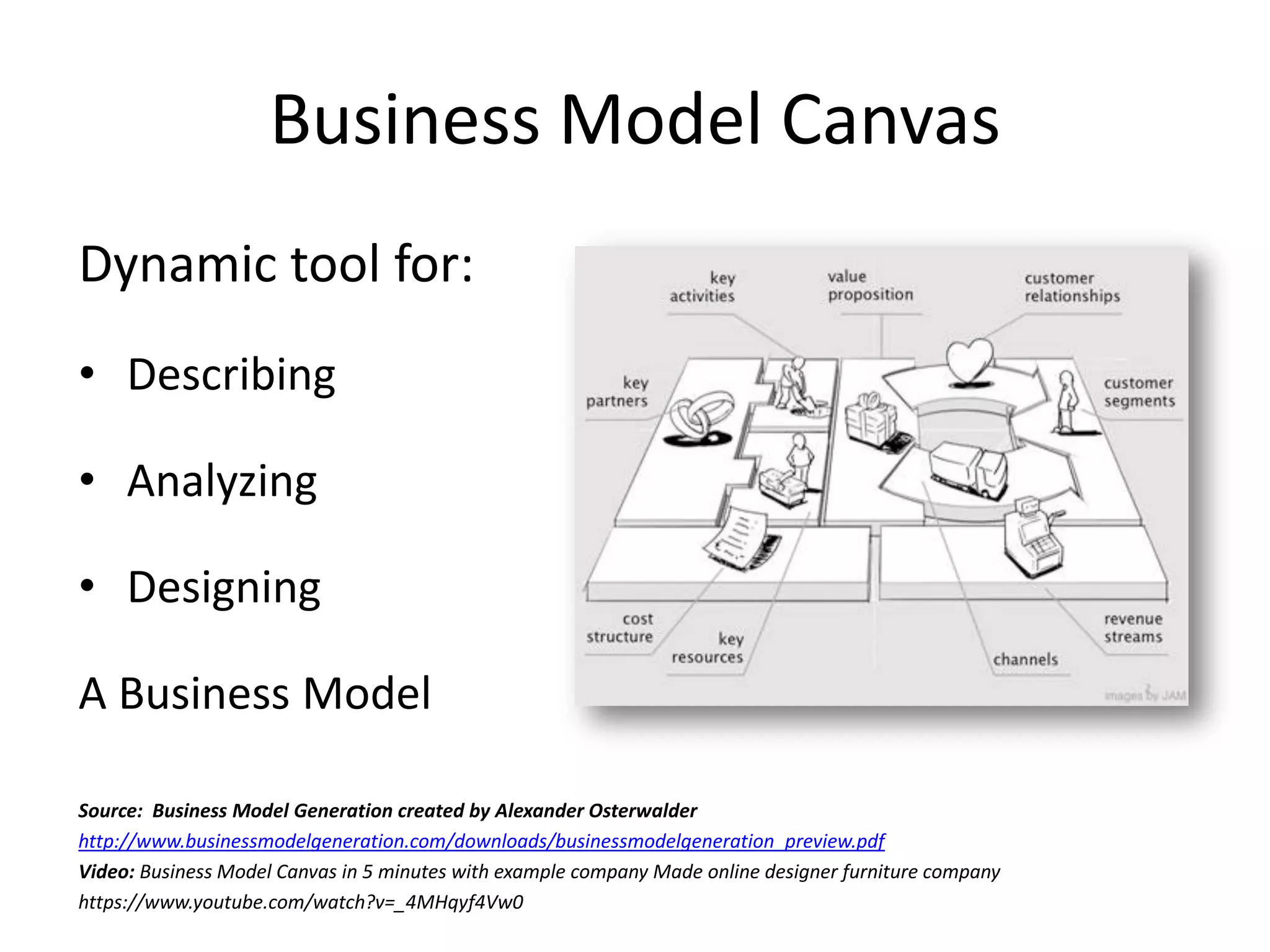
Dynamic tool for:
• Describing
• Analyzing
• Designing
A Business Model
Source: Business Model Generation created by Alexander Osterwalder
http://www.businessmodelgeneration.com/downloads/businessmodelgeneration_preview.pdf
Video: Business Model Canvas in 5 minutes with example company Made online designer furniture company
https://www.youtube.com/watch?v=_4MHqyf4Vw0
Business Model Canvas
Strategic business planning tool with 9 Building Blocks
1. Value Proposition
2. Customer Segments
3. Channels
4. Customer Relationships
5. Revenue Streams
6. Key Resources
7. Key Activities
8. Key Partnerships
9. Cost Structure
1. Value Proposition
Tries to solve customer problem & satisfy
their needs with value propositions.
• What value do we deliver to the customer?
• Which one of our customer’s problems are
we helping to solve?
• What bundles of products & services are
we offering to each Customer Segment?
• Which customer needs are we satisfying?
1. Value Proposition
v
v
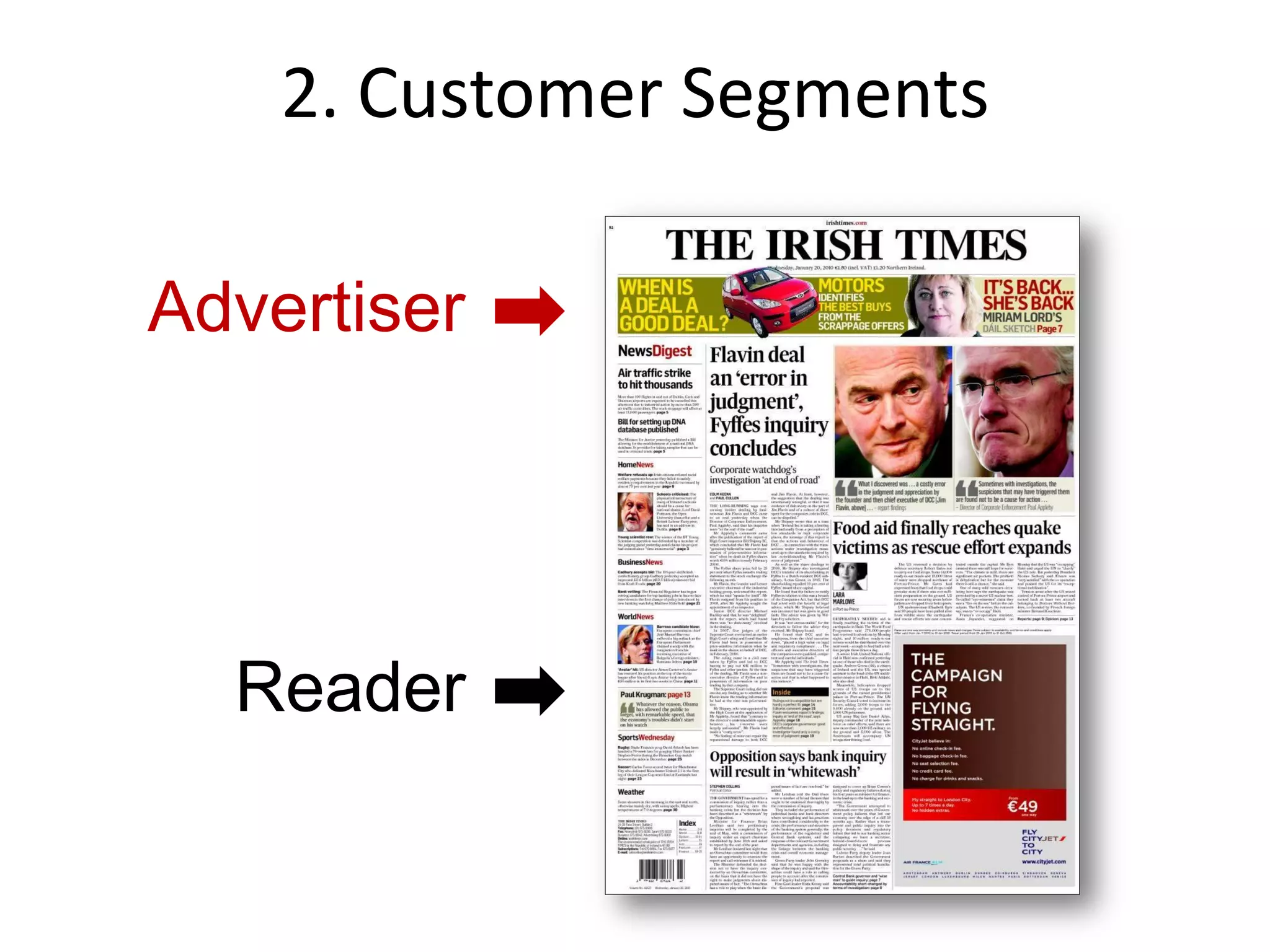
2. Customer Segments
For whom are we creating value?
Who are our most important
customers?
• Mass Market
• Niche Market
• Segmented
2. Customer Segments
Reader
Advertiser
3. Channels
Value propositions are delivered to
customers through communication,
distribution, and sales channels.
• How are we reaching them now?
• How are our Channels integrated?
• Which ones work best?
• Which ones are most cost-efficient?
• How are we integrating them with
customer routines?
3. Channels Phases
Channel Phases
1. Awareness: How to raise awareness about
our company’s products & services?
2. Evaluations: How to help customers evaluate
our organisation's Value Proposition?
3. Purchase: How to allow customers to
purchase specific products and services?
4. Delivery: How to deliver a Value Proposition
to customers?
5. After sales: How to provide post-purchase
customer support?
4. Customer Relationships
Customer relationships are established
& maintained with each Customer Segment.
• What type of relationship does each of
our Customer Segments expect us to
establish & maintain with them?
• Which ones have we established?
• How are they integrated with the rest
of our business model?
• How costly are they?
Customer Relationships
v
v
5. Revenue Streams
A result from value propositions
successfully offered to customers.
• For what value are our customers really
willing to pay?
• For what do they currently pay?
• How are they currently paying?
• How would they prefer to pay?
• How much does each Revenue Stream
contribute to overall revenues?
5. Revenue Streams
Types
• Subscription Fees
• Lending/Renting/Leasing
• Licensing
• Brokerage fees
• Advertising
5. Revenue Streams
6. Key Resources
These are the assets required to provide
• Distribution Channels
• Customer Relationships
Types
 Physical
 Intellectual
(brand patents, copyrights, data)
 Human
 Financial
6. Key Resources
7. Key Activities
What Key Activities do Value Propositions require?
• Distribution Channels?
• Customer Relationships?
• Revenue Streams?
Categories
• Production
• Problem Solving
• Platform/Network
Some activities are outsourced &
some resources are acquired outside
• Who are our Key Partners?
• Who are our Key Suppliers?
• Which Key Resources are we acquiring from partners?
• Which Key Activities do partners perform?
Motivation
 Optimisation & economy
 Reduction of risk & uncertainty
 Acquisition of particular resources & activities
8. Key Partnerships
Customer Relationships
v
v
9. Cost Structure
The business model elements result in the
cost structure
• What are the most important costs?
• Which Key Resources are most expensive?
• Which Key Activities are most expensive?
Is your business more?
• Cost Driven (leanest cost structure)
• Value Driven (focused on value creation)
Sample characteristics
• Fixed Costs (salaries, rents, utilities)
• Variable costs
Business Model Canvas
What next?
• Test the guesses in the Building Model Canvas
• Get out of the building and talk to customers
• Only when potential customers validate the idea,
then build the product or service
• Saves time & money
• Or Pivot
Summary
Aim:
• To introduce the Business Model Canvas Tool
Objectives:
1. Define a Business Model
2. Show a real life example
3. Explore the 9 Building Blocks
of the Business Model Canvas
Additional Information
YouTube
Business Model Canvas in 5 minutes
https://www.youtube.com/watch?v=_4MHqyf4Vw0
Strategyzer.com
Business Model Canvas Explained
• https://www.youtube.com/watch?v=QoAOzMTLP5s
Business Model Canvas Tutorial Episodes 1 - 6
• https://www.youtube.com/watch?v=wwShFsSFb-Y
• https://www.youtube.com/watch?v=wlKP-BaC0jA
• https://www.youtube.com/watch?v=iA5MVUNkSkM
• https://www.youtube.com/watch?v=7O36YBn9x_4
• https://www.youtube.com/watch?v=-2gd_vhNYT4
• https://www.youtube.com/watch?v=SshglHDKQCc
Catherine Duggan:
gmail: duggancatherine56@gmail.com
LinkedIn: ie.linkedin.com/pub/catherine-kearns/40/b4a/126/
Conclusion
Thank you for your attention
Questions & Answers

Updated Business Model Canvas 23 May 2016

  • 1.
    Welcome An Introduction to BusinessModel Canvas Catherine Duggan Monday 23 May 2016
  • 2.
  • 3.
    Aim Aim: • To introducethe Business Model Canvas Tool Objectives: 1. Define a Business Model 2. Show a real life example 3. Explore the 9 Building Blocks of the Business Model Canvas
  • 4.
    Business Model Definition Abusiness model describes the thinking behind how an organisation: • Creates • Delivers • Captures value
  • 5.
    Future based: • Predictions •Estimations • Timings Traditional Business Plan
  • 6.
    Dynamic tool for: •Describing • Analyzing • Designing A Business Model Source: Business Model Generation created by Alexander Osterwalder http://www.businessmodelgeneration.com/downloads/businessmodelgeneration_preview.pdf Video: Business Model Canvas in 5 minutes with example company Made online designer furniture company https://www.youtube.com/watch?v=_4MHqyf4Vw0 Business Model Canvas
  • 7.
    Business Model Canvas Strategicbusiness planning tool with 9 Building Blocks 1. Value Proposition 2. Customer Segments 3. Channels 4. Customer Relationships 5. Revenue Streams 6. Key Resources 7. Key Activities 8. Key Partnerships 9. Cost Structure
  • 8.
    1. Value Proposition Triesto solve customer problem & satisfy their needs with value propositions. • What value do we deliver to the customer? • Which one of our customer’s problems are we helping to solve? • What bundles of products & services are we offering to each Customer Segment? • Which customer needs are we satisfying?
  • 9.
  • 10.
    2. Customer Segments Forwhom are we creating value? Who are our most important customers? • Mass Market • Niche Market • Segmented
  • 11.
  • 12.
    3. Channels Value propositionsare delivered to customers through communication, distribution, and sales channels. • How are we reaching them now? • How are our Channels integrated? • Which ones work best? • Which ones are most cost-efficient? • How are we integrating them with customer routines?
  • 13.
    3. Channels Phases ChannelPhases 1. Awareness: How to raise awareness about our company’s products & services? 2. Evaluations: How to help customers evaluate our organisation's Value Proposition? 3. Purchase: How to allow customers to purchase specific products and services? 4. Delivery: How to deliver a Value Proposition to customers? 5. After sales: How to provide post-purchase customer support?
  • 14.
    4. Customer Relationships Customerrelationships are established & maintained with each Customer Segment. • What type of relationship does each of our Customer Segments expect us to establish & maintain with them? • Which ones have we established? • How are they integrated with the rest of our business model? • How costly are they?
  • 15.
  • 16.
    5. Revenue Streams Aresult from value propositions successfully offered to customers. • For what value are our customers really willing to pay? • For what do they currently pay? • How are they currently paying? • How would they prefer to pay? • How much does each Revenue Stream contribute to overall revenues?
  • 17.
    5. Revenue Streams Types •Subscription Fees • Lending/Renting/Leasing • Licensing • Brokerage fees • Advertising
  • 18.
  • 19.
    6. Key Resources Theseare the assets required to provide • Distribution Channels • Customer Relationships Types  Physical  Intellectual (brand patents, copyrights, data)  Human  Financial
  • 20.
  • 21.
    7. Key Activities WhatKey Activities do Value Propositions require? • Distribution Channels? • Customer Relationships? • Revenue Streams? Categories • Production • Problem Solving • Platform/Network
  • 22.
    Some activities areoutsourced & some resources are acquired outside • Who are our Key Partners? • Who are our Key Suppliers? • Which Key Resources are we acquiring from partners? • Which Key Activities do partners perform? Motivation  Optimisation & economy  Reduction of risk & uncertainty  Acquisition of particular resources & activities 8. Key Partnerships
  • 23.
  • 24.
    9. Cost Structure Thebusiness model elements result in the cost structure • What are the most important costs? • Which Key Resources are most expensive? • Which Key Activities are most expensive? Is your business more? • Cost Driven (leanest cost structure) • Value Driven (focused on value creation) Sample characteristics • Fixed Costs (salaries, rents, utilities) • Variable costs
  • 25.
  • 26.
    What next? • Testthe guesses in the Building Model Canvas • Get out of the building and talk to customers • Only when potential customers validate the idea, then build the product or service • Saves time & money • Or Pivot
  • 27.
    Summary Aim: • To introducethe Business Model Canvas Tool Objectives: 1. Define a Business Model 2. Show a real life example 3. Explore the 9 Building Blocks of the Business Model Canvas
  • 28.
    Additional Information YouTube Business ModelCanvas in 5 minutes https://www.youtube.com/watch?v=_4MHqyf4Vw0 Strategyzer.com Business Model Canvas Explained • https://www.youtube.com/watch?v=QoAOzMTLP5s Business Model Canvas Tutorial Episodes 1 - 6 • https://www.youtube.com/watch?v=wwShFsSFb-Y • https://www.youtube.com/watch?v=wlKP-BaC0jA • https://www.youtube.com/watch?v=iA5MVUNkSkM • https://www.youtube.com/watch?v=7O36YBn9x_4 • https://www.youtube.com/watch?v=-2gd_vhNYT4 • https://www.youtube.com/watch?v=SshglHDKQCc Catherine Duggan: gmail: duggancatherine56@gmail.com LinkedIn: ie.linkedin.com/pub/catherine-kearns/40/b4a/126/
  • 29.
    Conclusion Thank you foryour attention Questions & Answers