V
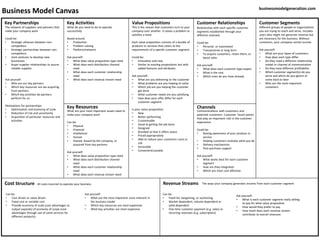
Business Model Canvas
Key Partnerships Key Activities Value Propositions Customer Relationships Customer Segments
Key Resources Channels
Cost Structure Revenue Streams
Relationship with each specific customer
segments established through your
different channels
Could be:
• Personal or automated
• Transactional or long term
• To acquire customers, retain them, or
boost sales
Ask yourself:
• What does each customer type expect
• What is the cost
• Which ones do you have already
Different groups of people or organizations
you are trying to reach and serve. Includes
users who might not generate revenue but
are necessary for the business. Without
customers, your company cannot survive.
Ask yourself:
• What are your types of customers
• How does each type differ
• Do they need a different relationship
model or channel of communication
• Do they have different profitability
• Which customer segment(s) do you
serve and which do you ignore or
come back to later
• Who are the most important
customers
Communications with customers and
potential customers. Customer ‘touch points’
that play an important role in the customer
experience.
Could be:
• Raising awareness of your produce or
service
• Helping customers evaluate what you do
• Delivery mechanisms
• Post-purchase support
Ask yourself:
• What works best for each customer
segment
• How are they integrated
• Which are most cost effective
This is the reason that customers turn to your
company over another. It solves a problem or
satisfies a need.
Each value proposition consists of a bundle of
products or services that caters to the
requirements of a specific customer segment.
Could be:
• Innovative and new
• Similar to existing propositions but with
added features and attributes
Ask yourself:
• What are you delivering to the customer
• What problems are you helping to solve
• Which job are you helping the customer
get done
• What customer needs are you satisfying
• How does your offer differ for each
customer segment
Is your value proposition:
• New
• Better performing
• Customisable
• Good at getting the job done
• Designed
• Branded so that it offers status
• Priced appropriately
• Able to reduce your customers costs or
risk
• Accessible
• Convenient/useable
What do you need to do to operate
successfully
Based around:
• Production
• Problem solving
• Platform/network
Ask yourself:
• What does value proposition type need
• What does each distribution channel
need
• What does each customer relationship
need
• What does each revenue stream need
What are your most important assets need to
make your company work
Can be:
• Physical
• Financial
• Intellectual
• Human
• Owned, leased by the company, or
acquired from key partners
Ask yourself:
• What does value proposition type need
• What does each distribution channel
need
• What does each customer relationship
need
• What does each revenue stream need
The network of suppliers and partners that
make your company work
Could be:
• Strategic alliances between non-
competitors
• Strategic partnerships between non-
competitors
• Joint ventures to develop new
businesses
• Buyer-supplier relationships to assure
reliable supplies
Ask yourself:
• Who are our key partners
• Which key resources are we acquiring
from partners
• Which key activities do partners
perform for us
Motivations for partnerships:
• Optimisation and economy of scale
• Reduction of risk and uncertainty
• Acquisition of particular resources and
activities
All costs incurred to operate your business
Can be:
• Cost driven or value driven
• Fixed cost or variable cost
• Provide economy of scale (cost advantages as
output expands) of economy of scope (cost
advantages through use of same services for
different products)
Ask yourself:
• What are the most important costs inherent in
the business model
• Which key resources are most expensive
• What key activities are most expensive
The ways your company generates income from each customer segment
Can be:
• Fixed list, bargaining, or auctioning
• Market dependent, volume dependent or
yield dependent
• One-time customer payment (e.g. sales) or
recurring revenues (e.g. subscription)
Ask yourself:
• What is each customer segment really willing
to pay for what value proposition
• How would they prefer to pay
• How much does each revenue stream
contribute to overall revenues
businessmodelgeneration.com

Business Model Canvas with Instructions.pptx

  • 1.
    V Business Model Canvas KeyPartnerships Key Activities Value Propositions Customer Relationships Customer Segments Key Resources Channels Cost Structure Revenue Streams Relationship with each specific customer segments established through your different channels Could be: • Personal or automated • Transactional or long term • To acquire customers, retain them, or boost sales Ask yourself: • What does each customer type expect • What is the cost • Which ones do you have already Different groups of people or organizations you are trying to reach and serve. Includes users who might not generate revenue but are necessary for the business. Without customers, your company cannot survive. Ask yourself: • What are your types of customers • How does each type differ • Do they need a different relationship model or channel of communication • Do they have different profitability • Which customer segment(s) do you serve and which do you ignore or come back to later • Who are the most important customers Communications with customers and potential customers. Customer ‘touch points’ that play an important role in the customer experience. Could be: • Raising awareness of your produce or service • Helping customers evaluate what you do • Delivery mechanisms • Post-purchase support Ask yourself: • What works best for each customer segment • How are they integrated • Which are most cost effective This is the reason that customers turn to your company over another. It solves a problem or satisfies a need. Each value proposition consists of a bundle of products or services that caters to the requirements of a specific customer segment. Could be: • Innovative and new • Similar to existing propositions but with added features and attributes Ask yourself: • What are you delivering to the customer • What problems are you helping to solve • Which job are you helping the customer get done • What customer needs are you satisfying • How does your offer differ for each customer segment Is your value proposition: • New • Better performing • Customisable • Good at getting the job done • Designed • Branded so that it offers status • Priced appropriately • Able to reduce your customers costs or risk • Accessible • Convenient/useable What do you need to do to operate successfully Based around: • Production • Problem solving • Platform/network Ask yourself: • What does value proposition type need • What does each distribution channel need • What does each customer relationship need • What does each revenue stream need What are your most important assets need to make your company work Can be: • Physical • Financial • Intellectual • Human • Owned, leased by the company, or acquired from key partners Ask yourself: • What does value proposition type need • What does each distribution channel need • What does each customer relationship need • What does each revenue stream need The network of suppliers and partners that make your company work Could be: • Strategic alliances between non- competitors • Strategic partnerships between non- competitors • Joint ventures to develop new businesses • Buyer-supplier relationships to assure reliable supplies Ask yourself: • Who are our key partners • Which key resources are we acquiring from partners • Which key activities do partners perform for us Motivations for partnerships: • Optimisation and economy of scale • Reduction of risk and uncertainty • Acquisition of particular resources and activities All costs incurred to operate your business Can be: • Cost driven or value driven • Fixed cost or variable cost • Provide economy of scale (cost advantages as output expands) of economy of scope (cost advantages through use of same services for different products) Ask yourself: • What are the most important costs inherent in the business model • Which key resources are most expensive • What key activities are most expensive The ways your company generates income from each customer segment Can be: • Fixed list, bargaining, or auctioning • Market dependent, volume dependent or yield dependent • One-time customer payment (e.g. sales) or recurring revenues (e.g. subscription) Ask yourself: • What is each customer segment really willing to pay for what value proposition • How would they prefer to pay • How much does each revenue stream contribute to overall revenues businessmodelgeneration.com