Business Communication
Definition
• “Communication,”           which       is
  etymologically     related     to   both
  “communion” and “community,” comes
  from the Latin communicare, which means
  “to make common” or “to share.”
• DeVito (1986) expanded on this, writing
  that communication is “the process or
  act of transmitting a message from a
  sender to a receiver, through a channel
  and with the interference of noise”
Definition of Communication
The process of creating and exchanging
 meaning through symbolic interaction.

 ◦ As a process communication constantly
   moves and changes. It does not stand still.
 ◦ Meaning involves thoughts, ideas, and
   understandings shared by communicators.

 ◦ Symbolic means that we rely on words and
   nonverbal behaviors to communicate meaning
   and feelings.
Definition of Communication
Communication is the process of
sharing our ideas, thoughts,
feelings and values with other
people and having those ideas,
thoughts, feelings and values
understood by the people we are
communicating with in the same
sense.
Features of Communication

Two  way communication
Information sharing and
 understanding
Verbal and non-verbal
Circular flow
Goal oriented
Continuous process
Features of Communication

Pervasive activity
Transactional
Complex
Unavoidable
Learned
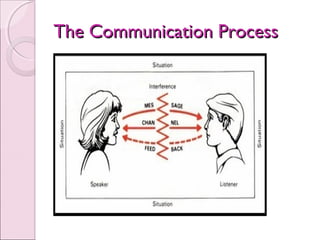
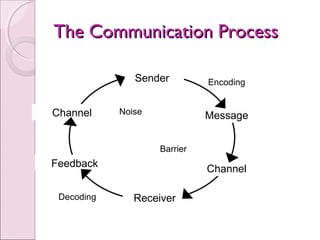
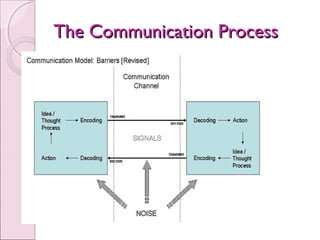
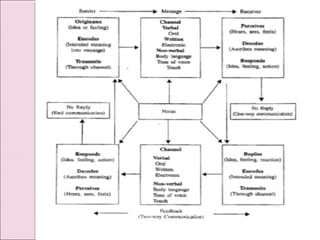
The Communication Process

               Sender         Encoding


Channel     Noise             Message


                    Barrier
Feedback                      Channel

 Decoding      Receiver
The Communication Process
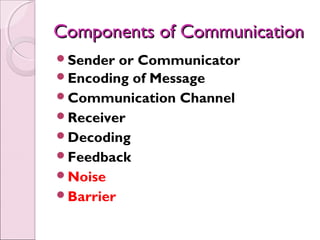
Components of Communication
Sender  or Communicator
Encoding of Message
Communication Channel
Receiver
Decoding
Feedback
Noise
Barrier
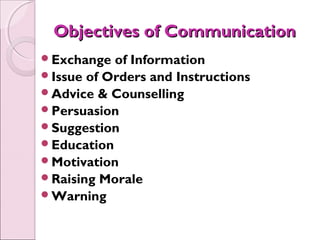
Objectives of Communication
Exchange  of Information
Issue of Orders and Instructions
Advice & Counselling
Persuasion
Suggestion
Education
Motivation
Raising Morale
Warning
Need For Communication

Giant Organization(Large Business
 Houses)
 Global Business Environment
Technological Advancement
Timely Information
Need for Better Human Relations
Better Public Relations.
Importance of Communication
Facilitates Planning
Basis in Decision-making
Achieves Effective Co-ordination
Facilitates Better Administration
Creation of Mutual Trust & Confidence.
Motivation Of Employees
Building Employees Morale
Binding Force
Facilitates Effective Control.
COMMUNICATION
  NETWORKS

CHAIN  NETWORK
WHEEL/Y NETWORK
CIRCULAR NETWORK
FREE FLOW NETWORK/All CHANNELS
KITE NETWORK
SLASH NETWORK
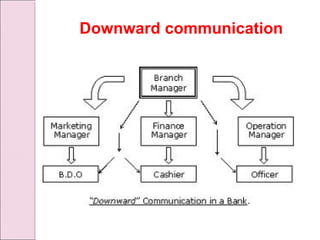
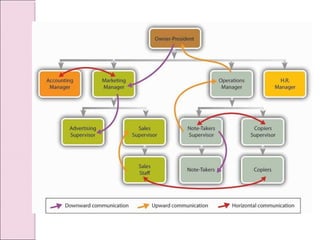
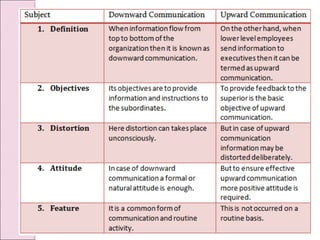
Downward communication
DIRECTION/FLOW OF COMMUNICATION
  Downward       communication represents flow
   of information from top level to lower levels of
   the organisation.

  Modes     of Downward Communication
       Handbooks & Pamphlets
       Posters & Bulletins
       House Journal,
       Direct mail,
       Annual Reports,
       Special Meetings
MERITS OF DOWNWARD COMMUNICATION


  Mission  and Goals
  Plans and Policies
  Duty and Authority
  Job satisfaction
DEMERITS OF DOWNWARD COMMUNICATION


    Distortion
    Incomplete   information.
    Time consuming
    Filtration of Information
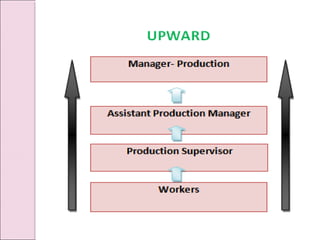
UPWARD
COMMUNICATION
It signifies the flow of communication
 from the lower level to upper level.
Media of upward communication are
 ◦   suggestion system,
 ◦   Grievance procedure,
 ◦   Open-door policy,
 ◦   Questionnaires,
 ◦   Ombudsperson.
MERITS OF UPWARD COMMUNICATION


 Feedback
 Creative ideas
 Better relations
 Overcomes resistance to change
 Increased motivation
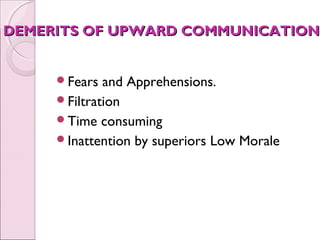
DEMERITS OF UPWARD COMMUNICATION


     Fears  and Apprehensions.
     Filtration
     Time consuming
     Inattention by superiors Low Morale
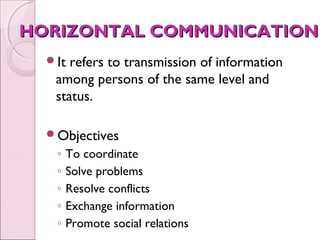
HORIZONTAL COMMUNICATION
  It refers to transmission of information
   among persons of the same level and
   status.

  Objectives
   ◦   To coordinate
   ◦   Solve problems
   ◦   Resolve conflicts
   ◦   Exchange information
   ◦   Promote social relations
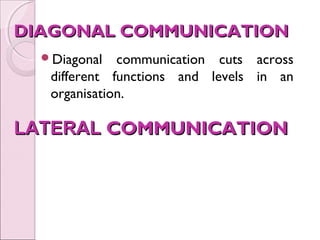
DIAGONAL COMMUNICATION
  Diagonal   communication cuts across
   different functions and levels in an
   organisation.

LATERAL COMMUNICATION
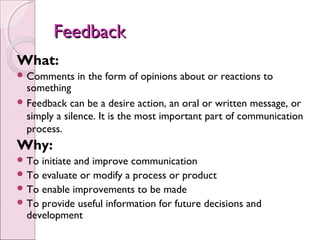
Feedback
What:
 Comments    in the form of opinions about or reactions to
  something
 Feedback can be a desire action, an oral or written message, or
  simply a silence. It is the most important part of communication
  process.
Why:
 To initiate and improve communication
 To evaluate or modify a process or product
 To enable improvements to be made
 To provide useful information for future decisions and
  development
FEEDBACK

Purpose
Types
Importance
Developing   Feedback Skills
PURPOSE OF FEEDBACK

To  provide the information about the work to
 be done.
To facilitate understanding
To tell subordinates about their performance
To give specific directions
To give information about organizational
 procedure and practices
Types of FEEDBACK

     Self Feedback
     Listener’s Feedback
     Positive Feedback
     Negative Feedback
IMPORTANCE OF FEEDBACK
Confirmation   of Transmission
Seeking Solution to Problem
Identification of Change Required
Better Understanding
Better Planning
Overall Coordination
Psychological Satisfaction
Higher Productivity
Development of Employees
Nature of Feedback
Personal   Element

Observation


Detailed   and Specific

Tone


Approach
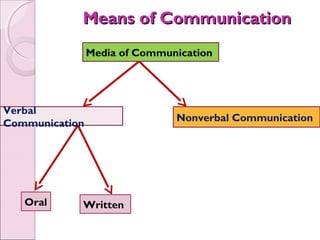
Means of Communication
                Media of Communication


Verbal
                               Nonverbal Communication
Communication


   Oral     Written
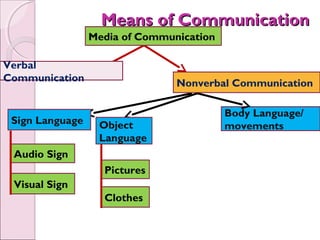
Means of Communication
                 Media of Communication

Verbal
Communication                   Nonverbal Communication

                                          Body Language/
 Sign Language    Object                  movements
                  Language
 Audio Sign
                   Pictures
 Visual Sign
                   Clothes
Means of Communication
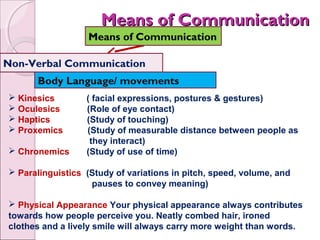
                   Means of Communication

Non-Verbal Communication
      Body Language/ movements
 Kinesics        ( facial expressions, postures & gestures)
 Oculesics       (Role of eye contact)
 Haptics         (Study of touching)
 Proxemics       (Study of measurable distance between people as
                   they interact)
 Chronemics      (Study of use of time)

 Paralinguistics (Study of variations in pitch, speed, volume, and
                   pauses to convey meaning)

 Physical Appearance Your physical appearance always contributes
towards how people perceive you. Neatly combed hair, ironed
clothes and a lively smile will always carry more weight than words.
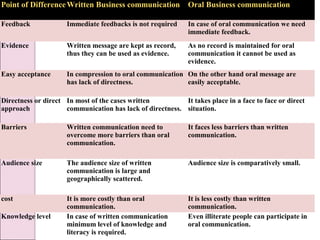
Point of Difference Written Business communication            Oral Business communication

Feedback             Immediate feedbacks is not required      In case of oral communication we need
                                                              immediate feedback.
Evidence             Written message are kept as record,      As no record is maintained for oral
                     thus they can be used as evidence.       communication it cannot be used as
                                                              evidence.
Easy acceptance      In compression to oral communication On the other hand oral message are
                     has lack of directness.              easily acceptable.

Directness or direct In most of the cases written          It takes place in a face to face or direct
approach             communication has lack of directness. situation.

Barriers             Written communication need to            It faces less barriers than written
                     overcome more barriers than oral         communication.
                     communication.

Audience size        The audience size of written             Audience size is comparatively small.
                     communication is large and
                     geographically scattered.

cost                 It is more costly than oral              It is less costly than written
                     communication.                           communication.
Knowledge level      In case of written communication         Even illiterate people can participate in
                     minimum level of knowledge and           oral communication.
                     literacy is required.
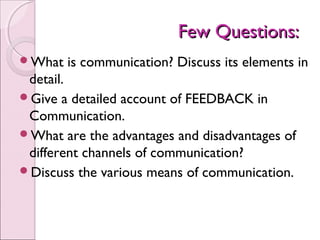
Few Questions:
What   is communication? Discuss its elements in
 detail.
Give a detailed account of FEEDBACK in
 Communication.
What are the advantages and disadvantages of
 different channels of communication?
Discuss the various means of communication.
Bibliography

Business   Communication by K.K.Sinha

Business  Communication Concepts
 and Skills by T.N.Chhabra

Essentialsof Business Communication
 by Rajendra Pal and J.S.Korlahalli
Thank You
    and
  have
     a
 nice daY

Business communication 12 aug

  • 1.
  • 2.
    Definition • “Communication,” which is etymologically related to both “communion” and “community,” comes from the Latin communicare, which means “to make common” or “to share.” • DeVito (1986) expanded on this, writing that communication is “the process or act of transmitting a message from a sender to a receiver, through a channel and with the interference of noise”
  • 3.
    Definition of Communication Theprocess of creating and exchanging meaning through symbolic interaction. ◦ As a process communication constantly moves and changes. It does not stand still. ◦ Meaning involves thoughts, ideas, and understandings shared by communicators. ◦ Symbolic means that we rely on words and nonverbal behaviors to communicate meaning and feelings.
  • 4.
    Definition of Communication Communicationis the process of sharing our ideas, thoughts, feelings and values with other people and having those ideas, thoughts, feelings and values understood by the people we are communicating with in the same sense.
  • 5.
    Features of Communication Two way communication Information sharing and understanding Verbal and non-verbal Circular flow Goal oriented Continuous process
  • 6.
    Features of Communication Pervasiveactivity Transactional Complex Unavoidable Learned
  • 7.
  • 8.
    The Communication Process Sender Encoding Channel Noise Message Barrier Feedback Channel Decoding Receiver
  • 9.
  • 11.
    Components of Communication Sender or Communicator Encoding of Message Communication Channel Receiver Decoding Feedback Noise Barrier
  • 12.
    Objectives of Communication Exchange of Information Issue of Orders and Instructions Advice & Counselling Persuasion Suggestion Education Motivation Raising Morale Warning
  • 13.
    Need For Communication GiantOrganization(Large Business Houses)  Global Business Environment Technological Advancement Timely Information Need for Better Human Relations Better Public Relations.
  • 14.
    Importance of Communication FacilitatesPlanning Basis in Decision-making Achieves Effective Co-ordination Facilitates Better Administration Creation of Mutual Trust & Confidence. Motivation Of Employees Building Employees Morale Binding Force Facilitates Effective Control.
  • 15.
    COMMUNICATION NETWORKS CHAIN NETWORK WHEEL/Y NETWORK CIRCULAR NETWORK FREE FLOW NETWORK/All CHANNELS KITE NETWORK SLASH NETWORK
  • 16.
  • 20.
    DIRECTION/FLOW OF COMMUNICATION Downward communication represents flow of information from top level to lower levels of the organisation. Modes of Downward Communication  Handbooks & Pamphlets  Posters & Bulletins  House Journal,  Direct mail,  Annual Reports,  Special Meetings
  • 21.
    MERITS OF DOWNWARDCOMMUNICATION Mission and Goals Plans and Policies Duty and Authority Job satisfaction
  • 22.
    DEMERITS OF DOWNWARDCOMMUNICATION Distortion Incomplete information. Time consuming Filtration of Information
  • 23.
    UPWARD COMMUNICATION It signifies theflow of communication from the lower level to upper level. Media of upward communication are ◦ suggestion system, ◦ Grievance procedure, ◦ Open-door policy, ◦ Questionnaires, ◦ Ombudsperson.
  • 24.
    MERITS OF UPWARDCOMMUNICATION Feedback Creative ideas Better relations Overcomes resistance to change Increased motivation
  • 25.
    DEMERITS OF UPWARDCOMMUNICATION Fears and Apprehensions. Filtration Time consuming Inattention by superiors Low Morale
  • 30.
    HORIZONTAL COMMUNICATION It refers to transmission of information among persons of the same level and status. Objectives ◦ To coordinate ◦ Solve problems ◦ Resolve conflicts ◦ Exchange information ◦ Promote social relations
  • 31.
    DIAGONAL COMMUNICATION Diagonal communication cuts across different functions and levels in an organisation. LATERAL COMMUNICATION
  • 32.
    Feedback What:  Comments in the form of opinions about or reactions to something  Feedback can be a desire action, an oral or written message, or simply a silence. It is the most important part of communication process. Why:  To initiate and improve communication  To evaluate or modify a process or product  To enable improvements to be made  To provide useful information for future decisions and development
  • 33.
  • 34.
    PURPOSE OF FEEDBACK To provide the information about the work to be done. To facilitate understanding To tell subordinates about their performance To give specific directions To give information about organizational procedure and practices
  • 35.
    Types of FEEDBACK   Self Feedback  Listener’s Feedback  Positive Feedback  Negative Feedback
  • 36.
    IMPORTANCE OF FEEDBACK Confirmation of Transmission Seeking Solution to Problem Identification of Change Required Better Understanding Better Planning Overall Coordination Psychological Satisfaction Higher Productivity Development of Employees
  • 37.
    Nature of Feedback Personal Element Observation Detailed and Specific Tone Approach
  • 38.
    Means of Communication Media of Communication Verbal Nonverbal Communication Communication Oral Written
  • 39.
    Means of Communication Media of Communication Verbal Communication Nonverbal Communication Body Language/ Sign Language Object movements Language Audio Sign Pictures Visual Sign Clothes
  • 40.
    Means of Communication Means of Communication Non-Verbal Communication Body Language/ movements  Kinesics ( facial expressions, postures & gestures)  Oculesics (Role of eye contact)  Haptics (Study of touching)  Proxemics (Study of measurable distance between people as they interact)  Chronemics (Study of use of time)  Paralinguistics (Study of variations in pitch, speed, volume, and pauses to convey meaning)  Physical Appearance Your physical appearance always contributes towards how people perceive you. Neatly combed hair, ironed clothes and a lively smile will always carry more weight than words.
  • 41.
    Point of DifferenceWritten Business communication Oral Business communication Feedback Immediate feedbacks is not required In case of oral communication we need immediate feedback. Evidence Written message are kept as record, As no record is maintained for oral thus they can be used as evidence. communication it cannot be used as evidence. Easy acceptance In compression to oral communication On the other hand oral message are has lack of directness. easily acceptable. Directness or direct In most of the cases written It takes place in a face to face or direct approach communication has lack of directness. situation. Barriers Written communication need to It faces less barriers than written overcome more barriers than oral communication. communication. Audience size The audience size of written Audience size is comparatively small. communication is large and geographically scattered. cost It is more costly than oral It is less costly than written communication. communication. Knowledge level In case of written communication Even illiterate people can participate in minimum level of knowledge and oral communication. literacy is required.
  • 42.
    Few Questions: What is communication? Discuss its elements in detail. Give a detailed account of FEEDBACK in Communication. What are the advantages and disadvantages of different channels of communication? Discuss the various means of communication.
  • 43.
    Bibliography Business Communication by K.K.Sinha Business Communication Concepts and Skills by T.N.Chhabra Essentialsof Business Communication by Rajendra Pal and J.S.Korlahalli
  • 44.
    Thank You and have a nice daY