Communication: An overview
Prepared by:
Rasila Jambucha
Meaning of communication
- Term ‘communication’ derived form the Latin word Communis
which means to share ,I. e. sharing of ideas, concept, feelings
and emotions.
- Literally communication means to inform, to tell, to show, or to
spread information.
Definitions of communication
George vardman – “purposive interchange, resulting in workable
understanding and agreement between the sender and receiver
of a message”.
Robert Anderson – “communication is interchange of thoughts,
opinions, or information, by speech, writing, or signs”.
Allen Louis – “communication is the sum of the entire things one
person does when he wants to create understanding in the mind
of another; it involves a systematic and continuous process of
telling, listening, and understanding”.
Keith Davis – “ The transfer of information and understanding from
one person to another. It is a way of reaching others with facts,
ideas, thoughts and values. It is a bridge of meanings among
people so that they can share what they feel and know. By using
the bridge, a person can cross safely the river of
misunderstanding that sometimes separate people”.
Koontz and O’Donnell – “ The transfer of information from one
person to another whether or not it elicit confidence”.
George Terry – “communication is an exchange of facts, ideas,
opinions or emotions by two or more persons”.
The American Management Association – “ communication is any
behaviour that results in an exchange of meaning”.
D. E. McFarland – “communication may be broadly defined as the
process of interaction among human beings. More specifically it is
the process by which meaning are perceived and understandings
are reached among human beings”.
Peter Little – “communication is a process by which information is
passed between individuals and/or organizations by means of
previously agreed symbols”.
Process of communication
- As communication is two way process there is an exchange of
ideas. It includes five key components.
Sender/encoder/
speaker
Message
Medium/
Channels
Receiver/
Decoder/
Listener
Feedback
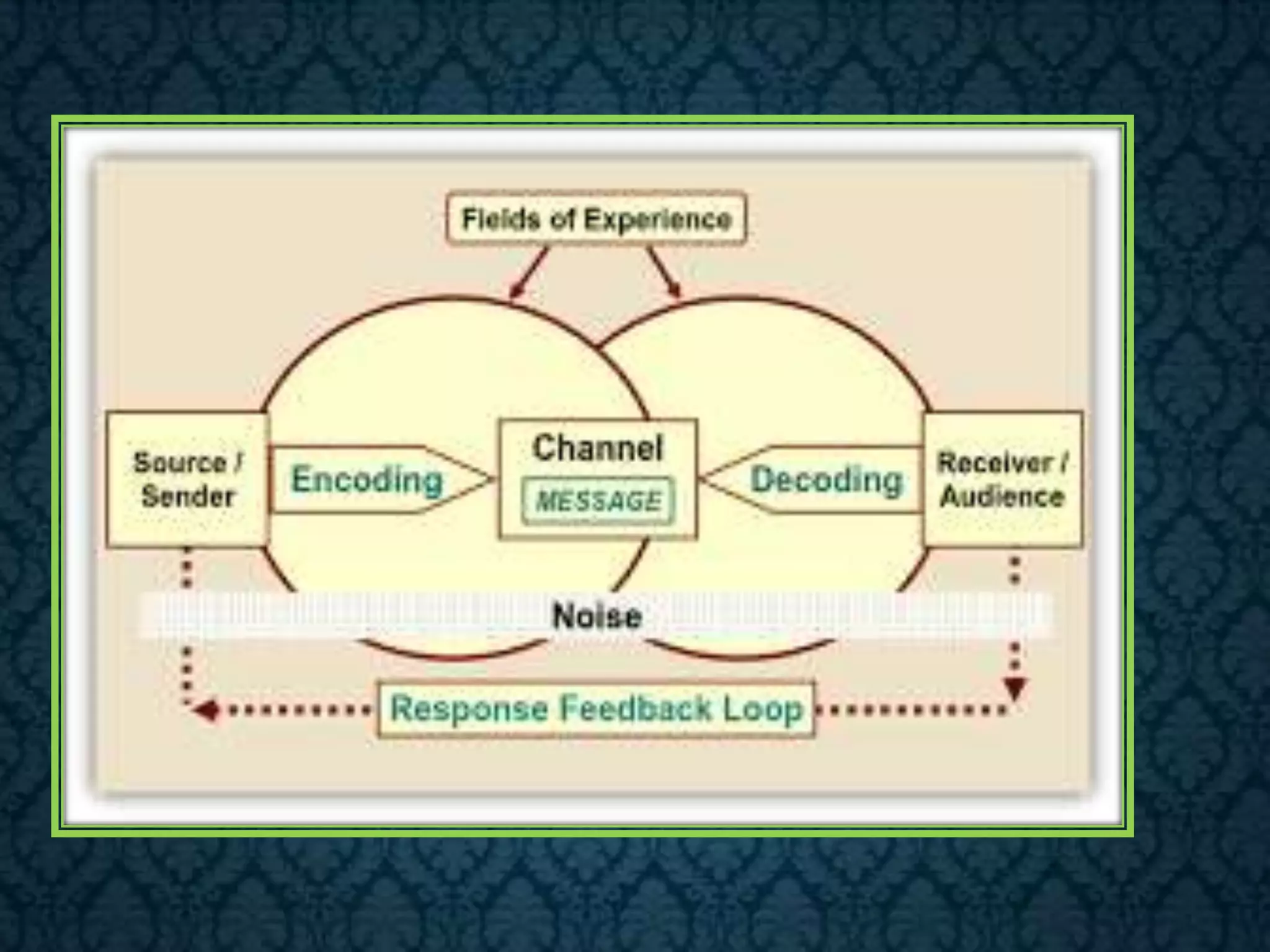
Process of communication
Communication process follows the following steps:
 There is a sender
 The sender has an idea
 The sender encodes the idea into a message
 The message travels through the channel
 Noise in the transmission process
 The receiver gets the message
 The receiver decodes the ,message
 The receiver gives the feedback
1. The sender has an idea
- The intent of this phase is to start the process at a time when a
sender intentionally decide to send a message to someone else.
So, the sender has an idea.
2. The Sender encodes the idea
- When encoding one’s idea, one has to pick the code that will fit the
message and that will allow the receiver to understand. Humans
use a multitude of symbols to represent their ideas. Some symbols
are linguistic (verbal or written) code developed into complex
languages. Languages are many: the Morse code, the Braille
language, the American Sign Language, and all the spoken and
dead languages of the world. Other symbols are also in use to
communicate: mathematical formulas, paintings, pictographs,
hieroglyphs, traffic signals, zip codes, baseball gestures signaling
instructions from managers to players.
3. The sender transmits the message
- In order for the sender to transmit the encoded message, the
sender has to choose a channel, a medium through which to send
the message. Senders can send information verbally or
nonverbally. In nonverbal communication, messages are sent
through gestures, tone of voice, use of space, etc. In verbal
communication, messages are sent through speeches or through
documents.
- A good medium is one that (1) can convey a message using more
than one type of clue (visual and verbal and vocal), (2) can
facilitate feedback, and (3) can establish personal focus. The
richest medium is a face-to-face conversation
4. The receiver gets the message
5. The receiver decodes the message: The receiver always decodes
the message using his or her knowledge of the code used to
encode the message.
6. The receiver send feedback to the sender
- Using the same phases as the sender, the receiver send a
message back to the sender providing information on his or her
level of comprehension of the message.
Noises or barriers to communication process:
- Throughout the communication process, unintentional
interferences occur, distorting or interrupting the process. These
interferences are called noises. Noises can be real noises,
auditory stimuli, like phones ringing, people talking. Noises
distractions and distortions as well: static over a phone, solar
flares altering a television’s reception, or psychological illnesses
modifying how people perceive the world. Communication
without noises has yet to happen. Therefore, recognizing the
sources of noise and attempting to minimize its effect is essential
to improving the efficiency of one’s communication.
Process of communication
This involves a series of actions taking place that involve
various types of expressions, interpretations, response.
verbal communication – use of language
Non verbal communication – use of sign & symbol
Oral communication
 Anything comes from the mouth is referred to as oral. We can
involve,
Listening
- audio clips(ex. Music, today we also got audio clips in
WhatsApp)
Speaking
- Face to face conversation
- Telephone
- Presentation
- Public speech
- Interview
- Meeting
Written communication
- Anything which was in written form (ex. News paper,
magazines, Email)
- The word Write derived from the old English word Writan
which means to scratch, draw or inscribe.
- Written communication requires conscious and creative
efforts.
- Create a permanent record
Reading
-Book late
-Newspaper
-Magazines
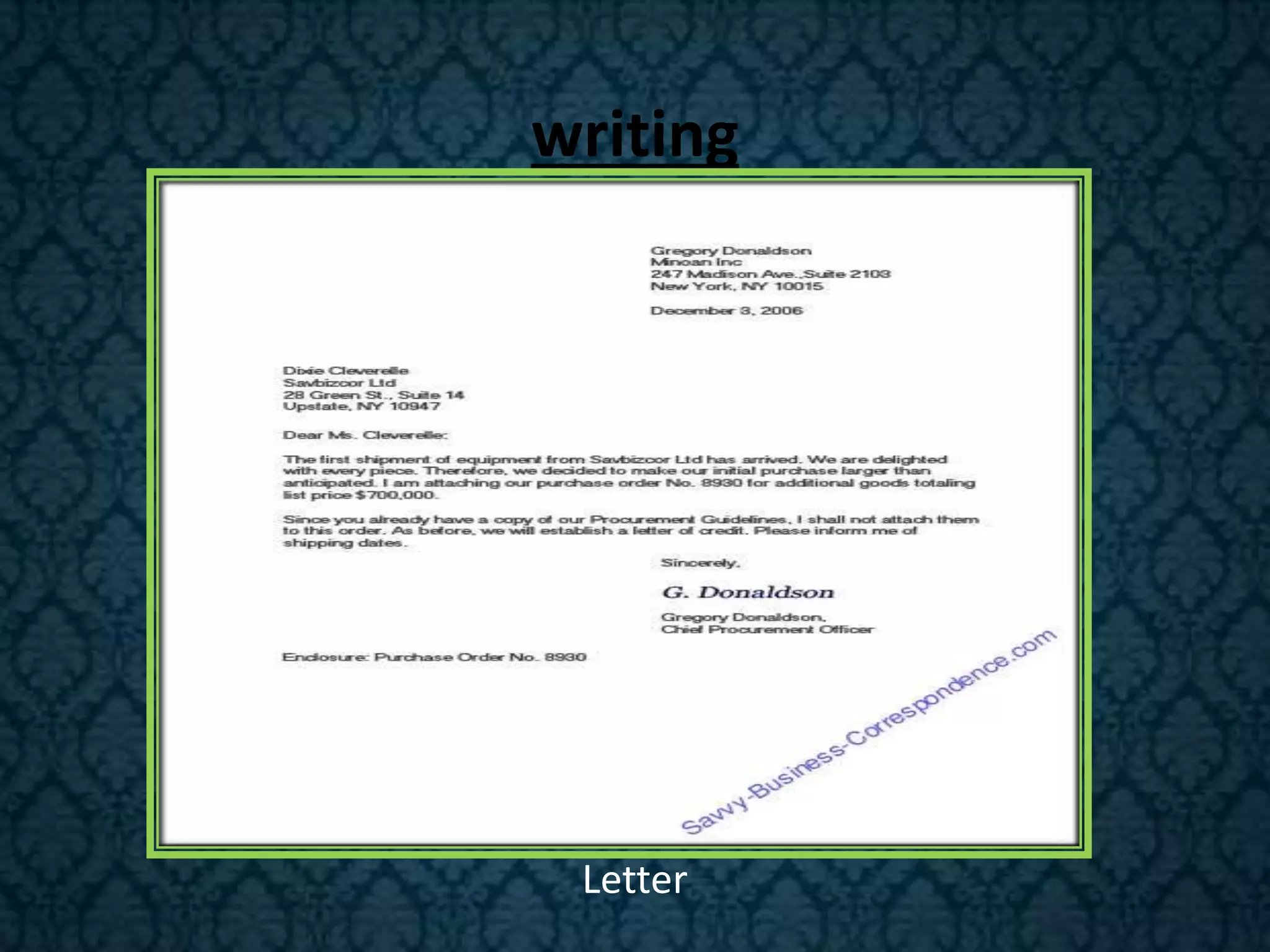
writing
Letter
Memo
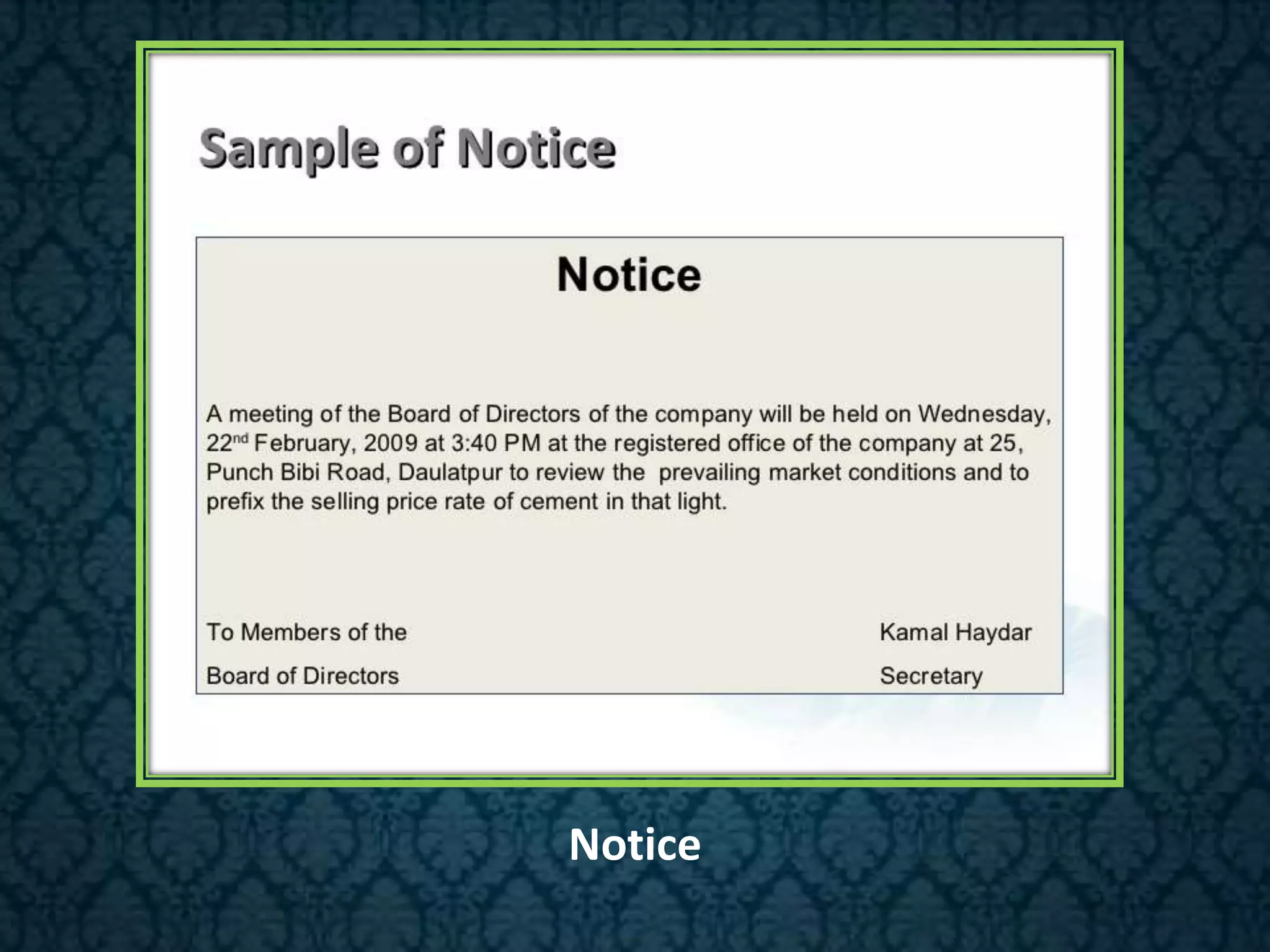
Notice
Circular
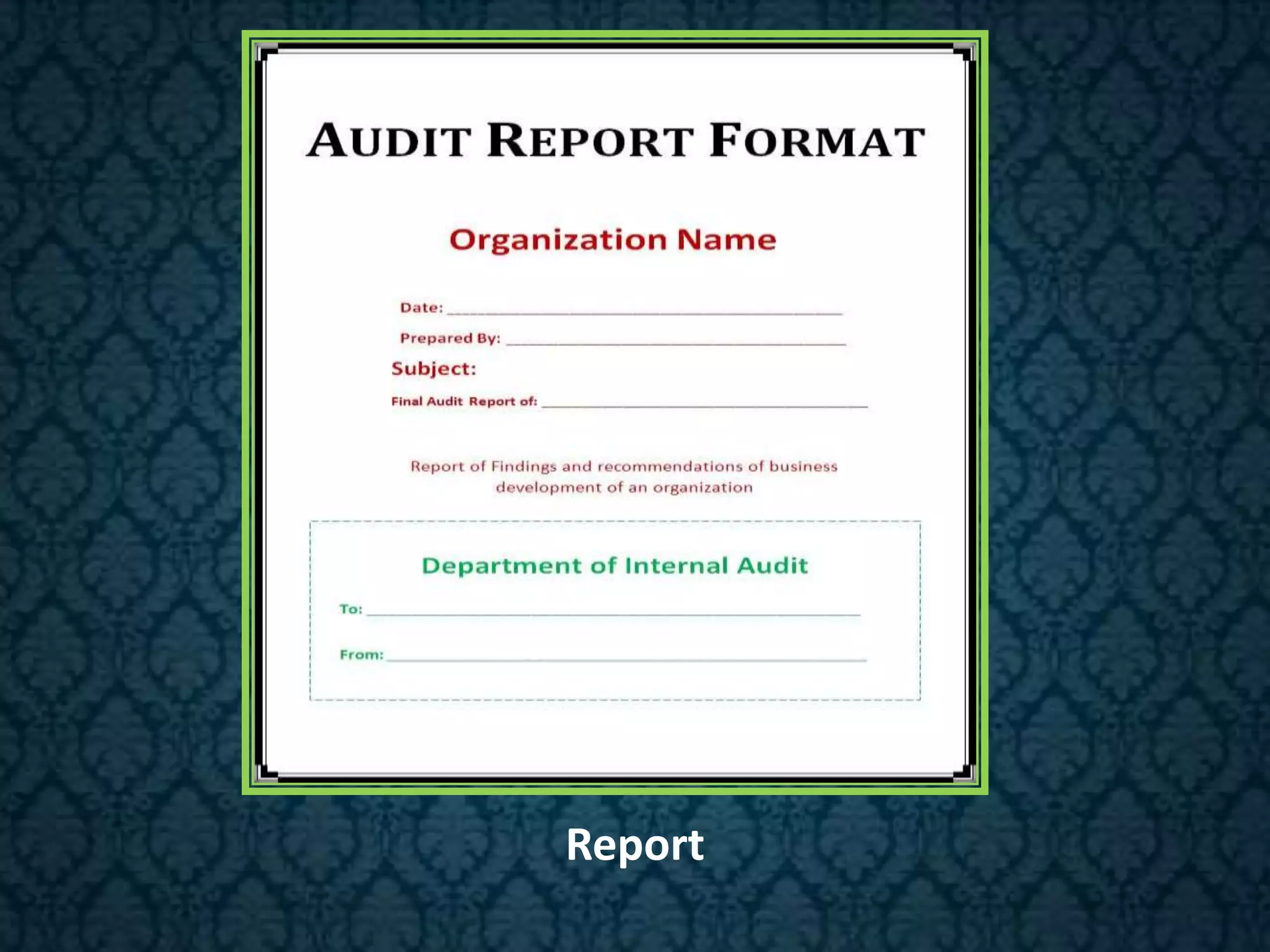
Report
Minutes
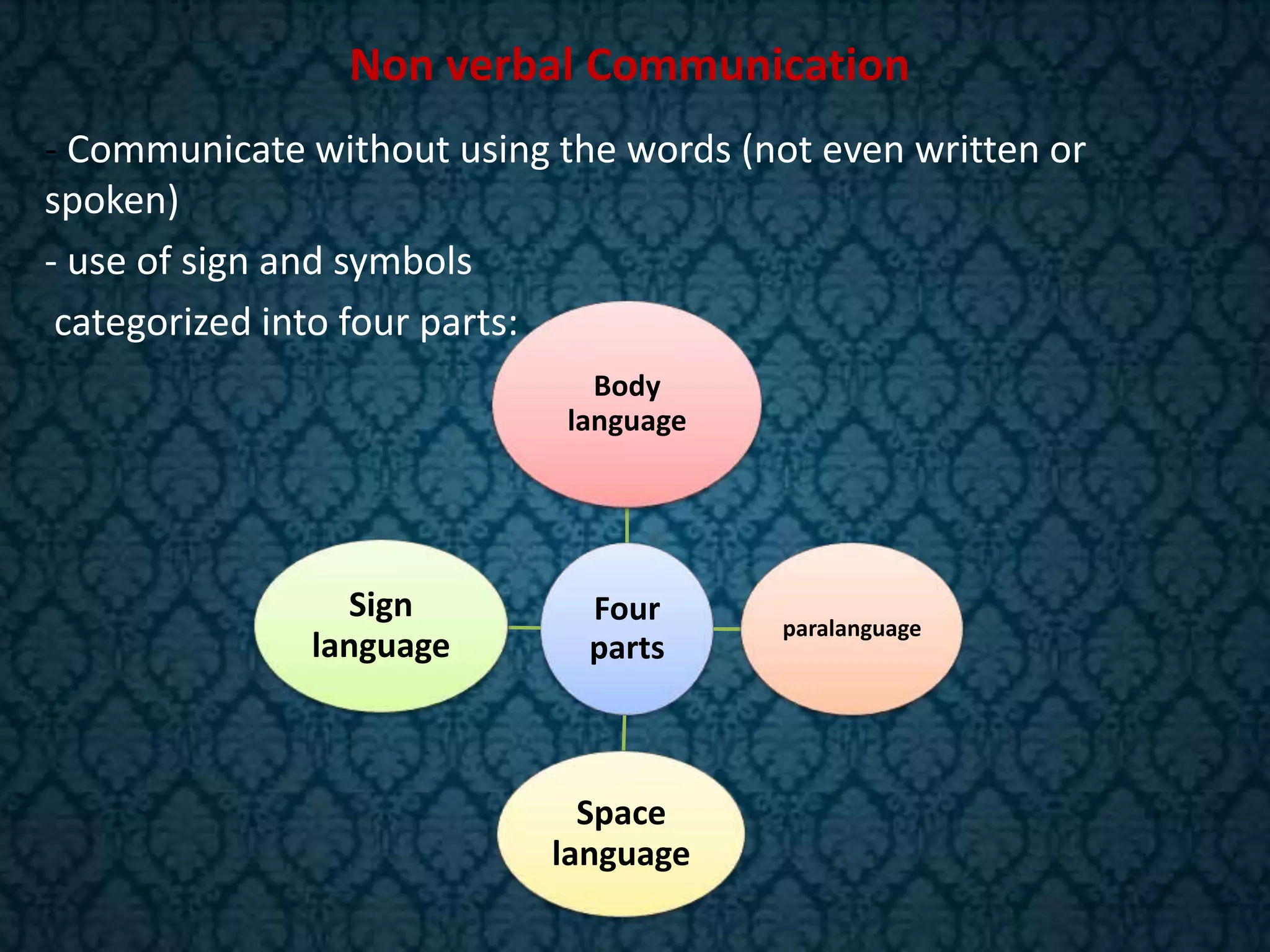
Non verbal Communication
- Communicate without using the words (not even written or
spoken)
- use of sign and symbols
categorized into four parts:
Four
parts
Body
language
paralanguage
Space
language
Sign
language
1)body language covers this points:
Facial expression Eye contact
Gestures
Gestures Appearance
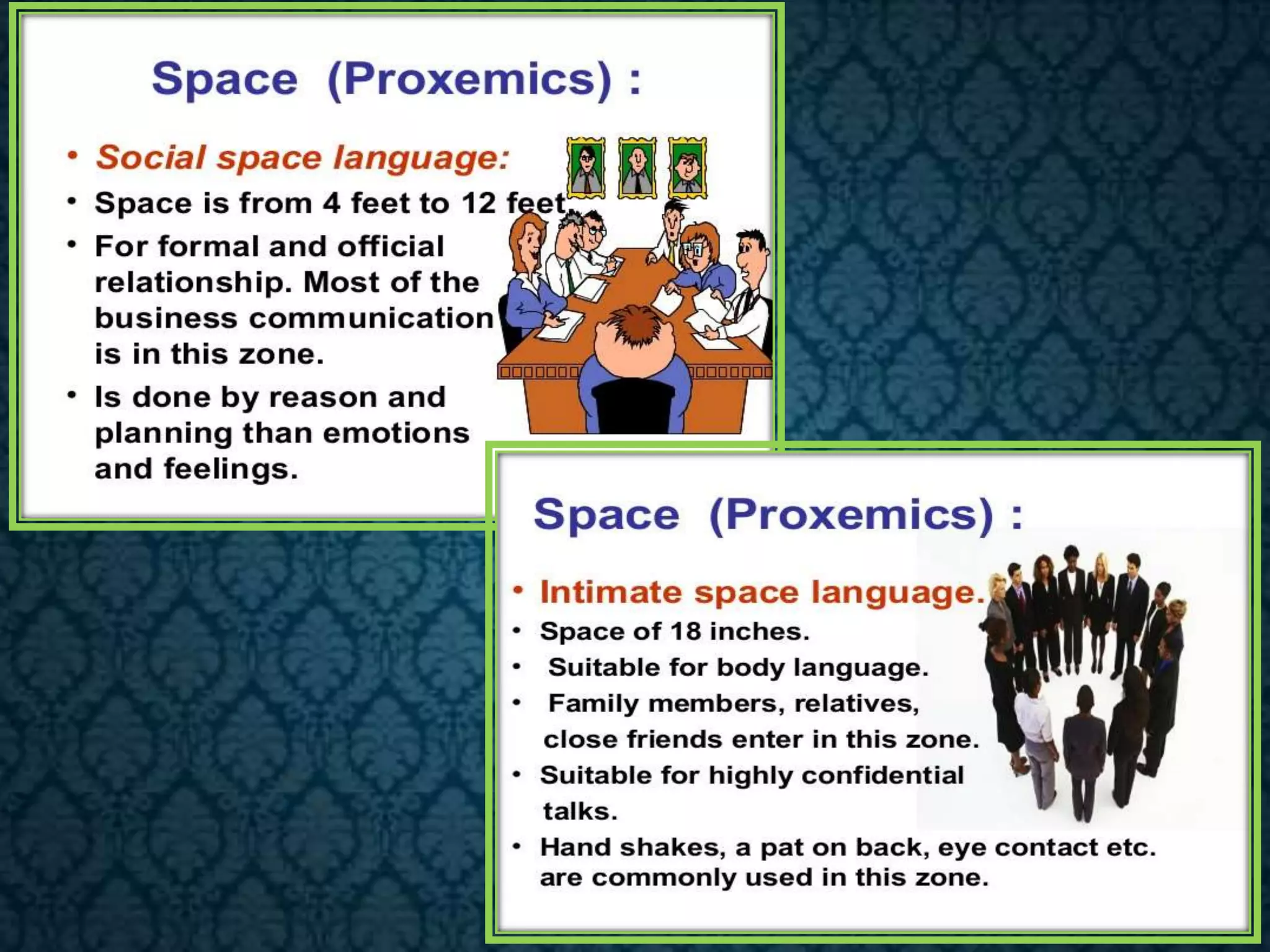
2)
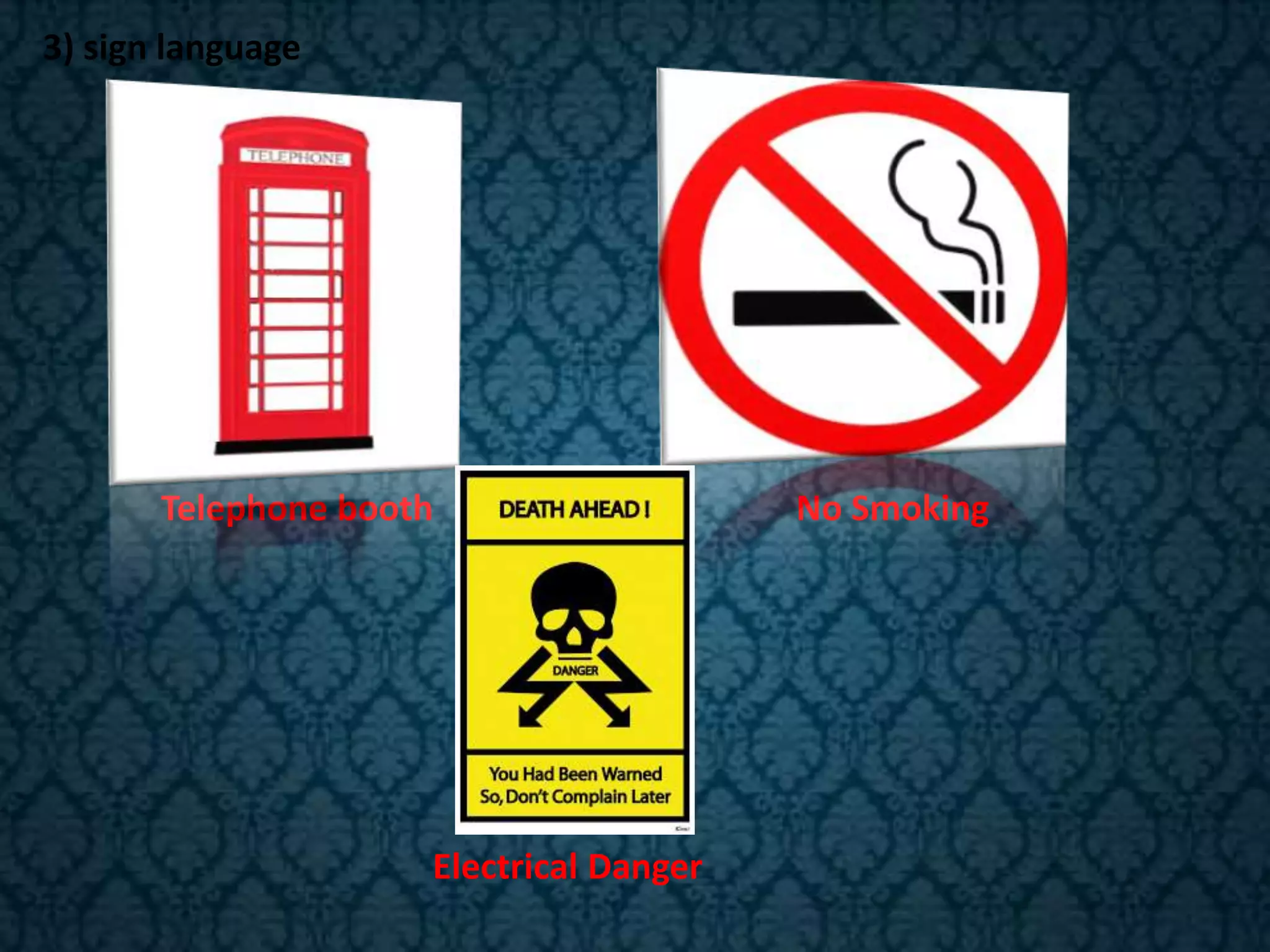
3) sign language
Telephone booth No Smoking
No
Electrical Danger
Objectives of Communication
To inform
To educate
To train To motivate
To integrate
To relate To promote
To entertain
To facilitate
decision-
making
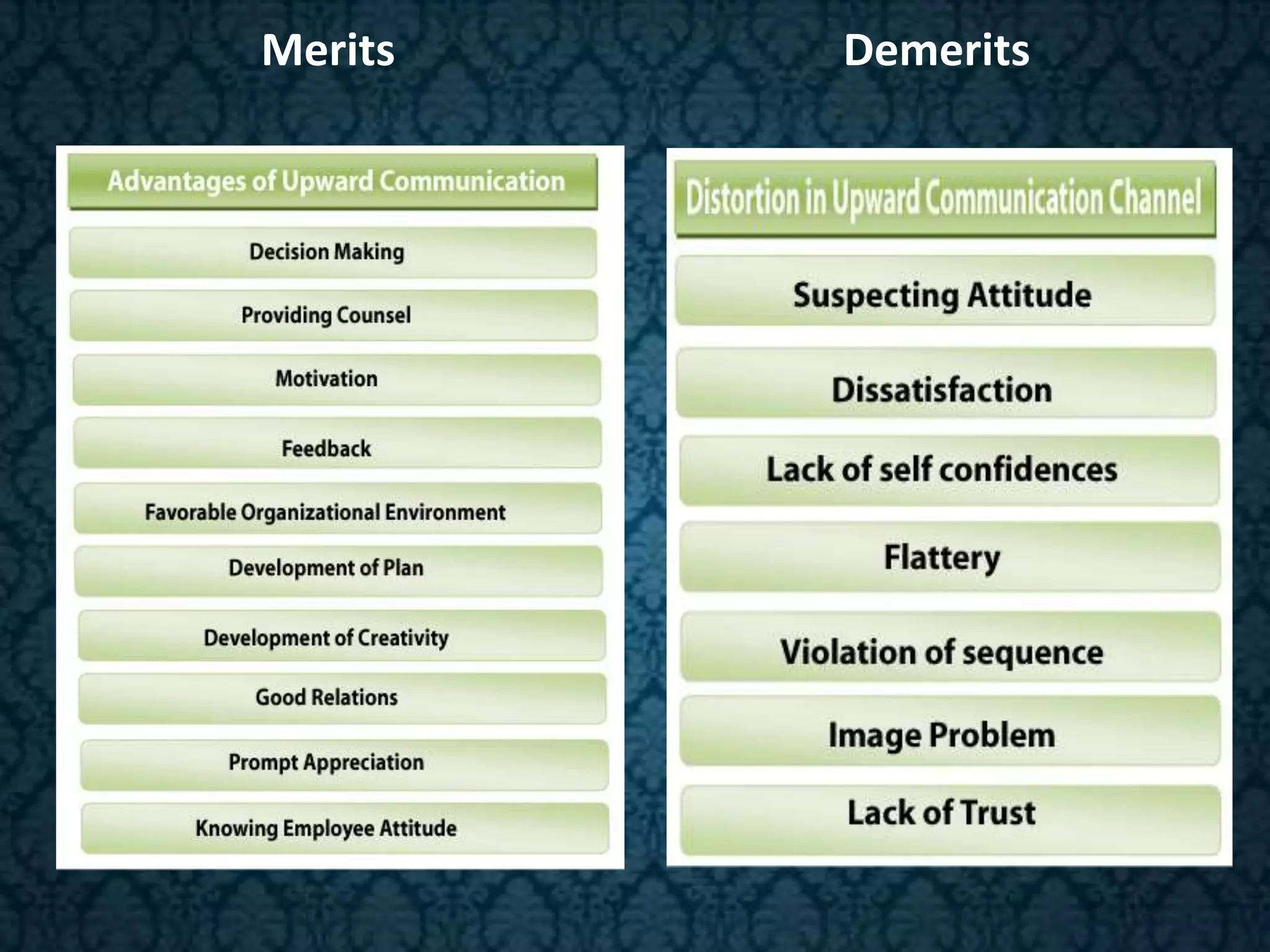
Merits and Demerits of Upward Communication
What does mean by Upward Communication ?
- Process of information flowing from the lower levels of hierarchy
to the upper level
- Ex. Complain and suggestion box, job satisfaction survey,
feedback
- Keeps managers aware of how employees feel about their jobs,
coworkers and organization in general
- Managers also gets ideas on how things can be improved
Merits Demerits
Merits Demerits
Merits and Demerits of Downward communication
What does mean by Downward communication ?
Merits Demerits
Merits and Demerits of Vertical & Horizontal Communication
What does mean by vertical Communication ?
- in this communication, transmission of message takes place in two
opposite level as per situation
- Ex. Just as worker in organization communicating with the
manager of his department, at the same time he communicates
with his co-workers
Merits (Advantage)
- Conveying message of subordinate
- Maintains good labor-management
relations
- Maintains organizational discipline
- Explaining polices and plan
- Effective decision making
- Help in decentralizations
- Avoid by-passing
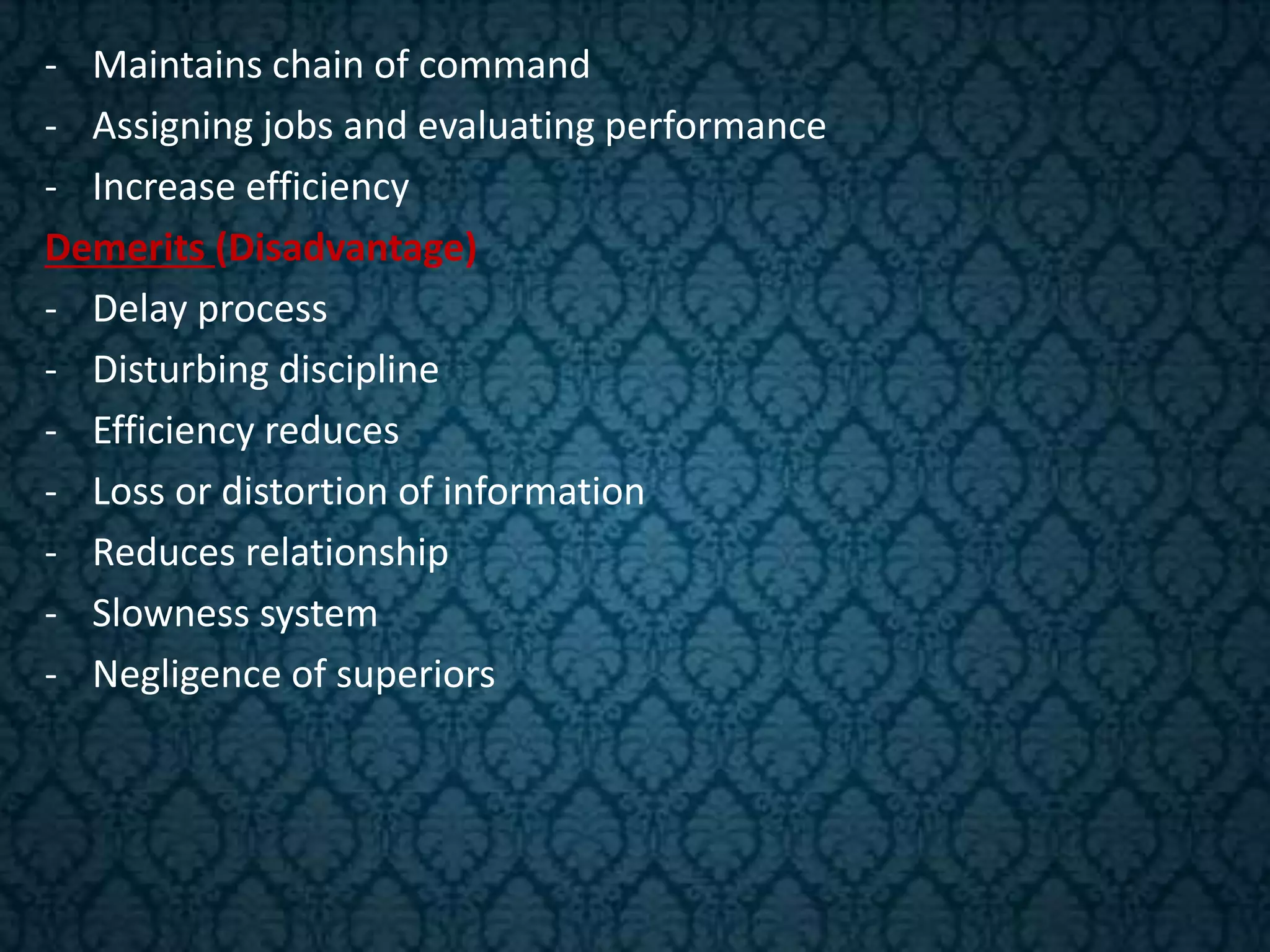
- Maintains chain of command
- Assigning jobs and evaluating performance
- Increase efficiency
Demerits (Disadvantage)
- Delay process
- Disturbing discipline
- Efficiency reduces
- Loss or distortion of information
- Reduces relationship
- Slowness system
- Negligence of superiors
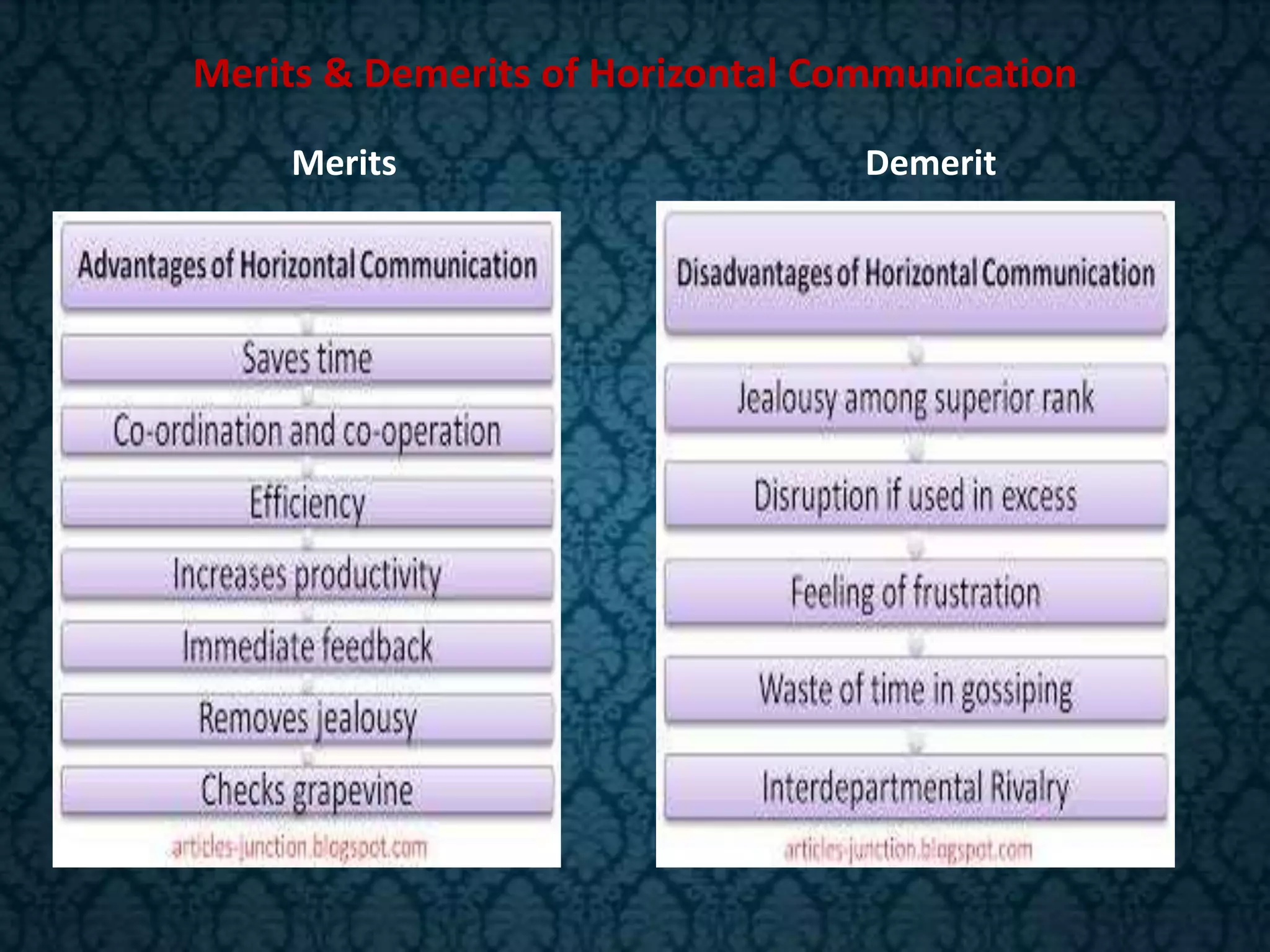
Merits & Demerits of Horizontal Communication
Merits Demerit
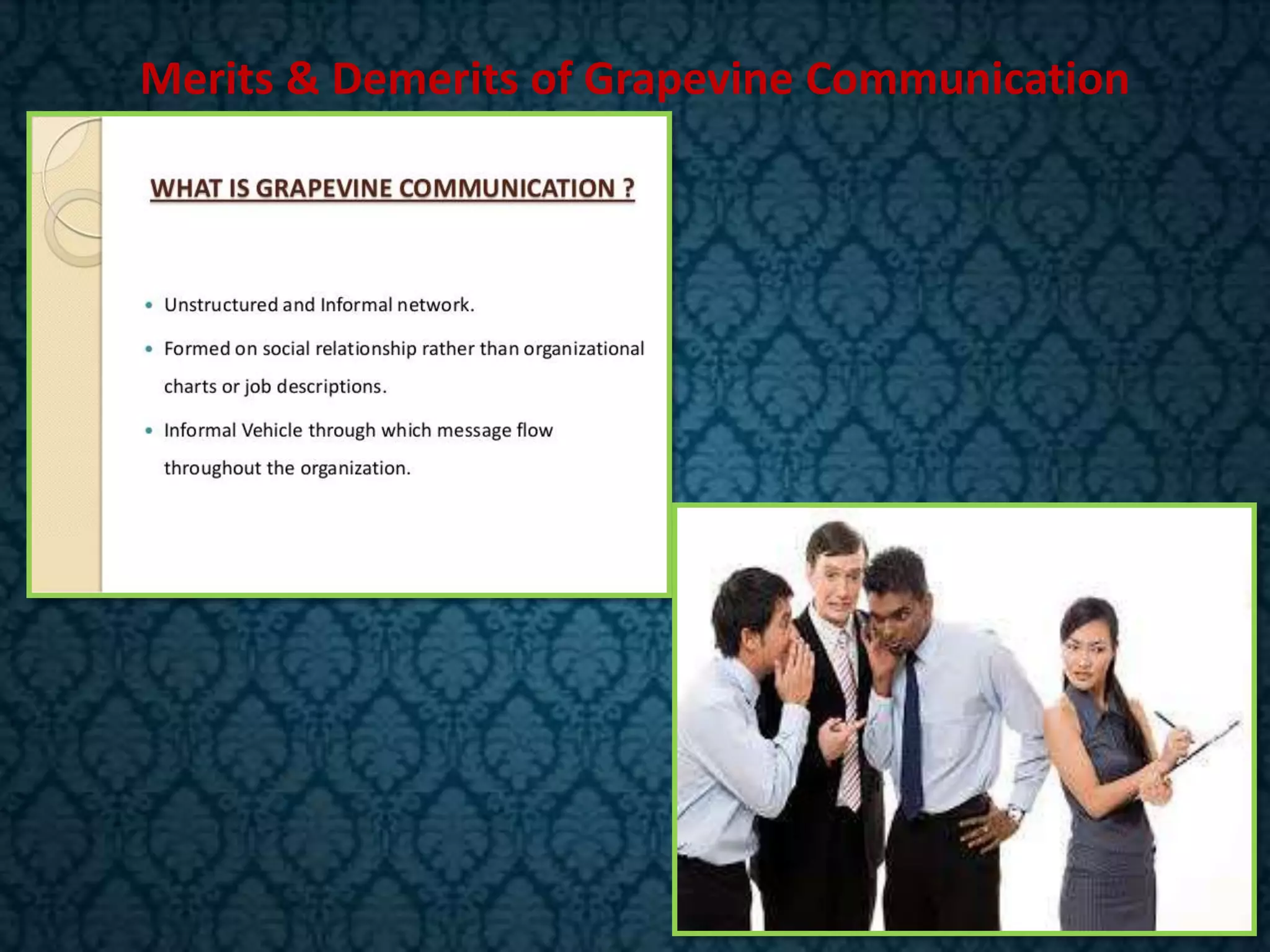
Merits & Demerits of Grapevine Communication
Merits & Demerits of Kinds of Communication Network
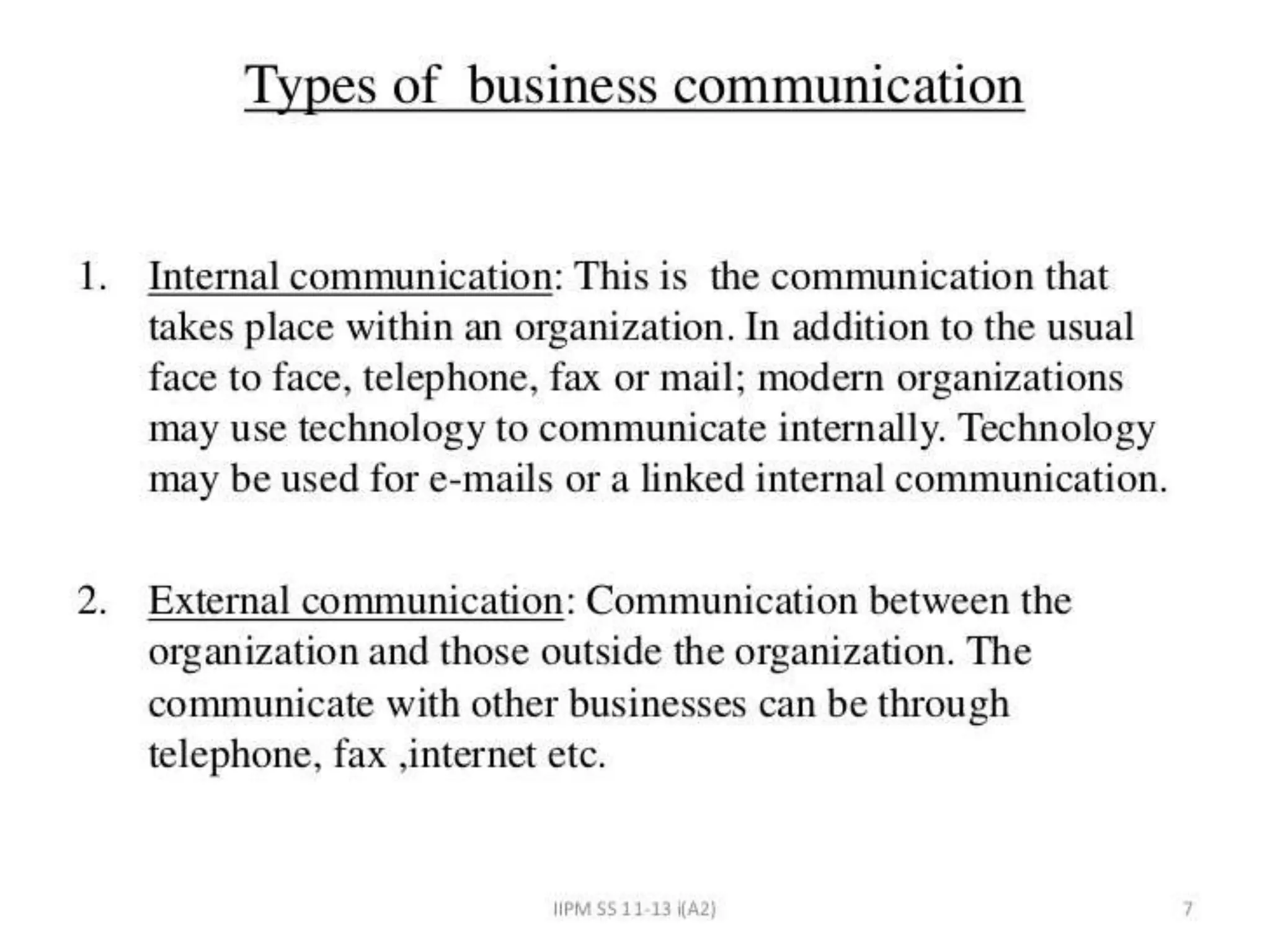
• Two types of communication network:
1. Internal communication
2. External communication
Internal communication – interaction between members of the
same organization
Merits
 It can be readily used
 It is instantaneous
 It is persuasive and cost
effective
 It facilitates effective
person-to-person exchange
 It works very well in small
groups
 It can be supplemented by
non verbal messages
Demerits
 It is not very effective when
the target group is spread
out
 It is constrained by
language, accent and
vocabulary
 It is also constrained by
noise and other physical
barriers
 It is not normally recorded
or documented
 It does not permit repeated
references
Merits & Demerits of Oral Communication
 Less expensive
 Save time
 Immediate feed back
 Personal contact
 Useful for all kind of
audience
 Adjustable
 clarification
Demerits
 It is often dependent on
memory
 Time consuming
 Easily forgotten
 Wide Scope of errors
 No useful for long distance
 No records
 Misunderstanding
 Not useful if speaker is poor
Merits
Merits
 It has an extremely wide
reach
 It creates record and is
easily documented
 It can be erased and
rewritten
 Take a time in high level of
planning and structuring
 Repeated references
 Permanent record
 Legal document
 Suitable for long message
Demerits
 Take a time in reaching the
target
 Less interactive
 Depends on word power
 Takes more time to get
feedback
 Depends on the messenger
and the mode of transmission
 Slow and time consuming
 Lengthy and expensive
 Unsuitable for illiterate people
 Does not provide instant
feedback
Merits & Demerits of written Communication
Formal & Informal Channel of Communication
Recorded vs. Live Communication
- Prepared in advance of its delivery
- Ex. Audio tapes, video tapes
Advantage – delivers a consistent message each time and the
recipient can access the communication at a time that suits them
Live Communication
- Delivered as it happens, in real time
- Ex. Live Radio, T.V broadcast, meeting, video conferencing
Advantage - it is immediate
Passive vs. Interactive communication
- Receiver is not able to respond directly Ex: Audio tapes ,printed
materials ,radio and TV broadcast.
Advantages:
Requires less efforts from the receiver because there are no
opportunities for interaction.
Interactive communication:
- Two way communication
-Each party in the process is able to send and receive messages .
Ex: Emails, Phone calls, videoconferencing calls
Advantages:
Provides feedbacks
Local vs. Remote communication
- t It Stand-alone and off-line.
- Ex. Letters, printed materials, audiotapes, videotapes
Advantage
no sacrifice has to be made to quality because of bandwidth
limitations, and that there are fewer restrictions on where the
media can be used or communication take place
Remote Communication
- Delivered from distance
- Ex. E-mails, internet, videoconferencing
Advantage
there is no delay in sending the message to receiver, whenever they
are. So it can take place over large distances
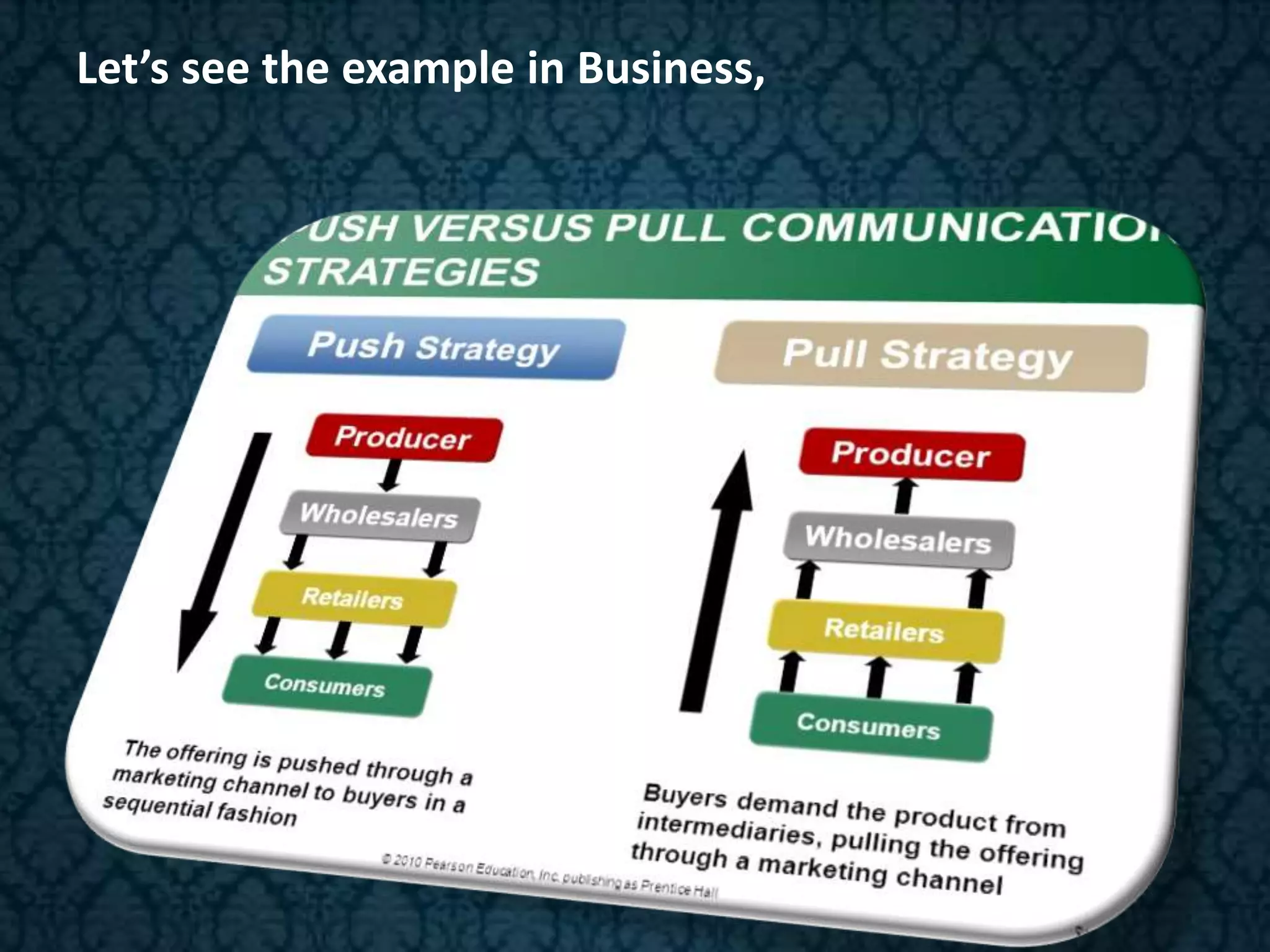
Push vs. Pull Communication
- Message will be sent to specific receiver
- Ex. Letter - in college in Uni. Send a letter , it was for principle or
managing head not for teachers or student. So here the specific
receiver is principle or managing head.
Advantage
message will reach its target within an appropriate timeframe
Pull communication
- Made available to be enter at the receivers desire
- Ex. Internet, radio, TV broadcast
Advantage
it is less stressful for the receiver, and that very large quantities of
information can be made available at any time
Let’s see the example in Business,

Communication: An Overview

  • 1.
  • 2.
    Meaning of communication -Term ‘communication’ derived form the Latin word Communis which means to share ,I. e. sharing of ideas, concept, feelings and emotions. - Literally communication means to inform, to tell, to show, or to spread information.
  • 3.
    Definitions of communication Georgevardman – “purposive interchange, resulting in workable understanding and agreement between the sender and receiver of a message”. Robert Anderson – “communication is interchange of thoughts, opinions, or information, by speech, writing, or signs”. Allen Louis – “communication is the sum of the entire things one person does when he wants to create understanding in the mind of another; it involves a systematic and continuous process of telling, listening, and understanding”. Keith Davis – “ The transfer of information and understanding from one person to another. It is a way of reaching others with facts, ideas, thoughts and values. It is a bridge of meanings among people so that they can share what they feel and know. By using the bridge, a person can cross safely the river of misunderstanding that sometimes separate people”.
  • 4.
    Koontz and O’Donnell– “ The transfer of information from one person to another whether or not it elicit confidence”. George Terry – “communication is an exchange of facts, ideas, opinions or emotions by two or more persons”. The American Management Association – “ communication is any behaviour that results in an exchange of meaning”. D. E. McFarland – “communication may be broadly defined as the process of interaction among human beings. More specifically it is the process by which meaning are perceived and understandings are reached among human beings”. Peter Little – “communication is a process by which information is passed between individuals and/or organizations by means of previously agreed symbols”.
  • 5.
    Process of communication -As communication is two way process there is an exchange of ideas. It includes five key components. Sender/encoder/ speaker Message Medium/ Channels Receiver/ Decoder/ Listener Feedback
  • 6.
    Process of communication Communicationprocess follows the following steps:  There is a sender  The sender has an idea  The sender encodes the idea into a message  The message travels through the channel  Noise in the transmission process  The receiver gets the message  The receiver decodes the ,message  The receiver gives the feedback
  • 8.
    1. The senderhas an idea - The intent of this phase is to start the process at a time when a sender intentionally decide to send a message to someone else. So, the sender has an idea. 2. The Sender encodes the idea - When encoding one’s idea, one has to pick the code that will fit the message and that will allow the receiver to understand. Humans use a multitude of symbols to represent their ideas. Some symbols are linguistic (verbal or written) code developed into complex languages. Languages are many: the Morse code, the Braille language, the American Sign Language, and all the spoken and dead languages of the world. Other symbols are also in use to communicate: mathematical formulas, paintings, pictographs, hieroglyphs, traffic signals, zip codes, baseball gestures signaling instructions from managers to players.
  • 9.
    3. The sendertransmits the message - In order for the sender to transmit the encoded message, the sender has to choose a channel, a medium through which to send the message. Senders can send information verbally or nonverbally. In nonverbal communication, messages are sent through gestures, tone of voice, use of space, etc. In verbal communication, messages are sent through speeches or through documents. - A good medium is one that (1) can convey a message using more than one type of clue (visual and verbal and vocal), (2) can facilitate feedback, and (3) can establish personal focus. The richest medium is a face-to-face conversation 4. The receiver gets the message 5. The receiver decodes the message: The receiver always decodes the message using his or her knowledge of the code used to encode the message.
  • 10.
    6. The receiversend feedback to the sender - Using the same phases as the sender, the receiver send a message back to the sender providing information on his or her level of comprehension of the message. Noises or barriers to communication process: - Throughout the communication process, unintentional interferences occur, distorting or interrupting the process. These interferences are called noises. Noises can be real noises, auditory stimuli, like phones ringing, people talking. Noises distractions and distortions as well: static over a phone, solar flares altering a television’s reception, or psychological illnesses modifying how people perceive the world. Communication without noises has yet to happen. Therefore, recognizing the sources of noise and attempting to minimize its effect is essential to improving the efficiency of one’s communication.
  • 11.
    Process of communication Thisinvolves a series of actions taking place that involve various types of expressions, interpretations, response.
  • 12.
    verbal communication –use of language Non verbal communication – use of sign & symbol
  • 14.
    Oral communication  Anythingcomes from the mouth is referred to as oral. We can involve, Listening - audio clips(ex. Music, today we also got audio clips in WhatsApp) Speaking - Face to face conversation - Telephone - Presentation - Public speech - Interview - Meeting
  • 15.
    Written communication - Anythingwhich was in written form (ex. News paper, magazines, Email) - The word Write derived from the old English word Writan which means to scratch, draw or inscribe. - Written communication requires conscious and creative efforts. - Create a permanent record Reading -Book late -Newspaper -Magazines
  • 16.
  • 17.
  • 18.
  • 19.
  • 20.
  • 21.
  • 22.
    Non verbal Communication -Communicate without using the words (not even written or spoken) - use of sign and symbols categorized into four parts: Four parts Body language paralanguage Space language Sign language
  • 23.
    1)body language coversthis points: Facial expression Eye contact Gestures Gestures Appearance
  • 24.
  • 27.
    3) sign language Telephonebooth No Smoking No Electrical Danger
  • 28.
    Objectives of Communication Toinform To educate To train To motivate To integrate To relate To promote To entertain To facilitate decision- making
  • 29.
    Merits and Demeritsof Upward Communication What does mean by Upward Communication ? - Process of information flowing from the lower levels of hierarchy to the upper level - Ex. Complain and suggestion box, job satisfaction survey, feedback - Keeps managers aware of how employees feel about their jobs, coworkers and organization in general - Managers also gets ideas on how things can be improved
  • 30.
  • 31.
  • 32.
    Merits and Demeritsof Downward communication What does mean by Downward communication ?
  • 33.
  • 34.
    Merits and Demeritsof Vertical & Horizontal Communication What does mean by vertical Communication ?
  • 35.
    - in thiscommunication, transmission of message takes place in two opposite level as per situation - Ex. Just as worker in organization communicating with the manager of his department, at the same time he communicates with his co-workers Merits (Advantage) - Conveying message of subordinate - Maintains good labor-management relations - Maintains organizational discipline - Explaining polices and plan - Effective decision making - Help in decentralizations - Avoid by-passing
  • 36.
    - Maintains chainof command - Assigning jobs and evaluating performance - Increase efficiency Demerits (Disadvantage) - Delay process - Disturbing discipline - Efficiency reduces - Loss or distortion of information - Reduces relationship - Slowness system - Negligence of superiors
  • 38.
    Merits & Demeritsof Horizontal Communication Merits Demerit
  • 39.
    Merits & Demeritsof Grapevine Communication
  • 42.
    Merits & Demeritsof Kinds of Communication Network • Two types of communication network: 1. Internal communication 2. External communication Internal communication – interaction between members of the same organization
  • 46.
    Merits  It canbe readily used  It is instantaneous  It is persuasive and cost effective  It facilitates effective person-to-person exchange  It works very well in small groups  It can be supplemented by non verbal messages Demerits  It is not very effective when the target group is spread out  It is constrained by language, accent and vocabulary  It is also constrained by noise and other physical barriers  It is not normally recorded or documented  It does not permit repeated references Merits & Demerits of Oral Communication
  • 47.
     Less expensive Save time  Immediate feed back  Personal contact  Useful for all kind of audience  Adjustable  clarification Demerits  It is often dependent on memory  Time consuming  Easily forgotten  Wide Scope of errors  No useful for long distance  No records  Misunderstanding  Not useful if speaker is poor Merits
  • 48.
    Merits  It hasan extremely wide reach  It creates record and is easily documented  It can be erased and rewritten  Take a time in high level of planning and structuring  Repeated references  Permanent record  Legal document  Suitable for long message Demerits  Take a time in reaching the target  Less interactive  Depends on word power  Takes more time to get feedback  Depends on the messenger and the mode of transmission  Slow and time consuming  Lengthy and expensive  Unsuitable for illiterate people  Does not provide instant feedback Merits & Demerits of written Communication
  • 49.
    Formal & InformalChannel of Communication Recorded vs. Live Communication - Prepared in advance of its delivery - Ex. Audio tapes, video tapes Advantage – delivers a consistent message each time and the recipient can access the communication at a time that suits them Live Communication - Delivered as it happens, in real time - Ex. Live Radio, T.V broadcast, meeting, video conferencing Advantage - it is immediate
  • 50.
    Passive vs. Interactivecommunication - Receiver is not able to respond directly Ex: Audio tapes ,printed materials ,radio and TV broadcast. Advantages: Requires less efforts from the receiver because there are no opportunities for interaction. Interactive communication: - Two way communication -Each party in the process is able to send and receive messages . Ex: Emails, Phone calls, videoconferencing calls Advantages: Provides feedbacks
  • 51.
    Local vs. Remotecommunication - t It Stand-alone and off-line. - Ex. Letters, printed materials, audiotapes, videotapes Advantage no sacrifice has to be made to quality because of bandwidth limitations, and that there are fewer restrictions on where the media can be used or communication take place Remote Communication - Delivered from distance - Ex. E-mails, internet, videoconferencing Advantage there is no delay in sending the message to receiver, whenever they are. So it can take place over large distances
  • 52.
    Push vs. PullCommunication - Message will be sent to specific receiver - Ex. Letter - in college in Uni. Send a letter , it was for principle or managing head not for teachers or student. So here the specific receiver is principle or managing head. Advantage message will reach its target within an appropriate timeframe Pull communication - Made available to be enter at the receivers desire - Ex. Internet, radio, TV broadcast Advantage it is less stressful for the receiver, and that very large quantities of information can be made available at any time
  • 53.
    Let’s see theexample in Business,