This document discusses different types of communication. There are two main types - verbal communication, which uses words either spoken or written, and non-verbal communication, which conveys meaning through facial expressions, gestures, body language, etc. Verbal communication can be oral, through speaking, or written. Non-verbal communication includes kinesics (body language), vocalics (paralanguage), proxemics (use of space), haptics (touch), and chronemics (use of time). Communication can also be formal, following official rules along the organizational hierarchy, or informal, occurring spontaneously without conforming to formal processes.
What is communication?
TheTerm ‘COMMUNIVATION’ comes
from the Latin word ‘CUMMUNICARE’
which means ‘to share’.
‘COMMUNICATION’ is a process of
passing information, idea and knowledge
between a sender and a receiver
through an accepted code of symbols.
2
Verbal communication isany
communication that uses words to share
information with others. These words may
be both spoken and written.
When messages or information is
exchanged or communicated through
words is called verbal communication.
6
‘Written Communication’ means
transmissionof message, order or
instruction in writing.
The media of written communication are
letter, circular, manual, report, telegram,
office memo, bulletin, journal, magazine,
e-mail, fax, internet, etc.
In written communication feedback
requires some time.
9
10.
It is time-consumingand costly.
Sending of long message or statistical data
with accuracy is suitable for written
communication.
Motivation through written words is less
effective.
A written document preserved properly
becomes a permanent record of the
organization and can be used as future
reference.
10
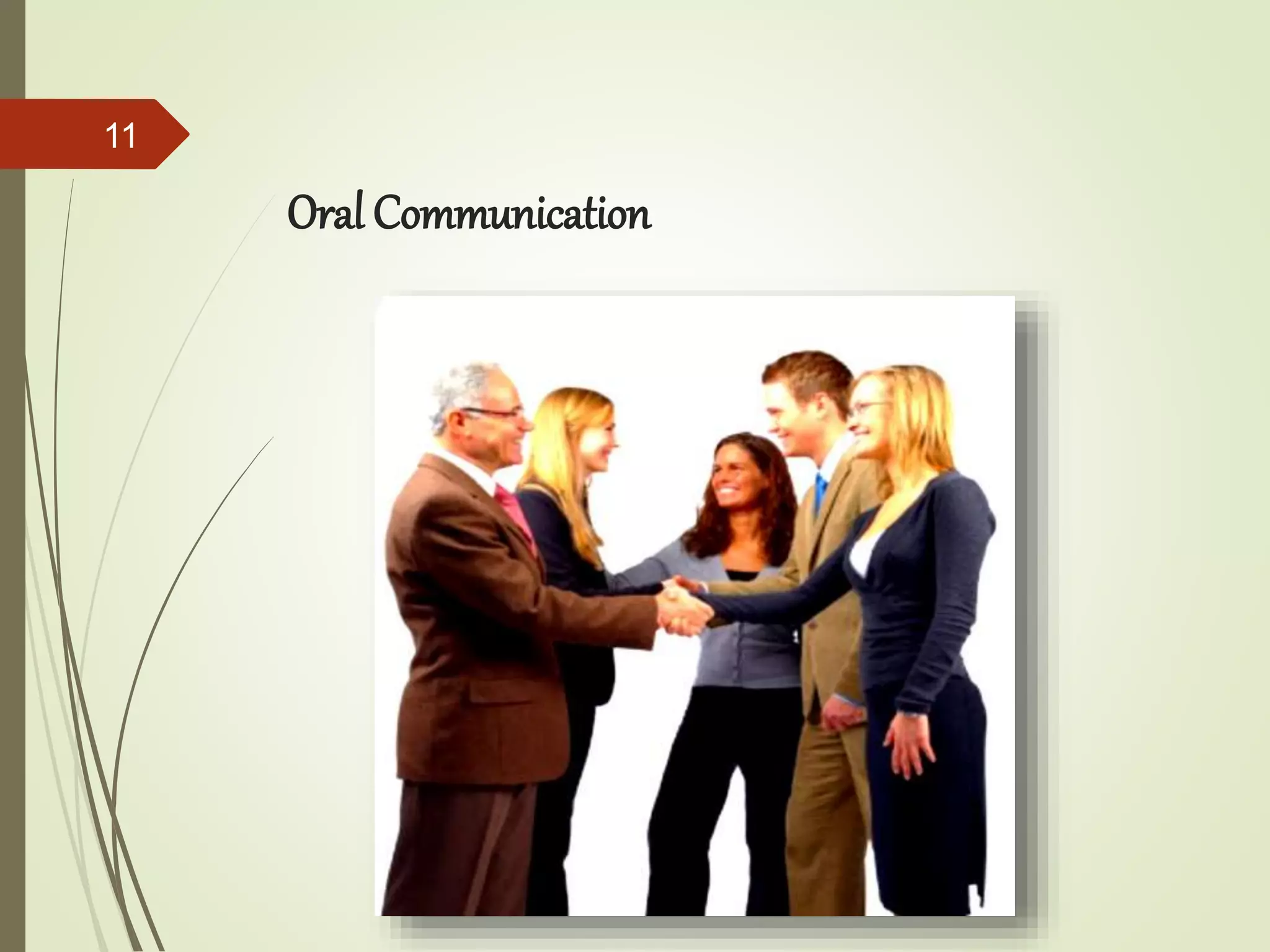
‘Oral Communication’ impliesthe
transmission of orders, message or
suggestions through the spoken words.
The media of oral communication are
face-to-face talk, speech, lecture,
interview, meeting, telephonic talk, video
conference, etc.
In oral communication the contact being
direct, feedback is immediate.
12
13.
It saves timeand money as
communication is direct.
Communication of long message or
statistical data is not suitable for it.
The employees can be motivated by
personal contact.
No record is kept generally (unless audio
or video tape- recording is made).
13
The Non-Verbal Communicationis the
process of conveying meaning without the
use of words either written or spoken.
In other words, any communication made
between two or more persons through the
use of facial expressions, hand
movements, body language, postures, and
gestures is called as non-verbal
communication.
15
16.
Judee Burgoon (1994)has identified five
different nonverbal dimensions:
1. Kinesics
2. Vocalics
3. Proxemics
4. Haptics
5. Chronemics
16
17.
1. kinesics
The studyof body language is known as
Kinesics.
Human body and its various parts play an
important role in communication. The
study of messages conveyed by body
movement is known as kinesics.
17
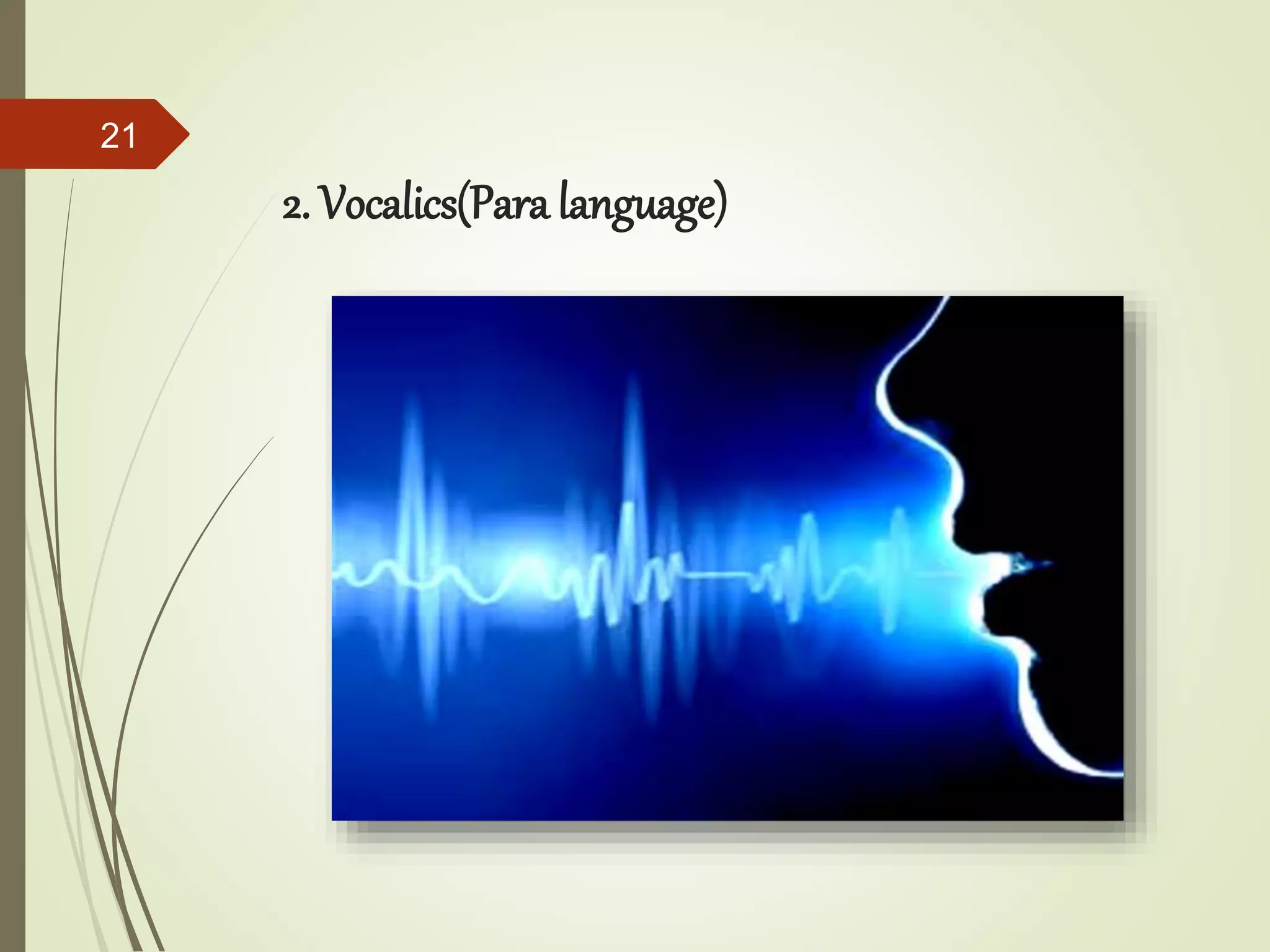
The word 'Para'means ‘like' and
therefore, paralanguage is 'like language'.
It is very closely associated with verbal
language because it is concerned with the
way words are spoken.
paralanguage is non-verbal component
because it does not involve use of words.
22
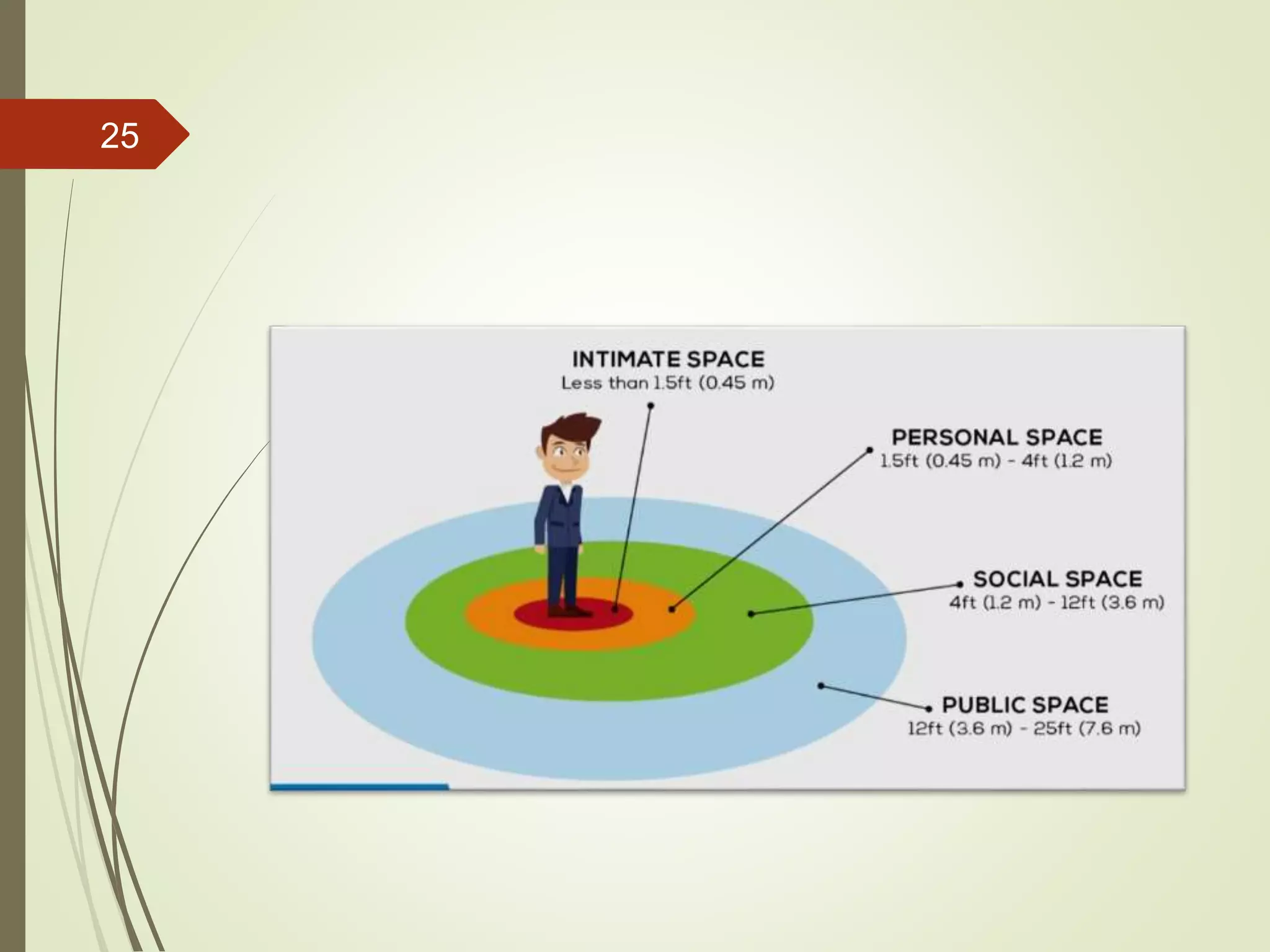
3. Proxemics (space)
Non-verbalsignals which are mutually
understood by the sender and the receiver
originate from many sources. One such
important source is the space around us
which communicates in its own way.
Space, technically known as ‘Proxemics',
is the study of communication by the
means of space.
24
4. Haptics
Haptics communicationis a form of
nonverbal communication and the
way by which people communicate
via touching. Touch is the most
effective means of communicating
feeling and emotions.
26
27.
There are fourtypes of touches or haptics like,
Professional, social or polite, warmth, intimacy or
love.
27
Chronemics is thestudy of how human
being communicate through time.
Time perception can be expressed through
punctuality, willingness to wait, speed of
speech or even the amount of time people
are willing to listen.
29
Verbal
communication
Verbal communicationis the
type of communication that
is done using the words.
The elements of verbal
communication are oral or
written.
Non-verbal
communication
The non verbal
communication is the
wordless communication.
The elements of non verbal
communication are facial
expression, body
movements, gesture and eye
contact.
31
32.
Types ofverbal
communication are formal
and informal.
verbal communication is
more reliable.
In verbal communication the
sender and receiver don’t
require face to face presence
in the verbal
communication.
The types of nonverbal
communication are kinesics,
proxemics, haptics, vocalics
and chrnemics.
non verbal communication
is less reliable
In non verbal
communication, the sender
and receiver need to be
present at the similar place
3232
35
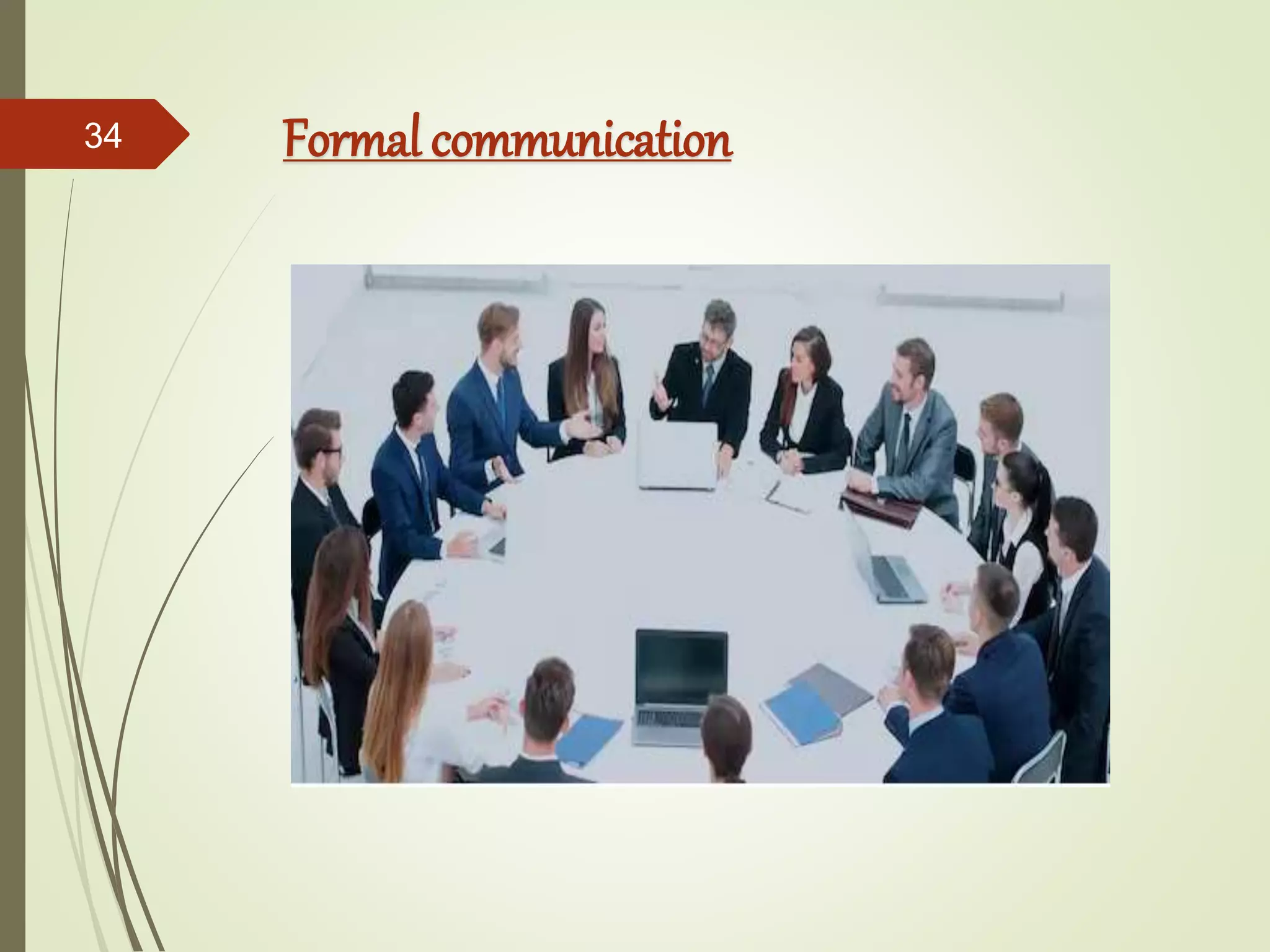
The Formal Communicationis the
exchange of official information that flows
along the different levels of the
organizational hierarchy and conforms to the
prescribed professional rules, policy,
standards, processes and regulations of the
organization.
37
The Informal Communicationis the casual
and unofficial form of communication
wherein the information is exchanged
spontaneously between two or more persons
without conforming the prescribed official
rules, processes, system, formalities and
chain of command.