Communication Process
PRESENTED BY:
PRINSON RODRIGUES
What is Communication?
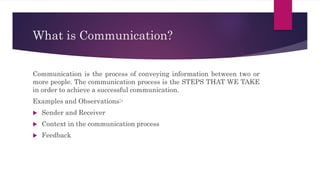
Communication is the process of conveying information between two or
more people. The communication process is the STEPS THAT WE TAKE
in order to achieve a successful communication.
Examples and Observations:-
 Sender and Receiver
 Context in the communication process
 Feedback
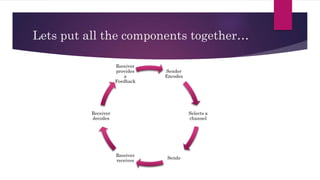
Lets put all the components together…
Sender
Encodes
Selects a
channel
Sends
Receiver
receives
Receiver
decodes
Receiver
provides
a
Feedback
Organizational Communication
A process by which activities of a society are collected and coordinated
to reach the goals of both individuals and the collective group. It is a
subfield of general communications studies and is often
a component to effective management in a workplace environment.
Its main function is to inform, persuade and promote goodwill.
The flow of communication could be either formal or informal.
Models Of
Communication
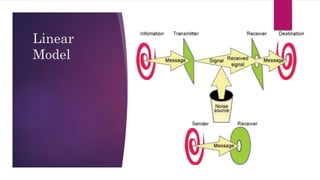
Linear
Model
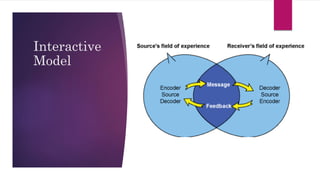
Interactive
Model
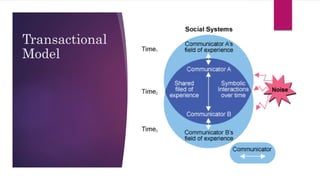
Transactional
Model
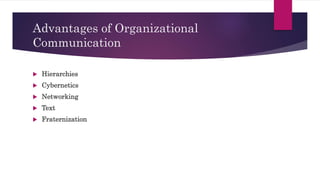
Advantages of Organizational
Communication
 Hierarchies
 Cybernetics
 Networking
 Text
 Fraternization
Types of
Organizational
Communication
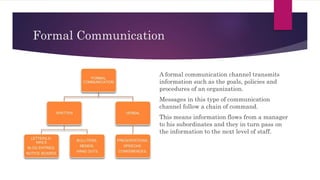
Formal Communication
A formal communication channel transmits
information such as the goals, policies and
procedures of an organization.
Messages in this type of communication
channel follow a chain of command.
This means information flows from a manager
to his subordinates and they in turn pass on
the information to the next level of staff.
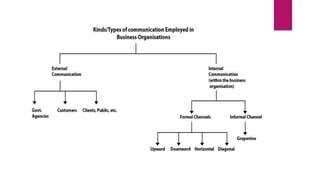
 Oral Communication
• Between two individuals.
• Exchange ideas through oral words either in face to face or mechanical or electrical device such as
telephone, teleconference etc.
• Can ask questions or explanations or sometimes when not properly understood.
• Meetings and conferences, lectures and interviews.
 Written Communication
• When the communication is reduced to black and white (writing), it is called written
communication.
• Extensively used in organisations.
• Constructed over a longer period of time.
• Multiple people can contribute to one document before that document is sent to the intended
audience.
Informal Communication
 When an organization does not follow any official rules of the organization is called informal
communication.
 So, grapevine or informal communication is the process of spontaneous exchange of
information between two or more person at different status without following any prescribed
or official rules, formalities and chain of command in the organizational structure.
 Characteristics of grapevine or informal communication:
• Un-official channel of communication
• Not controlled by management
• More reliable information
• Oral way of communication
• Spontaneous
• Multidirectional
Directions of Communication
 Downward Communication
• Flows from the superiors to subordinates.
• Accepts a hierarchical structure and is based on the assumption that people at the
higher level have the ability and authority to direct the employees.
• Downward communication, if practised without complementing it with upward
communication, will fail because it accepts the premise ” The boss is always right”.
• But it helps in creating an awareness among employees of the objectives, targets and
goals.
• In the armed forces and police department, mostly, only downward communication
exists.
 Upward Communication
• In an upward communication, the persons from the lower level are expected to have
communication with those who are above them.
• Includes reactions and suggestions from workers, their grievances etc.
• Contents of upward communication are reports, reaction, suggestion statements and
proposals prepared for the submission to the boss.
• Upward communication may cause ego problems to persons in higher hierarchical positions.
• But on the whole, modern management recognises the need for healthy upward
communication to make the organization responsive to suggestions and ideas.
• For example the HRD section take steps to see that a healthy and acceptable upward
communication system is adopted by organizations.
 Horizontal / Lateral Communication
• The interaction among peer groups is called horizontal communication. Inter departmental
communication is also horizontal communication.
• Constant communication between sales department, production department, quality control
department
• Horizontal communication leads to a better understanding among individuals and
departments, cooperation and coordination.
 Diagonal or multi-directional Communication
• Diagonal communication means the use of upward, downward and horizontal communication.
• Diagonal communication leads to better feedback at all levels.
• But such communication should not be allowed to degenerate to a meaningless criss-cross
communication which will lead to chaos and confusion.
THANK YOU…

Communication Process, Types and Models of Communication

  • 1.
  • 2.
    What is Communication? Communicationis the process of conveying information between two or more people. The communication process is the STEPS THAT WE TAKE in order to achieve a successful communication. Examples and Observations:-  Sender and Receiver  Context in the communication process  Feedback
  • 3.
    Lets put allthe components together… Sender Encodes Selects a channel Sends Receiver receives Receiver decodes Receiver provides a Feedback
  • 4.
    Organizational Communication A processby which activities of a society are collected and coordinated to reach the goals of both individuals and the collective group. It is a subfield of general communications studies and is often a component to effective management in a workplace environment. Its main function is to inform, persuade and promote goodwill. The flow of communication could be either formal or informal.
  • 5.
  • 6.
  • 7.
  • 8.
  • 9.
    Advantages of Organizational Communication Hierarchies  Cybernetics  Networking  Text  Fraternization
  • 10.
  • 12.
    Formal Communication A formalcommunication channel transmits information such as the goals, policies and procedures of an organization. Messages in this type of communication channel follow a chain of command. This means information flows from a manager to his subordinates and they in turn pass on the information to the next level of staff.
  • 13.
     Oral Communication •Between two individuals. • Exchange ideas through oral words either in face to face or mechanical or electrical device such as telephone, teleconference etc. • Can ask questions or explanations or sometimes when not properly understood. • Meetings and conferences, lectures and interviews.  Written Communication • When the communication is reduced to black and white (writing), it is called written communication. • Extensively used in organisations. • Constructed over a longer period of time. • Multiple people can contribute to one document before that document is sent to the intended audience.
  • 14.
    Informal Communication  Whenan organization does not follow any official rules of the organization is called informal communication.  So, grapevine or informal communication is the process of spontaneous exchange of information between two or more person at different status without following any prescribed or official rules, formalities and chain of command in the organizational structure.  Characteristics of grapevine or informal communication: • Un-official channel of communication • Not controlled by management • More reliable information • Oral way of communication • Spontaneous • Multidirectional
  • 15.
    Directions of Communication Downward Communication • Flows from the superiors to subordinates. • Accepts a hierarchical structure and is based on the assumption that people at the higher level have the ability and authority to direct the employees. • Downward communication, if practised without complementing it with upward communication, will fail because it accepts the premise ” The boss is always right”. • But it helps in creating an awareness among employees of the objectives, targets and goals. • In the armed forces and police department, mostly, only downward communication exists.
  • 16.
     Upward Communication •In an upward communication, the persons from the lower level are expected to have communication with those who are above them. • Includes reactions and suggestions from workers, their grievances etc. • Contents of upward communication are reports, reaction, suggestion statements and proposals prepared for the submission to the boss. • Upward communication may cause ego problems to persons in higher hierarchical positions. • But on the whole, modern management recognises the need for healthy upward communication to make the organization responsive to suggestions and ideas. • For example the HRD section take steps to see that a healthy and acceptable upward communication system is adopted by organizations.
  • 17.
     Horizontal /Lateral Communication • The interaction among peer groups is called horizontal communication. Inter departmental communication is also horizontal communication. • Constant communication between sales department, production department, quality control department • Horizontal communication leads to a better understanding among individuals and departments, cooperation and coordination.  Diagonal or multi-directional Communication • Diagonal communication means the use of upward, downward and horizontal communication. • Diagonal communication leads to better feedback at all levels. • But such communication should not be allowed to degenerate to a meaningless criss-cross communication which will lead to chaos and confusion.
  • 18.