BUSINESS COMMUNICATION
COMMUNICATION IS THE ART OF TRANSMITTING  INFORMATION, IDEAS AND ATTITUDES FROM ONE PERSON  TO ANOTHER.COMMUNICATION IS THE PROCESS OF  MEANINGFUL INTERACTION AMONG HUMAN BEINGS. ITS ESSENCES  : PERSONAL PROCESS  OCCURS BETWEEN PEOPLE  INVOLVES CHANGE IN BEHAVIOUR MEANS TO INFLUENCE OTHERS EXPRESSION OF THOUGHTS AND EMOTIONS THROUGH WORDS &  ACTIONS. TOOLS FOR CONTROLLING AND MOTIVATING PEOPLE. IT IS A SOCIAL AND EMOTIONAL PROCESS. What is Communication?
A Definition Communication is a process by which information is exchanged between individuals through a common system of symbols, signs or information.
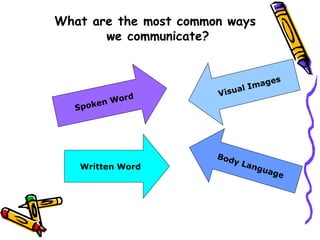
What are the most common ways  we communicate? Spoken Word Written Word Visual Images Body Language
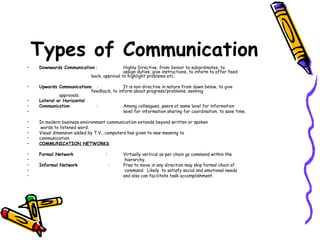
Types of Communication Downwards Communication  : Highly Directive, from Senior to subordinates, to  assign duties, give instructions, to inform to offer feed  back, approval to highlight problems etc. Upwards Communications   : It is non directive in nature from down below, to give  feedback, to inform about progress/problems, seeking  approvals. Lateral or Horizontal  Communication   : Among colleagues, peers at same level for information  level for information sharing for coordination, to save time. In modern business environment communication extends beyond written or spoken words to listened word. Visual dimension added by T.V., computers has given to new meaning to  communication. COMMUNICATION NETWORKS Formal Network   :  Virtually vertical as per chain go command within the   hierarchy. Informal Network   : Free to move in any direction may skip formal chain of   command.  Likely  to satisfy social and emotional needs and also can facilitate task accomplishment.
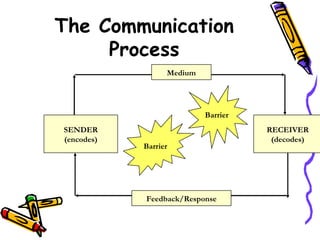
The Communication Process SENDER (encodes) RECEIVER (decodes) Barrier Barrier Medium Feedback/Response
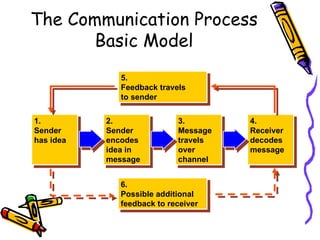
The Communication Process Basic Model 2. Sender encodes idea in message 3. Message travels over channel 1. Sender has idea 4. Receiver decodes message 6. Possible additional feedback to receiver 5. Feedback travels to sender
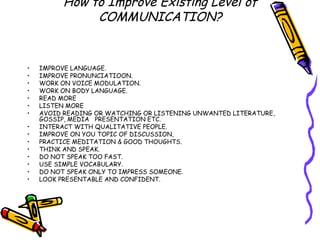
How to Improve Existing Level of COMMUNICATION? IMPROVE LANGUAGE. IMPROVE PRONUNCIATIOON. WORK ON VOICE MODULATION. WORK ON BODY LANGUAGE. READ MORE LISTEN MORE AVOID READING OR WATCHING OR LISTENING UNWANTED LITERATURE, GOSSIP, MEDIA  PRESENTATION ETC. INTERACT WITH QUALITATIVE PEOPLE. IMPROVE ON YOU TOPIC OF DISCUSSION, PRACTICE MEDITATION & GOOD THOUGHTS. THINK AND SPEAK. DO NOT SPEAK TOO FAST. USE SIMPLE VOCABULARY. DO NOT SPEAK ONLY TO IMPRESS SOMEONE. LOOK PRESENTABLE AND CONFIDENT.
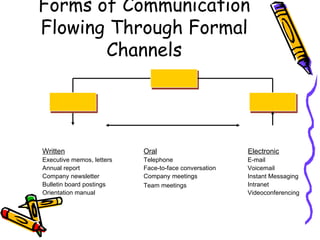
Forms of Communication Flowing Through Formal Channels Written Executive memos, letters Annual report Company newsletter Bulletin board postings Orientation manual Electronic E-mail Voicemail Instant Messaging Intranet Videoconferencing Oral Telephone Face-to-face conversation Company meetings Team meetings
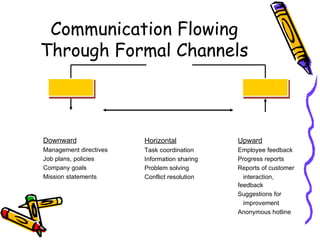
Communication Flowing Through Formal Channels Downward Management directives Job plans, policies Company goals Mission statements Horizontal Task coordination Information sharing Problem solving Conflict resolution Upward Employee feedback Progress reports Reports of customer interaction, feedback Suggestions for  improvement Anonymous hotline
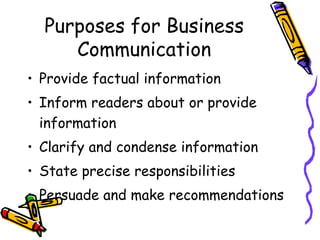
Purposes for Business Communication Provide factual information Inform readers about or provide information Clarify and condense information State precise responsibilities Persuade and make recommendations
Types of Communication Nonverbal Less structured, harder to classify More spontaneous, less control Verbal More structured, easier to study Conscious purpose, more control
Genres of Communication Written Communication Oral Communication Mixed Communication
Written Communication Letters Memos Email Reports/White Papers Web sites Promotional Materials Other written documents
Oral Communication Meetings Conference calls Phone calls Presentations Video or audio recordings Other forms of oral communication
Mixed Communication Web sites  PowerPoint presentations (spoken and written communication) Performance reviews
Internal Communication Official structure Formal chain of command Up, down, across formal power lines The grapevine Informal networking Unofficial lines of power
External Communication Formal contacts Marketing Public relations Informal contacts Employees Managers
EFFECTIVE COMMUNICATION SKILLS
EFFECTIVE COMMUNICATION EFFECTIVE COMMUNICATION OCCURS WHEN THE MESSAGE RECEIVED IS AS CLOSE AS POSSIBLE AS THE MESSAGE INTENDED TO BE SENT – MUTUAL UNDERSTANDING. COMMUNICATION IS EFFECTIVE ONLY IF PEOPLE: - UNDERSTAND EACH OTHER - STIMULATE OTHERS TO TAKE ACTION - ENCOURAGE OTHERS TO THINK IN NEW  WAYS.
SEVEN “C’s” OF COMMUNICATION COMPLETENESS  – CONTAINS ALL FACTS THE READER OR LISTENER NEEDS FOR DESIRED ACTION. CONCISENESS CONSIDERATION CONCRETENESS CLARITY COURTESY CORRECTNESS
NON-VERBAL COMMUNICATION
NON-VERBAL COMMUNICATION The most basic form of communication is non-verbal. The term non-verbal means “without word”. Thus non-verbal communication is communication without words. Non-verbal communication means communication that occurs without words.
DEFINITION Acc to Raymond and John “ All communication that involves neither written nor spoken words but occurs without use of words are termed as non-verbal communication .”
FUNCTIONS To provide information, either consciously or unconsciously. To regulate the flow of conversation. To express emotion. To qualify, complement, contradict or expand verbal messages. To control or influence others. To facilitate specific tasks.
Types of non-verbal communication KINESICS OR BODY LANGUAGE PROXEMICS OR SPACE LANGUAGE PARA LANGUAGE
KINESICS OR BODY LANGUAGE Body language is a prominent and an important medium of non-verbal communication. Body language expresses internal feelings very clearly. Body language is also known as KINESICS.  Kinesics is the study of body movements and gestures.
TYPES OF BODY LANGUAGE  POSTURES GESTURES FACIAL EXPRESSIONS EYE CONTACT BODILY CONTACT APPEARANCE SILENCE
FUNCTIONS OF BODY LANGUAGE  They can provide information about feelings and intentions. They can be used to regulate interactions. They can be used to express intimacy. They can be used to establish dominance or control. They can be used to facilitate goal attainment.
SIGNIFICANCE OF BODY LANGUAGE  Reveals the working of Emotions. Reveals the Status. Replaces Verbal Communication. Sustain Verbal Conversation. Reveals a Person’s Attitudes and Traits. Reveals the Truth. Practical Application.
PROXEMICS The term ‘Proxemics’ was first used in the field of communication by eminent researcher  Edward T. Hall. he  derived the term Proxemics from proximity. In the words of Barker and Gaut, “The study of spatial factors between the sender and receiver of the message is called Proxemics.”
TYPES OF PROXEMICS SPACE LANGUAGE TIME LANGUAGE SURROUNDINGS
PARA LANGUAGE The term para language is combination of two words-”para”’ means like and “language” means mode of communication. Thus, para language  literally means “like language”. In the words of  Prof. Barker and Gaut , “A language alongside of language and includes vocal characteristics such as pitch, range, resonance, tempo and quality and various vocal sounds such as grunts, groans and clearing the throat.”
VERBAL COMMUNICATION
VERBAL COMMUNICATION ORAL COMMUNICATION  WRITTEN COMMUNICATION
ORAL COMMUNICATION Oral communication is that channel of communication in which message is transmitted in spoken form.  The term ‘oral’ means ‘anything pertaining to the mouth’.  There are two components of Oral communication : Words and The manner in which words are pronounced.
ADVANTAGES OF ORAL COMMUNICATION Quickness in Exchange of ideas Quick Feedback Flexibility Economic Source Personal Touch Effective Source Removal of Misunderstanding Motivation Possible Increase in Efficiency
DISADVANTAGES OF ORAL COMMUNICATION Unfit for lengthy Message Unfit for Policy Matters Lack of Written Proof Expensive Method Lack of Clarity Misuse of Time Presence of Both the Parties Necessary
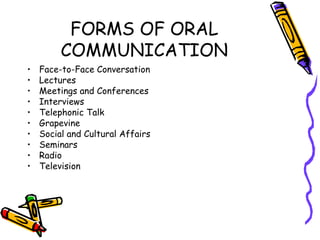
FORMS OF ORAL COMMUNICATION Face-to-Face Conversation Lectures Meetings and Conferences Interviews Telephonic Talk Grapevine Social and Cultural Affairs Seminars Radio Television
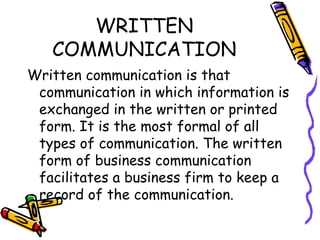
WRITTEN COMMUNICATION Written communication is that communication in which information is exchanged in the written or printed form. It is the most formal of all types of communication. The written form of business communication facilitates a business firm to keep a record of the communication.
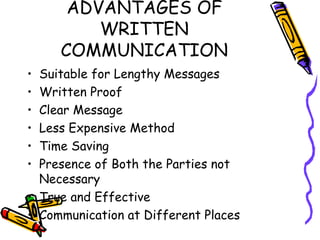
ADVANTAGES OF WRITTEN COMMUNICATION Suitable for Lengthy Messages Written Proof Clear Message Less Expensive Method Time Saving Presence of Both the Parties not Necessary True and Effective Communication at Different Places
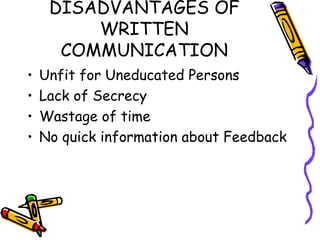
DISADVANTAGES OF WRITTEN COMMUNICATION Unfit for Uneducated Persons Lack of Secrecy Wastage of time No quick information about Feedback
BARRIERS TO COMMUNICATION
COMMON BARRIERS TO COMMUNICATION 1. SEMANTICS Definition of words Choice of words
COMMON BARRIERS TO COMMUNICATION 2. POOR CHOICE, USE OF CHANNELS When to use certain channel Oral alone: Simple reprimand Settle simple dispute Written alone: Don’t need immediate feedback Need record
COMMON BARRIERS TO COMMUNICATION 2. USE OF CHANNELS Both channels: Commendation Serious reprimand Important policy change Nonverbal Be aware of it.
COMMON BARRIERS TO COMMUNICATION 3. PHYSICAL DISTRACTIONS 4. NOISE, PHYSICAL, PSYCHOLOGICAL 5. STATUS DIFFERENCE 6. EFFECTS OF EMOTIONS
COMMON BARRIERS TO COMMUNICATION 7.  PERCEPTIONS Stereotypes Halo effects Selective perception See and hear what we expect Ignore if conflicts with “what we know.” Projection
COMMON BARRIERS TO COMMUNICATION 8.  FILTERING, SCREENING   NEGATIVE INFORMTAION 9.  EVALUATING THE SOURCE 10.ABSENCE OF FEEDBACK,  POOR FEEDBACK
COMMON BARRIERS TO COMMUNICATION 11. INFORMATION, DATA OVERLOAD 12. POOR LISTENING LISTEN TO RESPOND LISTEN TO UNDERSTAND
TO OVERCOME BARRIERS: Learn to use feedback well. Be sensitive to receiver’s point of view. Listen to UNDERSTAND! Use direct, simple language, or at least use language appropriate to the receiver. Use proper channel(s).  Learn to use channels well. Learn to use supportive communication, not defensive communication .
LISTENING
What is Listening? listening  (ILA, 1996): the process of receiving, constructing meaning from, and responding to spoken and/or nonverbal messages; to hear something with thoughtful attention  Effective communication is 2-way depends on speaking  and  listening
Listening vs. Hearing Hearing - physical process; natural; passive Listening - physical & mental process; active; learned process; a skill Listening is hard! You must choose to participate in the process of listening.
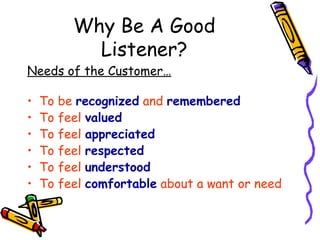
Why Be A Good Listener? Needs of the Customer… To be  recognized  and  remembered To feel  valued To feel  appreciated To feel  respected To feel  understood To feel  comfortable  about a want or need
Listening is the most powerful form of acknowledgment …a way of saying, “You are  important.”
Listening builds stronger relationships …creates a desire to cooperate  among people because they feel  accepted and acknowledged.
Listening promotes being heard …”Seek first to understand, then  be understood.”  - Stephen Covey
Listening creates acceptance and openness …conveys the message that “I am  not judging you.”
Listening leads to learning …openness encourages personal  growth and learning
Listening reduces stress and tension …minimizes confusion and  misunderstanding, eliminating  related stress and tension
Listening is CRITICAL in conflict resolution … much conflict comes from the  need to be heard.  Successful  resolution depends on  being a  non-anxious presence .
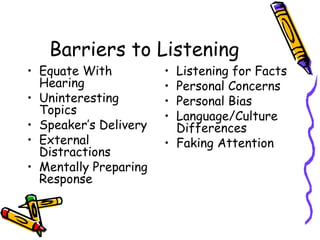
Barriers to Listening Equate With Hearing Uninteresting Topics Speaker’s Delivery External Distractions Mentally Preparing Response Listening for Facts Personal Concerns Personal Bias Language/Culture Differences Faking Attention
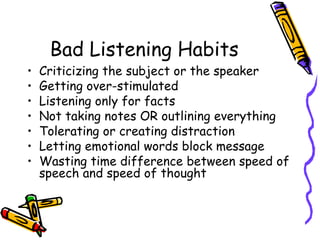
Bad Listening Habits Criticizing the subject or the speaker Getting over-stimulated Listening only for facts Not taking notes OR outlining everything Tolerating or creating distraction Letting emotional words block message Wasting time difference between speed of speech and speed of thought
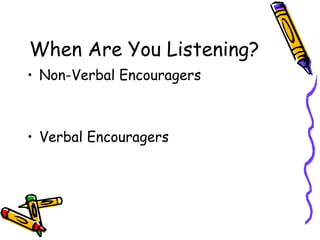
When Are You Listening? Non-Verbal Encouragers Verbal Encouragers
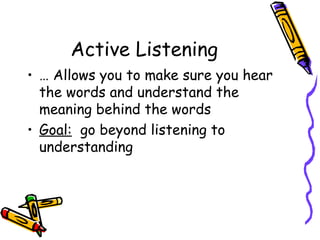
Active Listening …  Allows you to make sure you hear the words and understand the meaning behind the words Goal:   go beyond listening to understanding
Active Listening Requires… Definite Intent to Listen Focus on the Speaker Verbal and Non-Verbal Encouragers Feedback Loop to Insure Accuracy
Active Listening (4 Steps) Listen Question Reflect-Paraphrase Agree
Step 1: Listen To Feelings As Well As Words Words – Emotions -- Implications Focus on Speaker Don’t plan, speak, or get distracted What Is Speaker Talking About? Topic? Speaker? Listener? Others? Look At Speaker Use Verbal & Non-Verbal Encouragers
Step 2:  Question 3 Purposes Demonstrates you are listening Gather information Clarification Open-ended Tell me more? How did you feel? Then what happened?
Step 3: Reflect-Paraphrase Reflect What Is Said (In your words) Reflect Feelings Reframe Capture the essence of the communication Remove negative framing Move toward problem solving
Step 4:  Agree Get Speaker’s Consent to Your Reframing Speaker Has Been Heard and Knows It! Solution Is Near!
Activity Speaker  – talk for 2 min. Listener  – listen using the skills we’ve discussed Observer  – observe the application of the skills and take notes
INTERVIEW
INTERVIEW In the words of  Stewart and Cash , “Interview is a process of didactic communication with pre-determined  and serious purpose designed to interchange behavior and involving the asking and answering the questions.”
ATTENDING INTERVIEW In regard to people being interviewed for a job, a national survey of employment interviewers listed the following qualities in order of their relative importance: (1) appearance (2) manner of ideas, (3) personality, (4) speech and voice, (5) manners and (6) skills.
APPEARING FOR INTERVIEWS PLANNING AHEAD STUDY THE COMPANY PREPARE YOURSELF Dress properly Take all the Certificate Be on Time Appearing for the Interview Walk Right In! Being Interviewed Do not overstay your Allotted Time Reason for Leaving  On Leaving, Sincerely Thanks the Interviewer for His or Her Time
CONDUCTING INTERVIEW Decision about the Suitable Location Preparation for the Interview Commencing the Interview Using questions for control Listening by the Interviewers Summarizing Note-Taking Closing the Interview Making Judgments and Analyzing Results

Bus.communication

  • 1.
  • 2.
    COMMUNICATION IS THEART OF TRANSMITTING INFORMATION, IDEAS AND ATTITUDES FROM ONE PERSON TO ANOTHER.COMMUNICATION IS THE PROCESS OF MEANINGFUL INTERACTION AMONG HUMAN BEINGS. ITS ESSENCES : PERSONAL PROCESS OCCURS BETWEEN PEOPLE INVOLVES CHANGE IN BEHAVIOUR MEANS TO INFLUENCE OTHERS EXPRESSION OF THOUGHTS AND EMOTIONS THROUGH WORDS & ACTIONS. TOOLS FOR CONTROLLING AND MOTIVATING PEOPLE. IT IS A SOCIAL AND EMOTIONAL PROCESS. What is Communication?
  • 3.
    A Definition Communicationis a process by which information is exchanged between individuals through a common system of symbols, signs or information.
  • 4.
    What are themost common ways we communicate? Spoken Word Written Word Visual Images Body Language
  • 5.
    Types of CommunicationDownwards Communication : Highly Directive, from Senior to subordinates, to assign duties, give instructions, to inform to offer feed back, approval to highlight problems etc. Upwards Communications : It is non directive in nature from down below, to give feedback, to inform about progress/problems, seeking approvals. Lateral or Horizontal Communication : Among colleagues, peers at same level for information level for information sharing for coordination, to save time. In modern business environment communication extends beyond written or spoken words to listened word. Visual dimension added by T.V., computers has given to new meaning to communication. COMMUNICATION NETWORKS Formal Network : Virtually vertical as per chain go command within the hierarchy. Informal Network : Free to move in any direction may skip formal chain of command. Likely to satisfy social and emotional needs and also can facilitate task accomplishment.
  • 6.
    The Communication ProcessSENDER (encodes) RECEIVER (decodes) Barrier Barrier Medium Feedback/Response
  • 7.
    The Communication ProcessBasic Model 2. Sender encodes idea in message 3. Message travels over channel 1. Sender has idea 4. Receiver decodes message 6. Possible additional feedback to receiver 5. Feedback travels to sender
  • 8.
    How to ImproveExisting Level of COMMUNICATION? IMPROVE LANGUAGE. IMPROVE PRONUNCIATIOON. WORK ON VOICE MODULATION. WORK ON BODY LANGUAGE. READ MORE LISTEN MORE AVOID READING OR WATCHING OR LISTENING UNWANTED LITERATURE, GOSSIP, MEDIA PRESENTATION ETC. INTERACT WITH QUALITATIVE PEOPLE. IMPROVE ON YOU TOPIC OF DISCUSSION, PRACTICE MEDITATION & GOOD THOUGHTS. THINK AND SPEAK. DO NOT SPEAK TOO FAST. USE SIMPLE VOCABULARY. DO NOT SPEAK ONLY TO IMPRESS SOMEONE. LOOK PRESENTABLE AND CONFIDENT.
  • 9.
    Forms of CommunicationFlowing Through Formal Channels Written Executive memos, letters Annual report Company newsletter Bulletin board postings Orientation manual Electronic E-mail Voicemail Instant Messaging Intranet Videoconferencing Oral Telephone Face-to-face conversation Company meetings Team meetings
  • 10.
    Communication Flowing ThroughFormal Channels Downward Management directives Job plans, policies Company goals Mission statements Horizontal Task coordination Information sharing Problem solving Conflict resolution Upward Employee feedback Progress reports Reports of customer interaction, feedback Suggestions for improvement Anonymous hotline
  • 11.
    Purposes for BusinessCommunication Provide factual information Inform readers about or provide information Clarify and condense information State precise responsibilities Persuade and make recommendations
  • 12.
    Types of CommunicationNonverbal Less structured, harder to classify More spontaneous, less control Verbal More structured, easier to study Conscious purpose, more control
  • 13.
    Genres of CommunicationWritten Communication Oral Communication Mixed Communication
  • 14.
    Written Communication LettersMemos Email Reports/White Papers Web sites Promotional Materials Other written documents
  • 15.
    Oral Communication MeetingsConference calls Phone calls Presentations Video or audio recordings Other forms of oral communication
  • 16.
    Mixed Communication Websites PowerPoint presentations (spoken and written communication) Performance reviews
  • 17.
    Internal Communication Officialstructure Formal chain of command Up, down, across formal power lines The grapevine Informal networking Unofficial lines of power
  • 18.
    External Communication Formalcontacts Marketing Public relations Informal contacts Employees Managers
  • 19.
  • 20.
    EFFECTIVE COMMUNICATION EFFECTIVECOMMUNICATION OCCURS WHEN THE MESSAGE RECEIVED IS AS CLOSE AS POSSIBLE AS THE MESSAGE INTENDED TO BE SENT – MUTUAL UNDERSTANDING. COMMUNICATION IS EFFECTIVE ONLY IF PEOPLE: - UNDERSTAND EACH OTHER - STIMULATE OTHERS TO TAKE ACTION - ENCOURAGE OTHERS TO THINK IN NEW WAYS.
  • 21.
    SEVEN “C’s” OFCOMMUNICATION COMPLETENESS – CONTAINS ALL FACTS THE READER OR LISTENER NEEDS FOR DESIRED ACTION. CONCISENESS CONSIDERATION CONCRETENESS CLARITY COURTESY CORRECTNESS
  • 22.
  • 23.
    NON-VERBAL COMMUNICATION Themost basic form of communication is non-verbal. The term non-verbal means “without word”. Thus non-verbal communication is communication without words. Non-verbal communication means communication that occurs without words.
  • 24.
    DEFINITION Acc toRaymond and John “ All communication that involves neither written nor spoken words but occurs without use of words are termed as non-verbal communication .”
  • 25.
    FUNCTIONS To provideinformation, either consciously or unconsciously. To regulate the flow of conversation. To express emotion. To qualify, complement, contradict or expand verbal messages. To control or influence others. To facilitate specific tasks.
  • 26.
    Types of non-verbalcommunication KINESICS OR BODY LANGUAGE PROXEMICS OR SPACE LANGUAGE PARA LANGUAGE
  • 27.
    KINESICS OR BODYLANGUAGE Body language is a prominent and an important medium of non-verbal communication. Body language expresses internal feelings very clearly. Body language is also known as KINESICS. Kinesics is the study of body movements and gestures.
  • 28.
    TYPES OF BODYLANGUAGE POSTURES GESTURES FACIAL EXPRESSIONS EYE CONTACT BODILY CONTACT APPEARANCE SILENCE
  • 29.
    FUNCTIONS OF BODYLANGUAGE They can provide information about feelings and intentions. They can be used to regulate interactions. They can be used to express intimacy. They can be used to establish dominance or control. They can be used to facilitate goal attainment.
  • 30.
    SIGNIFICANCE OF BODYLANGUAGE Reveals the working of Emotions. Reveals the Status. Replaces Verbal Communication. Sustain Verbal Conversation. Reveals a Person’s Attitudes and Traits. Reveals the Truth. Practical Application.
  • 31.
    PROXEMICS The term‘Proxemics’ was first used in the field of communication by eminent researcher Edward T. Hall. he derived the term Proxemics from proximity. In the words of Barker and Gaut, “The study of spatial factors between the sender and receiver of the message is called Proxemics.”
  • 32.
    TYPES OF PROXEMICSSPACE LANGUAGE TIME LANGUAGE SURROUNDINGS
  • 33.
    PARA LANGUAGE Theterm para language is combination of two words-”para”’ means like and “language” means mode of communication. Thus, para language literally means “like language”. In the words of Prof. Barker and Gaut , “A language alongside of language and includes vocal characteristics such as pitch, range, resonance, tempo and quality and various vocal sounds such as grunts, groans and clearing the throat.”
  • 34.
  • 35.
    VERBAL COMMUNICATION ORALCOMMUNICATION WRITTEN COMMUNICATION
  • 36.
    ORAL COMMUNICATION Oralcommunication is that channel of communication in which message is transmitted in spoken form. The term ‘oral’ means ‘anything pertaining to the mouth’. There are two components of Oral communication : Words and The manner in which words are pronounced.
  • 37.
    ADVANTAGES OF ORALCOMMUNICATION Quickness in Exchange of ideas Quick Feedback Flexibility Economic Source Personal Touch Effective Source Removal of Misunderstanding Motivation Possible Increase in Efficiency
  • 38.
    DISADVANTAGES OF ORALCOMMUNICATION Unfit for lengthy Message Unfit for Policy Matters Lack of Written Proof Expensive Method Lack of Clarity Misuse of Time Presence of Both the Parties Necessary
  • 39.
    FORMS OF ORALCOMMUNICATION Face-to-Face Conversation Lectures Meetings and Conferences Interviews Telephonic Talk Grapevine Social and Cultural Affairs Seminars Radio Television
  • 40.
    WRITTEN COMMUNICATION Writtencommunication is that communication in which information is exchanged in the written or printed form. It is the most formal of all types of communication. The written form of business communication facilitates a business firm to keep a record of the communication.
  • 41.
    ADVANTAGES OF WRITTENCOMMUNICATION Suitable for Lengthy Messages Written Proof Clear Message Less Expensive Method Time Saving Presence of Both the Parties not Necessary True and Effective Communication at Different Places
  • 42.
    DISADVANTAGES OF WRITTENCOMMUNICATION Unfit for Uneducated Persons Lack of Secrecy Wastage of time No quick information about Feedback
  • 43.
  • 44.
    COMMON BARRIERS TOCOMMUNICATION 1. SEMANTICS Definition of words Choice of words
  • 45.
    COMMON BARRIERS TOCOMMUNICATION 2. POOR CHOICE, USE OF CHANNELS When to use certain channel Oral alone: Simple reprimand Settle simple dispute Written alone: Don’t need immediate feedback Need record
  • 46.
    COMMON BARRIERS TOCOMMUNICATION 2. USE OF CHANNELS Both channels: Commendation Serious reprimand Important policy change Nonverbal Be aware of it.
  • 47.
    COMMON BARRIERS TOCOMMUNICATION 3. PHYSICAL DISTRACTIONS 4. NOISE, PHYSICAL, PSYCHOLOGICAL 5. STATUS DIFFERENCE 6. EFFECTS OF EMOTIONS
  • 48.
    COMMON BARRIERS TOCOMMUNICATION 7. PERCEPTIONS Stereotypes Halo effects Selective perception See and hear what we expect Ignore if conflicts with “what we know.” Projection
  • 49.
    COMMON BARRIERS TOCOMMUNICATION 8. FILTERING, SCREENING NEGATIVE INFORMTAION 9. EVALUATING THE SOURCE 10.ABSENCE OF FEEDBACK, POOR FEEDBACK
  • 50.
    COMMON BARRIERS TOCOMMUNICATION 11. INFORMATION, DATA OVERLOAD 12. POOR LISTENING LISTEN TO RESPOND LISTEN TO UNDERSTAND
  • 51.
    TO OVERCOME BARRIERS:Learn to use feedback well. Be sensitive to receiver’s point of view. Listen to UNDERSTAND! Use direct, simple language, or at least use language appropriate to the receiver. Use proper channel(s). Learn to use channels well. Learn to use supportive communication, not defensive communication .
  • 52.
  • 53.
    What is Listening?listening (ILA, 1996): the process of receiving, constructing meaning from, and responding to spoken and/or nonverbal messages; to hear something with thoughtful attention Effective communication is 2-way depends on speaking and listening
  • 54.
    Listening vs. HearingHearing - physical process; natural; passive Listening - physical & mental process; active; learned process; a skill Listening is hard! You must choose to participate in the process of listening.
  • 55.
    Why Be AGood Listener? Needs of the Customer… To be recognized and remembered To feel valued To feel appreciated To feel respected To feel understood To feel comfortable about a want or need
  • 56.
    Listening is themost powerful form of acknowledgment …a way of saying, “You are important.”
  • 57.
    Listening builds strongerrelationships …creates a desire to cooperate among people because they feel accepted and acknowledged.
  • 58.
    Listening promotes beingheard …”Seek first to understand, then be understood.” - Stephen Covey
  • 59.
    Listening creates acceptanceand openness …conveys the message that “I am not judging you.”
  • 60.
    Listening leads tolearning …openness encourages personal growth and learning
  • 61.
    Listening reduces stressand tension …minimizes confusion and misunderstanding, eliminating related stress and tension
  • 62.
    Listening is CRITICALin conflict resolution … much conflict comes from the need to be heard. Successful resolution depends on being a non-anxious presence .
  • 63.
    Barriers to ListeningEquate With Hearing Uninteresting Topics Speaker’s Delivery External Distractions Mentally Preparing Response Listening for Facts Personal Concerns Personal Bias Language/Culture Differences Faking Attention
  • 64.
    Bad Listening HabitsCriticizing the subject or the speaker Getting over-stimulated Listening only for facts Not taking notes OR outlining everything Tolerating or creating distraction Letting emotional words block message Wasting time difference between speed of speech and speed of thought
  • 65.
    When Are YouListening? Non-Verbal Encouragers Verbal Encouragers
  • 66.
    Active Listening … Allows you to make sure you hear the words and understand the meaning behind the words Goal: go beyond listening to understanding
  • 67.
    Active Listening Requires…Definite Intent to Listen Focus on the Speaker Verbal and Non-Verbal Encouragers Feedback Loop to Insure Accuracy
  • 68.
    Active Listening (4Steps) Listen Question Reflect-Paraphrase Agree
  • 69.
    Step 1: ListenTo Feelings As Well As Words Words – Emotions -- Implications Focus on Speaker Don’t plan, speak, or get distracted What Is Speaker Talking About? Topic? Speaker? Listener? Others? Look At Speaker Use Verbal & Non-Verbal Encouragers
  • 70.
    Step 2: Question 3 Purposes Demonstrates you are listening Gather information Clarification Open-ended Tell me more? How did you feel? Then what happened?
  • 71.
    Step 3: Reflect-ParaphraseReflect What Is Said (In your words) Reflect Feelings Reframe Capture the essence of the communication Remove negative framing Move toward problem solving
  • 72.
    Step 4: Agree Get Speaker’s Consent to Your Reframing Speaker Has Been Heard and Knows It! Solution Is Near!
  • 73.
    Activity Speaker – talk for 2 min. Listener – listen using the skills we’ve discussed Observer – observe the application of the skills and take notes
  • 74.
  • 75.
    INTERVIEW In thewords of Stewart and Cash , “Interview is a process of didactic communication with pre-determined and serious purpose designed to interchange behavior and involving the asking and answering the questions.”
  • 76.
    ATTENDING INTERVIEW Inregard to people being interviewed for a job, a national survey of employment interviewers listed the following qualities in order of their relative importance: (1) appearance (2) manner of ideas, (3) personality, (4) speech and voice, (5) manners and (6) skills.
  • 77.
    APPEARING FOR INTERVIEWSPLANNING AHEAD STUDY THE COMPANY PREPARE YOURSELF Dress properly Take all the Certificate Be on Time Appearing for the Interview Walk Right In! Being Interviewed Do not overstay your Allotted Time Reason for Leaving On Leaving, Sincerely Thanks the Interviewer for His or Her Time
  • 78.
    CONDUCTING INTERVIEW Decisionabout the Suitable Location Preparation for the Interview Commencing the Interview Using questions for control Listening by the Interviewers Summarizing Note-Taking Closing the Interview Making Judgments and Analyzing Results