FORMULATION OF THE RESEARCH PROBLEM
&
DEVELOPMENT OF THE RESEARCH HYPOTHESES
By:
Sanjeet Singh
Faculty, Dept. of Mgt Studies
Chandigarh Business School, Landran
Defining the research problem
A research problem can be defined as a gap or
uncertainty in the decision makers’ existing body
of knowledge which inhibits efficient decision
making. The gap could be academic &
theoretical (basic) or real time and action
oriented (applied).
SLIDE 2-1
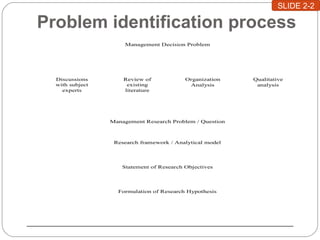
Problem identification process
Management Decision Problem
Discussions
with subject
experts
Review of
existing
literature
Organization
Analysis
Qualitative
analysis
Management Research Problem / Question
Research framework / Analytical model
Statement of Research Objectives
Formulation of Research Hypothesis
SLIDE 2-2
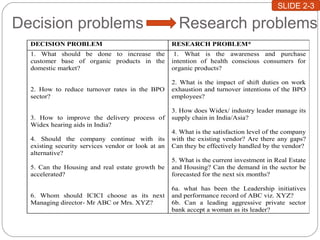
Decision problems Research problems
DECISION PROBLEM RESEARCH PROBLEM*
1. What should be done to increase the
customer base of organic products in the
domestic market?
2. How to reduce turnover rates in the BPO
sector?
3. How to improve the delivery process of
Widex hearing aids in India?
4. Should the company continue with its
existing security services vendor or look at an
alternative?
5. Can the Housing and real estate growth be
accelerated?
6. Whom should ICICI choose as its next
Managing director- Mr ABC or Mrs. XYZ?
1. What is the awareness and purchase
intention of health conscious consumers for
organic products?
2. What is the impact of shift duties on work
exhaustion and turnover intentions of the BPO
employees?
3. How does Widex/ industry leader manage its
supply chain in India/Asia?
4. What is the satisfaction level of the company
with the existing vendor? Are there any gaps?
Can they be effectively handled by the vendor?
5. What is the current investment in Real Estate
and Housing? Can the demand in the sector be
forecasted for the next six months?
6a. what has been the Leadership initiatives
and performance record of ABC viz. XYZ?
6b. Can a leading aggressive private sector
bank accept a woman as its leader?
SLIDE 2-3
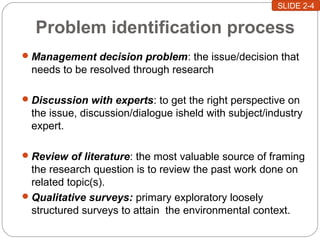
Problem identification process
Management decision problem: the issue/decision that
needs to be resolved through research
Discussion with experts: to get the right perspective on
the issue, discussion/dialogue isheld with subject/industry
expert.
Review of literature: the most valuable source of framing
the research question is to review the past work done on
related topic(s).
Qualitative surveys: primary exploratory loosely
structured surveys to attain the environmental context.
SLIDE 2-4
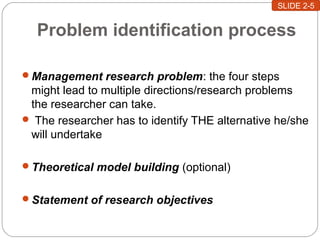
Problem identification process
Management research problem: the four steps
might lead to multiple directions/research problems
the researcher can take.
 The researcher has to identify THE alternative he/she
will undertake
Theoretical model building (optional)
Statement of research objectives
SLIDE 2-5
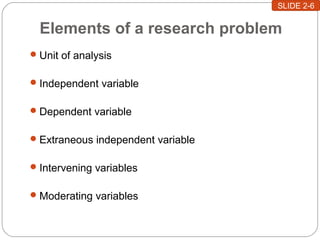
Elements of a research problem
Unit of analysis
Independent variable
Dependent variable
Extraneous independent variable
Intervening variables
Moderating variables
SLIDE 2-6
The research hypotheses
A hypotheses is any assumption/presupposition that
the researcher makes about the probable direction of
the results that might be obtained on the completion of
the research process
Descriptive hypotheses: This is simply a statement
about the magnitude, trend, or behaviour of a
population under study.
Relational hypotheses: These are the typical kind of
hypotheses which state the expected relationship
between two variables.
SLIDE 2-7
Criteria for hypotheses formulation
In simple, declarative statement form
Measurable and quantifiable
Is essentially a conjectural statement
Has underlying assumptions on the testing of the
stated relationships
SLIDE 2-8
CONCEPTS AND CASES
Criteria for hypotheses formulation
In simple, declarative statement form
Measurable and quantifiable
Is essentially a conjectural statement
Has underlying assumptions on the testing of the
stated relationships
SLIDE 2-8
CONCEPTS AND CASES

Problem definition research methodology

  • 1.
    FORMULATION OF THERESEARCH PROBLEM & DEVELOPMENT OF THE RESEARCH HYPOTHESES By: Sanjeet Singh Faculty, Dept. of Mgt Studies Chandigarh Business School, Landran
  • 2.
    Defining the researchproblem A research problem can be defined as a gap or uncertainty in the decision makers’ existing body of knowledge which inhibits efficient decision making. The gap could be academic & theoretical (basic) or real time and action oriented (applied). SLIDE 2-1
  • 3.
    Problem identification process ManagementDecision Problem Discussions with subject experts Review of existing literature Organization Analysis Qualitative analysis Management Research Problem / Question Research framework / Analytical model Statement of Research Objectives Formulation of Research Hypothesis SLIDE 2-2
  • 4.
    Decision problems Researchproblems DECISION PROBLEM RESEARCH PROBLEM* 1. What should be done to increase the customer base of organic products in the domestic market? 2. How to reduce turnover rates in the BPO sector? 3. How to improve the delivery process of Widex hearing aids in India? 4. Should the company continue with its existing security services vendor or look at an alternative? 5. Can the Housing and real estate growth be accelerated? 6. Whom should ICICI choose as its next Managing director- Mr ABC or Mrs. XYZ? 1. What is the awareness and purchase intention of health conscious consumers for organic products? 2. What is the impact of shift duties on work exhaustion and turnover intentions of the BPO employees? 3. How does Widex/ industry leader manage its supply chain in India/Asia? 4. What is the satisfaction level of the company with the existing vendor? Are there any gaps? Can they be effectively handled by the vendor? 5. What is the current investment in Real Estate and Housing? Can the demand in the sector be forecasted for the next six months? 6a. what has been the Leadership initiatives and performance record of ABC viz. XYZ? 6b. Can a leading aggressive private sector bank accept a woman as its leader? SLIDE 2-3
  • 5.
    Problem identification process Managementdecision problem: the issue/decision that needs to be resolved through research Discussion with experts: to get the right perspective on the issue, discussion/dialogue isheld with subject/industry expert. Review of literature: the most valuable source of framing the research question is to review the past work done on related topic(s). Qualitative surveys: primary exploratory loosely structured surveys to attain the environmental context. SLIDE 2-4
  • 6.
    Problem identification process Managementresearch problem: the four steps might lead to multiple directions/research problems the researcher can take.  The researcher has to identify THE alternative he/she will undertake Theoretical model building (optional) Statement of research objectives SLIDE 2-5
  • 7.
    Elements of aresearch problem Unit of analysis Independent variable Dependent variable Extraneous independent variable Intervening variables Moderating variables SLIDE 2-6
  • 8.
    The research hypotheses Ahypotheses is any assumption/presupposition that the researcher makes about the probable direction of the results that might be obtained on the completion of the research process Descriptive hypotheses: This is simply a statement about the magnitude, trend, or behaviour of a population under study. Relational hypotheses: These are the typical kind of hypotheses which state the expected relationship between two variables. SLIDE 2-7
  • 9.
    Criteria for hypothesesformulation In simple, declarative statement form Measurable and quantifiable Is essentially a conjectural statement Has underlying assumptions on the testing of the stated relationships SLIDE 2-8 CONCEPTS AND CASES
  • 10.
    Criteria for hypothesesformulation In simple, declarative statement form Measurable and quantifiable Is essentially a conjectural statement Has underlying assumptions on the testing of the stated relationships SLIDE 2-8 CONCEPTS AND CASES

Editor's Notes