Introduction to Messages and
the Writing Process
Session -9
Informal Writing
• Retains some casual qualities
(personal pronouns, contractions)
• Corresponds to proper
conversation
 Example: “I’ve read your
excellent proposal. I predict the
administrators will approve it.”
Formal Writing
• Maintains distance between
writer and reader.
• Avoids personal references
and contractions.
Example: “The proposal is
excellent. The executives
are likely to approve it.”
The Process of Writing (3 of 6)
• Then analyzing and organizing
the information.
–In the direct order if positive or neutral
reaction expected
–In the indirect order if negative
reaction is anticipated
The Process of Writing (4 of 6)
• Writing the message
–Follow preceding chapters’ clear
writing instructions.
–Present in good format.
The Process of Writing (5 of 6)
• Rewriting
–Rewrite.
–And rewrite, and
rewrite.
–Get input from
others.
The Process of Writing (6 of 6)
• Finally, editing, polishing,
and presenting
–The rewrite process is useful
while you’re learning (as a
student).
–In your eventual work
assignment, you first draft may
be the finished product.
Routine Business Letters
““Once An Arrow Leave The BowOnce An Arrow Leave The Bow
You Can Not Recall It”You Can Not Recall It”
Routine Business Letters
GOALS
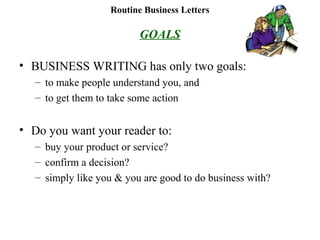
• BUSINESS WRITING has only two goals:
– to make people understand you, and
– to get them to take some action
• Do you want your reader to:
– buy your product or service?
– confirm a decision?
– simply like you & you are good to do business with?
Routine Business Letters
WRITING INTERNATIONAL LETTERS
• American letters are direct, informal and concise.
• Japanese letter begin with references to nature
• Germans start letters with a long, formal lead-in
• Italians may refer to the receiver's family and
children.
Routine Business Letters
PLANNING
• Business Letters Require Plans
Any kind of communication requires planning,
whether it is a report, memo, or a business letter.
Three major elements exist in the planning of a
business letter:
– Analyze subject / reader
– Know your objectives / Idea
– Organize your letter
Routine Business Letters
PLANNING
• Analyze subject / reader
– Much of your writing will be directed to the people
you have never met.
– Realize how important it is to adapt your messages
to your receivers’ views, needs, interest, attitude
and culture.
Routine Business Letters
PLANNING
• Know your objectives / Idea
– The idea you include depend on the type of letter
you are sending and the background and the need
of your receiver.
For instance: In a response from a large resort
hotel to a person who has asked about rates, you
might send a brief list of in-and-out of season
price. If you limited your response to this list, you
would miss an opportunity to sell the other
services you have to offer.
Routine Business Letters
PLANNING
• Organize your Message:
– Always keep in your mind the order in which you
are presenting your idea to the addressee is as
important as your idea.
– Disorganized, rambling text of your letters often
seem careless, confusing, and unimportant.
However, different approaches are necessary for
different cultures.
Routine Business Letters
BUSINESS LETTER WRITING
• PURPOSE:
– Letters can be informational or persuasive and
covering Claims, Inquiry, Orders, Quotation,
Tender & Request for Adjustments.
ORGANIZATIONAL STRATEGY:
Generally organization use two types of strategy:
1)Direct Message
2)Indirect Message
Routine Business Letters
BUSINESS LETTER WRITING
• Indirect Messages:
Negative, Persuasive, Convincing
Giving psychological treatment 4 to 5 paragraph
with neutral reaction
 Buffer – neutral opening by praising
Appreciation, Similarity in agreement, Congratulations,
Good News, Assurance / Confidence
 Explanation
 Bad news (eg. I wish I could have attend the meeting …..)
 Alternatives
 Courteous Close end
Routine Business Letters
BUSINESS LETTER WRITING
– Exceptional Letters’ Scenario:
the Exceptional Messages have –ve aspect but that will be
processed in direct manners:
Refusals (Routine Matters)
Job Refusals
Contract Refusals
Show Cause Notices
Explanation Letters
Termination Letters
The 3x3 Writing Process
The model used for this course has three main
steps, and each main step has three subcategories.
The three major categories are
 Prewriting
 Writing
Revising
The following slides will discuss the subcategories of
each of these three main steps.
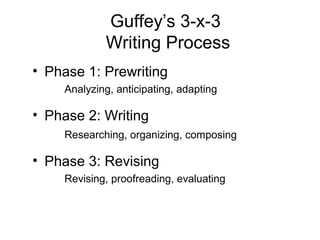
Guffey’s 3-x-3
Writing Process
• Phase 1: Prewriting
Analyzing, anticipating, adapting
• Phase 2: Writing
Researching, organizing, composing
• Phase 3: Revising
Revising, proofreading, evaluating
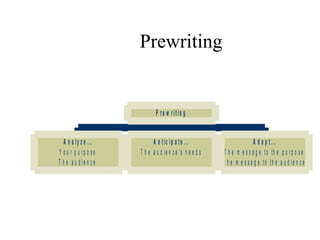
Prewriting
A n a ly z e ...
Y o u r p u r p o s e
T h e a u d ie n c e
A n t ic ip a t e ...
T h e a u d ie n c e 's n e e d s
A d a p t ...
T h e m e s s a g e to th e p u r p o s e
T h e m e s s a g e to th e a u d ie n c e
P r e w r it in g
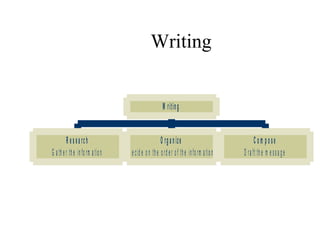
Writing
R e s ea rch
G a th e r th e in fo rm a tio n
O rg a n ize
D e cid e o n th e o rd e r o f th e in fo rm a tio n
C o m p o se
D ra ft th e m e ssa g e
W riting
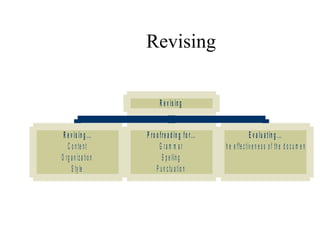
Revising
R e v is in g ...
C o n te n t
O rg a n iz a tio n
S ty le
P ro o fre a d in g fo r...
G ra m m a r
S p e llin g
P u n c tu a tio n
E v a lu a tin g ...
T h e e ffe c tiv e n e s s o f th e d o c u m e n t
R e v is in g
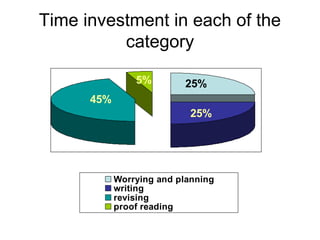
Worrying and planning
writing
revising
proof reading
25%
25%
45%
5%
Time investment in each of the
category
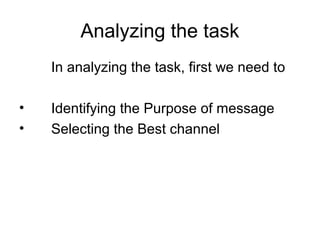
Analyzing the task
In analyzing the task, first we need to
• Identifying the Purpose of message
• Selecting the Best channel
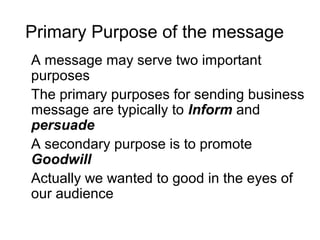
Primary Purpose of the message
A message may serve two important
purposes
The primary purposes for sending business
message are typically to Inform and
persuade
A secondary purpose is to promote
Goodwill
Actually we wanted to good in the eyes of
our audience
Choosing Channels
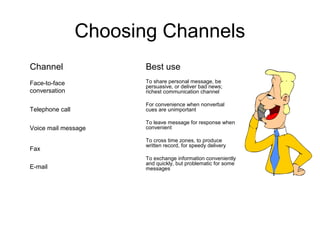
Channel
Face-to-face
conversation
Telephone call
Voice mail message
Fax
E-mail
Best use
To share personal message, be
persuasive, or deliver bad news;
richest communication channel
For convenience when nonverbal
cues are unimportant
To leave message for response when
convenient
To cross time zones, to produce
written record, for speedy delivery
To exchange information conveniently
and quickly, but problematic for some
messages
Choosing Channels
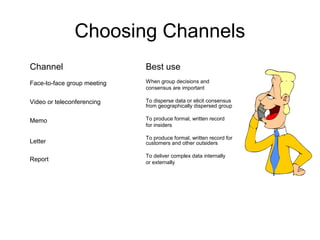
Channel
Face-to-face group meeting
Video or teleconferencing
Memo
Letter
Report
Best use
When group decisions and
consensus are important
To disperse data or elicit consensus
from geographically dispersed group
To produce formal, written record
for insiders
To produce formal, written record for
customers and other outsiders
To deliver complex data internally
or externally
Communication channel
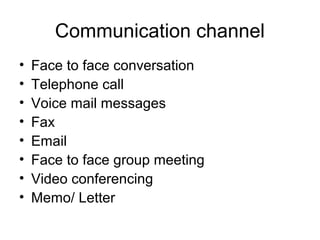
• Face to face conversation
• Telephone call
• Voice mail messages
• Fax
• Email
• Face to face group meeting
• Video conferencing
• Memo/ Letter
Profiling the audience
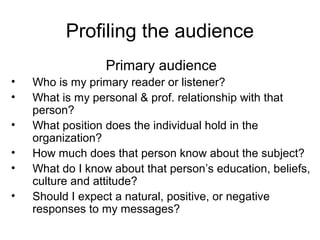
Primary audience
• Who is my primary reader or listener?
• What is my personal & prof. relationship with that
person?
• What position does the individual hold in the
organization?
• How much does that person know about the subject?
• What do I know about that person’s education, beliefs,
culture and attitude?
• Should I expect a natural, positive, or negative
responses to my messages?
Profiling the audience….. Contd.
Secondary audience
• Who might see this message after the primary
audience?
• How do these people differ from the primary
audience?
Spotlight Receive Behavior
• Our messages should be focus on
“Reader Benefit”
• Adapting message to the receivers need
means putting yourself in that person
shoes
• It is called as EMPATHY
• EMPATHIC sender think about how a
receiver will decode a message.
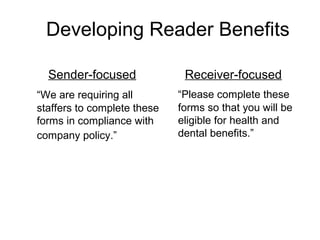
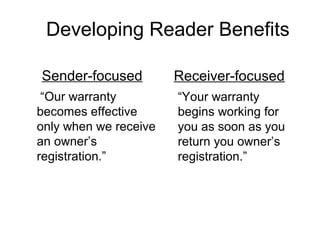
Developing Reader Benefits
Sender-focused
“We are requiring all
staffers to complete these
forms in compliance with
company policy.”
Receiver-focused
“Please complete these
forms so that you will be
eligible for health and
dental benefits.”
Developing Reader Benefits
Sender-focused
“Our warranty
becomes effective
only when we receive
an owner’s
registration.”
Receiver-focused
“Your warranty
begins working for
you as soon as you
return you owner’s
registration.”
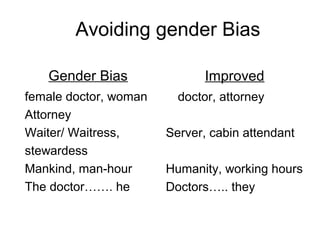
Avoiding gender Bias
Gender Bias
female doctor, woman
Attorney
Waiter/ Waitress,
stewardess
Mankind, man-hour
The doctor……. he
Improved
doctor, attorney
Server, cabin attendant
Humanity, working hours
Doctors….. they
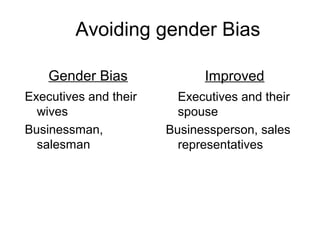
Avoiding gender Bias
Gender Bias
Executives and their
wives
Businessman,
salesman
Improved
Executives and their
spouse
Businessperson, sales
representatives
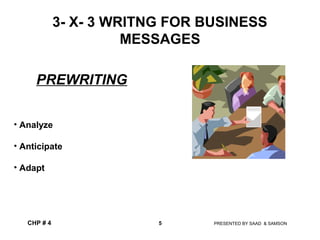
3- X- 3 WRITNG FOR BUSINESS
MESSAGES
CHP # 4 5 PRESENTED BY SAAD & SAMSON
PREWRITING
• Analyze
• Anticipate
• Adapt
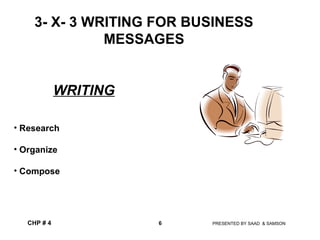
3- X- 3 WRITING FOR BUSINESS
MESSAGES
CHP # 4 6 PRESENTED BY SAAD & SAMSON
WRITING
• Research
• Organize
• Compose
3- X- 3 WRITNG FOR BUSINESS
MESSAGES
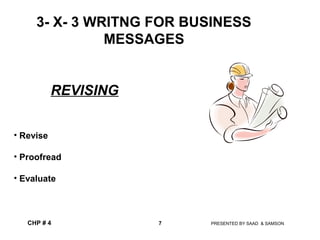
CHP # 4 7 PRESENTED BY SAAD & SAMSON
REVISING
• Revise
• Proofread
• Evaluate
Organizing Data
 process of organization may begin before you
collect data
 might occur simultaneously with data collection
 ideas follow in a sequence helps readers
Tips To Organize Data
• cross out idea that are obvious irrelevant; simplify
and clarify
• add new ideas that seem to be appropriate
• study the ideas for similarities
CHP # 5
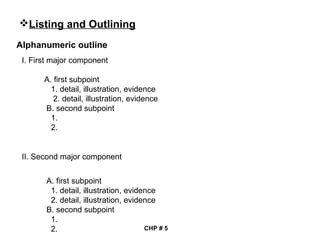
Listing and Outlining
Alphanumeric outline
I. First major component
A. first subpoint
1. detail, illustration, evidence
2. detail, illustration, evidence
B. second subpoint
1.
2.
II. Second major component
A. first subpoint
1. detail, illustration, evidence
2. detail, illustration, evidence
B. second subpoint
1.
2. CHP # 5
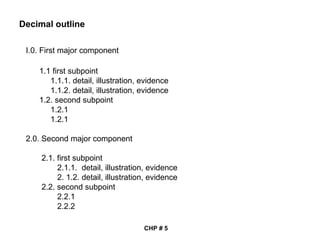
Decimal outline
I.0. First major component
1.1 first subpoint
1.1.1. detail, illustration, evidence
1.1.2. detail, illustration, evidence
1.2. second subpoint
1.2.1
1.2.1
2.0. Second major component
2.1. first subpoint
2.1.1. detail, illustration, evidence
2. 1.2. detail, illustration, evidence
2.2. second subpoint
2.2.1
2.2.2
CHP # 5
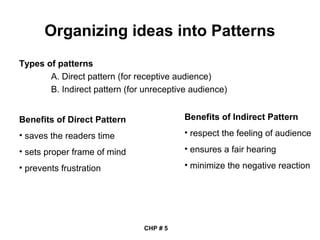
Organizing ideas into Patterns
Types of patterns
A. Direct pattern (for receptive audience)
B. Indirect pattern (for unreceptive audience)
Benefits of Direct Pattern
• saves the readers time
• sets proper frame of mind
• prevents frustration
Benefits of Indirect Pattern
• respect the feeling of audience
• ensures a fair hearing
• minimize the negative reaction
CHP # 5
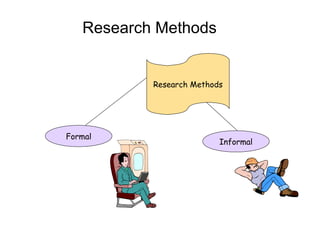
Research Methods
Formal
Informal
Research Methods
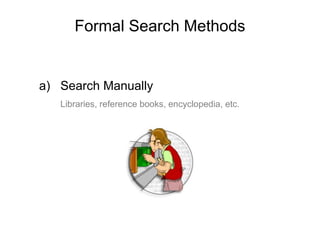
Formal Search Methods
a) Search Manually
Libraries, reference books, encyclopedia, etc.
Formal Search Methods
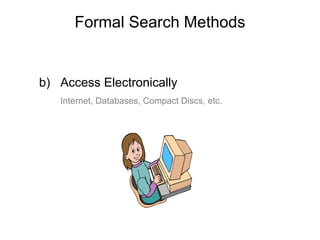
b) Access Electronically
Internet, Databases, Compact Discs, etc.
Formal Search Methods
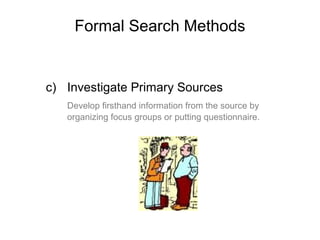
c) Investigate Primary Sources
Develop firsthand information from the source by
organizing focus groups or putting questionnaire.
Formal Search Methods
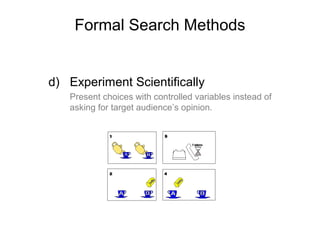
d) Experiment Scientifically
Present choices with controlled variables instead of
asking for target audience’s opinion.
Informal Search Methods
a) Look in the Files
Before asking others for help, see what you can find
yourself.
Informal Search Methods
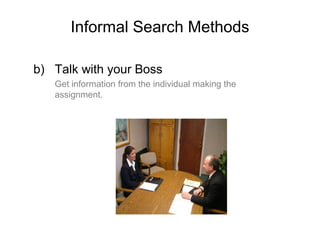
b) Talk with your Boss
Get information from the individual making the
assignment.
Informal Search Methods
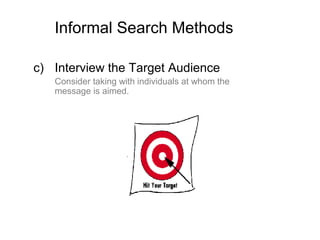
c) Interview the Target Audience
Consider taking with individuals at whom the
message is aimed.
Informal Search Methods
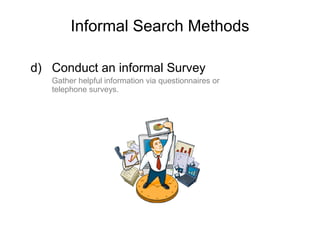
d) Conduct an informal Survey
Gather helpful information via questionnaires or
telephone surveys.
Informal Search Methods
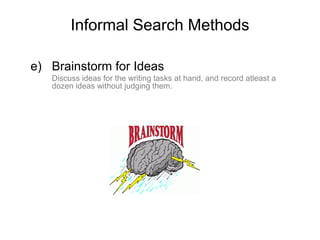
e) Brainstorm for Ideas
Discuss ideas for the writing tasks at hand, and record atleast a
dozen ideas without judging them.
Informal Search Methods
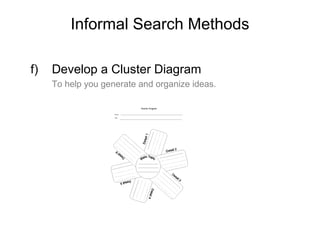
f) Develop a Cluster Diagram
To help you generate and organize ideas.
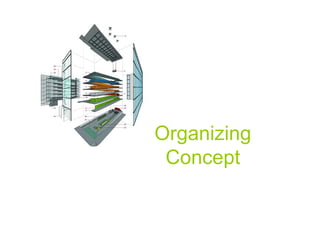
Organizing
Concept
Organizing Data
Primary Purpose >>>>>>>>>>>>> Grouping & Patterning
• Necessary before or during collecting data.
• For more complex work it may be ongoing.
Organizing Ideas:
Writers of well organized messages group similar ideas
together so that the readers can see
relationships and follow
arguments.
Organizing Data
• Self Composure
Are you organized?
Organizing Data
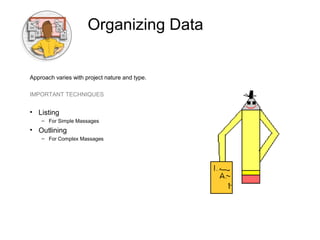
Approach varies with project nature and type.
IMPORTANT TECHNIQUES
• Listing
– For Simple Massages
• Outlining
– For Complex Massages
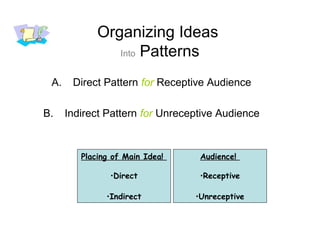
Organizing Ideas
Into Patterns
A. Direct Pattern for Receptive Audience
B. Indirect Pattern for Unreceptive Audience
Placing of Main Idea!
•Direct
•Indirect
Audience!
•Receptive
•Unreceptive
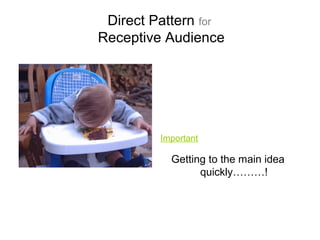
Direct Pattern for
Receptive Audience
Important
Getting to the main idea
quickly………!
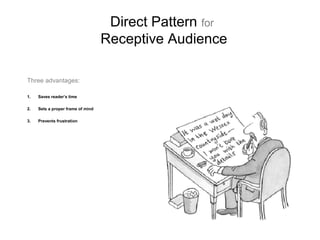
Direct Pattern for
Receptive Audience
Three advantages:
1. Saves reader’s time
2. Sets a proper frame of mind
3. Prevents frustration
Indirect Pattern for
Unreceptive Audience
Works well with three kinds of messages:
Bad News
Needs persuasion
Important Idea
Three benefits:
1. Respects the feelings of the audience
2. Ensures a fair hearing
3. Minimizes the negative reaction
Indirect Pattern for
Unreceptive Audience
Composing
Message
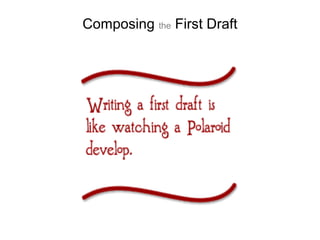
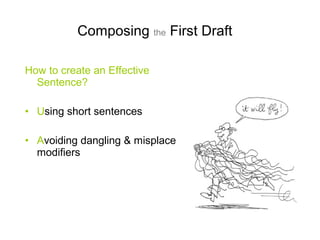
Composing the First Draft
How to create an Effective
Sentence?
• Using short sentences
• Avoiding dangling & misplace
modifiers
Composing the First Draft
Example of Dangling & Misplaced Modifier
Dangling Modifier: To win the lottery, a ticket must be purchased.
Improved: To win the lottery, you must purchase a ticket.
Misplaced Modifier: Seeing his error too late, the envelope was
immediately resealed by Mark.
Improved: Seeing his error too late, Mark immediately
resealed the envelope .
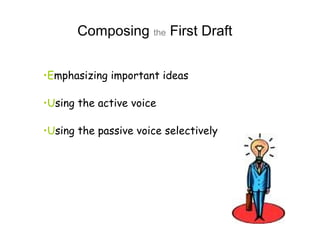
Composing the First Draft
•Emphasizing important ideas
•Using the active voice
•Using the passive voice selectively
Composing the First Draft
Drafting Effective Paragraphs
1. Discussing one topic
Effective Para focus on one topic
2. Using transitional expressions to build coherence,
such as;
Additionally, for example, accordingly, furthermore, etc
3. Composing short paragraphs
Fewer than 8 lines
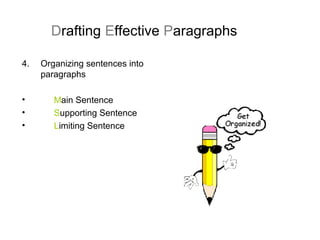
4. Organizing sentences into
paragraphs
• Main Sentence
• Supporting Sentence
• Limiting Sentence
Drafting Effective Paragraphs
5. Using the direct paragraph plan
6. Using the pivoting paragraph plan
7. Using the indirect paragraph plan
Drafting Effective Paragraphs
Linking ideas to build coherence:
• Sustaining the key ideas
• Using pronouns
• Dovetailing sentences
Drafting Effective Paragraphs
THANK YOU

Introduction to messages and the writing process - Business Communication

  • 1.
    Introduction to Messagesand the Writing Process Session -9
  • 2.
    Informal Writing • Retainssome casual qualities (personal pronouns, contractions) • Corresponds to proper conversation  Example: “I’ve read your excellent proposal. I predict the administrators will approve it.”
  • 3.
    Formal Writing • Maintainsdistance between writer and reader. • Avoids personal references and contractions. Example: “The proposal is excellent. The executives are likely to approve it.”
  • 4.
    The Process ofWriting (3 of 6) • Then analyzing and organizing the information. –In the direct order if positive or neutral reaction expected –In the indirect order if negative reaction is anticipated
  • 5.
    The Process ofWriting (4 of 6) • Writing the message –Follow preceding chapters’ clear writing instructions. –Present in good format.
  • 6.
    The Process ofWriting (5 of 6) • Rewriting –Rewrite. –And rewrite, and rewrite. –Get input from others.
  • 7.
    The Process ofWriting (6 of 6) • Finally, editing, polishing, and presenting –The rewrite process is useful while you’re learning (as a student). –In your eventual work assignment, you first draft may be the finished product.
  • 8.
    Routine Business Letters ““OnceAn Arrow Leave The BowOnce An Arrow Leave The Bow You Can Not Recall It”You Can Not Recall It”
  • 9.
    Routine Business Letters GOALS •BUSINESS WRITING has only two goals: – to make people understand you, and – to get them to take some action • Do you want your reader to: – buy your product or service? – confirm a decision? – simply like you & you are good to do business with?
  • 10.
    Routine Business Letters WRITINGINTERNATIONAL LETTERS • American letters are direct, informal and concise. • Japanese letter begin with references to nature • Germans start letters with a long, formal lead-in • Italians may refer to the receiver's family and children.
  • 11.
    Routine Business Letters PLANNING •Business Letters Require Plans Any kind of communication requires planning, whether it is a report, memo, or a business letter. Three major elements exist in the planning of a business letter: – Analyze subject / reader – Know your objectives / Idea – Organize your letter
  • 12.
    Routine Business Letters PLANNING •Analyze subject / reader – Much of your writing will be directed to the people you have never met. – Realize how important it is to adapt your messages to your receivers’ views, needs, interest, attitude and culture.
  • 13.
    Routine Business Letters PLANNING •Know your objectives / Idea – The idea you include depend on the type of letter you are sending and the background and the need of your receiver. For instance: In a response from a large resort hotel to a person who has asked about rates, you might send a brief list of in-and-out of season price. If you limited your response to this list, you would miss an opportunity to sell the other services you have to offer.
  • 14.
    Routine Business Letters PLANNING •Organize your Message: – Always keep in your mind the order in which you are presenting your idea to the addressee is as important as your idea. – Disorganized, rambling text of your letters often seem careless, confusing, and unimportant. However, different approaches are necessary for different cultures.
  • 15.
    Routine Business Letters BUSINESSLETTER WRITING • PURPOSE: – Letters can be informational or persuasive and covering Claims, Inquiry, Orders, Quotation, Tender & Request for Adjustments. ORGANIZATIONAL STRATEGY: Generally organization use two types of strategy: 1)Direct Message 2)Indirect Message
  • 16.
    Routine Business Letters BUSINESSLETTER WRITING • Indirect Messages: Negative, Persuasive, Convincing Giving psychological treatment 4 to 5 paragraph with neutral reaction  Buffer – neutral opening by praising Appreciation, Similarity in agreement, Congratulations, Good News, Assurance / Confidence  Explanation  Bad news (eg. I wish I could have attend the meeting …..)  Alternatives  Courteous Close end
  • 17.
    Routine Business Letters BUSINESSLETTER WRITING – Exceptional Letters’ Scenario: the Exceptional Messages have –ve aspect but that will be processed in direct manners: Refusals (Routine Matters) Job Refusals Contract Refusals Show Cause Notices Explanation Letters Termination Letters
  • 18.
    The 3x3 WritingProcess The model used for this course has three main steps, and each main step has three subcategories. The three major categories are  Prewriting  Writing Revising The following slides will discuss the subcategories of each of these three main steps.
  • 19.
    Guffey’s 3-x-3 Writing Process •Phase 1: Prewriting Analyzing, anticipating, adapting • Phase 2: Writing Researching, organizing, composing • Phase 3: Revising Revising, proofreading, evaluating
  • 20.
    Prewriting A n aly z e ... Y o u r p u r p o s e T h e a u d ie n c e A n t ic ip a t e ... T h e a u d ie n c e 's n e e d s A d a p t ... T h e m e s s a g e to th e p u r p o s e T h e m e s s a g e to th e a u d ie n c e P r e w r it in g
  • 21.
    Writing R e sea rch G a th e r th e in fo rm a tio n O rg a n ize D e cid e o n th e o rd e r o f th e in fo rm a tio n C o m p o se D ra ft th e m e ssa g e W riting
  • 22.
    Revising R e vis in g ... C o n te n t O rg a n iz a tio n S ty le P ro o fre a d in g fo r... G ra m m a r S p e llin g P u n c tu a tio n E v a lu a tin g ... T h e e ffe c tiv e n e s s o f th e d o c u m e n t R e v is in g
  • 23.
    Worrying and planning writing revising proofreading 25% 25% 45% 5% Time investment in each of the category
  • 24.
    Analyzing the task Inanalyzing the task, first we need to • Identifying the Purpose of message • Selecting the Best channel
  • 25.
    Primary Purpose ofthe message A message may serve two important purposes The primary purposes for sending business message are typically to Inform and persuade A secondary purpose is to promote Goodwill Actually we wanted to good in the eyes of our audience
  • 26.
    Choosing Channels Channel Face-to-face conversation Telephone call Voicemail message Fax E-mail Best use To share personal message, be persuasive, or deliver bad news; richest communication channel For convenience when nonverbal cues are unimportant To leave message for response when convenient To cross time zones, to produce written record, for speedy delivery To exchange information conveniently and quickly, but problematic for some messages
  • 27.
    Choosing Channels Channel Face-to-face groupmeeting Video or teleconferencing Memo Letter Report Best use When group decisions and consensus are important To disperse data or elicit consensus from geographically dispersed group To produce formal, written record for insiders To produce formal, written record for customers and other outsiders To deliver complex data internally or externally
  • 28.
    Communication channel • Faceto face conversation • Telephone call • Voice mail messages • Fax • Email • Face to face group meeting • Video conferencing • Memo/ Letter
  • 29.
    Profiling the audience Primaryaudience • Who is my primary reader or listener? • What is my personal & prof. relationship with that person? • What position does the individual hold in the organization? • How much does that person know about the subject? • What do I know about that person’s education, beliefs, culture and attitude? • Should I expect a natural, positive, or negative responses to my messages?
  • 30.
    Profiling the audience…..Contd. Secondary audience • Who might see this message after the primary audience? • How do these people differ from the primary audience?
  • 31.
    Spotlight Receive Behavior •Our messages should be focus on “Reader Benefit” • Adapting message to the receivers need means putting yourself in that person shoes • It is called as EMPATHY • EMPATHIC sender think about how a receiver will decode a message.
  • 32.
    Developing Reader Benefits Sender-focused “Weare requiring all staffers to complete these forms in compliance with company policy.” Receiver-focused “Please complete these forms so that you will be eligible for health and dental benefits.”
  • 33.
    Developing Reader Benefits Sender-focused “Ourwarranty becomes effective only when we receive an owner’s registration.” Receiver-focused “Your warranty begins working for you as soon as you return you owner’s registration.”
  • 34.
    Avoiding gender Bias GenderBias female doctor, woman Attorney Waiter/ Waitress, stewardess Mankind, man-hour The doctor……. he Improved doctor, attorney Server, cabin attendant Humanity, working hours Doctors….. they
  • 35.
    Avoiding gender Bias GenderBias Executives and their wives Businessman, salesman Improved Executives and their spouse Businessperson, sales representatives
  • 36.
    3- X- 3WRITNG FOR BUSINESS MESSAGES CHP # 4 5 PRESENTED BY SAAD & SAMSON PREWRITING • Analyze • Anticipate • Adapt
  • 37.
    3- X- 3WRITING FOR BUSINESS MESSAGES CHP # 4 6 PRESENTED BY SAAD & SAMSON WRITING • Research • Organize • Compose
  • 38.
    3- X- 3WRITNG FOR BUSINESS MESSAGES CHP # 4 7 PRESENTED BY SAAD & SAMSON REVISING • Revise • Proofread • Evaluate
  • 39.
    Organizing Data  processof organization may begin before you collect data  might occur simultaneously with data collection  ideas follow in a sequence helps readers Tips To Organize Data • cross out idea that are obvious irrelevant; simplify and clarify • add new ideas that seem to be appropriate • study the ideas for similarities CHP # 5
  • 40.
    Listing and Outlining Alphanumericoutline I. First major component A. first subpoint 1. detail, illustration, evidence 2. detail, illustration, evidence B. second subpoint 1. 2. II. Second major component A. first subpoint 1. detail, illustration, evidence 2. detail, illustration, evidence B. second subpoint 1. 2. CHP # 5
  • 41.
    Decimal outline I.0. Firstmajor component 1.1 first subpoint 1.1.1. detail, illustration, evidence 1.1.2. detail, illustration, evidence 1.2. second subpoint 1.2.1 1.2.1 2.0. Second major component 2.1. first subpoint 2.1.1. detail, illustration, evidence 2. 1.2. detail, illustration, evidence 2.2. second subpoint 2.2.1 2.2.2 CHP # 5
  • 42.
    Organizing ideas intoPatterns Types of patterns A. Direct pattern (for receptive audience) B. Indirect pattern (for unreceptive audience) Benefits of Direct Pattern • saves the readers time • sets proper frame of mind • prevents frustration Benefits of Indirect Pattern • respect the feeling of audience • ensures a fair hearing • minimize the negative reaction CHP # 5
  • 43.
  • 44.
    Formal Search Methods a)Search Manually Libraries, reference books, encyclopedia, etc.
  • 45.
    Formal Search Methods b)Access Electronically Internet, Databases, Compact Discs, etc.
  • 46.
    Formal Search Methods c)Investigate Primary Sources Develop firsthand information from the source by organizing focus groups or putting questionnaire.
  • 47.
    Formal Search Methods d)Experiment Scientifically Present choices with controlled variables instead of asking for target audience’s opinion.
  • 48.
    Informal Search Methods a)Look in the Files Before asking others for help, see what you can find yourself.
  • 49.
    Informal Search Methods b)Talk with your Boss Get information from the individual making the assignment.
  • 50.
    Informal Search Methods c)Interview the Target Audience Consider taking with individuals at whom the message is aimed.
  • 51.
    Informal Search Methods d)Conduct an informal Survey Gather helpful information via questionnaires or telephone surveys.
  • 52.
    Informal Search Methods e)Brainstorm for Ideas Discuss ideas for the writing tasks at hand, and record atleast a dozen ideas without judging them.
  • 53.
    Informal Search Methods f)Develop a Cluster Diagram To help you generate and organize ideas.
  • 54.
  • 55.
    Organizing Data Primary Purpose>>>>>>>>>>>>> Grouping & Patterning • Necessary before or during collecting data. • For more complex work it may be ongoing. Organizing Ideas: Writers of well organized messages group similar ideas together so that the readers can see relationships and follow arguments.
  • 56.
    Organizing Data • SelfComposure Are you organized?
  • 57.
    Organizing Data Approach varieswith project nature and type. IMPORTANT TECHNIQUES • Listing – For Simple Massages • Outlining – For Complex Massages
  • 58.
    Organizing Ideas Into Patterns A.Direct Pattern for Receptive Audience B. Indirect Pattern for Unreceptive Audience Placing of Main Idea! •Direct •Indirect Audience! •Receptive •Unreceptive
  • 59.
    Direct Pattern for ReceptiveAudience Important Getting to the main idea quickly………!
  • 60.
    Direct Pattern for ReceptiveAudience Three advantages: 1. Saves reader’s time 2. Sets a proper frame of mind 3. Prevents frustration
  • 61.
    Indirect Pattern for UnreceptiveAudience Works well with three kinds of messages: Bad News Needs persuasion Important Idea
  • 62.
    Three benefits: 1. Respectsthe feelings of the audience 2. Ensures a fair hearing 3. Minimizes the negative reaction Indirect Pattern for Unreceptive Audience
  • 63.
  • 64.
  • 65.
    How to createan Effective Sentence? • Using short sentences • Avoiding dangling & misplace modifiers Composing the First Draft
  • 66.
    Example of Dangling& Misplaced Modifier Dangling Modifier: To win the lottery, a ticket must be purchased. Improved: To win the lottery, you must purchase a ticket. Misplaced Modifier: Seeing his error too late, the envelope was immediately resealed by Mark. Improved: Seeing his error too late, Mark immediately resealed the envelope . Composing the First Draft
  • 67.
    •Emphasizing important ideas •Usingthe active voice •Using the passive voice selectively Composing the First Draft
  • 68.
    Drafting Effective Paragraphs 1.Discussing one topic Effective Para focus on one topic 2. Using transitional expressions to build coherence, such as; Additionally, for example, accordingly, furthermore, etc 3. Composing short paragraphs Fewer than 8 lines
  • 69.
    4. Organizing sentencesinto paragraphs • Main Sentence • Supporting Sentence • Limiting Sentence Drafting Effective Paragraphs
  • 70.
    5. Using thedirect paragraph plan 6. Using the pivoting paragraph plan 7. Using the indirect paragraph plan Drafting Effective Paragraphs
  • 71.
    Linking ideas tobuild coherence: • Sustaining the key ideas • Using pronouns • Dovetailing sentences Drafting Effective Paragraphs
  • 72.

Editor's Notes

  • #9 “Once an arrow leave the bow you can not recall it” Let see how can we relate this proverb to our business letters. Our business letters are like an arrow which carries company’s capability, goodwill, reputation, credentials and in return achieve targeted goals. On the other hand, if the arrow could not be thrown at write time at write place, the adverse impact might be proved disappointing for organization in shape of heavy losses.
  • #10 Your readers take the proper action only when they know not just what you say , but what you want. Do you want them To buy your product or service? To confirm a decision? Or to simply like you and think you are good to do business with? All those things -- buying, confirming, even liking and thinking -- are actions. For your reader to understand what you want, he or she must first understand precisely what you mean in your writing. If he or she has to guess, there is a chance the guess might be wrong.
  • #11 These are some types of international letters like American usually write letters ……… But there are some rules which are internationally recognized and adopt for letter writing.
  • #12 Five Planning Steps for Writing / Communication: Identify your purpose: Your first step when planning your communication is to determine your specific purpose. Is your message mainly informational, such as announcing your firm’s new location? Is it mainly persuasive, such as asking customers to by your product? Are you trying to negotiate a contract with a parts supplier in the region? Or explanation why you are not granting a customer’s request for credit?
  • #13 Analyze your Subject / Reader: Much your writing, however, will be directed to people you have never met. Realize how important it is to adapt your messages to your readers’ views, mental filters, needs, interest, attitude and culture. Before sending a letter to that person as a member of a group, such as business of professional person or laborer, superior, colleague, or subordinate, women or man, new or longtime customer, young, middle-aged, or elderly.
  • #14 Choose your Ideas: The idea you include depend on the type of message you are sending and the background and location of your receiver. For instance, in a response from a large resort hotel to a person who has asked about rates, you might send a brief list of in-and-out of season price. If you limited your response to this list, you would miss an opportunity to sell the other services you have to offer. In this kind of response, the following ideas should be included:- Thank the reader for the letter asking about rates. Mention the services the hotel provides. Include information regarding the place where the hotel is located. Describe the facilities. List the rate. You might also include a brochure of your hotel along with small brochure of popular sights in your area.
  • #15 Organize your Message: Always keep in your mind the order in which you are presenting your idea to the addressee is as important as your idea. Disorganized, rambling text of your letter often seem careless, confusing, and unimportant. However, different approaches are necessary for different cultures.
  • #16 Direct Letters Positive and Neutral Messages Main Idea immediately in opening Body explains and give details Letter closed with request, telling what action is required and establishing a deadlines.
  • #20 3
  • #27 4
  • #28 4