Prepared by
I MBA Students(2018-2020), CBIT Proddatur, Kadapa Dist
Communications are of two types
1. Verbal Communication
2. Non-Verbal Communication
VERBAL COMMUNICATION
The sharing of information between individuals by
using speech. Individuals working within a business need to
effectively use verbal communication that employs readily
understood spoken words.
Verbal communications are of two types
1. Oral Communication
2. Written Communication
ORAL COMMUNICATION
Oral communication is a process of expressing information or ideas word
of mouth. It can be either formal or informal.
FORMAL
• Presentation at business meetings
• Classroom lectures
• Commencement speech given at a graduation ceremony.
INFORMAL
• Face to face conversations
• Telephone conversations
• Discussions that take place at business meetings
Advantages of Oral Communication
 Oral communication is best in case of problem resolution.
 Oral communication is an essential for teamwork and
group energy.
 Oral communication is best to transfer private and
confidential matter.
 There is high level of understanding and transparency in
oral communication as it is interpersonal.
 The feedback is spontaneous in case of oral
communication .Thus, decisions can be made quickly
without delay.
Disadvantages of Oral Communication
 There may be misunderstanding as the information is not
complete.
 It requires activeness on the part of the
audience/receiver.
 Oral communications are not easy to maintain.
 Oral communication is time saving as far as daily
interactions are concerned, but in case of meetings, long
speeches consume lot of time.
WRITTEN COMMUNICATION
The written communication is the most
common mode of business communication. In any
organisation, the electronic mails, memos, reports,
documents, letters, Journals, Job descriptions,
employee manuals etc., are some of the commonly
used forms of written communication.
Characteristics of written communication
 Most formal type of communication
 Used for documentation
 Used for circulation of information
 Conventional by nature
 Presence of both sender and receiver is not necessary at the same
time
 Time factor
 It has fewer cycles
 A creative activity
Advantages of written communication
 Easy to preserve
 Easy presentation of complex matter
 Permanent record
 Prevention of wastage of time and money
 Accurate presentation
 Use as a reference
 Delegation of authority
 Longevity
 Effective communication
 Maintaining image
 Proper information
 Less distortion possibility
 No opportunity to misinterpret
 Controlling tool
 Easy to verify
 others
Disadvantages of written communication
 Expensive
 Time consuming
 Red-Tapism
 Useless for illiterate person
 Difficult to maintain secrecy
 Lack of flexibility
 Delay in response
 Delay in decision making
 Cost in record keeping
 Complex words
 Lack of direct relation
 other
NON - VERBAL COMMUNICATION
Communication without the use of spoken
language. Nonverbal communication includes
gestures, facial expressions, and body positions,
as well as unspoken understandings and
presuppositions, and cultural and environmental
conditions that may affect any encounter between
people.
Characteristics of Non verbal communication
 Verbal and non-verbal clues co-exist
 Body postures, gestures and dress suggestive of social
status and education level
 Non-verbal clues are more reliable than verbal clues
 Non-verbal clues carry cultural biases
 It is necessary to interpret non-verbal clues in relation to
their context
Ex: Facial expressions , gestures, eye contact etc.,
Types of Non-verbal communication
1. Sign Language
2. Kinesics
3. Proxemics
4. Chronemics
5. Hepatics
6. Vocalics
1. SIGN LANGUAGE
Sign language is movements of your hands and arms used to
communicate. There are
several official systems of sign
language, used for example by
deaf people. Movements are
also sometimes invented by
people when they want to
communicate with someone who
does not speak the same language.
Types of Sign Language:
• Sign language for the deaf.
• Sign language for people who are deaf and blind.
• Sign language for children and adults with special need.
• Sign language for babies.
• Sign language for communicating with animals.
• Home sign
• A village sign language.
2. KINESICS
Body language, technically
known as Kinesics, is very
essential in communication. Human
body and its various parts play an
important role in communication.
The study of messages conveyed
by body movements is known as body
language or kinesics.
Different body parts play specific role in
communication. The role of different parts of
the body in communication are:
1. Head:
There is an old saying ‘Hold your head
high’. It is a sign of honour, self respect and
self confidence. A head bent low, on the other
hand, shows modesty, politeness and guilt.
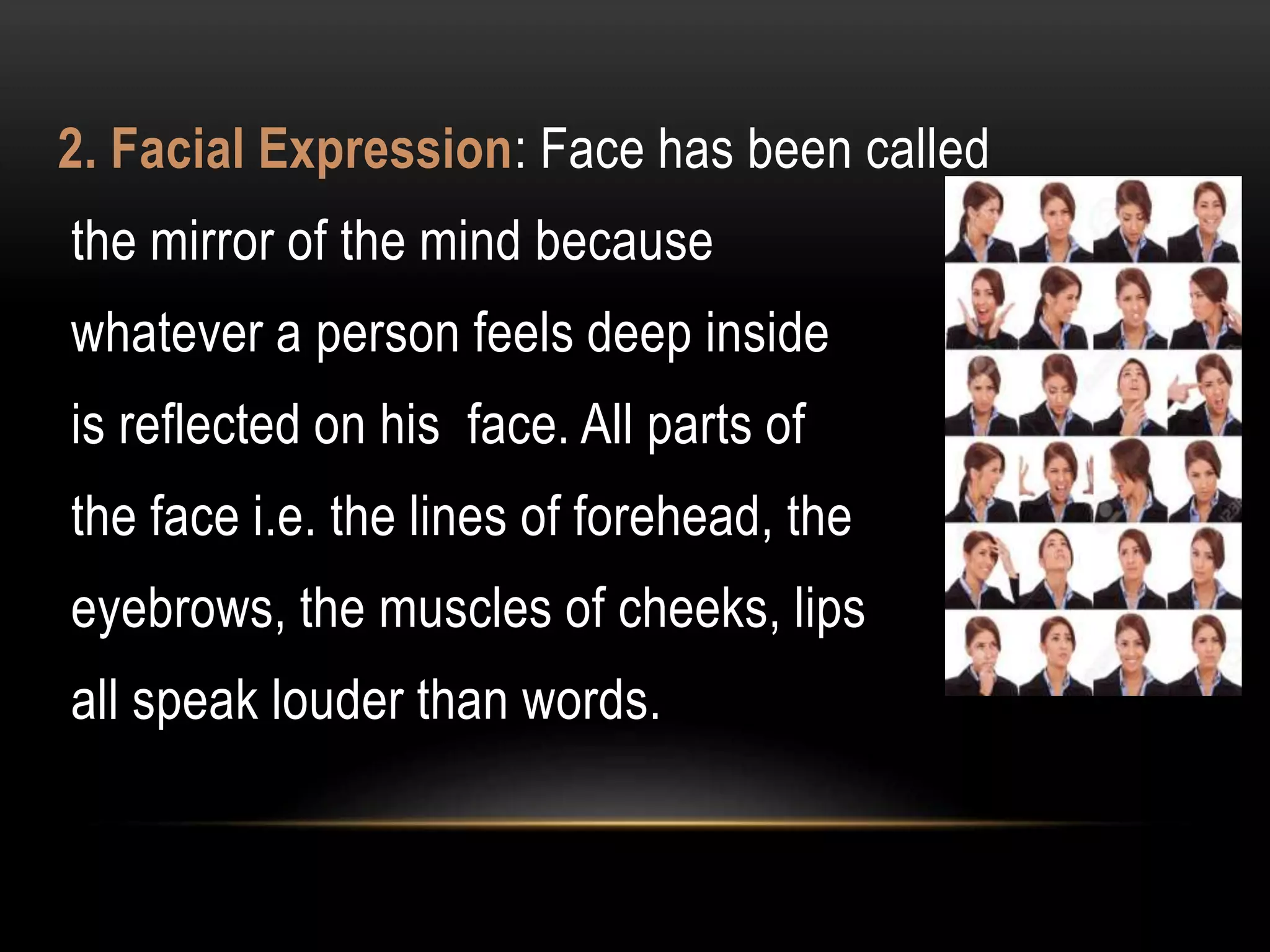
2. Facial Expression: Face has been called
the mirror of the mind because
whatever a person feels deep inside
is reflected on his face. All parts of
the face i.e. the lines of forehead, the
eyebrows, the muscles of cheeks, lips
all speak louder than words.
3. Eye Contact: Eye contact is powerful tool of
communication. It can be used in positive ways to effectively
express
confidence, intellect, honesty,
love, desire, friendship,
compassion, sympathy and
more. While negatively, eye
contact can reflect lies, anger,
lack of remorse, and a callous
non-genuine attitude.
4. Gesture: Gestures are our hand
movements. Different hand movements convey
different meanings.
E.g. Pounding of fist on table shows anger
while a forefinger raised above the head shows
‘Number 1’. Thumbs-up is acknowledge as
‘well done’ and ‘very good’.
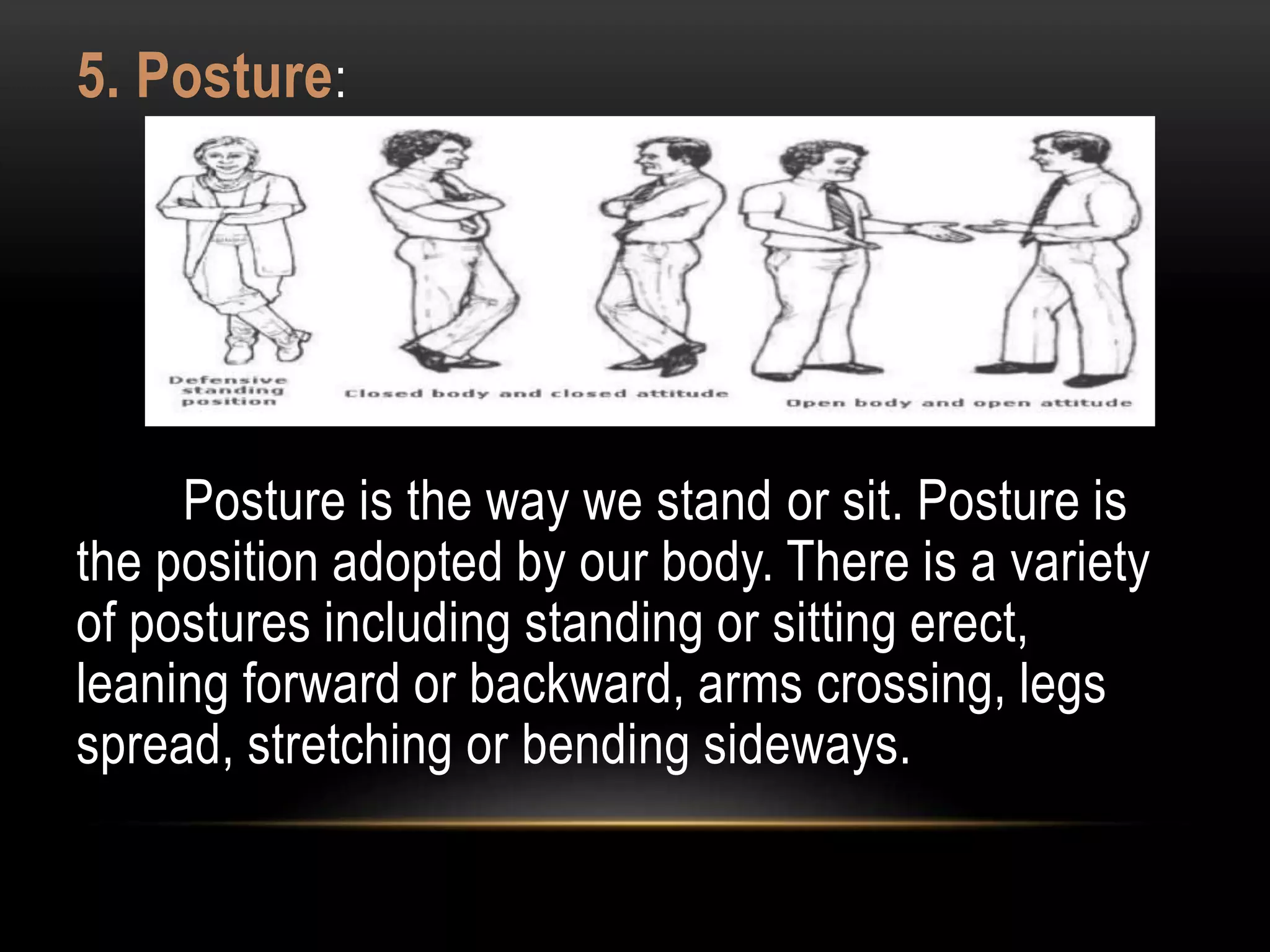
5. Posture:
Posture is the way we stand or sit. Posture is
the position adopted by our body. There is a variety
of postures including standing or sitting erect,
leaning forward or backward, arms crossing, legs
spread, stretching or bending sideways.
3. PROXEMICS
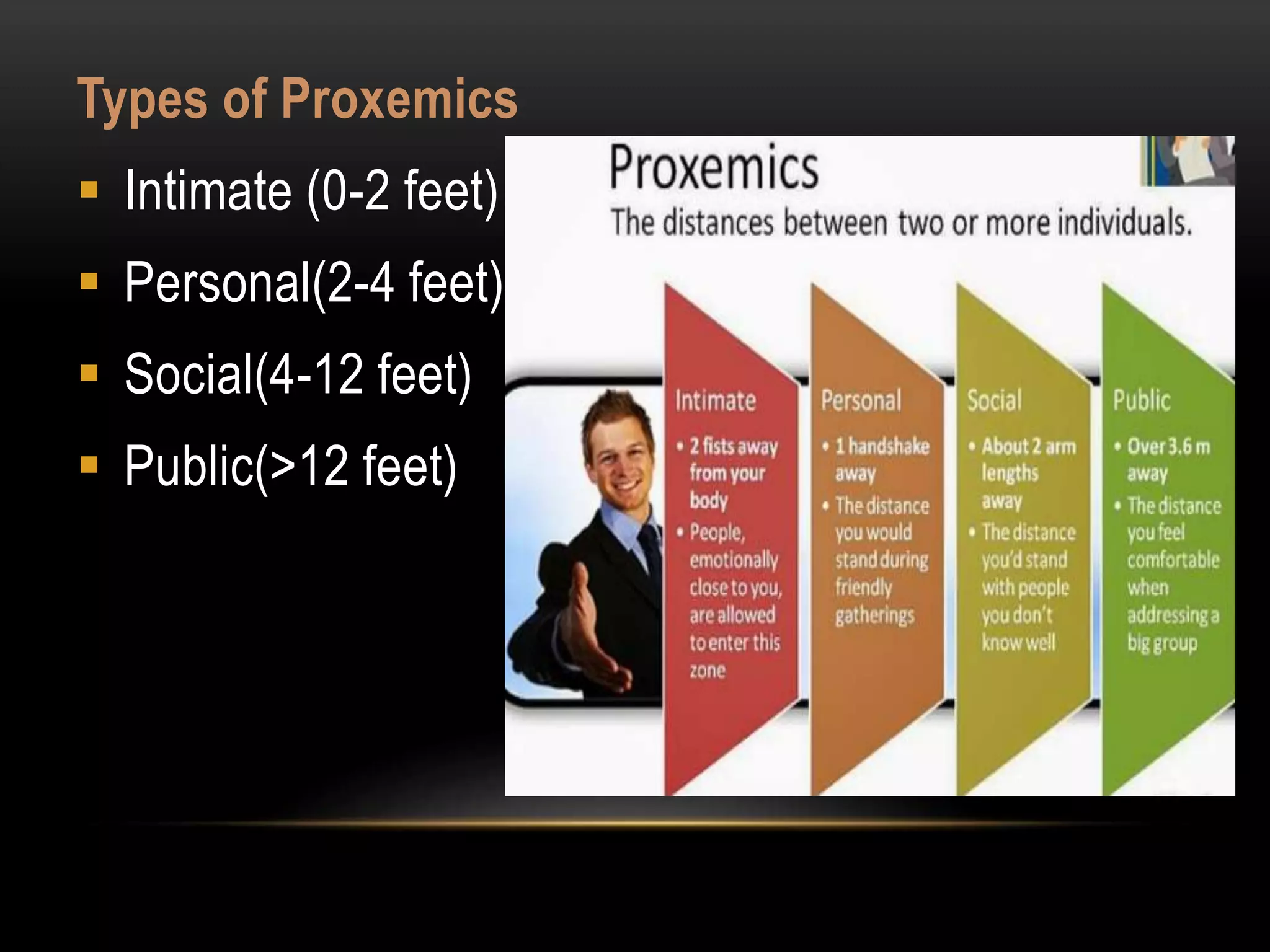
Proxemics is the study of how humans use
space when we’re communicating. How close we
stand to someone, whether we touch them, and
how comfortable we feel are all part of the study of
proxemics.
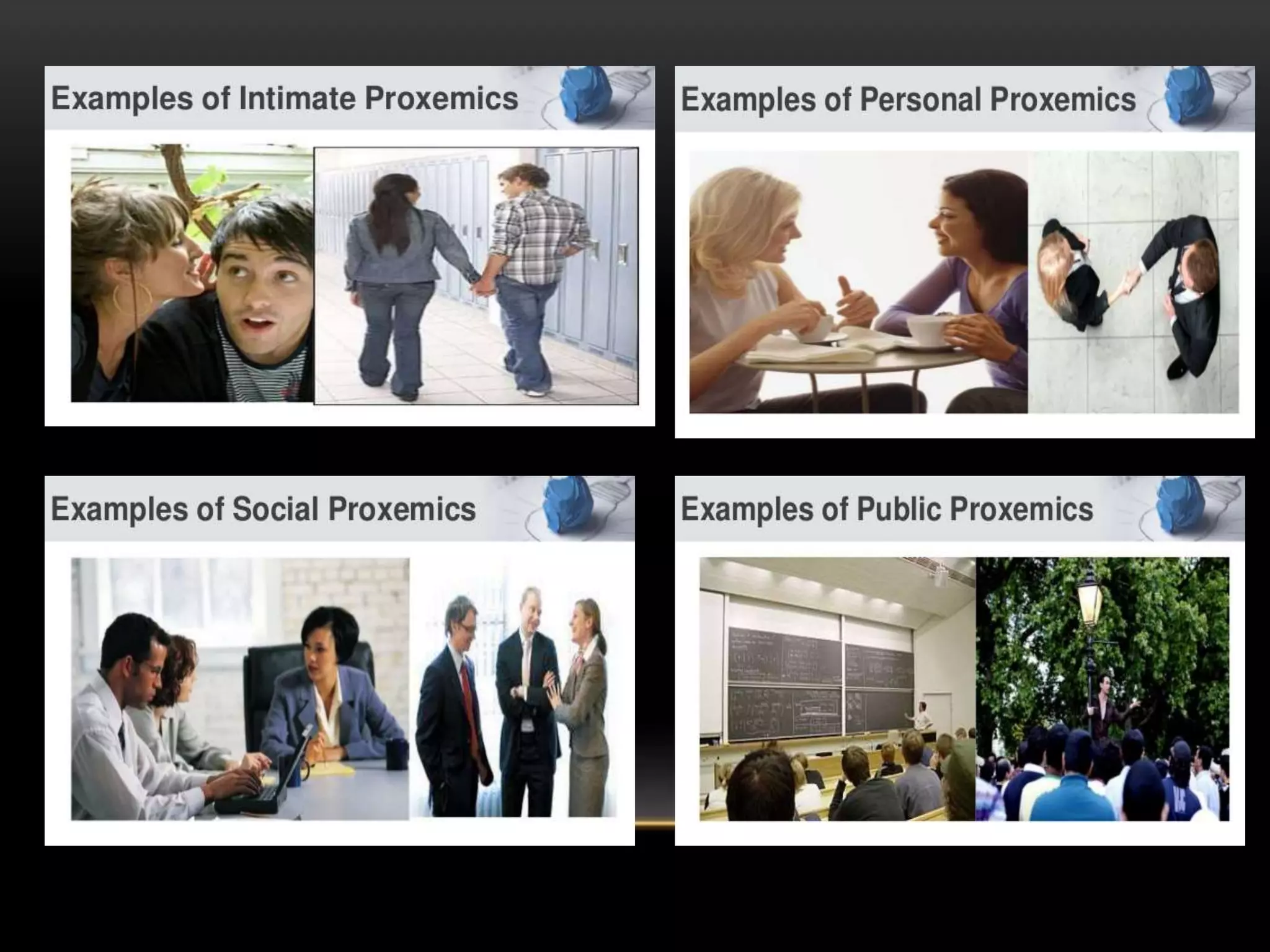
Types of Proxemics
 Intimate (0-2 feet)
 Personal(2-4 feet)
 Social(4-12 feet)
 Public(>12 feet)
.
Definition
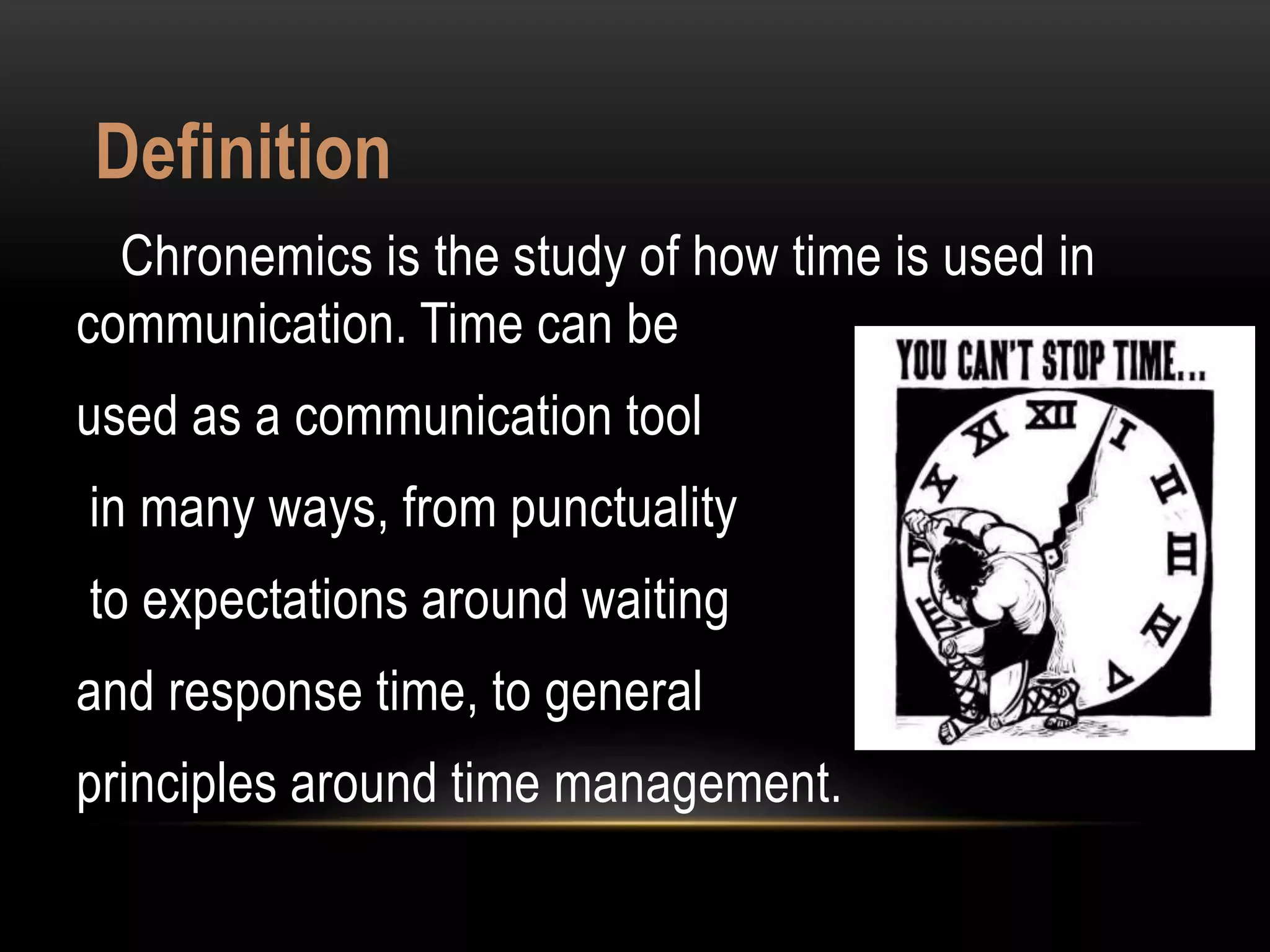
Chronemics is the study of how time is used in
communication. Time can be
used as a communication tool
in many ways, from punctuality
to expectations around waiting
and response time, to general
principles around time management.
Importance and significance
• Some speech therapists use seven types of non-verbal
communication. Chronemics is one of them, where time is used as
a message system, including punctuality, amount of time spent
with another, and waiting time.
• Time is an important non-verbal cue that factors heavily into
communication, particularly in the world of business.
• Chronemics is a focus of anthropological studies in terms of how
time affects different cultures.
• Everything communicates, including material objects, physical
space, and time systems.
5. HEPATICS
• Hepatic communication is a form of nonverbal
communication and the way by which people
and animals communicate via touching. Touch is
the most effective means to communicate
feelings and emotions.
• The withholding of touch may communicate a
variety of negative feelings.
Categories of Touch
• Friendship-Warmth Touch.
• Professional-Functional Touch.
* A handshake or a pat on the
back.
• Social-Polite Touch.
* Blessing some one or meeting in a
party or just a casual meeting.
6. VOCALICS
Vocalics is the use of the voice to communicate nonverbally
• Probably the most important aspect of vocalics is voice quality
1. Rate is how fast you talk
2. Volume is the loudness of your voice
3. Inflection is the vocal emphasis you place on words.
Properties and Qualities of the Voice
Articulation
Vocal qualities
Breathiness
Raspiness
Nasality
Vocalizations
Filled pause
The advantages of non-verbal communication
1. You can communicate with someone who is hard of hearing of
deaf.
2. You can communicate at place where you are supposed to
maintain silence.
3. You can communicate something which you don’t want others to
hear or listen to.
4. You can communicate if you are far away from a person. The
person can see but not hear you.
5. Non-verbal communication makes conversation short and brief.
6. You can save on time and use it as a tool to communicate with
people who don’t understand your language.
• Limitations of Non-verbal communication
1. Lack of formality
2. Expressing contradiction with verbal statement
3. Ambiguity
4. Culture-bound
5. Lack of explanation of message
6. Problem relating to preserving information
Types of communication

Types of communication

  • 1.
    Prepared by I MBAStudents(2018-2020), CBIT Proddatur, Kadapa Dist
  • 2.
    Communications are oftwo types 1. Verbal Communication 2. Non-Verbal Communication
  • 3.
    VERBAL COMMUNICATION The sharingof information between individuals by using speech. Individuals working within a business need to effectively use verbal communication that employs readily understood spoken words. Verbal communications are of two types 1. Oral Communication 2. Written Communication
  • 4.
    ORAL COMMUNICATION Oral communicationis a process of expressing information or ideas word of mouth. It can be either formal or informal. FORMAL • Presentation at business meetings • Classroom lectures • Commencement speech given at a graduation ceremony. INFORMAL • Face to face conversations • Telephone conversations • Discussions that take place at business meetings
  • 5.
    Advantages of OralCommunication  Oral communication is best in case of problem resolution.  Oral communication is an essential for teamwork and group energy.  Oral communication is best to transfer private and confidential matter.  There is high level of understanding and transparency in oral communication as it is interpersonal.  The feedback is spontaneous in case of oral communication .Thus, decisions can be made quickly without delay.
  • 6.
    Disadvantages of OralCommunication  There may be misunderstanding as the information is not complete.  It requires activeness on the part of the audience/receiver.  Oral communications are not easy to maintain.  Oral communication is time saving as far as daily interactions are concerned, but in case of meetings, long speeches consume lot of time.
  • 7.
    WRITTEN COMMUNICATION The writtencommunication is the most common mode of business communication. In any organisation, the electronic mails, memos, reports, documents, letters, Journals, Job descriptions, employee manuals etc., are some of the commonly used forms of written communication.
  • 8.
    Characteristics of writtencommunication  Most formal type of communication  Used for documentation  Used for circulation of information  Conventional by nature  Presence of both sender and receiver is not necessary at the same time  Time factor  It has fewer cycles  A creative activity
  • 9.
    Advantages of writtencommunication  Easy to preserve  Easy presentation of complex matter  Permanent record  Prevention of wastage of time and money  Accurate presentation  Use as a reference  Delegation of authority  Longevity  Effective communication  Maintaining image  Proper information  Less distortion possibility  No opportunity to misinterpret  Controlling tool  Easy to verify  others
  • 10.
    Disadvantages of writtencommunication  Expensive  Time consuming  Red-Tapism  Useless for illiterate person  Difficult to maintain secrecy  Lack of flexibility  Delay in response  Delay in decision making  Cost in record keeping  Complex words  Lack of direct relation  other
  • 11.
    NON - VERBALCOMMUNICATION Communication without the use of spoken language. Nonverbal communication includes gestures, facial expressions, and body positions, as well as unspoken understandings and presuppositions, and cultural and environmental conditions that may affect any encounter between people.
  • 12.
    Characteristics of Nonverbal communication  Verbal and non-verbal clues co-exist  Body postures, gestures and dress suggestive of social status and education level  Non-verbal clues are more reliable than verbal clues  Non-verbal clues carry cultural biases  It is necessary to interpret non-verbal clues in relation to their context Ex: Facial expressions , gestures, eye contact etc.,
  • 13.
    Types of Non-verbalcommunication 1. Sign Language 2. Kinesics 3. Proxemics 4. Chronemics 5. Hepatics 6. Vocalics
  • 14.
    1. SIGN LANGUAGE Signlanguage is movements of your hands and arms used to communicate. There are several official systems of sign language, used for example by deaf people. Movements are also sometimes invented by people when they want to communicate with someone who does not speak the same language.
  • 15.
    Types of SignLanguage: • Sign language for the deaf. • Sign language for people who are deaf and blind. • Sign language for children and adults with special need. • Sign language for babies. • Sign language for communicating with animals. • Home sign • A village sign language.
  • 16.
    2. KINESICS Body language,technically known as Kinesics, is very essential in communication. Human body and its various parts play an important role in communication. The study of messages conveyed by body movements is known as body language or kinesics.
  • 18.
    Different body partsplay specific role in communication. The role of different parts of the body in communication are: 1. Head: There is an old saying ‘Hold your head high’. It is a sign of honour, self respect and self confidence. A head bent low, on the other hand, shows modesty, politeness and guilt.
  • 19.
    2. Facial Expression:Face has been called the mirror of the mind because whatever a person feels deep inside is reflected on his face. All parts of the face i.e. the lines of forehead, the eyebrows, the muscles of cheeks, lips all speak louder than words.
  • 20.
    3. Eye Contact:Eye contact is powerful tool of communication. It can be used in positive ways to effectively express confidence, intellect, honesty, love, desire, friendship, compassion, sympathy and more. While negatively, eye contact can reflect lies, anger, lack of remorse, and a callous non-genuine attitude.
  • 21.
    4. Gesture: Gesturesare our hand movements. Different hand movements convey different meanings. E.g. Pounding of fist on table shows anger while a forefinger raised above the head shows ‘Number 1’. Thumbs-up is acknowledge as ‘well done’ and ‘very good’.
  • 22.
    5. Posture: Posture isthe way we stand or sit. Posture is the position adopted by our body. There is a variety of postures including standing or sitting erect, leaning forward or backward, arms crossing, legs spread, stretching or bending sideways.
  • 23.
    3. PROXEMICS Proxemics isthe study of how humans use space when we’re communicating. How close we stand to someone, whether we touch them, and how comfortable we feel are all part of the study of proxemics.
  • 24.
    Types of Proxemics Intimate (0-2 feet)  Personal(2-4 feet)  Social(4-12 feet)  Public(>12 feet)
  • 25.
  • 27.
    Definition Chronemics is thestudy of how time is used in communication. Time can be used as a communication tool in many ways, from punctuality to expectations around waiting and response time, to general principles around time management.
  • 28.
    Importance and significance •Some speech therapists use seven types of non-verbal communication. Chronemics is one of them, where time is used as a message system, including punctuality, amount of time spent with another, and waiting time. • Time is an important non-verbal cue that factors heavily into communication, particularly in the world of business. • Chronemics is a focus of anthropological studies in terms of how time affects different cultures. • Everything communicates, including material objects, physical space, and time systems.
  • 29.
    5. HEPATICS • Hepaticcommunication is a form of nonverbal communication and the way by which people and animals communicate via touching. Touch is the most effective means to communicate feelings and emotions. • The withholding of touch may communicate a variety of negative feelings.
  • 30.
    Categories of Touch •Friendship-Warmth Touch. • Professional-Functional Touch. * A handshake or a pat on the back. • Social-Polite Touch. * Blessing some one or meeting in a party or just a casual meeting.
  • 31.
    6. VOCALICS Vocalics isthe use of the voice to communicate nonverbally • Probably the most important aspect of vocalics is voice quality 1. Rate is how fast you talk 2. Volume is the loudness of your voice 3. Inflection is the vocal emphasis you place on words.
  • 32.
    Properties and Qualitiesof the Voice Articulation Vocal qualities Breathiness Raspiness Nasality Vocalizations Filled pause
  • 33.
    The advantages ofnon-verbal communication 1. You can communicate with someone who is hard of hearing of deaf. 2. You can communicate at place where you are supposed to maintain silence. 3. You can communicate something which you don’t want others to hear or listen to. 4. You can communicate if you are far away from a person. The person can see but not hear you. 5. Non-verbal communication makes conversation short and brief. 6. You can save on time and use it as a tool to communicate with people who don’t understand your language.
  • 34.
    • Limitations ofNon-verbal communication 1. Lack of formality 2. Expressing contradiction with verbal statement 3. Ambiguity 4. Culture-bound 5. Lack of explanation of message 6. Problem relating to preserving information