Teacher in charge: Prof. Pooja Fernandes
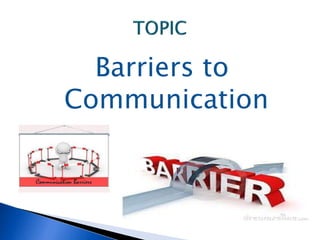
Barriers to
Communication
Name Roll No.
1. Misbah Ansari 01
2. Sakina Digosewala 06
3. Tanzila Mukri 26
4. Henal Shah 36
5. Pranita Varanase 46
 Meaning of Communication.
 Meaning of Barriers to Communication.
 Types of Barriers to Communication.
 Conclusion.
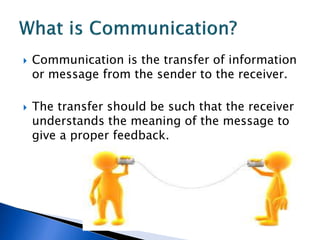
 Communication is the transfer of information
or message from the sender to the receiver.
 The transfer should be such that the receiver
understands the meaning of the message to
give a proper feedback.
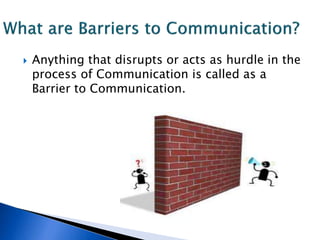
 Anything that disrupts or acts as hurdle in the
process of Communication is called as a
Barrier to Communication.
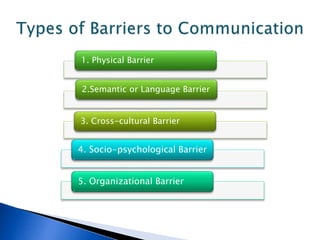
1. Physical Barrier
2.Semantic or Language Barrier
3. Cross-cultural Barrier
4. Socio-psychological Barrier
5. Organizational Barrier
Types:
1. Noise.
2. Defects in Communication system.
3. Time and distance.
4. Wrong selection of medium.
5. Temperature and humidity.
How to overcome:
 Ensure all Communication medium are in
working condition.
 Ensure less noise during conduct of meeting.
 Overcome physical distractions.
 Plan your meeting wisely.
 Choose richest media for complex messages.
 Use multiple channels to communicate messages.
Meaning:
Semantic barriers occur due to
difference in meaning attached to
words or signs used in communication
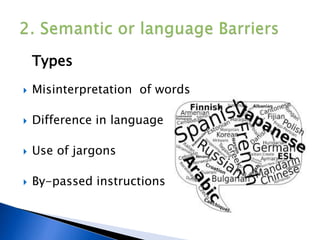
Types
 Misinterpretation of words
 Difference in language
 Use of jargons
 By-passed instructions
How to overcome:
 Usage of concrete and specific language.
 Use of jargons should be avoided.
 Keeping receivers in mind, use simple & short
sentences.
 Pay attention to pronunciation and accent.
 Reduce number of messages by thinking twice
before sending one.
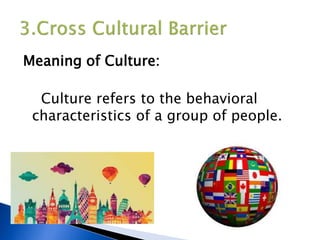
Meaning of Culture:
Culture refers to the behavioral
characteristics of a group of people.
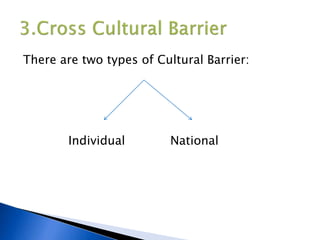
There are two types of Cultural Barrier:
Individual National
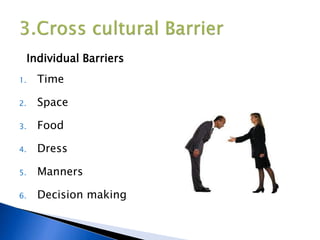
Individual Barriers
1. Time
2. Space
3. Food
4. Dress
5. Manners
6. Decision making
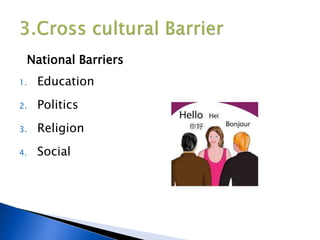
National Barriers
1. Education
2. Politics
3. Religion
4. Social
How to overcome:
1. Recognize the diversity of people within the country and
abroad.
2. Avoid drawing conclusion about a particular cultural group.
3. Provide adequate, relevant and truthful information.
4. While communicating use a language the receiver is familiar
with.
5. Management should facilitate learning about other cultures.
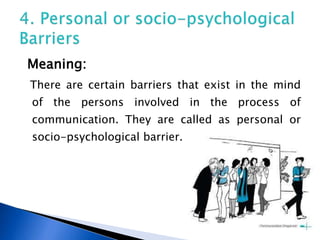
Meaning:
There are certain barriers that exist in the mind
of the persons involved in the process of
communication. They are called as personal or
socio-psychological barrier.
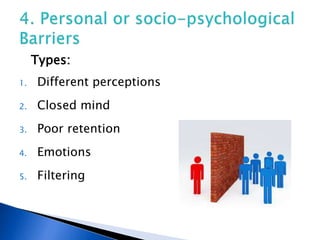
Types:
1. Different perceptions
2. Closed mind
3. Poor retention
4. Emotions
5. Filtering
How to overcome:
1. Be aware of your own state of mind/ emotion/attitude.
2. Convey oral message directly and not through
intermediaries or answering machine.
3. Deliver message rationally or analytically keeping
personal emotions and bias at bay.
4. Avoid making demand on a receiver who doesn’t have
time to pay careful attention to your message.
5. Set aside enough time for important message .
Meaning of organizational communication :
 In-house sharing of ideas, views & concepts
in an organization.
 Can be formal or informal.
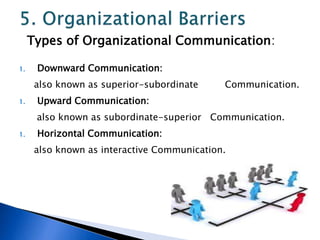
Types of Organizational Communication:
1. Downward Communication:
also known as superior-subordinate Communication.
1. Upward Communication:
also known as subordinate-superior Communication.
1. Horizontal Communication:
also known as interactive Communication.
Types:
1. Lack of Communication policy.
2. Authoritarian attitude of management.
3. Poorly defined authority & responsibility.
4. Too many levels in organizational structure.
5. Insufficient Communication training.
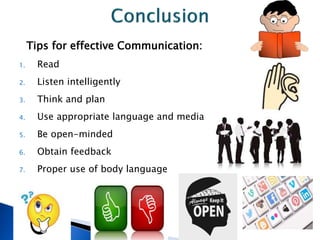
Tips for effective Communication:
1. Read
2. Listen intelligently
3. Think and plan
4. Use appropriate language and media
5. Be open-minded
6. Obtain feedback
7. Proper use of body language
barriers to communication

barriers to communication

  • 1.
    Teacher in charge:Prof. Pooja Fernandes
  • 2.
  • 3.
    Name Roll No. 1.Misbah Ansari 01 2. Sakina Digosewala 06 3. Tanzila Mukri 26 4. Henal Shah 36 5. Pranita Varanase 46
  • 4.
     Meaning ofCommunication.  Meaning of Barriers to Communication.  Types of Barriers to Communication.  Conclusion.
  • 5.
     Communication isthe transfer of information or message from the sender to the receiver.  The transfer should be such that the receiver understands the meaning of the message to give a proper feedback.
  • 6.
     Anything thatdisrupts or acts as hurdle in the process of Communication is called as a Barrier to Communication.
  • 7.
    1. Physical Barrier 2.Semanticor Language Barrier 3. Cross-cultural Barrier 4. Socio-psychological Barrier 5. Organizational Barrier
  • 8.
    Types: 1. Noise. 2. Defectsin Communication system. 3. Time and distance. 4. Wrong selection of medium. 5. Temperature and humidity.
  • 9.
    How to overcome: Ensure all Communication medium are in working condition.  Ensure less noise during conduct of meeting.  Overcome physical distractions.  Plan your meeting wisely.  Choose richest media for complex messages.  Use multiple channels to communicate messages.
  • 10.
    Meaning: Semantic barriers occurdue to difference in meaning attached to words or signs used in communication
  • 11.
    Types  Misinterpretation ofwords  Difference in language  Use of jargons  By-passed instructions
  • 12.
    How to overcome: Usage of concrete and specific language.  Use of jargons should be avoided.  Keeping receivers in mind, use simple & short sentences.  Pay attention to pronunciation and accent.  Reduce number of messages by thinking twice before sending one.
  • 13.
    Meaning of Culture: Culturerefers to the behavioral characteristics of a group of people.
  • 14.
    There are twotypes of Cultural Barrier: Individual National
  • 15.
    Individual Barriers 1. Time 2.Space 3. Food 4. Dress 5. Manners 6. Decision making
  • 16.
    National Barriers 1. Education 2.Politics 3. Religion 4. Social
  • 17.
    How to overcome: 1.Recognize the diversity of people within the country and abroad. 2. Avoid drawing conclusion about a particular cultural group. 3. Provide adequate, relevant and truthful information. 4. While communicating use a language the receiver is familiar with. 5. Management should facilitate learning about other cultures.
  • 18.
    Meaning: There are certainbarriers that exist in the mind of the persons involved in the process of communication. They are called as personal or socio-psychological barrier.
  • 19.
    Types: 1. Different perceptions 2.Closed mind 3. Poor retention 4. Emotions 5. Filtering
  • 20.
    How to overcome: 1.Be aware of your own state of mind/ emotion/attitude. 2. Convey oral message directly and not through intermediaries or answering machine. 3. Deliver message rationally or analytically keeping personal emotions and bias at bay. 4. Avoid making demand on a receiver who doesn’t have time to pay careful attention to your message. 5. Set aside enough time for important message .
  • 21.
    Meaning of organizationalcommunication :  In-house sharing of ideas, views & concepts in an organization.  Can be formal or informal.
  • 22.
    Types of OrganizationalCommunication: 1. Downward Communication: also known as superior-subordinate Communication. 1. Upward Communication: also known as subordinate-superior Communication. 1. Horizontal Communication: also known as interactive Communication.
  • 23.
    Types: 1. Lack ofCommunication policy. 2. Authoritarian attitude of management. 3. Poorly defined authority & responsibility. 4. Too many levels in organizational structure. 5. Insufficient Communication training.
  • 24.
    Tips for effectiveCommunication: 1. Read 2. Listen intelligently 3. Think and plan 4. Use appropriate language and media 5. Be open-minded 6. Obtain feedback 7. Proper use of body language