
KINESICS
Presented by - Syed Farman Abbas
Roll No. - 17BEDW-09
B.Ed 1st Semester
KINESICS
• Kinesics is the interpretation of body motion
communication such as facial expressions and
gestures, nonverbal behavior related to
movement of any part of the body or the body
as a whole.
• The equivalent popular culture term is body
language. In body language, a person trasmits
the message by moving various parts of his body
such as face, eyes, heads, hands, etc.
ELEMENTS OF BODY LANGUAGE
1. PERSONAL APPEARANCE
2. FACIAL EXPRESSIONS
3. HEAD
4. POSTURE
5. EYE CONTACT
6. GESTURES
PERSONAL APPEARANCE
• It acts as a significant nonverbal clue.
• The audience judge us initially from our physical
appearance.
• Personality creates an impression on audience
prior to our speech.
• The actual physical presence depends on self
confidence and awareness.
• Now-a-days ' dressing for success' is used to send
a desired non-verbal message.
FACIAL EXPRESSION
• Face is the primary site For expressing emotions.
• Facial expressions add meaning to the verbal
communication.
• Facial expressions convey happiness, anger,
surprise, etc.
• Different parts of human face are capable of
carrying wide range of emotions and expressions.
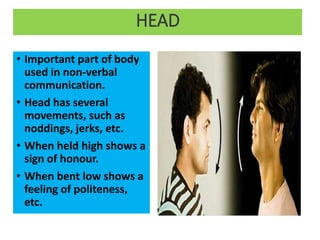
HEAD
• Important part of body
used in non-verbal
communication.
• Head has several
movements, such as
noddings, jerks, etc.
• When held high shows a
sign of honour.
• When bent low shows a
feeling of politeness,
etc.
POSTURE
• Posture refers to the
way one stands, sits
and Walks.
• Postures changes
accoding the situation.
• Postures reveals a lot
about an individual's
personality.
• Slumped posture-lows
spirit
• Erect posture-high
spirit
• Lean forward- open
,honest
• Lean backward-
defensive
• Crossed arms-not
ready to listen
• Uncrossed arm-
willingness to listen
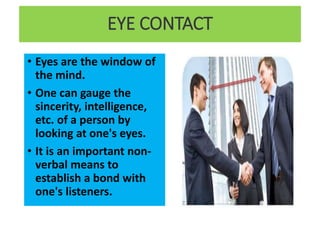
EYE CONTACT
• Eyes are the window of
the mind.
• One can gauge the
sincerity, intelligence,
etc. of a person by
looking at one's eyes.
• It is an important non-
verbal means to
establish a bond with
one's listeners.
GESTURES
• Gestures is the
movement made
by hands,head or
face.
• It adds to the
impact of verbal
communication.
• It clarifies our
ideas or reinforce
them.
• Enumerative-numbers
• Descriptive-size of the
object
• Symbolic-abstract
concepts
• Locative-location of an
objects
• Emphatic-emphasis
Thank you.

KINESICS

  • 1.
    KINESICS Presented by -Syed Farman Abbas Roll No. - 17BEDW-09 B.Ed 1st Semester
  • 2.
    KINESICS • Kinesics isthe interpretation of body motion communication such as facial expressions and gestures, nonverbal behavior related to movement of any part of the body or the body as a whole. • The equivalent popular culture term is body language. In body language, a person trasmits the message by moving various parts of his body such as face, eyes, heads, hands, etc.
  • 3.
    ELEMENTS OF BODYLANGUAGE 1. PERSONAL APPEARANCE 2. FACIAL EXPRESSIONS 3. HEAD 4. POSTURE 5. EYE CONTACT 6. GESTURES
  • 4.
    PERSONAL APPEARANCE • Itacts as a significant nonverbal clue. • The audience judge us initially from our physical appearance. • Personality creates an impression on audience prior to our speech. • The actual physical presence depends on self confidence and awareness. • Now-a-days ' dressing for success' is used to send a desired non-verbal message.
  • 5.
    FACIAL EXPRESSION • Faceis the primary site For expressing emotions. • Facial expressions add meaning to the verbal communication. • Facial expressions convey happiness, anger, surprise, etc. • Different parts of human face are capable of carrying wide range of emotions and expressions.
  • 6.
    HEAD • Important partof body used in non-verbal communication. • Head has several movements, such as noddings, jerks, etc. • When held high shows a sign of honour. • When bent low shows a feeling of politeness, etc.
  • 7.
    POSTURE • Posture refersto the way one stands, sits and Walks. • Postures changes accoding the situation. • Postures reveals a lot about an individual's personality. • Slumped posture-lows spirit • Erect posture-high spirit • Lean forward- open ,honest • Lean backward- defensive • Crossed arms-not ready to listen • Uncrossed arm- willingness to listen
  • 8.
    EYE CONTACT • Eyesare the window of the mind. • One can gauge the sincerity, intelligence, etc. of a person by looking at one's eyes. • It is an important non- verbal means to establish a bond with one's listeners.
  • 9.
    GESTURES • Gestures isthe movement made by hands,head or face. • It adds to the impact of verbal communication. • It clarifies our ideas or reinforce them. • Enumerative-numbers • Descriptive-size of the object • Symbolic-abstract concepts • Locative-location of an objects • Emphatic-emphasis
  • 10.