BRAIN-COMPUTER INTERFACE The next  generation  user interface
INTRODUCTION A  Brain-Computer Interface  (BCI)  is a  direct communication pathway between the human or an animal brain and an external device
CLASSIFICATION BCI INVASIVE BCI PARTIALLY INVASIVE BCI NON-INVASIVE BCI
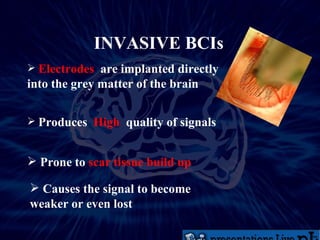
INVASIVE BCIs Electrodes   are implanted directly into the grey matter of the brain Produces  High   quality of signals   Prone to  scar tissue build up Causes the signal to become weaker or even lost
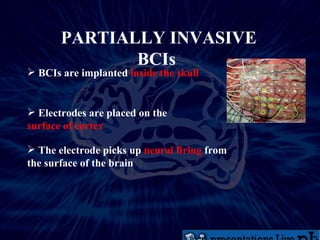
PARTIALLY INVASIVE BCIs  BCIs are implanted  inside the skull   Electrodes are placed on the  surface of cortex The electrode picks up  neural firing  from the surface of the brain
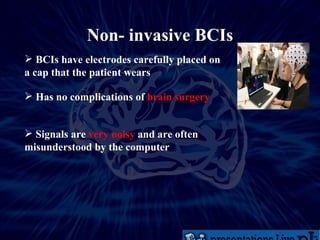
Non- invasive BCIs BCIs have electrodes carefully placed on a cap that the patient wears Has no complications of  brain surgery Signals are  very noisy  and are often misunderstood by the computer
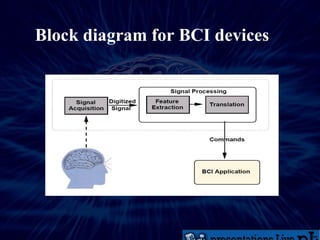
Block diagram for BCI devices
Signal Acquisition Different ways of extracting signals form the brain Direct neural contact ECoG fMRI EEG
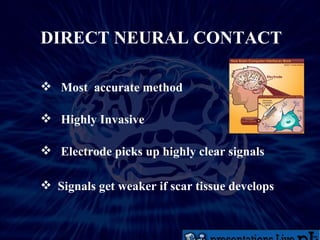
DIRECT NEURAL CONTACT Most  accurate method Highly Invasive Electrode picks up highly clear signals  Signals get weaker if scar tissue develops
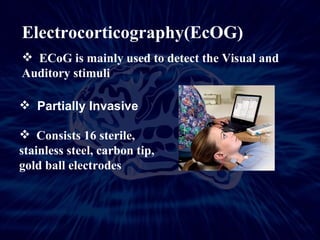
Electrocorticography(EcOG) Partially Invasive Consists 16 sterile, stainless steel, carbon tip, gold ball electrodes  ECoG is mainly used to detect the Visual and Auditory stimuli
FUNCTIONAL Magnetic Resonance Imaging  (fMRI) Type of specialized MRI scans  Measures blood flow in brain using MRI Studies the brain‘s function Very Accurate High cost due to MRI
ELECTROENCEPHALOGRAPHY(eeG)  Electronic monitoring device to measures electrical activity in brain Pain less test  Used to record the electrical signals from the brain  Used to confirm brain death
electroencephalogram
Interface  via  eeg VEP (Visual Evoked Potential) P300 (Potential 300)  SSVEP (Steady State Visual Evoked Potential)
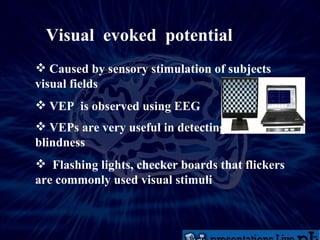
Visual  evoked  potential Caused by sensory stimulation of subjects visual fields VEP  is observed using EEG VEPs are very useful in detecting blindness Flashing lights, checker boards that flickers are commonly used visual stimuli
P 300 Unexpected sensory stimuli Peeks in the vicinity of 300 ms and lie for very simple decisions  Longer it takes for P 300 to appear in harder decision Used for screening  terrorists and other criminals
SSVEP Steady State Visual Evoked Potential SSVEP are signals that are natural  responses to visual stimulation This technique is used widely used in Electroencephalographic  research  regarding vision
Pros  &  cons  Can help people with inabilities to control wheel chairs or other devices with brain activity To develop better sensing system BCIs are linguistic independent and can be used any where across the world The signals are weak and are prone to interference Surgery to brain  might be risky and cause brain death  There are chemical reactions involved in brain which BCI devices cannot pick up
CONCLUSION BCI  research is an interdisciplinary  endeavor  involving neuroscience , engineering , signal processing, and clinical  rehabilitation , and lies at the  intersection of  several  emerging technologies  such as Machine Learning and Artificial Intelligence  among others. BCI is considered as an new frontier in science and technology
QUERIES..??

Brain computer interface

  • 1.
    BRAIN-COMPUTER INTERFACE Thenext generation user interface
  • 2.
    INTRODUCTION A Brain-Computer Interface (BCI) is a direct communication pathway between the human or an animal brain and an external device
  • 3.
    CLASSIFICATION BCI INVASIVEBCI PARTIALLY INVASIVE BCI NON-INVASIVE BCI
  • 4.
    INVASIVE BCIs Electrodes are implanted directly into the grey matter of the brain Produces High quality of signals Prone to scar tissue build up Causes the signal to become weaker or even lost
  • 5.
    PARTIALLY INVASIVE BCIs BCIs are implanted inside the skull Electrodes are placed on the surface of cortex The electrode picks up neural firing from the surface of the brain
  • 6.
    Non- invasive BCIsBCIs have electrodes carefully placed on a cap that the patient wears Has no complications of brain surgery Signals are very noisy and are often misunderstood by the computer
  • 7.
    Block diagram forBCI devices
  • 8.
    Signal Acquisition Differentways of extracting signals form the brain Direct neural contact ECoG fMRI EEG
  • 9.
    DIRECT NEURAL CONTACTMost accurate method Highly Invasive Electrode picks up highly clear signals Signals get weaker if scar tissue develops
  • 10.
    Electrocorticography(EcOG) Partially InvasiveConsists 16 sterile, stainless steel, carbon tip, gold ball electrodes ECoG is mainly used to detect the Visual and Auditory stimuli
  • 11.
    FUNCTIONAL Magnetic ResonanceImaging (fMRI) Type of specialized MRI scans Measures blood flow in brain using MRI Studies the brain‘s function Very Accurate High cost due to MRI
  • 12.
    ELECTROENCEPHALOGRAPHY(eeG) Electronicmonitoring device to measures electrical activity in brain Pain less test Used to record the electrical signals from the brain Used to confirm brain death
  • 13.
  • 14.
    Interface via eeg VEP (Visual Evoked Potential) P300 (Potential 300) SSVEP (Steady State Visual Evoked Potential)
  • 15.
    Visual evoked potential Caused by sensory stimulation of subjects visual fields VEP is observed using EEG VEPs are very useful in detecting blindness Flashing lights, checker boards that flickers are commonly used visual stimuli
  • 16.
    P 300 Unexpectedsensory stimuli Peeks in the vicinity of 300 ms and lie for very simple decisions Longer it takes for P 300 to appear in harder decision Used for screening terrorists and other criminals
  • 17.
    SSVEP Steady StateVisual Evoked Potential SSVEP are signals that are natural responses to visual stimulation This technique is used widely used in Electroencephalographic research regarding vision
  • 18.
    Pros & cons Can help people with inabilities to control wheel chairs or other devices with brain activity To develop better sensing system BCIs are linguistic independent and can be used any where across the world The signals are weak and are prone to interference Surgery to brain might be risky and cause brain death There are chemical reactions involved in brain which BCI devices cannot pick up
  • 19.
    CONCLUSION BCI research is an interdisciplinary endeavor involving neuroscience , engineering , signal processing, and clinical rehabilitation , and lies at the intersection of several emerging technologies such as Machine Learning and Artificial Intelligence among others. BCI is considered as an new frontier in science and technology
  • 20.