RAGHU ENGINEERING COLLEGE
(Autonomous)
Department of electronics and communication
engineering
SEMINAR ON
BRAIN COMPUTER INTERFACE
(NEURALINK)
By
M.UDAY KUMAR
(17981A04B8)
ECE-C
ABSTRACT
A Brain Computer Interface (BCI) provides a
communication path between human brain and
the computer system. With the advancement in
the areas of information technology and
neurosciences, there has been a surge of interest
in turning fiction into reality. The major goal of
BCI research is to develop a system that allows
disabled people to communicate with other
persons and helps to interact with the external
environments. This area includes components
like, comparison of invasive and noninvasive
technologies to measure brain activity
CONTENTS
• INTRODUCTION
• HISTORY
• EARLY WORK
• BCI STRUCTURE
• WORKING
• BCI TYPES
• FUTURE OF BCI
• APPLICATIONS
• CONCLUSION
INTRODUCTION
• A brain–computer interface is called as neuralink
• Brain–machine interface (BMI), is a direct communication
pathway between an enhanced or wired brain and an external
device.
HISTORY
• The history of brain–computer interfaces (BCIs) starts
with Hans Berger's discovery of the electrical activity of the
human brain and the development of EEG
• Electroencephalography (EEG) is
an electrophysiological monitoring method to record electrical
activity of the brain. It is typically noninvasive, with
the electrodes placed along the scalp, although invasive
electrodes
• In 1924 Berger was the first to record human brain activity by
means of EEG. Berger was able to identify oscillatory activity,
such as Berger's wave or the alpha wave (8–13 Hz), by
analyzing EEG traces
EARLY WORK
• Algorithms to reconstruct movements from motor cortex
neurons, which control movement, were developed in 1970s.
• The first Intra-Cortical Brain-Computer Interface was built by
implanting electrodes into monkeys.
• After conducting initial studies in rats during the 1990s,
researchers developed Brain Computer Interfaces that
decoded brain activity in monkeys and used the devices to
reproduce movements in monkeys and used the devices to
reproduce monkey movements in robotic arms.
BCI STRUCTURE
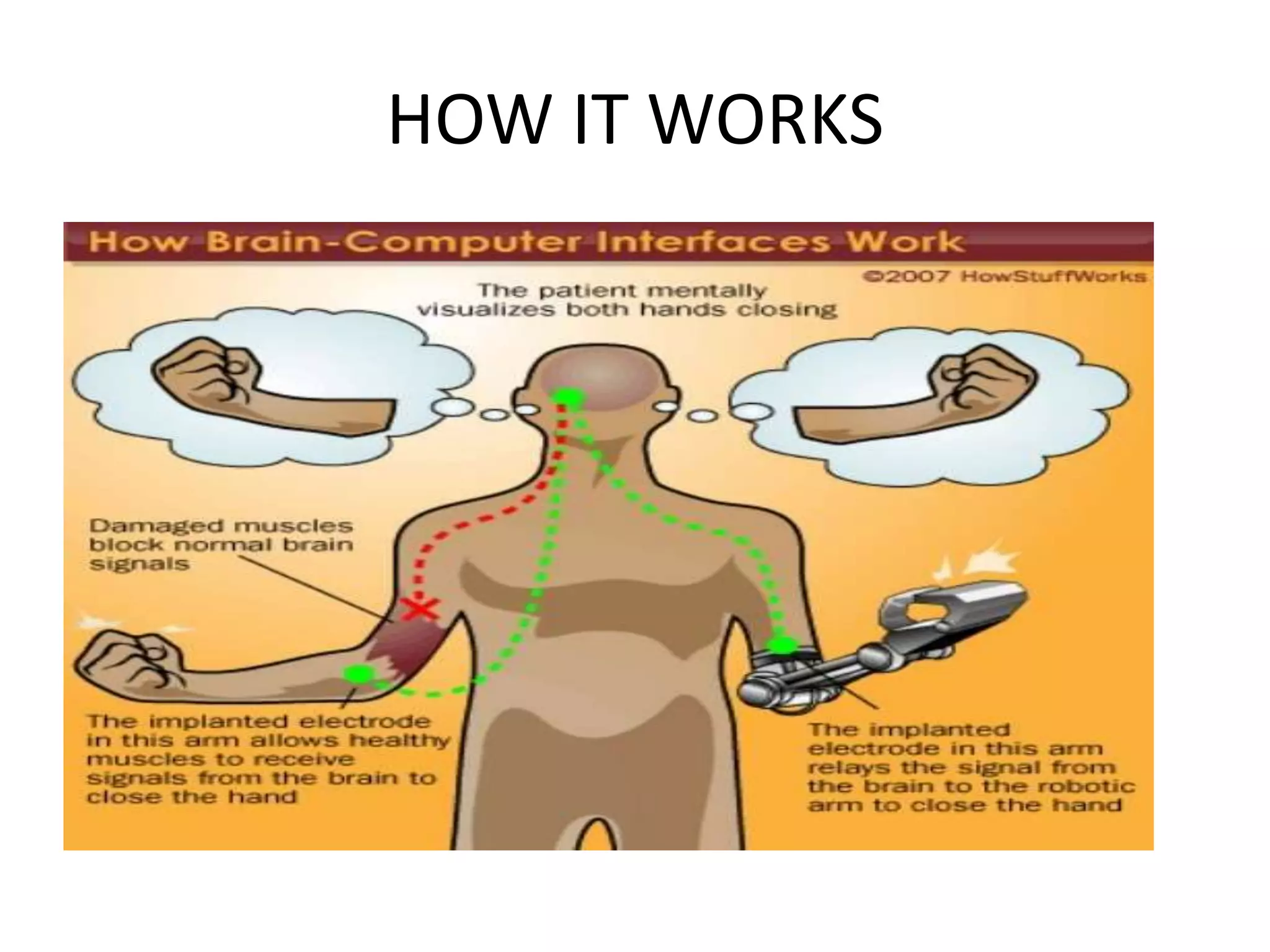
HOW IT WORKS
LAYERS OF BRAIN
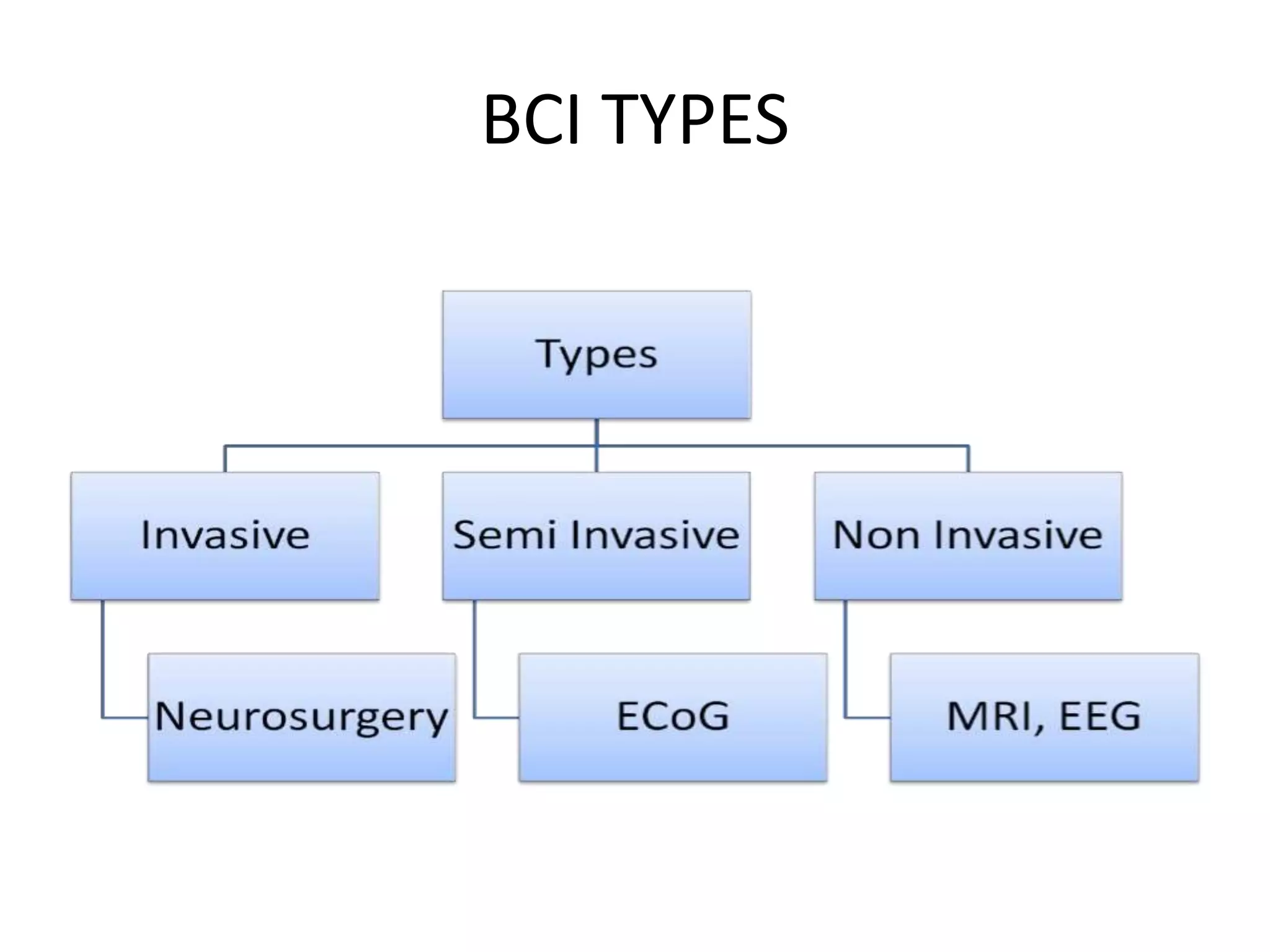
BCI TYPES
INVASIVE BCI
• Invasive BCI requires surgery to implant electrodes under
scalp for communicating brain signals.
• The main advantage is to provide more accurate reading;
however, its downside includes side effects from the surgery.
After the surgery, scar tissues may form which can make brain
signals weaker.
• In addition, according to the research of Abdulkader et al.,
(2015) . once implanted electrodes, the body may not accept
the electrodes which may cause medical complications.
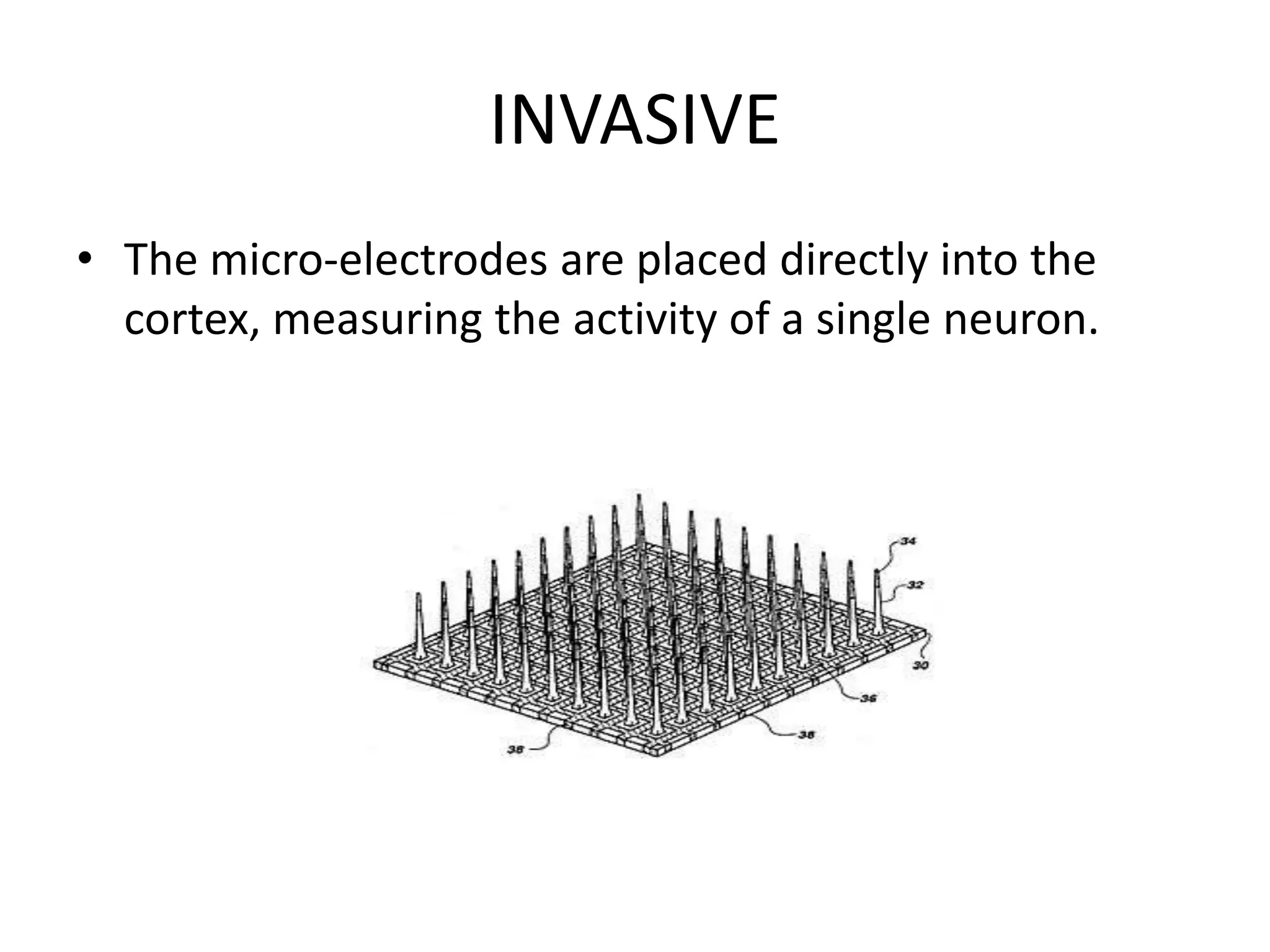
INVASIVE
• The micro-electrodes are placed directly into the
cortex, measuring the activity of a single neuron.
ADVANTAGES
• We get a signal of high amplitude and less noise
• We get high resolution
DISADVANTAGES
• It damages neurons
SEMI INVASIVE
• Partially invasive BCI devices are implanted inside the skull but
rest outside the brain rather than within the grey matter.
• They produce better resolution signals than non-invasive BCIs
where the bone tissue of the cranium deflects and deforms
signals and have a lower risk of forming scar-tissue in the
brain than fully invasive BCIs.
• There has been preclinical demonstration of intracortical BCIs
from the stroke perilesional cortex.
• The electrodes are placed on the exposed
surface of the brain(ECoG).
ECoG
• Electrocorticography uses electrodes placed on the exposed
surface of the brain to measure electrical activity from the
cerebral cortex.
• It has been used for the first time in the 1950s at the
Montreal Neurological Institute.
• It is called semi-invasive but it still requires a craniotomy to
implant the electrodes.
• The electrodes may be placed outside the dura mater
(epidural) or under the dura mater (subdural).
• The positive characteristics of ECoG are
• high spatial resolution and signal fidelity
• resistance to noise
• lower clinical risk and Robustness over long recording period
• Higher amplitude
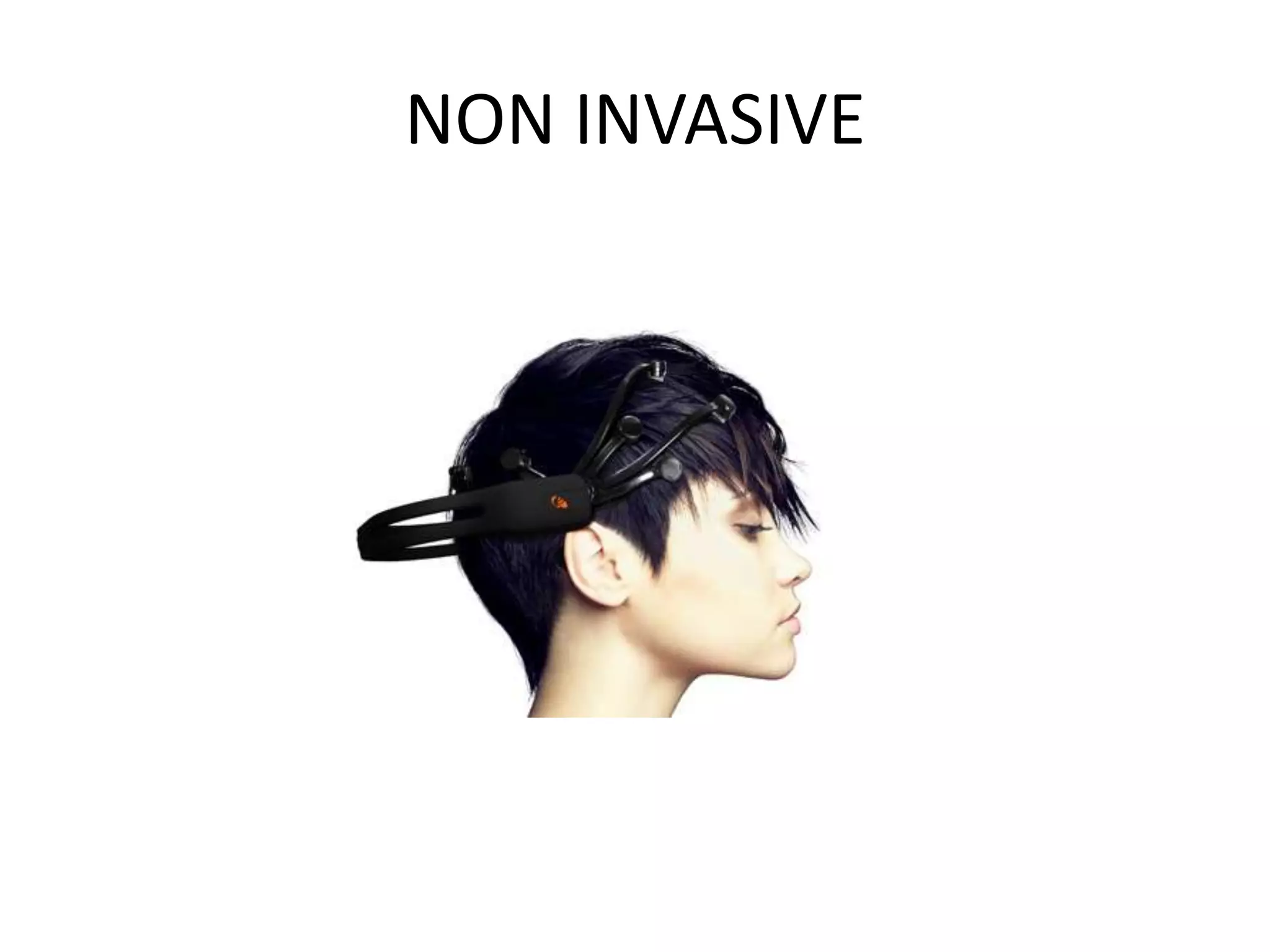
NON INVASIVE BCI
• There have also been experiments in humans using non-invasive
neuro imaging technologies as interfaces.
• The substantial majority of published BCI work involves noninvasive
EEG-based BCIs.
• Noninvasive EEG-based technologies and interfaces have been used
for a much broader variety of applications.
• Although EEG-based interfaces are easy to wear and do not require
surgery, they have relatively poor spatial resolution and cannot
effectively use higher-frequency signals because the skull dampens
signals, dispersing and blurring the electromagnetic waves created
by the neurons.
• EEG-based interfaces also require some time and effort prior to
each usage session, whereas non-EEG-based ones, as well as
invasive ones require no prior-usage training. Overall, the best BCI
for each user depends on numerous factors.
NON INVASIVE
MRI
• Magnetic resonance imaging procedure using MRI
technology that measures the brain activity by detecting
changes associated with blood flow.
EEG
• EEG provides the recording of electrical activity of the brain
from the surface of the scalp.
FUTURE OF BCI
• 1998: First (invasive, non-EEG) implant in the human brain
that produces high quality signals
• 1999: BCI is used to aid a quadriplegic for limited hand
movement
• 2002: Monkeys are trained to control a computer cursor
• 2003: First BCI game is demonstrated to the public (BrainGate)
• 2005: Monkey brain controls a robotic arm
• 2008: Voiceless phone calls are demonstrated (The Audeo – TI
developers conference)
• 2014 Direct brain-to-brain communication achieved by
transmitting EEG signals over the internet
APPLICATIONS
• Bionics/Cybernetics
• Memory Upload/Download
• Dream Capture
• Brain as a Computer
• “Google Search” through brain
• More helpful for paralysed patients
BIONIC EYE
CONCLUSION
•BCI is an advancing technology promising paradigm shift in
areas like Machine Control, Human Enhancement, Virtual
reality and etc. So, it’s potentially high impact technology.
REFFERENCES
• http://learn.neurotechedu.com/introtobci/
• https://www.frontiersin.org/research-
topics/9784/datasets-for-brain-computer-
interface-applications
THANK YOU

Neurallink

  • 1.
    RAGHU ENGINEERING COLLEGE (Autonomous) Departmentof electronics and communication engineering SEMINAR ON BRAIN COMPUTER INTERFACE (NEURALINK) By M.UDAY KUMAR (17981A04B8) ECE-C
  • 2.
    ABSTRACT A Brain ComputerInterface (BCI) provides a communication path between human brain and the computer system. With the advancement in the areas of information technology and neurosciences, there has been a surge of interest in turning fiction into reality. The major goal of BCI research is to develop a system that allows disabled people to communicate with other persons and helps to interact with the external environments. This area includes components like, comparison of invasive and noninvasive technologies to measure brain activity
  • 3.
    CONTENTS • INTRODUCTION • HISTORY •EARLY WORK • BCI STRUCTURE • WORKING • BCI TYPES • FUTURE OF BCI • APPLICATIONS • CONCLUSION
  • 4.
    INTRODUCTION • A brain–computerinterface is called as neuralink • Brain–machine interface (BMI), is a direct communication pathway between an enhanced or wired brain and an external device.
  • 5.
    HISTORY • The historyof brain–computer interfaces (BCIs) starts with Hans Berger's discovery of the electrical activity of the human brain and the development of EEG • Electroencephalography (EEG) is an electrophysiological monitoring method to record electrical activity of the brain. It is typically noninvasive, with the electrodes placed along the scalp, although invasive electrodes • In 1924 Berger was the first to record human brain activity by means of EEG. Berger was able to identify oscillatory activity, such as Berger's wave or the alpha wave (8–13 Hz), by analyzing EEG traces
  • 6.
    EARLY WORK • Algorithmsto reconstruct movements from motor cortex neurons, which control movement, were developed in 1970s. • The first Intra-Cortical Brain-Computer Interface was built by implanting electrodes into monkeys. • After conducting initial studies in rats during the 1990s, researchers developed Brain Computer Interfaces that decoded brain activity in monkeys and used the devices to reproduce movements in monkeys and used the devices to reproduce monkey movements in robotic arms.
  • 7.
  • 8.
  • 9.
  • 10.
  • 11.
    INVASIVE BCI • InvasiveBCI requires surgery to implant electrodes under scalp for communicating brain signals. • The main advantage is to provide more accurate reading; however, its downside includes side effects from the surgery. After the surgery, scar tissues may form which can make brain signals weaker. • In addition, according to the research of Abdulkader et al., (2015) . once implanted electrodes, the body may not accept the electrodes which may cause medical complications.
  • 12.
    INVASIVE • The micro-electrodesare placed directly into the cortex, measuring the activity of a single neuron.
  • 13.
    ADVANTAGES • We geta signal of high amplitude and less noise • We get high resolution DISADVANTAGES • It damages neurons
  • 14.
    SEMI INVASIVE • Partiallyinvasive BCI devices are implanted inside the skull but rest outside the brain rather than within the grey matter. • They produce better resolution signals than non-invasive BCIs where the bone tissue of the cranium deflects and deforms signals and have a lower risk of forming scar-tissue in the brain than fully invasive BCIs. • There has been preclinical demonstration of intracortical BCIs from the stroke perilesional cortex.
  • 15.
    • The electrodesare placed on the exposed surface of the brain(ECoG).
  • 16.
    ECoG • Electrocorticography useselectrodes placed on the exposed surface of the brain to measure electrical activity from the cerebral cortex. • It has been used for the first time in the 1950s at the Montreal Neurological Institute. • It is called semi-invasive but it still requires a craniotomy to implant the electrodes. • The electrodes may be placed outside the dura mater (epidural) or under the dura mater (subdural).
  • 17.
    • The positivecharacteristics of ECoG are • high spatial resolution and signal fidelity • resistance to noise • lower clinical risk and Robustness over long recording period • Higher amplitude
  • 18.
    NON INVASIVE BCI •There have also been experiments in humans using non-invasive neuro imaging technologies as interfaces. • The substantial majority of published BCI work involves noninvasive EEG-based BCIs. • Noninvasive EEG-based technologies and interfaces have been used for a much broader variety of applications. • Although EEG-based interfaces are easy to wear and do not require surgery, they have relatively poor spatial resolution and cannot effectively use higher-frequency signals because the skull dampens signals, dispersing and blurring the electromagnetic waves created by the neurons. • EEG-based interfaces also require some time and effort prior to each usage session, whereas non-EEG-based ones, as well as invasive ones require no prior-usage training. Overall, the best BCI for each user depends on numerous factors.
  • 19.
  • 20.
    MRI • Magnetic resonanceimaging procedure using MRI technology that measures the brain activity by detecting changes associated with blood flow. EEG • EEG provides the recording of electrical activity of the brain from the surface of the scalp.
  • 21.
    FUTURE OF BCI •1998: First (invasive, non-EEG) implant in the human brain that produces high quality signals • 1999: BCI is used to aid a quadriplegic for limited hand movement • 2002: Monkeys are trained to control a computer cursor • 2003: First BCI game is demonstrated to the public (BrainGate) • 2005: Monkey brain controls a robotic arm • 2008: Voiceless phone calls are demonstrated (The Audeo – TI developers conference) • 2014 Direct brain-to-brain communication achieved by transmitting EEG signals over the internet
  • 22.
    APPLICATIONS • Bionics/Cybernetics • MemoryUpload/Download • Dream Capture • Brain as a Computer • “Google Search” through brain • More helpful for paralysed patients
  • 23.
  • 24.
    CONCLUSION •BCI is anadvancing technology promising paradigm shift in areas like Machine Control, Human Enhancement, Virtual reality and etc. So, it’s potentially high impact technology.
  • 25.
  • 26.