Submitted By:
Muhammad Saqib Sheraz
BS-Biotechnology 5th - Term
11/05/2017 1
INTRODUCTION:
 X-rays were discovered by Wilhelm Roentgen
who called them x-rays because the
nature at first was unknown so, x-rays
are also called Roentgen rays.
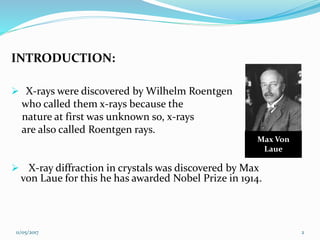
 X-ray diffraction in crystals was discovered by Max
von Laue for this he has awarded Nobel Prize in 1914.
Max Von
Laue
11/05/2017 2
X-Ray and its Production
 An electromagnetic waves of high energy and very
short wavelength (10-7 to about 10-15 nm), which is
able to pass through many materials is known as
X-RAYS.
PRODUCTION:
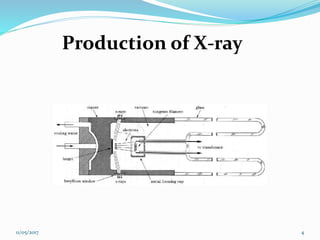
 X-rays are produced whenever high-speed
electrons collide with a metal target.
11/05/2017 3
Production of X-ray
11/05/2017 4
X-ray Diffraction (XRD)
 When X-ray waves are passed through a very small
opening and is scattered in different directions it is
called as X-ray diffraction.
 This technique is mainly used to study the structure of
crystalline solids.
11/05/2017 5
PRINCIPLE
X-ray
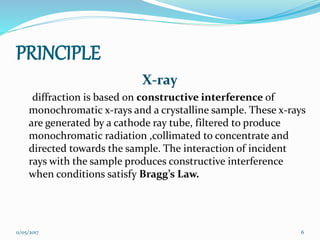
diffraction is based on constructive interference of
monochromatic x-rays and a crystalline sample. These x-rays
are generated by a cathode ray tube, filtered to produce
monochromatic radiation ,collimated to concentrate and
directed towards the sample. The interaction of incident
rays with the sample produces constructive interference
when conditions satisfy Bragg’s Law.
11/05/2017 6
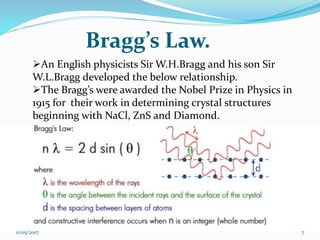
Bragg’s Law.
An English physicists Sir W.H.Bragg and his son Sir
W.L.Bragg developed the below relationship.
The Bragg’s were awarded the Nobel Prize in Physics in
1915 for their work in determining crystal structures
beginning with NaCl, ZnS and Diamond.
11/05/2017 7
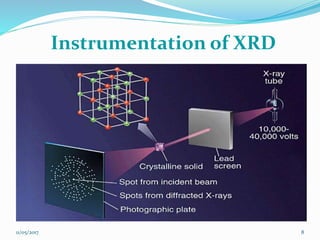
Instrumentation of XRD
11/05/2017 8
XRD In Protein Study
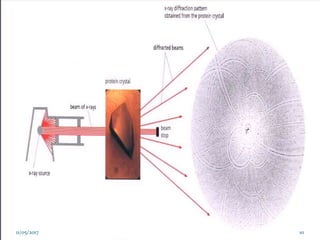
 In order to study the structure of any unknown protein
through X-ray Diffraction we do following steps;
i. First of all the extracted protein is crystallized.
ii. Then the X-rays are focused upon protein crystal.
iii. Most of rays pass out straight without being deflected,
only few rays are scattered at different angles which
reinforces with each other to create an X-ray pattern
upon photographic plate.
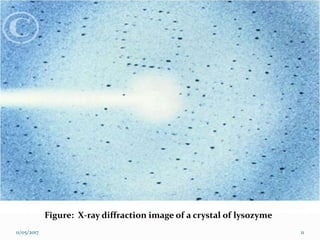
iv. From the dotted pattern we can tell the structure of that
protein.
11/05/2017 9
11/05/2017 10
Figure: X-ray diffraction image of a crystal of lysozyme
11/05/2017 11
11/05/2017 12
XRD IN DNA STUDY
APPLICATIONS
 Soil classification based on crystallinity
 Analysis of industrial dusts
 Assessment of weathering & degradation of
minerals & polymers
 Study of corrosion products
 Examination of tooth enamel & dentine
 Examination of bone state & tissue state
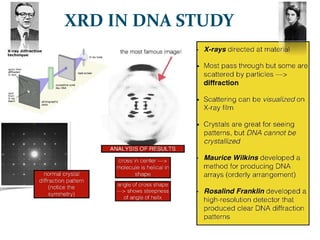
 Structure of DNA&RNA
11/05/2017 13
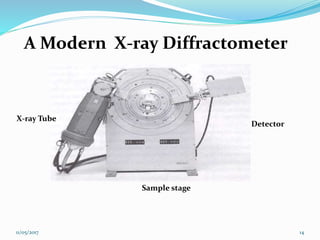
A Modern X-ray Diffractometer
X-ray Tube
Detector
Sample stage
11/05/2017 14
11/05/2017 15

X-ray Diffraction

  • 1.
    Submitted By: Muhammad SaqibSheraz BS-Biotechnology 5th - Term 11/05/2017 1
  • 2.
    INTRODUCTION:  X-rays werediscovered by Wilhelm Roentgen who called them x-rays because the nature at first was unknown so, x-rays are also called Roentgen rays.  X-ray diffraction in crystals was discovered by Max von Laue for this he has awarded Nobel Prize in 1914. Max Von Laue 11/05/2017 2
  • 3.
    X-Ray and itsProduction  An electromagnetic waves of high energy and very short wavelength (10-7 to about 10-15 nm), which is able to pass through many materials is known as X-RAYS. PRODUCTION:  X-rays are produced whenever high-speed electrons collide with a metal target. 11/05/2017 3
  • 4.
  • 5.
    X-ray Diffraction (XRD) When X-ray waves are passed through a very small opening and is scattered in different directions it is called as X-ray diffraction.  This technique is mainly used to study the structure of crystalline solids. 11/05/2017 5
  • 6.
    PRINCIPLE X-ray diffraction is basedon constructive interference of monochromatic x-rays and a crystalline sample. These x-rays are generated by a cathode ray tube, filtered to produce monochromatic radiation ,collimated to concentrate and directed towards the sample. The interaction of incident rays with the sample produces constructive interference when conditions satisfy Bragg’s Law. 11/05/2017 6
  • 7.
    Bragg’s Law. An Englishphysicists Sir W.H.Bragg and his son Sir W.L.Bragg developed the below relationship. The Bragg’s were awarded the Nobel Prize in Physics in 1915 for their work in determining crystal structures beginning with NaCl, ZnS and Diamond. 11/05/2017 7
  • 8.
  • 9.
    XRD In ProteinStudy  In order to study the structure of any unknown protein through X-ray Diffraction we do following steps; i. First of all the extracted protein is crystallized. ii. Then the X-rays are focused upon protein crystal. iii. Most of rays pass out straight without being deflected, only few rays are scattered at different angles which reinforces with each other to create an X-ray pattern upon photographic plate. iv. From the dotted pattern we can tell the structure of that protein. 11/05/2017 9
  • 10.
  • 11.
    Figure: X-ray diffractionimage of a crystal of lysozyme 11/05/2017 11
  • 12.
  • 13.
    APPLICATIONS  Soil classificationbased on crystallinity  Analysis of industrial dusts  Assessment of weathering & degradation of minerals & polymers  Study of corrosion products  Examination of tooth enamel & dentine  Examination of bone state & tissue state  Structure of DNA&RNA 11/05/2017 13
  • 14.
    A Modern X-rayDiffractometer X-ray Tube Detector Sample stage 11/05/2017 14
  • 15.