PRESENTATION
SERS AND ITS APPLICATION
(Raman spectroscopy)
Presented by: Submitted to:
Wajahat tula Hasan Prof. S.S Islam
M.Tech.
Centre for Nanoscience and Nanotechnology
Jamia Milia Islamia
New Delhi-110025
Context
INTRODUCTION TO SERS
FEATURES OF SERS
LITERARY SURVEY
PRINCIPLE
INSTRUMENTATIOM
SERS ENHANCEMENT
SERS FACTORS
EXPERIMENTAL DETAILS
APPLICATIONS
CONCUSION
INTRODUCTION TO SERS:
• SERS stands for Surface-enhanced Raman Spectroscopy. It is an analytical technique used to detect and
analyze molecules.
• The weak Raman signal can be greatly enhanced by introduc-
ion of Surface –Enhanced Raman Spectroscopy.
• It is a highly surface-sensitive, non-destructive and in situ
vibrational spectroscopy technique.
• It was first observed by Martin Fleischmann, Hendra and
McMullan.
• They reported strong Raman scattering from Pyridine(Py) adsorbed on the roughened silver(Ag) electrode.
•
• The Raman signals were enhanced by a factor of 10 to 1011 enhancement factor.
CONT…….
• They initially thought the intense surface Raman signal of Py was
due to increased surface area. Prevailing explanation was proposed
by Van Duyne in 1977.
• Van Duyne hypothesized that the phenomenon was originated by
strong electrochemical electric field at the metal surface.
•
• Moskivits proposed that the large signal was originated by optical
excitation of collective oscillation of the electron in the metallic
Nano sized features at the surface.
•
• A comprehensive theory of this effect was given by Lombardy and
Birke.
FEATURES OF SERS
 It is a highly surface-sensitive, non-destructive and in situ vibrational spectroscopic technique.
 It has extremely high spatial resolution. The enhancement range is several nanometers.
 SERS activity strongly depends on the nature of metal and surface roughness.
 SERS provides a significant amplification of Raman signals, resulting in a stronger and more
easily detectable signal compared to conventional Raman spectroscopy.
 SERS can be used for real-time and in-situ analysis, allowing researchers to monitor dynamic
processes, chemical reactions, and molecular interactions in various environments.
 The SERS technique is so sensitive that even single molecule can be deducted.
PRINCIPLE OF SERS
SERS is truly a surface selective effect.

SERS is a molecular spectroscopic technique which is based on plasmon assisted scattering
of molecules on or near metal Nano structures.

SERS consist in using the large local field enhancement that can exist at metallic surfaces
under the right condition.
The SERS enhancement of the nanostructures strongly relies upon the optical resonance
property of the coinage metallic Au, Ag.

The SERS effects due to the amplification of Raman signal of analytes by several orders of
magnitude, when the analytes are located at or very close to coinage metal nanostructures
• Localized Surface Plasmon Resonance (LSPR) boost the Raman signal to molecules at the
surface .
• The principle of Surface-Enhanced Raman Spectroscopy (SERS) is based on two key
phenomena:
Electromagnetic enhancement and Chemical enhancement.
• Electromagnetic Enhancement mechanism results from the amplification of light by
excited LSPR
• Chemical Enhancement involve charge transfer mechanism, where the excitation
wavelength is resultant with the metal molecule charge transfer electronic state
PLASMONS
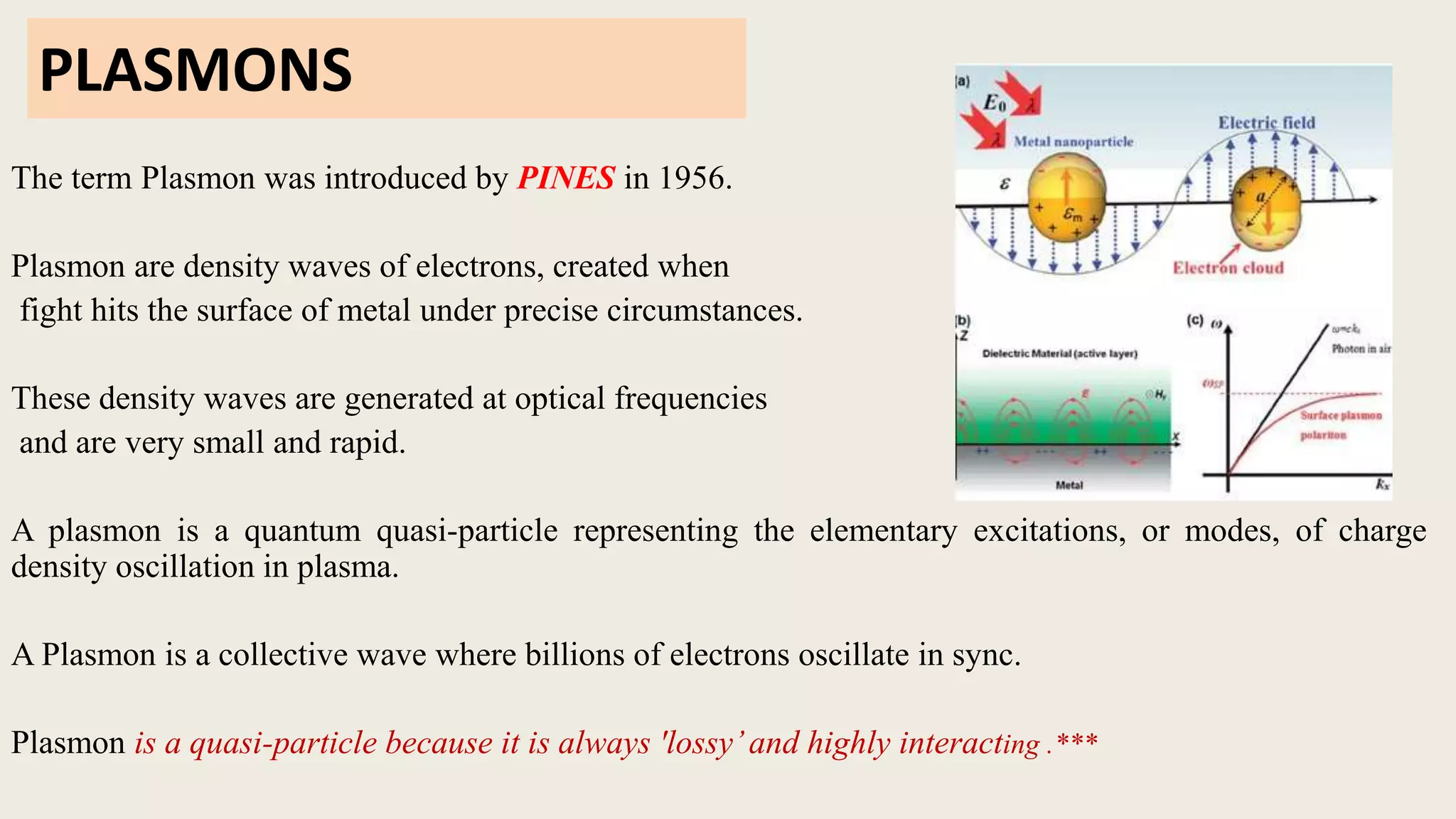
The term Plasmon was introduced by PINES in 1956.
Plasmon are density waves of electrons, created when
fight hits the surface of metal under precise circumstances.
These density waves are generated at optical frequencies
and are very small and rapid.
A plasmon is a quantum quasi-particle representing the elementary excitations, or modes, of charge
density oscillation in plasma.
A Plasmon is a collective wave where billions of electrons oscillate in sync.
Plasmon is a quasi-particle because it is always 'lossy’and highly interacting .***
LOCALISED SURFACE PLASMON ( LSP s)
A localized Surface Plasmon is a surface Plasmon geometrically confined to small cavity of a nanoparticle size
comparable to or smaller than the wavelength of light used to excite the Plasmon.
LSPs are collective oscillations of electrons at the surface of a metal nanoparticle or nanostructure.
LSPs are excited by electromagnetic radiation, such as light, and their resonant frequencies depend on the
size, shape, and material composition of the nanoparticle.
The interaction between light and LSPs gives rise to a variety of interesting optical phenomena, such as
enhanced light scattering, absorption, and emission, as well as localized heating and chemical reactions.
They have been used to develop a variety of nanoparticle-based devices with tailored optical properties, such as
color filters, biosensors, and photovoltaic cells.
MECHANISM
An analyses is absorbed
on a surface patterned
or roughened so that the
chosen excitation
frequency will excite a
Plasmon and create
scattering.
Energy from Plasmon is
transferred to the
absorbed molecule and
the Raman process
occurs on the molecule.
Energy is transferred
back to the Plasmon
less than the amount
transferred than the
nuclei and scattering
from the surface as
wavelength shifted
light.
PLASMON EXCITATION RAMAN PROCESS ENHANCEMENT
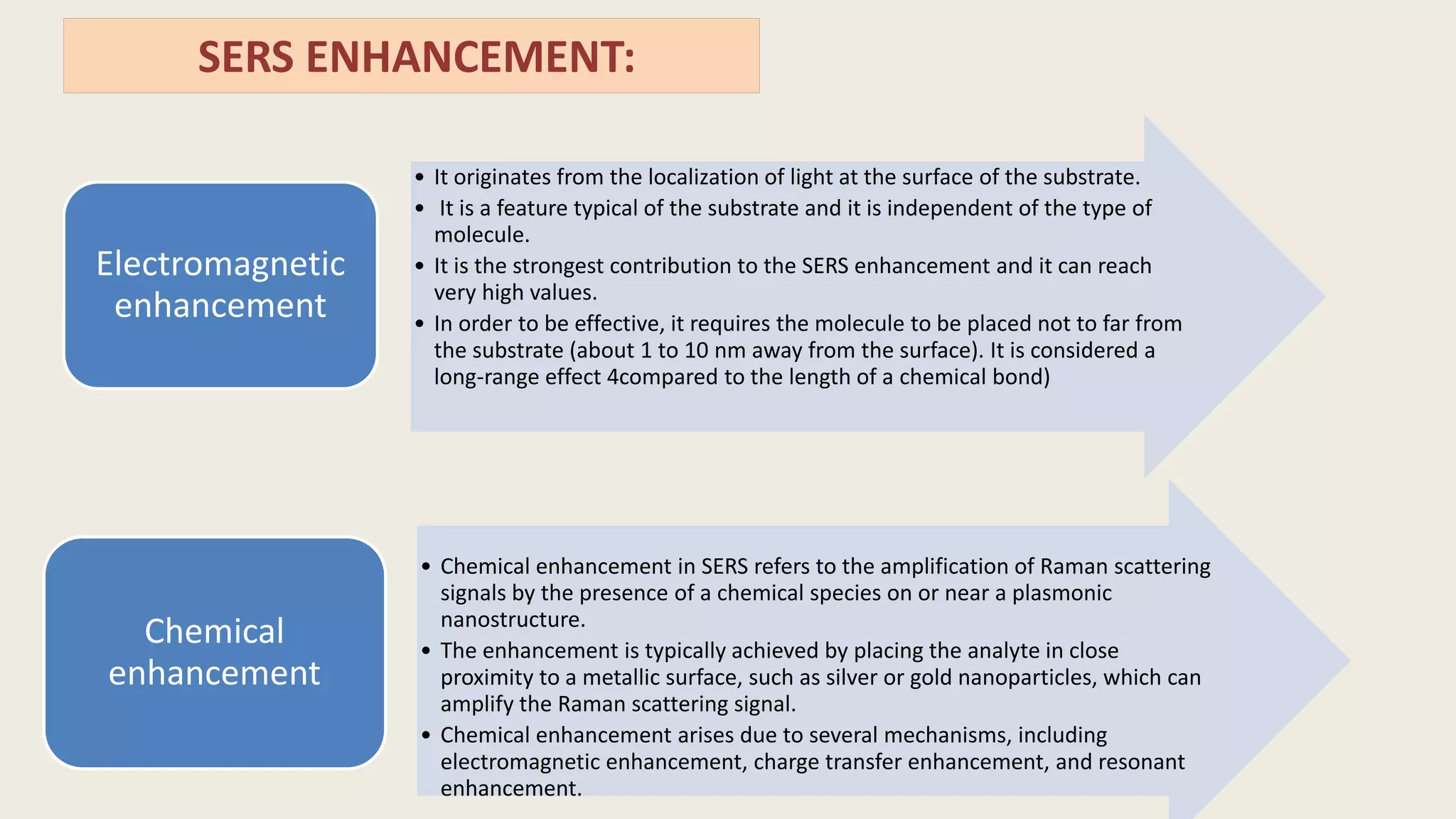
SERS ENHANCEMENT:
• It originates from the localization of light at the surface of the substrate.
• It is a feature typical of the substrate and it is independent of the type of
molecule.
• It is the strongest contribution to the SERS enhancement and it can reach
very high values.
• In order to be effective, it requires the molecule to be placed not to far from
the substrate (about 1 to 10 nm away from the surface). It is considered a
long-range effect 4compared to the length of a chemical bond)
Electromagnetic
enhancement
• Chemical enhancement in SERS refers to the amplification of Raman scattering
signals by the presence of a chemical species on or near a plasmonic
nanostructure.
• The enhancement is typically achieved by placing the analyte in close
proximity to a metallic surface, such as silver or gold nanoparticles, which can
amplify the Raman scattering signal.
• Chemical enhancement arises due to several mechanisms, including
electromagnetic enhancement, charge transfer enhancement, and resonant
enhancement.
Chemical
enhancement
 SERS has a wide range of applications, including environmental monitoring, food safety, biomedical diagnostics, and chemical sensing.
 In environmental monitoring, SERS can be used to detect and quantify pollutants, such as heavy metals, pesticides, and toxic gases, in
water, soil, and air.
 In food safety, SERS can be used to detect and identify contaminants, such as pathogens, pesticides, and food additives, in food and
beverages.
 In biomedical diagnostics, SERS can be used for disease detection and diagnosis, such as cancer, infectious diseases, and
neurodegenerative disorders.
 SERS can also be used for drug discovery and development, by studying the interactions between drugs and their targets, and for
monitoring drug release in real-time.
 SERS is a highly sensitive and specific technique, capable of detecting analytes at concentrations as low as parts per trillion, making it a
promising tool for a wide range of applications.
 SERS is a powerful analytical technique that can be used to detect and identify trace amounts of analytes, including molecules, ions, and
biological molecules.
APPLICATION
SERS (Raman Spectroscopy)

SERS (Raman Spectroscopy)

  • 1.
    PRESENTATION SERS AND ITSAPPLICATION (Raman spectroscopy) Presented by: Submitted to: Wajahat tula Hasan Prof. S.S Islam M.Tech. Centre for Nanoscience and Nanotechnology Jamia Milia Islamia New Delhi-110025
  • 2.
    Context INTRODUCTION TO SERS FEATURESOF SERS LITERARY SURVEY PRINCIPLE INSTRUMENTATIOM SERS ENHANCEMENT SERS FACTORS EXPERIMENTAL DETAILS APPLICATIONS CONCUSION
  • 3.
    INTRODUCTION TO SERS: •SERS stands for Surface-enhanced Raman Spectroscopy. It is an analytical technique used to detect and analyze molecules. • The weak Raman signal can be greatly enhanced by introduc- ion of Surface –Enhanced Raman Spectroscopy. • It is a highly surface-sensitive, non-destructive and in situ vibrational spectroscopy technique. • It was first observed by Martin Fleischmann, Hendra and McMullan. • They reported strong Raman scattering from Pyridine(Py) adsorbed on the roughened silver(Ag) electrode. • • The Raman signals were enhanced by a factor of 10 to 1011 enhancement factor.
  • 4.
    CONT……. • They initiallythought the intense surface Raman signal of Py was due to increased surface area. Prevailing explanation was proposed by Van Duyne in 1977. • Van Duyne hypothesized that the phenomenon was originated by strong electrochemical electric field at the metal surface. • • Moskivits proposed that the large signal was originated by optical excitation of collective oscillation of the electron in the metallic Nano sized features at the surface. • • A comprehensive theory of this effect was given by Lombardy and Birke.
  • 5.
    FEATURES OF SERS It is a highly surface-sensitive, non-destructive and in situ vibrational spectroscopic technique.  It has extremely high spatial resolution. The enhancement range is several nanometers.  SERS activity strongly depends on the nature of metal and surface roughness.  SERS provides a significant amplification of Raman signals, resulting in a stronger and more easily detectable signal compared to conventional Raman spectroscopy.  SERS can be used for real-time and in-situ analysis, allowing researchers to monitor dynamic processes, chemical reactions, and molecular interactions in various environments.  The SERS technique is so sensitive that even single molecule can be deducted.
  • 6.
    PRINCIPLE OF SERS SERSis truly a surface selective effect.  SERS is a molecular spectroscopic technique which is based on plasmon assisted scattering of molecules on or near metal Nano structures.  SERS consist in using the large local field enhancement that can exist at metallic surfaces under the right condition. The SERS enhancement of the nanostructures strongly relies upon the optical resonance property of the coinage metallic Au, Ag.  The SERS effects due to the amplification of Raman signal of analytes by several orders of magnitude, when the analytes are located at or very close to coinage metal nanostructures
  • 7.
    • Localized SurfacePlasmon Resonance (LSPR) boost the Raman signal to molecules at the surface . • The principle of Surface-Enhanced Raman Spectroscopy (SERS) is based on two key phenomena: Electromagnetic enhancement and Chemical enhancement. • Electromagnetic Enhancement mechanism results from the amplification of light by excited LSPR • Chemical Enhancement involve charge transfer mechanism, where the excitation wavelength is resultant with the metal molecule charge transfer electronic state
  • 8.
    PLASMONS The term Plasmonwas introduced by PINES in 1956. Plasmon are density waves of electrons, created when fight hits the surface of metal under precise circumstances. These density waves are generated at optical frequencies and are very small and rapid. A plasmon is a quantum quasi-particle representing the elementary excitations, or modes, of charge density oscillation in plasma. A Plasmon is a collective wave where billions of electrons oscillate in sync. Plasmon is a quasi-particle because it is always 'lossy’and highly interacting .***
  • 9.
    LOCALISED SURFACE PLASMON( LSP s) A localized Surface Plasmon is a surface Plasmon geometrically confined to small cavity of a nanoparticle size comparable to or smaller than the wavelength of light used to excite the Plasmon. LSPs are collective oscillations of electrons at the surface of a metal nanoparticle or nanostructure. LSPs are excited by electromagnetic radiation, such as light, and their resonant frequencies depend on the size, shape, and material composition of the nanoparticle. The interaction between light and LSPs gives rise to a variety of interesting optical phenomena, such as enhanced light scattering, absorption, and emission, as well as localized heating and chemical reactions. They have been used to develop a variety of nanoparticle-based devices with tailored optical properties, such as color filters, biosensors, and photovoltaic cells.
  • 10.
    MECHANISM An analyses isabsorbed on a surface patterned or roughened so that the chosen excitation frequency will excite a Plasmon and create scattering. Energy from Plasmon is transferred to the absorbed molecule and the Raman process occurs on the molecule. Energy is transferred back to the Plasmon less than the amount transferred than the nuclei and scattering from the surface as wavelength shifted light. PLASMON EXCITATION RAMAN PROCESS ENHANCEMENT
  • 11.
    SERS ENHANCEMENT: • Itoriginates from the localization of light at the surface of the substrate. • It is a feature typical of the substrate and it is independent of the type of molecule. • It is the strongest contribution to the SERS enhancement and it can reach very high values. • In order to be effective, it requires the molecule to be placed not to far from the substrate (about 1 to 10 nm away from the surface). It is considered a long-range effect 4compared to the length of a chemical bond) Electromagnetic enhancement • Chemical enhancement in SERS refers to the amplification of Raman scattering signals by the presence of a chemical species on or near a plasmonic nanostructure. • The enhancement is typically achieved by placing the analyte in close proximity to a metallic surface, such as silver or gold nanoparticles, which can amplify the Raman scattering signal. • Chemical enhancement arises due to several mechanisms, including electromagnetic enhancement, charge transfer enhancement, and resonant enhancement. Chemical enhancement
  • 13.
     SERS hasa wide range of applications, including environmental monitoring, food safety, biomedical diagnostics, and chemical sensing.  In environmental monitoring, SERS can be used to detect and quantify pollutants, such as heavy metals, pesticides, and toxic gases, in water, soil, and air.  In food safety, SERS can be used to detect and identify contaminants, such as pathogens, pesticides, and food additives, in food and beverages.  In biomedical diagnostics, SERS can be used for disease detection and diagnosis, such as cancer, infectious diseases, and neurodegenerative disorders.  SERS can also be used for drug discovery and development, by studying the interactions between drugs and their targets, and for monitoring drug release in real-time.  SERS is a highly sensitive and specific technique, capable of detecting analytes at concentrations as low as parts per trillion, making it a promising tool for a wide range of applications.  SERS is a powerful analytical technique that can be used to detect and identify trace amounts of analytes, including molecules, ions, and biological molecules. APPLICATION