Kashmeera N.A.
III Sem MSc Zoology
Roll no: 37
Water salinity based on dissolved salts in parts per thousand (ppt)
        Fresh water      Brackish water        Saline water
          <0.5                0.5–30                30–50


                   Brackish water is water that has more salinity
                   than fresh water, but not as much as seawater.
                   In estuaries it result from mixing of seawater with
                   fresh water.
Brackish water fish farming is a system of aquaculture that focuses on the
production of quality fin and shell fish that are found in the creeks, lagoons, and
estuaries.

  In India, traditional system of brackishwater aquaculture is in vogue since time
immemorial in West Bengal (Bheris) and Kerala (Pokkalifields).

 Present day traditional systems

Gheris of Orissa,
Kharlands of Karnataka
Ghazani fields of Goa
Cultivable Brackishwater
        Finfishes
Grey mullet (Mugil cephalus)
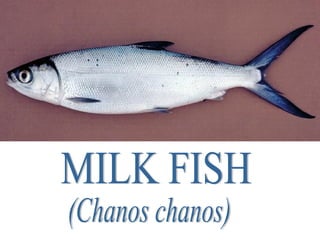
Milk fish (Chanos chanos)
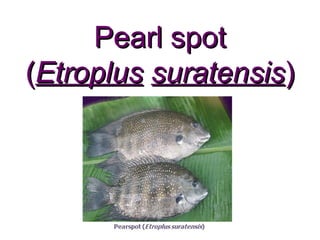
Pearl spot (Etroplus suratensis )
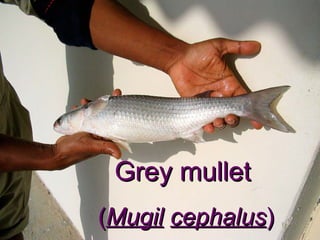
Grey mullet
(Mugil cephalus)
• Fast growth rate & comparatively large
  size.

• Fry & fingerlings of M.cephalus not as
  abuntantly available as of other species.

• In India mullets are cultured in
  combination with milk fish,pearlspot and
  other estuarine species.
Fry Collection
• Seines & dipnets.

• Acclimatize the fry.

• Or directly transfer to production ponds after
  brief period of conditioning.

• If fry are to be transported long distances,it
  is advisable to condition them for a day.
Seines & dipnets.
Artificial propagation
• Grey mullets donot breed in confined waters

• Induced breeding by administration of pituitary
  extracts or gonadotropins.

• After rinsing in sea water ,fertilized eggs are
  transferred to incubators.

• Hatchlings are fed with brine shrimp & zooplankton
• Larvae grow to fry stage in about a month.
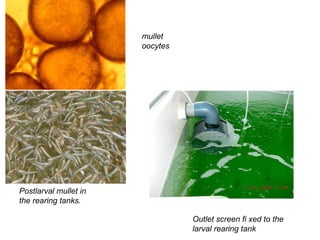
mullet
                       oocytes


Postlarval mullet in
the rearing tanks.

                                 Outlet screen fi xed to the
                                 larval rearing tank
Grow out
 Mono culture of mullets is seldom
practised.
 Mullets form a constituent of stocks in
milkfish farms of southeast asia although
many farmers consider mullets to be
incompatible with milk fish.Mullets seldom
constitute more than 10% of stock in such
ponds.
 Mullets are reared in polyculture with
common carp,silver carp & tilapia.
 Fry mullets are collected from coastal waters.

 Grown in nursery ponds to a wt of about 1-2g
 for stocking in polyculture ponds.

 Fry of this size are stocked at rate of
 5000/ha,where total stocking density is 12300/ha
 (3000 common carp,300 silver carp &4000
 tilapia).

 Mullet reaches around 100g in wt in about 4
 months & about 200g by the end of year.
 One of the most ideal finfishes for farming
 in coastal areas.
 Fast growing, tolerates a wide range of
 temperature, oxygen and salinity.
 Feed mostly on filamentous algae from
 the bottom of the pond.
 Free from major diseases and parasites.
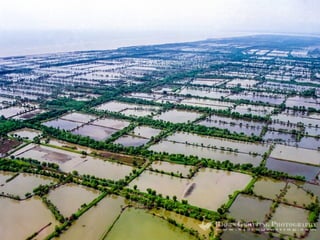
 Milkfish are cultured in large scales in
 countries like Indonesia, Philippines and
 Taiwan in ponds called “Tambak”.

 In India too the popularity of its farming is
 growing especially in Tamil Nadu and
 Kerala
Seed Collection
Seed Collection
 Seeds are collected from natural sources.

 The main fry season extends from March to June.

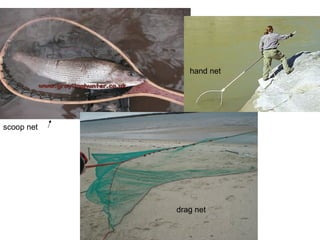
 The seeds are collected using scoop nets, dip nets and
  hand nets. In estuaries and lagoons, drag nets or seine nets
  may be used.

 Soon after collected the seeds are conditioned by keeping in
  a limited volume of clear water for a definite period .

 Seeds are transported in containers with diluted seawater
  of 10-15 ppt salinity and at a rate of about 100 fry/L.
hand net


scoop net


            drag net
Nursery Rearing
Nursery Rearing
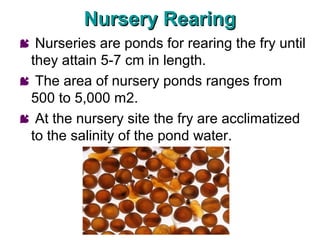
 Nurseries are ponds for rearing the fry until
 they attain 5-7 cm in length.
 The area of nursery ponds ranges from
 500 to 5,000 m2.
 At the nursery site the fry are acclimatized
 to the salinity of the pond water.
Preparation of pond for stocking
 The ponds are drained and dried for
 about 10 to 15 days and later tilled and
 raked.
 Lime is added @ 1000 kg/ha and water is
 let in.
 Pond water is fertilized with organic and
 inorganic fertilizers.
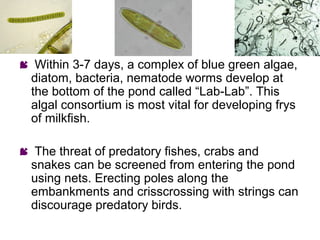
 Within 3-7 days, a complex of blue green algae,
 diatom, bacteria, nematode worms develop at
 the bottom of the pond called “Lab-Lab”. This
 algal consortium is most vital for developing frys
 of milkfish.

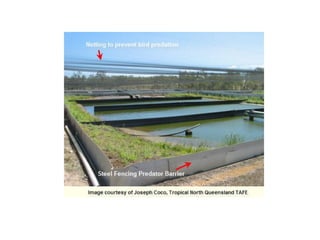
 The threat of predatory fishes, crabs and
 snakes can be screened from entering the pond
 using nets. Erecting poles along the
 embankments and crisscrossing with strings can
 discourage predatory birds.
Pond Management
Pond Management
• Farming in earthen ponds
• The production pond ranges from 0.5 ha to 3 ha
  in area and are rectangular in shape, with water
  depth ranging from 0.3 to 0.7 m.

• P.M similar to those practiced in nursery pond
  viz., draining of the water, drying, tilling, leveling
  and raking.

• Manuring of the ponds is always carried out.
  Usually, green manure is used, such as leaves
  and twigs of mangrove plants, rice straw, copra,
  rice bran, oilcakes, pig manure, chicken manure
  etc.
• Beside organic manure, inorganic fertilizers
  containing nitrates, phosphates and potassium
  (NPK) such as superphosphates, triple
  superphosphates, urea etc may also be applied .

• Within two weeks the algal-periphyton complex
  (Lab-lab) develops at the pond bottom. Stocking
  in earthen pond follows only after the growth of
  Lab-lab.

• Usually fingerlings of 7 to 15 cm length are
  stocked at a rate of 2,000 to 10,000 per ha.
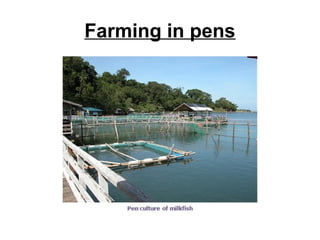
Farming in pens
• Constructed in shallow natural creeks, swamps,
  lagoons, lakes and bays, ranging in depth from
  1 to 3 m.

• The bottom in pen culture sites should be of firm
  clay or mud so that poles and posts can be
  driven sufficiently deep to make them support
  the pen structure.

• Traditionally pens are made up of wooden
  planks, split bamboo etc. But in recent times,
  nets materials made of synthetic materials such
  as nylon, polypropylene, polythene etc are used.
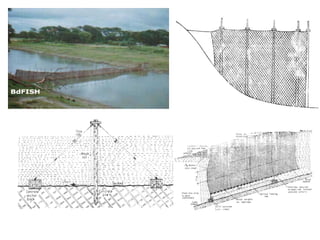
• A part of the vertical net barrier is buried
  inside the mud or ground with the aid of a
  footrope and small weights.

• At the upper level, floats are provided.

• Fingerlings stocked in usually feed upon
  the natural food and no artificial food is
  provided.
Harvesting
Harvesting
• Milkfish has a higher growth rate in its first year
  in brackishwater, during when it grows to a
  marketable size of 30-45 cm long and 300-800
  gm in weight.

• During harvesting the pond is drained using
  pumps, while in the case of pens, the lowest
  tidal period is the best time for harvest. If
  trenches were provided in culture ponds, it
  would be easier to gather all the fish inside the
  trenches by draining the water and then
  capturing them.
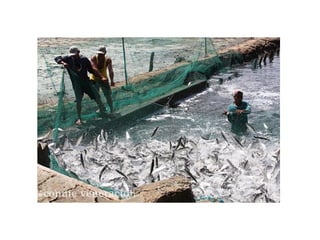
• Usually, seine nets are operated for
  capturing farmed fish.

• The survival rates ranges from 80 to 95%
  amounting to a production ranging from
  500 to 1000 kg/ha in ponds and 250 to
  500 kg/ha in pens.
Pearl spot
(Etroplus suratensis)
Pearl spot(Etroplus suratensis)
• Commonly known as “Karimeen” in Kerala.
• Cultured in both brackishwater and freshwater
  environments.
• Though growth is slow, at a high stocking
  density table-size fish can be harvested in 9-12
  months culture period.
Seed production
Seed available throughout the year along the east
                            andsouth-west coasts of India.

 Peak season of abundance - May-July and November-
February.


A simple method of seed collection is adopted taking
advantage of the tendency of the fish to congregate in large
numbers for feeding on epiphytic growth.
• In this method twigs or branches are kept
  submerged in the water a week ahead of day of
  collection.

• Juveniles congregating for feeding trapped
  using an encircling net or trap.

• Fecundity - low - around 3000-6000; hence a
  successful hatchery production of seeds is
  difficult.
• However, Central Institute of Brackishwater
  Aquaculture (CIBA), Chennai using the
  technique of environmental manipulation, has
  successfully demonstrated the hatchery seed
  production of pearl spot.
Pond preparation
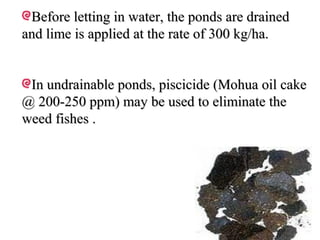
Before letting in water, the ponds are drained
and lime is applied at the rate of 300 kg/ha.


 In undrainable ponds, piscicide (Mohua oil cake
@ 200-250 ppm) may be used to eliminate the
weed fishes .
After a time gap of 10-15 days for the neutralization
   of the residual effect of the piscicide,

    water is let in through screens to avoid the entry of
   undesirable fishes.

     The pond is filled up to the appropriate level (1.2 m)
and cow dung applied at the rate of 1500-2000 kg/ha
for promoting plankton production.
Acclimatization and
stocking of breeders
Adult Etroplus - weight range - 50-125 g - procured from
the wild or culture ponds - stocked @ 5000/ha after one
week of fertilization of the pond.


  Disinfected by dipping in 1% commercial formalin and
acclimatised .
Additional breeders added from the second
year onwards to compensate the natural
mortality of breeders.

Breeders once stocked will be normally viable
for three years.
Provision of
spawning surfaces
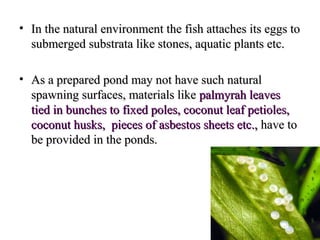
• In the natural environment the fish attaches its eggs to
  submerged substrata like stones, aquatic plants etc.

• As a prepared pond may not have such natural
  spawning surfaces, materials like palmyrah leaves
  tied in bunches to fixed poles, coconut leaf petioles,
  coconut husks, pieces of asbestos sheets etc., have to
  be provided in the ponds.
Water quality monitoring
   and management
Water quality parameters like
•   salinity (15-30 ppt),
•   dissolved oxygen (>3.5 ppm),
•   pH (7-8), temperature (24-32°C), transparency
    (>50 cm)
•   ammonia (<1 ppm) have to be maintained.

• Optimum water level in the pond is 1.2 m.

    The loss of water due to seepage and
    evaporation is to be compensated by pumping in
    water.
Feeding
Feeding of the breeders has to be
• .              initiated within 3-4 days after stocking

•    groundnut oil cake 40% + rice bran 45% + fish meal
    15% + vitamin and mineral mix (@ 2.5 kg per 100 kg
    feed)

• supplied daily either in pelleted or in dough form.

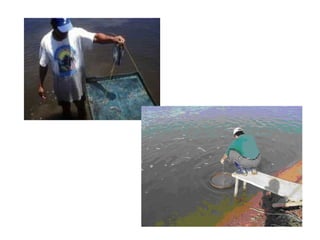
• supplied in feeding trays kept at the bottom of the
  pond. The feeding trays should be examined daily
  and cleaned outside the pond.
• The quantity of the feed can be reduced
  whenever left-over feed is present in the
  trays, to avoid wastage and water pollution.

• The presence of hatchlings indicates that the
  pond is to be manured with cow dung @
  500 kg/ha for the production of plankton,
  which forms the food for the hatchlings.

• Small quantities of the artificial feed (250-
  300 g/pond of 1000 m2) also can be
  broadcast in powder form during early
  morning.
Grow - out culture
• The pearlspot is suitable for culture in confined,
  fresh and brackishwaters

• The culture of pearlspot is more economical
  under polyculture system especially with milkfish
  and mullets than under monoculture.

• The fish can attain a marketable size of 120-150
  g over a period of 8-10 months.

• Though growth rate is relatively slow, high
  stocking density with low input management can
  yield optimum production.
• Being a herbivorous fish it is suitable for
  polyculture.

• Pearlspot farming could be adopted to
  any scale integrating with other
  occupations like poultry farming. The
  poultry droppings form good manure for
  natural food production in the culture
  ponds.
• Breeding occurs within 30-40 days of
  introduction of the brooders.

• A production of upto 6 lakhs fry/ha/year can be
  achieved.

• Harvesting is usually undertaken by draining the
  water from the ponds and operating a seine net,
  cast net or a drag net for capturing the fish.
Brackish water aquaculture 007

Brackish water aquaculture 007

  • 1.
    Kashmeera N.A. III SemMSc Zoology Roll no: 37
  • 2.
    Water salinity basedon dissolved salts in parts per thousand (ppt) Fresh water Brackish water Saline water <0.5 0.5–30 30–50 Brackish water is water that has more salinity than fresh water, but not as much as seawater. In estuaries it result from mixing of seawater with fresh water.
  • 3.
    Brackish water fishfarming is a system of aquaculture that focuses on the production of quality fin and shell fish that are found in the creeks, lagoons, and estuaries. In India, traditional system of brackishwater aquaculture is in vogue since time immemorial in West Bengal (Bheris) and Kerala (Pokkalifields). Present day traditional systems Gheris of Orissa, Kharlands of Karnataka Ghazani fields of Goa
  • 4.
    Cultivable Brackishwater Finfishes Grey mullet (Mugil cephalus) Milk fish (Chanos chanos) Pearl spot (Etroplus suratensis )
  • 5.
  • 6.
    • Fast growthrate & comparatively large size. • Fry & fingerlings of M.cephalus not as abuntantly available as of other species. • In India mullets are cultured in combination with milk fish,pearlspot and other estuarine species.
  • 7.
  • 8.
    • Seines &dipnets. • Acclimatize the fry. • Or directly transfer to production ponds after brief period of conditioning. • If fry are to be transported long distances,it is advisable to condition them for a day.
  • 9.
  • 10.
  • 11.
    Artificial propagation • Greymullets donot breed in confined waters • Induced breeding by administration of pituitary extracts or gonadotropins. • After rinsing in sea water ,fertilized eggs are transferred to incubators. • Hatchlings are fed with brine shrimp & zooplankton • Larvae grow to fry stage in about a month.
  • 12.
    mullet oocytes Postlarval mullet in the rearing tanks. Outlet screen fi xed to the larval rearing tank
  • 13.
  • 14.
     Mono cultureof mullets is seldom practised.  Mullets form a constituent of stocks in milkfish farms of southeast asia although many farmers consider mullets to be incompatible with milk fish.Mullets seldom constitute more than 10% of stock in such ponds.  Mullets are reared in polyculture with common carp,silver carp & tilapia.
  • 15.
     Fry mulletsare collected from coastal waters.  Grown in nursery ponds to a wt of about 1-2g for stocking in polyculture ponds.  Fry of this size are stocked at rate of 5000/ha,where total stocking density is 12300/ha (3000 common carp,300 silver carp &4000 tilapia).  Mullet reaches around 100g in wt in about 4 months & about 200g by the end of year.
  • 17.
     One ofthe most ideal finfishes for farming in coastal areas.  Fast growing, tolerates a wide range of temperature, oxygen and salinity.  Feed mostly on filamentous algae from the bottom of the pond.  Free from major diseases and parasites.
  • 18.
     Milkfish arecultured in large scales in countries like Indonesia, Philippines and Taiwan in ponds called “Tambak”.  In India too the popularity of its farming is growing especially in Tamil Nadu and Kerala
  • 20.
  • 21.
    Seed Collection  Seedsare collected from natural sources.  The main fry season extends from March to June.  The seeds are collected using scoop nets, dip nets and hand nets. In estuaries and lagoons, drag nets or seine nets may be used.  Soon after collected the seeds are conditioned by keeping in a limited volume of clear water for a definite period .  Seeds are transported in containers with diluted seawater of 10-15 ppt salinity and at a rate of about 100 fry/L.
  • 22.
  • 23.
  • 24.
    Nursery Rearing  Nurseriesare ponds for rearing the fry until they attain 5-7 cm in length.  The area of nursery ponds ranges from 500 to 5,000 m2.  At the nursery site the fry are acclimatized to the salinity of the pond water.
  • 25.
    Preparation of pondfor stocking  The ponds are drained and dried for about 10 to 15 days and later tilled and raked.  Lime is added @ 1000 kg/ha and water is let in.  Pond water is fertilized with organic and inorganic fertilizers.
  • 26.
     Within 3-7days, a complex of blue green algae, diatom, bacteria, nematode worms develop at the bottom of the pond called “Lab-Lab”. This algal consortium is most vital for developing frys of milkfish.  The threat of predatory fishes, crabs and snakes can be screened from entering the pond using nets. Erecting poles along the embankments and crisscrossing with strings can discourage predatory birds.
  • 28.
  • 29.
    Pond Management • Farmingin earthen ponds • The production pond ranges from 0.5 ha to 3 ha in area and are rectangular in shape, with water depth ranging from 0.3 to 0.7 m. • P.M similar to those practiced in nursery pond viz., draining of the water, drying, tilling, leveling and raking. • Manuring of the ponds is always carried out. Usually, green manure is used, such as leaves and twigs of mangrove plants, rice straw, copra, rice bran, oilcakes, pig manure, chicken manure etc.
  • 30.
    • Beside organicmanure, inorganic fertilizers containing nitrates, phosphates and potassium (NPK) such as superphosphates, triple superphosphates, urea etc may also be applied . • Within two weeks the algal-periphyton complex (Lab-lab) develops at the pond bottom. Stocking in earthen pond follows only after the growth of Lab-lab. • Usually fingerlings of 7 to 15 cm length are stocked at a rate of 2,000 to 10,000 per ha.
  • 31.
  • 32.
    • Constructed inshallow natural creeks, swamps, lagoons, lakes and bays, ranging in depth from 1 to 3 m. • The bottom in pen culture sites should be of firm clay or mud so that poles and posts can be driven sufficiently deep to make them support the pen structure. • Traditionally pens are made up of wooden planks, split bamboo etc. But in recent times, nets materials made of synthetic materials such as nylon, polypropylene, polythene etc are used.
  • 34.
    • A partof the vertical net barrier is buried inside the mud or ground with the aid of a footrope and small weights. • At the upper level, floats are provided. • Fingerlings stocked in usually feed upon the natural food and no artificial food is provided.
  • 35.
  • 36.
    Harvesting • Milkfish hasa higher growth rate in its first year in brackishwater, during when it grows to a marketable size of 30-45 cm long and 300-800 gm in weight. • During harvesting the pond is drained using pumps, while in the case of pens, the lowest tidal period is the best time for harvest. If trenches were provided in culture ponds, it would be easier to gather all the fish inside the trenches by draining the water and then capturing them.
  • 38.
    • Usually, seinenets are operated for capturing farmed fish. • The survival rates ranges from 80 to 95% amounting to a production ranging from 500 to 1000 kg/ha in ponds and 250 to 500 kg/ha in pens.
  • 39.
  • 40.
    Pearl spot(Etroplus suratensis) •Commonly known as “Karimeen” in Kerala. • Cultured in both brackishwater and freshwater environments. • Though growth is slow, at a high stocking density table-size fish can be harvested in 9-12 months culture period.
  • 41.
  • 42.
    Seed available throughoutthe year along the east andsouth-west coasts of India.  Peak season of abundance - May-July and November- February. A simple method of seed collection is adopted taking advantage of the tendency of the fish to congregate in large numbers for feeding on epiphytic growth.
  • 43.
    • In thismethod twigs or branches are kept submerged in the water a week ahead of day of collection. • Juveniles congregating for feeding trapped using an encircling net or trap. • Fecundity - low - around 3000-6000; hence a successful hatchery production of seeds is difficult.
  • 44.
    • However, CentralInstitute of Brackishwater Aquaculture (CIBA), Chennai using the technique of environmental manipulation, has successfully demonstrated the hatchery seed production of pearl spot.
  • 45.
  • 46.
    Before letting inwater, the ponds are drained and lime is applied at the rate of 300 kg/ha. In undrainable ponds, piscicide (Mohua oil cake @ 200-250 ppm) may be used to eliminate the weed fishes .
  • 47.
    After a timegap of 10-15 days for the neutralization of the residual effect of the piscicide, water is let in through screens to avoid the entry of undesirable fishes. The pond is filled up to the appropriate level (1.2 m) and cow dung applied at the rate of 1500-2000 kg/ha for promoting plankton production.
  • 48.
  • 49.
    Adult Etroplus -weight range - 50-125 g - procured from the wild or culture ponds - stocked @ 5000/ha after one week of fertilization of the pond. Disinfected by dipping in 1% commercial formalin and acclimatised .
  • 50.
    Additional breeders addedfrom the second year onwards to compensate the natural mortality of breeders. Breeders once stocked will be normally viable for three years.
  • 51.
  • 52.
    • In thenatural environment the fish attaches its eggs to submerged substrata like stones, aquatic plants etc. • As a prepared pond may not have such natural spawning surfaces, materials like palmyrah leaves tied in bunches to fixed poles, coconut leaf petioles, coconut husks, pieces of asbestos sheets etc., have to be provided in the ponds.
  • 53.
  • 54.
    Water quality parameterslike • salinity (15-30 ppt), • dissolved oxygen (>3.5 ppm), • pH (7-8), temperature (24-32°C), transparency (>50 cm) • ammonia (<1 ppm) have to be maintained. • Optimum water level in the pond is 1.2 m. The loss of water due to seepage and evaporation is to be compensated by pumping in water.
  • 55.
  • 56.
    Feeding of thebreeders has to be • . initiated within 3-4 days after stocking • groundnut oil cake 40% + rice bran 45% + fish meal 15% + vitamin and mineral mix (@ 2.5 kg per 100 kg feed) • supplied daily either in pelleted or in dough form. • supplied in feeding trays kept at the bottom of the pond. The feeding trays should be examined daily and cleaned outside the pond.
  • 58.
    • The quantityof the feed can be reduced whenever left-over feed is present in the trays, to avoid wastage and water pollution. • The presence of hatchlings indicates that the pond is to be manured with cow dung @ 500 kg/ha for the production of plankton, which forms the food for the hatchlings. • Small quantities of the artificial feed (250- 300 g/pond of 1000 m2) also can be broadcast in powder form during early morning.
  • 59.
    Grow - outculture
  • 60.
    • The pearlspotis suitable for culture in confined, fresh and brackishwaters • The culture of pearlspot is more economical under polyculture system especially with milkfish and mullets than under monoculture. • The fish can attain a marketable size of 120-150 g over a period of 8-10 months. • Though growth rate is relatively slow, high stocking density with low input management can yield optimum production.
  • 61.
    • Being aherbivorous fish it is suitable for polyculture. • Pearlspot farming could be adopted to any scale integrating with other occupations like poultry farming. The poultry droppings form good manure for natural food production in the culture ponds.
  • 62.
    • Breeding occurswithin 30-40 days of introduction of the brooders. • A production of upto 6 lakhs fry/ha/year can be achieved. • Harvesting is usually undertaken by draining the water from the ponds and operating a seine net, cast net or a drag net for capturing the fish.