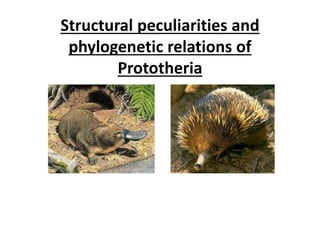
Structural peculiarities and
phylogenetic relations of
Prototheria
Mammals
Mammals evolved from reptiles during triassic period. It is
most highly evolved group of animals.
Characters of Mammal:
 Mammary glands on females for suckling the young ones.
 Hairy skin.
 Skin richly glandular.
 Differentiated dentition.
 Double occipital condyle.
 Double headed ribs.
 Constant body temperature.
 Three ear ossicles.
 Respiration always by lungs.
 Increase intelligence.
Subclass – Prototheria
This include primitive egg laying mammal. They nourish
their young with milk from mammary gland. It comprises
only one living order.
 Order- Monotremata
 Mammary glands without nipples.
 No external pinna.
 Females oviparous.
 Testis are abdominal.
 Teeth only in the young ones.
 Heart is four chambered.
 Example- Ornithorhynchus , Echidna
Distinctive characters of Prototheria
 Distribution-these are distributed in the
entire Australian region, including
Australia, Tasmania, Newguinea and
neighbouring Island.
 Habit and habitat-
Aquatic or terrestrial
Burrowing
Mainly insectivorous
Nocturnal
External features
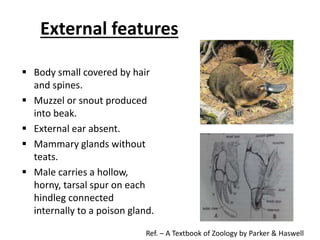
 Body small covered by hair
and spines.
 Muzzel or snout produced
into beak.
 External ear absent.
 Mammary glands without
teats.
 Male carries a hollow,
horny, tarsal spur on each
hindleg connected
internally to a poison gland.
Ref. – A Textbook of Zoology by Parker & Haswell
Body cavity - Divided by a typical mammalian
diaphragm.
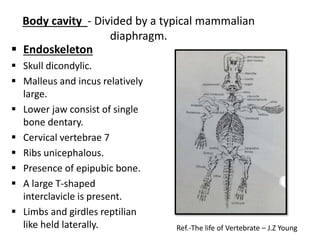
 Endoskeleton
 Skull dicondylic.
 Malleus and incus relatively
large.
 Lower jaw consist of single
bone dentary.
 Cervical vertebrae 7
 Ribs unicephalous.
 Presence of epipubic bone.
 A large T-shaped
interclavicle is present.
 Limbs and girdles reptilian
like held laterally. Ref.-The life of Vertebrate – J.Z Young
 Digestive system- teeth develop only in
embryo.
 Respiratory system-respiration pulmonary by
lungs.
 Circulatory system- heart four chambered,
right valve incomplete, R.B.C small circular and
non-nucleated.
 Excretory system- Kidney metanephric, ureter
open into urinogenital sinus which terminate
into common cloaca.
 Nervous system-brain small without carpus
Reproductive system
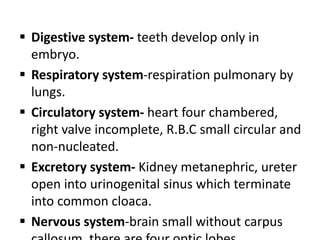
 In male testes is
abdominal, penis
retractile for passing
out sperms not urine.
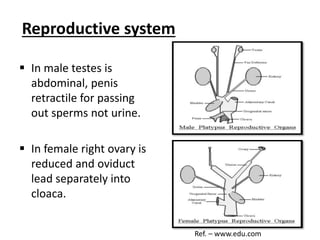
 In female right ovary is
reduced and oviduct
lead separately into
cloaca.
Ref. – www.edu.com
Development
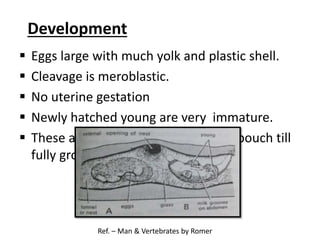
 Eggs large with much yolk and plastic shell.
 Cleavage is meroblastic.
 No uterine gestation
 Newly hatched young are very immature.
 These are fed on milk in abdominal pouch till
fully grown.
Ref. – Man & Vertebrates by Romer
Phylogenetic relationship
 Subclass- Prototheria shows its affinity to
reptiles and birds with little advance over
them.
 Affinities with class - Reptilia
 Claws are present.
 A median T shaped interclavicle present.
 They can survive during starvation for a
longer period.
 Eggs calcareous, uterine gestation is
absent.
 Testes abdominal.
Affinities with birds
 They have following resemblances-
 Teeth are absent.
 Feet are webbed.
 Tarsal region contain spur.
 Oil gland is present.
Affinities with mammals
 Body covered by hair.
 Skin richly glandular containing sweat
and sebaceous gland.
 Mammalian diaphragm divides body
cavity.
 Skull dicondylic, presence of four optic
lobes, cervical vertebrae seven.
 Liver is lobed like mammals.
 Heart is four chambered, only left aortic
Peculiar characters of Prototheria
The following characters are peculiar to
Prototheria :
 Presence of tarsal spur in male.
 Milk gland derived from sweat glands
and without teats.
 Temporary abdominal mammary pouch
in female during breeding season.
 Jaws elongated forming a beak or
rostrum.
THANK YOU

PROTOTHERIA.pptx

  • 1.
  • 2.
    Mammals Mammals evolved fromreptiles during triassic period. It is most highly evolved group of animals. Characters of Mammal:  Mammary glands on females for suckling the young ones.  Hairy skin.  Skin richly glandular.  Differentiated dentition.  Double occipital condyle.  Double headed ribs.  Constant body temperature.  Three ear ossicles.  Respiration always by lungs.  Increase intelligence.
  • 3.
    Subclass – Prototheria Thisinclude primitive egg laying mammal. They nourish their young with milk from mammary gland. It comprises only one living order.  Order- Monotremata  Mammary glands without nipples.  No external pinna.  Females oviparous.  Testis are abdominal.  Teeth only in the young ones.  Heart is four chambered.  Example- Ornithorhynchus , Echidna
  • 4.
    Distinctive characters ofPrototheria  Distribution-these are distributed in the entire Australian region, including Australia, Tasmania, Newguinea and neighbouring Island.  Habit and habitat- Aquatic or terrestrial Burrowing Mainly insectivorous Nocturnal
  • 5.
    External features  Bodysmall covered by hair and spines.  Muzzel or snout produced into beak.  External ear absent.  Mammary glands without teats.  Male carries a hollow, horny, tarsal spur on each hindleg connected internally to a poison gland. Ref. – A Textbook of Zoology by Parker & Haswell
  • 6.
    Body cavity -Divided by a typical mammalian diaphragm.  Endoskeleton  Skull dicondylic.  Malleus and incus relatively large.  Lower jaw consist of single bone dentary.  Cervical vertebrae 7  Ribs unicephalous.  Presence of epipubic bone.  A large T-shaped interclavicle is present.  Limbs and girdles reptilian like held laterally. Ref.-The life of Vertebrate – J.Z Young
  • 7.
     Digestive system-teeth develop only in embryo.  Respiratory system-respiration pulmonary by lungs.  Circulatory system- heart four chambered, right valve incomplete, R.B.C small circular and non-nucleated.  Excretory system- Kidney metanephric, ureter open into urinogenital sinus which terminate into common cloaca.  Nervous system-brain small without carpus
  • 8.
    Reproductive system  Inmale testes is abdominal, penis retractile for passing out sperms not urine.  In female right ovary is reduced and oviduct lead separately into cloaca. Ref. – www.edu.com
  • 9.
    Development  Eggs largewith much yolk and plastic shell.  Cleavage is meroblastic.  No uterine gestation  Newly hatched young are very immature.  These are fed on milk in abdominal pouch till fully grown. Ref. – Man & Vertebrates by Romer
  • 10.
    Phylogenetic relationship  Subclass-Prototheria shows its affinity to reptiles and birds with little advance over them.  Affinities with class - Reptilia  Claws are present.  A median T shaped interclavicle present.  They can survive during starvation for a longer period.  Eggs calcareous, uterine gestation is absent.  Testes abdominal.
  • 11.
    Affinities with birds They have following resemblances-  Teeth are absent.  Feet are webbed.  Tarsal region contain spur.  Oil gland is present.
  • 12.
    Affinities with mammals Body covered by hair.  Skin richly glandular containing sweat and sebaceous gland.  Mammalian diaphragm divides body cavity.  Skull dicondylic, presence of four optic lobes, cervical vertebrae seven.  Liver is lobed like mammals.  Heart is four chambered, only left aortic
  • 13.
    Peculiar characters ofPrototheria The following characters are peculiar to Prototheria :  Presence of tarsal spur in male.  Milk gland derived from sweat glands and without teats.  Temporary abdominal mammary pouch in female during breeding season.  Jaws elongated forming a beak or rostrum.
  • 14.