• Gills arethe respiratory organs of fish, enabling them to
extract oxygen from water and expel carbon dioxide.
• This adaptation is crucial for their survival in aquatic
environments, where oxygen is less readily available than in
air.
• By understanding the anatomy and physiology of gills, we
can appreciate the remarkable evolutionary adaptations that
allow fish to thrive underwater.
3.
Overview of FishRespiration
• Why do fish need gills?
1. Fish, like all living organisms, require oxygen for cellular respiration, the process that
generates energy.
2. In aquatic environments, oxygen is dissolved in water, but its concentration is much
lower than in air (about 5-10 mL of oxygen per liter of water, compared to 210 mL per
liter of air).
3. Gills are specialized structures that maximize the extraction of this limited oxygen.
1.Challenges of aquatic respiration:
1. Water is denser and more viscous than air, making it harder to move over respiratory
surfaces.
2. Oxygen diffuses more slowly in water than in air.
3. Fish must constantly pump water over their gills to maintain a steady supply of oxygen.
4.
Anatomy of Gills
1.Locationand external structure:
1. Gills are located in the pharyngeal region, behind the head, and are protected by a
bony flap called the operculum.
2. The operculum acts like a door, opening and closing to allow water to flow over the
gills while protecting them from physical damage.
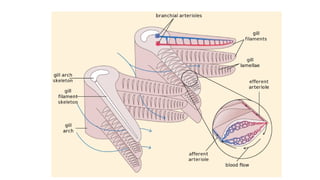
2.Gill arches:
1. These are the bony or cartilaginous structures that form the framework of the gills.
2. Most fish have four pairs of gill arches, though some species may have more or fewer.
3. Each gill arch supports two rows of gill filaments.
3.Gill filaments:
1. These are thin, finger-like projections that extend from the gill arches.
2. They are arranged in rows and are highly vascularized, meaning they contain a dense
network of capillaries.
5.
4. Gill lamellae:
1.Thegill filaments are covered with tiny, plate-like structures called
lamellae.
2.These lamellae are the primary sites of gas exchange due to their large
surface area and thin epithelial layer.
3.The thin epithelium allows for rapid diffusion of oxygen and carbon
dioxide.
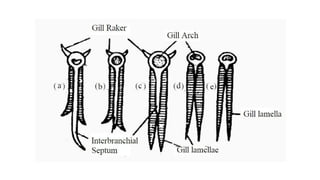
5. Gill rakers:
4.These are comb-like structures on the inner edge of the gill arches.
5.They play a dual role: (1) filtering out food particles and debris to
prevent clogging of the gill filaments, and (2) directing water flow over
the gill surfaces.
8.
III. Function ofGills
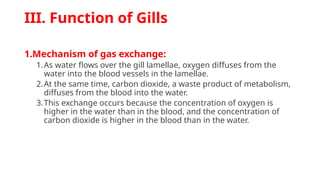
1.Mechanism of gas exchange:
1.As water flows over the gill lamellae, oxygen diffuses from the
water into the blood vessels in the lamellae.
2.At the same time, carbon dioxide, a waste product of metabolism,
diffuses from the blood into the water.
3.This exchange occurs because the concentration of oxygen is
higher in the water than in the blood, and the concentration of
carbon dioxide is higher in the blood than in the water.
9.
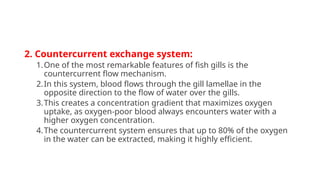
2. Countercurrent exchangesystem:
1.One of the most remarkable features of fish gills is the
countercurrent flow mechanism.
2.In this system, blood flows through the gill lamellae in the
opposite direction to the flow of water over the gills.
3.This creates a concentration gradient that maximizes oxygen
uptake, as oxygen-poor blood always encounters water with a
higher oxygen concentration.
4.The countercurrent system ensures that up to 80% of the oxygen
in the water can be extracted, making it highly efficient.
11.
3. Role ofventilation:
1.Fish actively pump water over their gills through a process called
ventilation.
2.This involves two main steps:
1.Buccal pumping: The fish opens its mouth, allowing water to enter the
buccal cavity.
2.Opercular pumping: The fish closes its mouth and opens its operculum,
forcing water over the gills and out of the body.
3.Some fast-swimming fish, like tuna, use a method called ram
ventilation, where they swim with their mouths open, allowing
water to flow continuously over their gills.
12.
IV. Adaptations ofGills
1.Surface area:
1. The extensive folding of gill filaments and lamellae creates a large surface area for gas exchange.
2. In some species, the total surface area of the gills can be up to 10 times the surface area of the fish's body.
2.Thin epithelium:
1. The walls of the gill lamellae are extremely thin, often just one or two cell layers thick.
2. This minimizes the distance oxygen must travel to enter the bloodstream.
3.Efficient blood flow:
1. The gills are richly supplied with blood vessels, ensuring rapid transport of oxygen to the rest of the body.
2. The blood vessels are arranged in such a way that blood flows in the opposite direction to water,
enhancing the efficiency of gas exchange.
4.Regulation of ion and water balance:
1. In addition to respiration, gills play a role in osmoregulation, helping fish maintain the balance of salts and
water in their bodies.
2. Specialized cells in the gills, called chloride cells, actively transport ions to regulate the fish's internal
environment.
13.
V. Comparative Aspects
1.Differencesin gill structure among fish species:
1. Active swimmers, such as tuna and mackerel, have larger gill surfaces with
more filaments and lamellae to meet their high oxygen demands.
2. Sedentary or slow-moving fish, like flounders and catfish, have smaller gill
surfaces.
3. Some fish, like lungfish, have evolved additional respiratory structures, such
as lungs, to survive in oxygen-poor environments.
2.Gills in other aquatic organisms:
1. While fish have the most specialized gills, other aquatic animals, such as
crustaceans (e.g., crabs and shrimp) and mollusks (e.g., clams and squid),
also possess gill-like structures for respiration.
2. These structures may differ in anatomy and function but serve the same
purpose of extracting oxygen from water.
14.
VI. Importance ofGills in Fish
Survival
1.Oxygen uptake and metabolic demands:
1. Efficient gill function is critical for supporting activities like swimming, feeding, and reproduction.
2. Fish with damaged or impaired gills may struggle to obtain enough oxygen, leading to reduced fitness
or even death.
2.Environmental sensitivity:
1. Gills are highly sensitive to changes in water quality, making fish vulnerable to pollutants, temperature
fluctuations, and low oxygen levels.
2. For example, high levels of ammonia or heavy metals in the water can damage gill tissues, impairing
their function.
3. Climate change and habitat degradation pose significant threats to fish populations by affecting the
quality of their aquatic environments.
3.Ecological and economic importance:
1. Fish are a vital part of aquatic ecosystems, serving as both predators and prey.
2. They are also an important food source for humans, with millions of people relying on fish for protein
and livelihoods.
3. Understanding gill function is essential for aquaculture, where maintaining optimal water quality is
crucial for fish health and productivity.
15.
Conclusion:
• In summary,the gills of fish are marvels of evolutionary
adaptation, perfectly suited to the challenges of aquatic life.
• Their intricate structure and efficient function enable fish to
extract oxygen from water, supporting their survival and success
in diverse aquatic habitats.
• By studying gills, we gain a deeper appreciation for the
complexity of life beneath the water's surface and the delicate
balance required to maintain healthy aquatic ecosystems.
• Moreover, this knowledge has practical applications in fields
ranging from medicine to conservation, highlighting the
interconnectedness of all living systems.
 Most read
 Most read
 Most read