
types of fishes scales
•Download as PPTX, PDF•
0 likes•1,154 views
Scales are a type of integumentary structure found in fish that provide both external protection and flexibility. There are four main types of scales - cosmoid, ganoid, placoid, and leptoid scales. Leptoid scales are further divided into cycloid and ctenoid scales. Cosmoid scales are very rare today and resemble fused placoid scales. Placoid scales are found on sharks and rays and resemble teeth. Ganoid scales have a bony base layer and are rhomboid in shape. Cycloid scales have a smooth outer edge while ctenoid scales have teeth along the outer edge.
Report
Share
Report
Share

Recommended
Fish scales
The document discusses the anatomy of fish scales, including the four main types (placoid, ganoid, cycloid, ctenoid), their structure consisting of layers like enamel and dentin, how they develop and vary between species, and their uses for classification, determining age from growth lines, and counting eggs from erosion marks. Fish scales are keratin structures that cover the skin in two layers (epidermis and dermis) and help protect the fish while also providing information about its biology.
Swim bladder general organization and circulation and function
The document summarizes the general organization, circulation, types, gas secreting complex, and functions of the swim bladder in fish. It notes that the swim bladder contains gas and develops from the gut wall. Blood supply comes directly from arteries or the coeliaco-mesenteric artery. Depending on connections to the esophagus, swim bladders are either physostomous or physoclistous types. The anterior part secretes gas while the posterior part absorbs gas. Main functions include respiration, sound production, hearing, pressure sensing, and providing buoyancy.
Foot and shell of molluscs
This document summarizes the foot and shell structures of molluscs. It describes how the foot aids in locomotion and adhesion. It then discusses the different classes of molluscs and how the foot is modified, such as being spade-like in scaphopods or arms in cephalopods. The document also summarizes shell structure, the three layers of shell, types of coiling, composition of shell material, and variations in shells across classes. It concludes by discussing reductions in shells and the protective and other functions shells provide.
Presentation on aquatic mammals
The document discusses the aquatic adaptation of mammals. It acknowledges those who helped with the seminar topic. The contents include introduction, adaptation of aquatic mammals, modification and loss of original structures, development of new structures, types of aquatic mammals, and conclusion. It describes various anatomical modifications that aquatic mammals undergo, such as streamlined bodies, flippers, valvular nostrils, large lungs, blubber, and tail flukes to adapt to aquatic living.
Classification of reptilia
This document provides a classification of reptiles based on their anatomical features. It discusses the five subclasses of reptiles: Anapsida, Euryapsida, Parapsida, Synapsida, and Diapsida. Within Diapsida are two superorders - Lepidosauria containing lizards and snakes, and Archosauria containing crocodilians. Key characteristics are described for each order, including turtles within Anapsida, lizards and snakes within Lepidosauria, and crocodilians. Temporal bone structure is an important distinguishing feature between subclasses.
Fish locomotion Notes
There are several forms of fish locomotion. The most common is carangiform locomotion, where fish sweep their caudal fin from side to side to move forward. Angulliform locomotion is used by fish with eel-like bodies, who send waves along their body length to push against water and propel themselves. Some stiff-bodied fish use ostraciform locomotion, wiggling their fins slowly. A few fish use labriform locomotion, paddling with pectoral fins. Ballistiform locomotion involves sending waves along fins like the anal fin, allowing knifefish to swim backward by reversing wave direction.
General characters amphibia
1) Amphibians are cold-blooded vertebrates that can live both on land and in water. They have four limbs and lungs as adults.
2) Amphibians are classified into three subclasses: Labyrinthodontia, Lepospondyli, and Lissamphibia.
3) The three orders of modern amphibians (Lissamphibia) are Anura (frogs and toads), Urodela (salamanders), and Apoda (limbless amphibians).
FINS IN FISHES ZOOLOGY.pptx
The document describes the key fins found in fish, including their locations and functions. It discusses the pectoral fins, dorsal fins, pelvic fins, and caudal fins. The caudal fin is described as the most important for forward propulsion during swimming. Different types of caudal fins are also outlined, including protocercal, heterocercal, and homocercal fins.
Recommended
Fish scales
The document discusses the anatomy of fish scales, including the four main types (placoid, ganoid, cycloid, ctenoid), their structure consisting of layers like enamel and dentin, how they develop and vary between species, and their uses for classification, determining age from growth lines, and counting eggs from erosion marks. Fish scales are keratin structures that cover the skin in two layers (epidermis and dermis) and help protect the fish while also providing information about its biology.
Swim bladder general organization and circulation and function
The document summarizes the general organization, circulation, types, gas secreting complex, and functions of the swim bladder in fish. It notes that the swim bladder contains gas and develops from the gut wall. Blood supply comes directly from arteries or the coeliaco-mesenteric artery. Depending on connections to the esophagus, swim bladders are either physostomous or physoclistous types. The anterior part secretes gas while the posterior part absorbs gas. Main functions include respiration, sound production, hearing, pressure sensing, and providing buoyancy.
Foot and shell of molluscs
This document summarizes the foot and shell structures of molluscs. It describes how the foot aids in locomotion and adhesion. It then discusses the different classes of molluscs and how the foot is modified, such as being spade-like in scaphopods or arms in cephalopods. The document also summarizes shell structure, the three layers of shell, types of coiling, composition of shell material, and variations in shells across classes. It concludes by discussing reductions in shells and the protective and other functions shells provide.
Presentation on aquatic mammals
The document discusses the aquatic adaptation of mammals. It acknowledges those who helped with the seminar topic. The contents include introduction, adaptation of aquatic mammals, modification and loss of original structures, development of new structures, types of aquatic mammals, and conclusion. It describes various anatomical modifications that aquatic mammals undergo, such as streamlined bodies, flippers, valvular nostrils, large lungs, blubber, and tail flukes to adapt to aquatic living.
Classification of reptilia
This document provides a classification of reptiles based on their anatomical features. It discusses the five subclasses of reptiles: Anapsida, Euryapsida, Parapsida, Synapsida, and Diapsida. Within Diapsida are two superorders - Lepidosauria containing lizards and snakes, and Archosauria containing crocodilians. Key characteristics are described for each order, including turtles within Anapsida, lizards and snakes within Lepidosauria, and crocodilians. Temporal bone structure is an important distinguishing feature between subclasses.
Fish locomotion Notes
There are several forms of fish locomotion. The most common is carangiform locomotion, where fish sweep their caudal fin from side to side to move forward. Angulliform locomotion is used by fish with eel-like bodies, who send waves along their body length to push against water and propel themselves. Some stiff-bodied fish use ostraciform locomotion, wiggling their fins slowly. A few fish use labriform locomotion, paddling with pectoral fins. Ballistiform locomotion involves sending waves along fins like the anal fin, allowing knifefish to swim backward by reversing wave direction.
General characters amphibia
1) Amphibians are cold-blooded vertebrates that can live both on land and in water. They have four limbs and lungs as adults.
2) Amphibians are classified into three subclasses: Labyrinthodontia, Lepospondyli, and Lissamphibia.
3) The three orders of modern amphibians (Lissamphibia) are Anura (frogs and toads), Urodela (salamanders), and Apoda (limbless amphibians).
FINS IN FISHES ZOOLOGY.pptx
The document describes the key fins found in fish, including their locations and functions. It discusses the pectoral fins, dorsal fins, pelvic fins, and caudal fins. The caudal fin is described as the most important for forward propulsion during swimming. Different types of caudal fins are also outlined, including protocercal, heterocercal, and homocercal fins.
Origin and evolution of ostracoderms
Ostracoderms were early jawless vertebrates that lived from the Cambrian to the late Devonian period. They were covered in bony plates and resembled modern hagfish and lampreys. While some evidence suggests they lived in freshwater, their habitat is still debated. Later in the Devonian, jawed fish evolved from ostracoderms and outcompeted them, contributing to their extinction by the end of the period. Ostracoderms were divided into two main groups and played an important role in the early evolution of vertebrates.
Class Polychaeta Notes
The document discusses the phylum Annelida, class Polychaeta. Polychaetes, also known as bristle worms, are segmented worms that live in a variety of marine habitats like the ocean floor, under rocks and shells, or in coral reef crevices. They have appendages called setae or parapodia that function as paddles. While some polychaetes are free-swimming predators or scavengers, others like tube worms live sessile in self-made tubes attached to surfaces. Tube worms extend feathery gills and radioles from their tubes to create water currents for filter feeding.
Origin and Evolution of Mammals
The document discusses the origin and evolution of mammals. It describes two main theories for the ancestry of mammals - through amphibians or reptiles. While amphibian ancestry was proposed, reptilian ancestry is now widely accepted based on fossil evidence. Many characteristics of early mammal-like reptiles called therapsids were mammalian. True mammals first appeared in the Jurassic period but remained small until after the extinction of dinosaurs. When ecological niches opened up in the Cenozoic era, mammals underwent adaptive radiations into various forms through modifications of limbs, teeth and other features for different habitats like trees, ground, burrows, water and air. Convergent evolution also led to similarities between unrelated mammals adapting to the same nic
Swim bladder
The document discusses the swim bladder, or air bladder, of fish. It is an internal gas-filled organ that contributes to a fish's ability to control buoyancy. There are two types - physostomous, which is directly connected to the digestive tract, and physoclistous, which is not connected. The basic structure includes a sac-like shape with two layers, an epidermis and endodermis. The swim bladder varies in shape and size between fish species and allows fish to rise and sink in water by increasing or decreasing the volume of gas inside without changing mass. Its key functions are to act as a hydrostatic organ, adjustable float, aid in respiration, produce sound, and maintain the fish's
Classification of fishes
Classification of Fishes can be summarized as follows:
1. Fishes are classified based on their anatomical features and placed in a systematic hierarchy ranging from superclass to species. Some key groups include chondrichthyes (cartilaginous fishes like sharks), osteichthyes (bony fishes), actinopterygii (ray-finned fishes) and sarcopterygii (lobe-finned fishes).
2. Important historical schemes for classifying fishes were proposed by scientists such as Berg in 1940, who grouped fishes based on characteristics like jaw structure, fin morphology, scale type and vertebral structure.
3. Major fish groups discussed in
Origin and Organization of Coelom_MS.pptx
This document discusses the origin and organization of the coelom. Some key points:
- The coelom is a fluid-filled cavity lined by mesoderm that separates the gut from the body wall in most animals.
- There are three main types of coelom development: acoelomate (no coelom), pseudocoelomate (non-mesoderm lined coelom), and eucoelomate (true coelom lined by mesoderm).
- Eucoelomates are divided into schizocoelomates, where the coelom forms from splitting of mesoderm, and enterocoelomates, where the coelom forms
Types of fish scales
Fishes possess dermal scales on the body for protection. Each scale is made of dentine that is secreted by dermal papilla which is a group of specialized neighbouring tissues. The exposed
portion of scale is covered with a layer of hard enamel to minimise wear and tear. Ancient
fishes generally had thick bony scales while the modern fishes have evolved thin and flexible
scales for more agility.
Pisces classication ppt
General fish classification:- bony fishes and cartilaginous fishes.
Character of bony fishes and cartilaginous fishes...
Jaw suspension in vertebrates [autosaved]
INTRODUCTION
The jaw (Upper and lower) is any opposable articulated structure at the entrance of the mouth.
It is typically used for grasping and manipulating food.
Jaw suspension means the fusion of upper jaw and lower jaw or skull for efficient biting.
There are different ways in which these attachments are attained depending upon the modifications in visceral arches in vertebrates.
In most vertebrates, the jaws are bony or cartilaginous and oppose vertically.
The vertebrate jaw is derived from the most anterior two pharyngeal arches supporting the gills, and usually bears numerous teeth.
The vertebrate jaw probably originally evolved in the Silurian period and appeared in the Placoderm fish which further diversified in the Devonian.
It is believed that the hyoid system suspends the jaw from the brain case of the skull, permitting great mobility of the jaws.
The original selective advantage offered by the jaw may not be related to feeding, but rather to increased respiration efficiency.
The jaws were used in the buccal pump (observable in modern fish and amphibians) that pumps water across the gills of fish or air into the lungs in the case of amphibians.
Over evolutionary time the more familiar use of jaws (to humans), in feeding, was selected for and became a very important function in vertebrates. Many teleost fish have substantially modified jaws for suction feeding and jaw protrusion, resulting in highly complex jaws with dozens of bones involved.
Jaw Suspension or Suspensoria:
The method by which the upper and lower jaws are suspended or attached from the chondrocranium is known as jaw suspension or suspensorium.
Amongst the visceral arches, the first (mandibular) arch consists of
= a dorsal palato pterygoquadrate bar forming the upper jaw,
= and ventral Meckel’s cartilage forms the lower jaw.
The second (hyoid) arch consists of = a dorsal hyomandibular supporting and suspending the jaws with the cranium, and a ventral hyoid.
The remaining visceral arches support the gills and are, hence, called branchial arches. Thus, splanchnocranium forms the jaws and suspends them with the chondrocranium.
Outline of classification of protochordates
Protochordate is an informal category of animals. This group is composed of the Phylum Hemichordata and the Subphyla Urochordata and Cephalochordata.
Porifera
A. Sponges are the most primitive multicellular animals belonging to Phylum Porifera. They consist of loosely organized cells and lack true tissues. Their bodies have 3 main cell types - pinacocytes forming the outer layer, mesenchyme cells in the jelly-like mesohyl, and choanocytes lining chambers.
B. Sponges have a skeleton that provides support, consisting of either silica or calcium carbonate spicules secreted by mesenchyme cells or spongin fibers. They exist in different forms depending on their branching canal system and water flow.
C. Sponges are filter feeders, using choanocyte flagella to draw water through their
Pisces general characters and classification - copy
This document provides information on the general characteristics of fishes. It discusses:
1) Fishes are cold-blooded aquatic vertebrates that first evolved in the Silurian period and increased in number during the Devonian period.
2) They have a streamlined body with scales or plates, paired and unpaired fins, breathe through gills, and vary greatly in size.
3) Fishes are classified into three classes - Placodermi, Elasmobranchii, and Osteichthyes - based on their skeleton composition and other features.
Inteugmentary system of fishes
The document summarizes the anatomy and histology of the integumentary system of fish. It describes the main layers of fish skin as the cuticle, epidermis, basement membrane, dermis, and hypodermis. It provides details on the cell types found in the epidermis including Malpighian cells, mucous cells, club cells, and pigment cells. It also discusses scales, embedded in the dermis, which provide protection. The dermis contains collagen fibers and pigment cells like melanophores, xanthophores, and iridophores. Fins are described as large folds of skin with special bone support.
Fish fins
Fins are important appendages that help fish maintain position, move, steer and stop in water. They are composed of bony spines covered in skin and aid with mobility, stability and maneuverability. The main types of fins are paired (pectoral and pelvic) and unpaired (dorsal, caudal, anal). Each fin type has a distinct function in swimming, turning and balancing. Fins have evolved diverse shapes and forms to help fish survive in their environments.
Fish skin
The document discusses the structure of fish skin, noting that it consists of an epidermis layer containing glands like mucous and poison glands, and a dermis layer where scales come in four types - placoid, cycloid, rhombic, and ctenoid. The dermis contains pigment cells like melanophores, xanthophores, and iridophores that contain pigments like melanin, carotenoids, and guanine crystals which give fishes their color and ability to reflect light. References on fish skin structure include modern textbooks by Kotpal and books on zoology by S.M. Sexsena and
Poisonous glands of fishes
Poisonous glands are specialized glands found in some fish and amphibians that secrete a venomous or poisonous mucus. These glands occur in the skin of cartilaginous fish or are associated with spines and fins of bony fish. The glands use a holocrine secretion method to release their toxic venom, which functions as a protective device and kills bacteria on bottom-dwelling fish. Some poisonous fish include porcupinefish, boxfish, and goatfish, while venomous fish like stingrays, catfish, stonefish, and butterfly cod have venom glands associated with their spines that can inflict painful wounds.
Migration in fishes
This document summarizes fish migration. It defines fish migration as seasonal movement that implies returning to the starting point. It discusses different types of migratory fish species and patterns of migration including diadromous, potamodromous, and oceanodromous. The causes of migration are to avoid unfavorable conditions and exploit food sources. Physical, chemical, and biological factors influence migration. Advantages include access to more food, breeding places, and distribution while avoiding competition. Conservation of migratory fish is important for sustaining fisheries and coastal communities.
Reproductive strategies in fishes
This document summarizes different reproductive strategies in fishes. It discusses that most fishes are oviparous and lay eggs externally. For marine fishes, the majority have pelagic eggs that float, while demersal eggs that sink are more common in freshwater. Some fishes are ovoviviparous or viviparous with internal fertilization. Different forms of parental care among fishes are also outlined, including by the male, female or both parents. Alternative reproductive strategies discussed include hermaphroditism, parthenogenesis, and natural polyploids and hybrids.
Integument of vertebrates
The document discusses the integumentary system across different chordate groups. It describes the key features of skin in protochordates, cyclostomes, fish, amphibians, reptiles, birds, and mammals. The integumentary system generally consists of an outer epidermis layer and inner dermis layer, with variations in features like keratinization, glands, scales/feathers/hair, and pigment cells across groups. The skin serves protective, sensory, and excretory functions for chordates.
Types of Scales in Fishes
Scales are small rigid plates that grow out of a fish's skin to provide protection. There are four main types of scales: placoid, cosmoid, ganoid, and leptoid. Leptoid scales include cycloid scales, found on fish with soft fins, and ctenoid scales, found on fish with spiny fins. Placoid scales resemble teeth and are found on sharks. Ganoid scales are diamond-shaped and interconnected. Scales protect fish and allow flexibility during swimming. The type and structure of scales can provide information about a fish's species and behavior.
SCALES OF FISHES AND REPTILES.pptx
This document discusses and compares the scales of fishes and reptiles. It begins by defining scales and explaining that they provide protection. It states that fishes and reptiles possess scales. It then describes the four main types of fish scales - placoid, cosmoid, ganoid, and cycloid/ctenoid scales - and provides details on each. It also discusses the types of reptile scales, including how they differ from fish scales in being made of keratin rather than containing hydroxyapatite. In summary, the document outlines the key types of scales found in fishes and reptiles, and compares their composition and formation between the two classes of animals.
More Related Content
What's hot
Origin and evolution of ostracoderms
Ostracoderms were early jawless vertebrates that lived from the Cambrian to the late Devonian period. They were covered in bony plates and resembled modern hagfish and lampreys. While some evidence suggests they lived in freshwater, their habitat is still debated. Later in the Devonian, jawed fish evolved from ostracoderms and outcompeted them, contributing to their extinction by the end of the period. Ostracoderms were divided into two main groups and played an important role in the early evolution of vertebrates.
Class Polychaeta Notes
The document discusses the phylum Annelida, class Polychaeta. Polychaetes, also known as bristle worms, are segmented worms that live in a variety of marine habitats like the ocean floor, under rocks and shells, or in coral reef crevices. They have appendages called setae or parapodia that function as paddles. While some polychaetes are free-swimming predators or scavengers, others like tube worms live sessile in self-made tubes attached to surfaces. Tube worms extend feathery gills and radioles from their tubes to create water currents for filter feeding.
Origin and Evolution of Mammals
The document discusses the origin and evolution of mammals. It describes two main theories for the ancestry of mammals - through amphibians or reptiles. While amphibian ancestry was proposed, reptilian ancestry is now widely accepted based on fossil evidence. Many characteristics of early mammal-like reptiles called therapsids were mammalian. True mammals first appeared in the Jurassic period but remained small until after the extinction of dinosaurs. When ecological niches opened up in the Cenozoic era, mammals underwent adaptive radiations into various forms through modifications of limbs, teeth and other features for different habitats like trees, ground, burrows, water and air. Convergent evolution also led to similarities between unrelated mammals adapting to the same nic
Swim bladder
The document discusses the swim bladder, or air bladder, of fish. It is an internal gas-filled organ that contributes to a fish's ability to control buoyancy. There are two types - physostomous, which is directly connected to the digestive tract, and physoclistous, which is not connected. The basic structure includes a sac-like shape with two layers, an epidermis and endodermis. The swim bladder varies in shape and size between fish species and allows fish to rise and sink in water by increasing or decreasing the volume of gas inside without changing mass. Its key functions are to act as a hydrostatic organ, adjustable float, aid in respiration, produce sound, and maintain the fish's
Classification of fishes
Classification of Fishes can be summarized as follows:
1. Fishes are classified based on their anatomical features and placed in a systematic hierarchy ranging from superclass to species. Some key groups include chondrichthyes (cartilaginous fishes like sharks), osteichthyes (bony fishes), actinopterygii (ray-finned fishes) and sarcopterygii (lobe-finned fishes).
2. Important historical schemes for classifying fishes were proposed by scientists such as Berg in 1940, who grouped fishes based on characteristics like jaw structure, fin morphology, scale type and vertebral structure.
3. Major fish groups discussed in
Origin and Organization of Coelom_MS.pptx
This document discusses the origin and organization of the coelom. Some key points:
- The coelom is a fluid-filled cavity lined by mesoderm that separates the gut from the body wall in most animals.
- There are three main types of coelom development: acoelomate (no coelom), pseudocoelomate (non-mesoderm lined coelom), and eucoelomate (true coelom lined by mesoderm).
- Eucoelomates are divided into schizocoelomates, where the coelom forms from splitting of mesoderm, and enterocoelomates, where the coelom forms
Types of fish scales
Fishes possess dermal scales on the body for protection. Each scale is made of dentine that is secreted by dermal papilla which is a group of specialized neighbouring tissues. The exposed
portion of scale is covered with a layer of hard enamel to minimise wear and tear. Ancient
fishes generally had thick bony scales while the modern fishes have evolved thin and flexible
scales for more agility.
Pisces classication ppt
General fish classification:- bony fishes and cartilaginous fishes.
Character of bony fishes and cartilaginous fishes...
Jaw suspension in vertebrates [autosaved]
INTRODUCTION
The jaw (Upper and lower) is any opposable articulated structure at the entrance of the mouth.
It is typically used for grasping and manipulating food.
Jaw suspension means the fusion of upper jaw and lower jaw or skull for efficient biting.
There are different ways in which these attachments are attained depending upon the modifications in visceral arches in vertebrates.
In most vertebrates, the jaws are bony or cartilaginous and oppose vertically.
The vertebrate jaw is derived from the most anterior two pharyngeal arches supporting the gills, and usually bears numerous teeth.
The vertebrate jaw probably originally evolved in the Silurian period and appeared in the Placoderm fish which further diversified in the Devonian.
It is believed that the hyoid system suspends the jaw from the brain case of the skull, permitting great mobility of the jaws.
The original selective advantage offered by the jaw may not be related to feeding, but rather to increased respiration efficiency.
The jaws were used in the buccal pump (observable in modern fish and amphibians) that pumps water across the gills of fish or air into the lungs in the case of amphibians.
Over evolutionary time the more familiar use of jaws (to humans), in feeding, was selected for and became a very important function in vertebrates. Many teleost fish have substantially modified jaws for suction feeding and jaw protrusion, resulting in highly complex jaws with dozens of bones involved.
Jaw Suspension or Suspensoria:
The method by which the upper and lower jaws are suspended or attached from the chondrocranium is known as jaw suspension or suspensorium.
Amongst the visceral arches, the first (mandibular) arch consists of
= a dorsal palato pterygoquadrate bar forming the upper jaw,
= and ventral Meckel’s cartilage forms the lower jaw.
The second (hyoid) arch consists of = a dorsal hyomandibular supporting and suspending the jaws with the cranium, and a ventral hyoid.
The remaining visceral arches support the gills and are, hence, called branchial arches. Thus, splanchnocranium forms the jaws and suspends them with the chondrocranium.
Outline of classification of protochordates
Protochordate is an informal category of animals. This group is composed of the Phylum Hemichordata and the Subphyla Urochordata and Cephalochordata.
Porifera
A. Sponges are the most primitive multicellular animals belonging to Phylum Porifera. They consist of loosely organized cells and lack true tissues. Their bodies have 3 main cell types - pinacocytes forming the outer layer, mesenchyme cells in the jelly-like mesohyl, and choanocytes lining chambers.
B. Sponges have a skeleton that provides support, consisting of either silica or calcium carbonate spicules secreted by mesenchyme cells or spongin fibers. They exist in different forms depending on their branching canal system and water flow.
C. Sponges are filter feeders, using choanocyte flagella to draw water through their
Pisces general characters and classification - copy
This document provides information on the general characteristics of fishes. It discusses:
1) Fishes are cold-blooded aquatic vertebrates that first evolved in the Silurian period and increased in number during the Devonian period.
2) They have a streamlined body with scales or plates, paired and unpaired fins, breathe through gills, and vary greatly in size.
3) Fishes are classified into three classes - Placodermi, Elasmobranchii, and Osteichthyes - based on their skeleton composition and other features.
Inteugmentary system of fishes
The document summarizes the anatomy and histology of the integumentary system of fish. It describes the main layers of fish skin as the cuticle, epidermis, basement membrane, dermis, and hypodermis. It provides details on the cell types found in the epidermis including Malpighian cells, mucous cells, club cells, and pigment cells. It also discusses scales, embedded in the dermis, which provide protection. The dermis contains collagen fibers and pigment cells like melanophores, xanthophores, and iridophores. Fins are described as large folds of skin with special bone support.
Fish fins
Fins are important appendages that help fish maintain position, move, steer and stop in water. They are composed of bony spines covered in skin and aid with mobility, stability and maneuverability. The main types of fins are paired (pectoral and pelvic) and unpaired (dorsal, caudal, anal). Each fin type has a distinct function in swimming, turning and balancing. Fins have evolved diverse shapes and forms to help fish survive in their environments.
Fish skin
The document discusses the structure of fish skin, noting that it consists of an epidermis layer containing glands like mucous and poison glands, and a dermis layer where scales come in four types - placoid, cycloid, rhombic, and ctenoid. The dermis contains pigment cells like melanophores, xanthophores, and iridophores that contain pigments like melanin, carotenoids, and guanine crystals which give fishes their color and ability to reflect light. References on fish skin structure include modern textbooks by Kotpal and books on zoology by S.M. Sexsena and
Poisonous glands of fishes
Poisonous glands are specialized glands found in some fish and amphibians that secrete a venomous or poisonous mucus. These glands occur in the skin of cartilaginous fish or are associated with spines and fins of bony fish. The glands use a holocrine secretion method to release their toxic venom, which functions as a protective device and kills bacteria on bottom-dwelling fish. Some poisonous fish include porcupinefish, boxfish, and goatfish, while venomous fish like stingrays, catfish, stonefish, and butterfly cod have venom glands associated with their spines that can inflict painful wounds.
Migration in fishes
This document summarizes fish migration. It defines fish migration as seasonal movement that implies returning to the starting point. It discusses different types of migratory fish species and patterns of migration including diadromous, potamodromous, and oceanodromous. The causes of migration are to avoid unfavorable conditions and exploit food sources. Physical, chemical, and biological factors influence migration. Advantages include access to more food, breeding places, and distribution while avoiding competition. Conservation of migratory fish is important for sustaining fisheries and coastal communities.
Reproductive strategies in fishes
This document summarizes different reproductive strategies in fishes. It discusses that most fishes are oviparous and lay eggs externally. For marine fishes, the majority have pelagic eggs that float, while demersal eggs that sink are more common in freshwater. Some fishes are ovoviviparous or viviparous with internal fertilization. Different forms of parental care among fishes are also outlined, including by the male, female or both parents. Alternative reproductive strategies discussed include hermaphroditism, parthenogenesis, and natural polyploids and hybrids.
Integument of vertebrates
The document discusses the integumentary system across different chordate groups. It describes the key features of skin in protochordates, cyclostomes, fish, amphibians, reptiles, birds, and mammals. The integumentary system generally consists of an outer epidermis layer and inner dermis layer, with variations in features like keratinization, glands, scales/feathers/hair, and pigment cells across groups. The skin serves protective, sensory, and excretory functions for chordates.
What's hot (20)
Pisces general characters and classification - copy
Pisces general characters and classification - copy
Similar to types of fishes scales
Types of Scales in Fishes
Scales are small rigid plates that grow out of a fish's skin to provide protection. There are four main types of scales: placoid, cosmoid, ganoid, and leptoid. Leptoid scales include cycloid scales, found on fish with soft fins, and ctenoid scales, found on fish with spiny fins. Placoid scales resemble teeth and are found on sharks. Ganoid scales are diamond-shaped and interconnected. Scales protect fish and allow flexibility during swimming. The type and structure of scales can provide information about a fish's species and behavior.
SCALES OF FISHES AND REPTILES.pptx
This document discusses and compares the scales of fishes and reptiles. It begins by defining scales and explaining that they provide protection. It states that fishes and reptiles possess scales. It then describes the four main types of fish scales - placoid, cosmoid, ganoid, and cycloid/ctenoid scales - and provides details on each. It also discusses the types of reptile scales, including how they differ from fish scales in being made of keratin rather than containing hydroxyapatite. In summary, the document outlines the key types of scales found in fishes and reptiles, and compares their composition and formation between the two classes of animals.
Fish
Fish are the gill-bearing aquatic craniate animals that lack limbs with digits. They form a sister group to the tunicates, together forming the olfactores. Included in this definition are the living hagfish, lampreys, and cartilaginous and bony fish as well as various extinct related groups.
Scales in fishes
This document discusses the different types of scales found in fish. It defines fish scales as small, rigid plates that grow out of the skin. Scales come in various types depending on the fish, including cosmoid, ganoid, placoid, cycloid, and ctenoid scales. Each scale type has a distinct structure and provides different functions like protection from predators or parasites and aiding movement. Some fish lack scales and instead have alternatives like tough skin, bony plates, or prickles for protection. In summary, the document outlines the definition, functions, and major types of scales present in different groups of fish.
Scales
Scales cover the bodies of fish and serve to protect them from predators and infection. They are composed of multiple layers including a vascular pulp, dentin middle layer, and outer enamel-like layer. As fish grow, new scales are added while existing scales do not increase in size. Scales help sharks and other fish swim faster by reducing water friction along their bodies.
FISH Integuments and poisonous fish.pptx
About the Fish Integuments and their structure best for Bachelor and Master students Ichthyology and fisheries science also
Scale of fishes
Scales are an important part of the exoskeleton of most fish species. There are several different types of scales that evolved over time, including placoid, cycloid, ctenoid, cosmoid, and ganoid scales. Placoid scales are found in sharks and resemble teeth, while cycloid and ctenoid scales are thin and circular or spiny and found in bony fish. Scales provide protection and can be used to determine age and growth rates in fish, as well as provide information about extinct fish species and the diets of predatory animals.
The giant jellyfish latest
The document discusses giant jellyfish, describing their anatomy and life cycle. It notes that jellyfish are not fish but invertebrates that lack complex organs. Their basic body plan includes an umbrella-shaped bell with tentacles used to catch prey. Jellyfish have a simple two-layered structure and nerve net. They exist in two forms, the polyp and medusa, and many species can reach over 6 feet wide. The document outlines some details of jellyfish fisheries and processing in Malaysia.
129506090000000000000000000000000000.ppt
This document summarizes fish anatomy and physiology. It discusses the various fins fish use for movement and stability, as well as their eyes, nostrils, mouth and senses. It describes the main propelling caudal fin as well as paired pectoral and pelvic fins. The document also covers the four main types of scales - placoid, ganoid, cycloid and ctenoid - and their defining characteristics. It states that fish anatomy studies form and morphology while physiology examines how parts function together in living fish.
PHYLUM COELENTERATA (Cnidaria).pptx
The document summarizes key characteristics of the phylum Cnidaria and its contained classes. It describes their aquatic habitat, body structure with two cell layers and digestive cavity, nervous system, and life cycles involving both sexual and asexual reproduction. Specific classes are then outlined, including Hydrozoa like hydras, Scyphomedusae like jellyfish, Anthozoa like sea anemones and corals, and the unique Ctenophora or comb jellies.
scales and Int modification.pptx
- True horns are found in certain hoofed mammals like pronghorns, antelopes, sheep and goats. They consist of an inner bone core covered by a keratinized sheath that grows continuously throughout life.
- Rhinoceros horns are not true horns as they lack a bone core and are made entirely of tightly packed keratin fibers. Pronghorn horns have a forked keratin sheath that is annually shed and replaced.
- Giraffe horns are also not true horns as they develop from cartilage and fuse to the skull as knobs covered in skin and hair. Male deer antlers are made of bone covered in velvet and are also shed annually.
Biology of Marine Catfish.pptx
Characteristics - Ariidae Medium to large sized fish.
Two pairs of nostrils closely on each side.
Paired maxillary and mental barbels present totally 4-6.
Dorsal fin short, with long more or less serrated spine preceded by a very short one.
Caudal fin deeply forked.
Adipose fin present.
Pectoral fin low set, with serrated spine.
Colour – Usually greyish blue, dark grey, yellow or brown sometimes with black patches or in some with silvery lateral stripe; pale to white below.
Varieties of Seafood-Composition of fish.pptx
1. The document discusses the classification, anatomy, and composition of various types of seafood including fish and shellfish.
2. It describes finfish and shellfish, breaking shellfish into two categories: crustaceans like crabs and lobsters, and mollusks like clams and oysters.
3. The anatomy of fish is examined in detail, identifying internal structures like gills, lateral line, and swim bladder, as well as external features like scales, fins, eyes, and mouth. Composition and cooking properties of different fish are also covered.
Fish Morphology.pptx
1. Fish bodies are divided into head, trunk, and tail sections, though divisions may not always be visible externally. They are classified based on body parts, mouth location and size, tail shape, color, and adaptations.
2. Body shape indicates how a fish moves and lives, with categories including fusiform for fast swimmers, depressiform for bottom dwellers, and anguilliform for eel-like fish.
3. Fish have a variety of fin, scale, mouth, coloration, and reproductive adaptations that help with functions like swimming, defense from predators, and reproduction.
Biology of coral,beauty of sea.
Coral are marine invertebrates that live in colonies made of many individual polyps. Each polyp has a mouth and ring of tentacles surrounded by calcium carbonate exoskeleton. Most reef-building corals have a symbiotic relationship with algae called zooxanthellae that live inside their cells and provide nutrients through photosynthesis. Corals can reproduce both sexually through broadcast spawning or brooding, and asexually through budding or dividing to form new polyps. The calcium carbonate skeletons of corals are the basis for coral reefs, which are diverse ecosystems home to thousands of species.
INVERTEBRATES Phylum Cnidaria.pdf
Cnidarians are a phylum of aquatic animals that include jellyfish, corals, sea anemones and Hydra. They have radial or biradial symmetry, two tissue layers separated by a jelly-like mesoglea, and specialized stinging cells called cnidocytes. Most cnidarians alternate between a sessile polyp stage and a motile medusa stage. They reproduce both sexually through external fertilization producing a planula larva, and asexually by budding. The four classes are Hydrozoa, Scyphozoa, Staurozoa and Anthozoa which includes corals and sea anemones that lack a medusa stage.
Comparative account of derivatives of integuments
the integument is the natural outer protective covering of an organism or an organ, such as its skin, husk, shell, or rind.
The cutaneous Membrane (skin) And its derivatives (Exoskeleton) are together referred to as Integuments.
Skin also includes conjunctiva Of eyeballs and the external surface of eardrums and it is directly continuous with the mucous epithelial lining of the mouth rectum, nostrils, Eyelids, and urinogenital ducts.
Osteichthyes Notes
Bony fish make up the largest group of vertebrates, with approximately 25,000 species worldwide. They are characterized by having a bony skeleton, two-chambered heart, scales, lateral line system, and being cold-blooded. Primitive bony fish had heavy scales and fins farther apart on their bodies, and used their air bladders like lungs. There are four main types of scales that provide protection: placoid on sharks, ganoid connected like armor, and cycloid and ctenoid which differ in smooth or spiked edges.
Skate Fish Introduction, Morphology & it's Characteristics.
Skate fish, also known simply as skates, are cartilaginous fish belonging to the family Rajidae. They are found in oceans worldwide, primarily in temperate and cold waters. Skates have a flattened body with large pectoral fins that resemble wings, allowing them to "fly" gracefully through the water. They are bottom-dwellers, often found on sandy or muddy seabeds, where they feed on small fish, crustaceans, and mollusks. Skates are known for their unique reproductive strategy, with females laying eggs in leathery egg cases known as mermaids' purses. They are commercially fished for their meat, which is firm and white, resembling that of other types of seafood like scallops or crab. However, some species of skates are vulnerable to overfishing and habitat degradation, highlighting the need for sustainable management practices.
phylum mollusca
The document provides information about the phylum Mollusca. It discusses that Mollusca is the second largest phylum and includes animals such as snails, squids, clams, and octopuses. It then summarizes the key characteristics of several mollusc classes, including Bivalvia (clams and mussels), Gastropoda (snails), and Cephalopoda (octopuses and squids). The document also describes some unique adaptations of molluscs and their life cycles.
Similar to types of fishes scales (20)
Skate Fish Introduction, Morphology & it's Characteristics.
Skate Fish Introduction, Morphology & it's Characteristics.
Recently uploaded
Thornton ESPP slides UK WW Network 4_6_24.pdf
ESPP presentation to EU Waste Water Network, 4th June 2024 “EU policies driving nutrient removal and recycling
and the revised UWWTD (Urban Waste Water Treatment Directive)”
Unlocking the mysteries of reproduction: Exploring fecundity and gonadosomati...
The pygmy halfbeak Dermogenys colletei, is known for its viviparous nature, this presents an intriguing case of relatively low fecundity, raising questions about potential compensatory reproductive strategies employed by this species. Our study delves into the examination of fecundity and the Gonadosomatic Index (GSI) in the Pygmy Halfbeak, D. colletei (Meisner, 2001), an intriguing viviparous fish indigenous to Sarawak, Borneo. We hypothesize that the Pygmy halfbeak, D. colletei, may exhibit unique reproductive adaptations to offset its low fecundity, thus enhancing its survival and fitness. To address this, we conducted a comprehensive study utilizing 28 mature female specimens of D. colletei, carefully measuring fecundity and GSI to shed light on the reproductive adaptations of this species. Our findings reveal that D. colletei indeed exhibits low fecundity, with a mean of 16.76 ± 2.01, and a mean GSI of 12.83 ± 1.27, providing crucial insights into the reproductive mechanisms at play in this species. These results underscore the existence of unique reproductive strategies in D. colletei, enabling its adaptation and persistence in Borneo's diverse aquatic ecosystems, and call for further ecological research to elucidate these mechanisms. This study lends to a better understanding of viviparous fish in Borneo and contributes to the broader field of aquatic ecology, enhancing our knowledge of species adaptations to unique ecological challenges.
Immersive Learning That Works: Research Grounding and Paths Forward
We will metaverse into the essence of immersive learning, into its three dimensions and conceptual models. This approach encompasses elements from teaching methodologies to social involvement, through organizational concerns and technologies. Challenging the perception of learning as knowledge transfer, we introduce a 'Uses, Practices & Strategies' model operationalized by the 'Immersive Learning Brain' and ‘Immersion Cube’ frameworks. This approach offers a comprehensive guide through the intricacies of immersive educational experiences and spotlighting research frontiers, along the immersion dimensions of system, narrative, and agency. Our discourse extends to stakeholders beyond the academic sphere, addressing the interests of technologists, instructional designers, and policymakers. We span various contexts, from formal education to organizational transformation to the new horizon of an AI-pervasive society. This keynote aims to unite the iLRN community in a collaborative journey towards a future where immersive learning research and practice coalesce, paving the way for innovative educational research and practice landscapes.
Micronuclei test.M.sc.zoology.fisheries.
Current Ms word generated power point presentation covers major details about the micronuclei test. It's significance and assays to conduct it. It is used to detect the micronuclei formation inside the cells of nearly every multicellular organism. It's formation takes place during chromosomal sepration at metaphase.
Sharlene Leurig - Enabling Onsite Water Use with Net Zero Water
Sharlene Leurig - Enabling Onsite Water Use with Net Zero WaterTexas Alliance of Groundwater Districts
Presented at June 6-7 Texas Alliance of Groundwater Districts Business Meeting8.Isolation of pure cultures and preservation of cultures.pdf
Isolation of pure culture, its various method.
Describing and Interpreting an Immersive Learning Case with the Immersion Cub...
Current descriptions of immersive learning cases are often difficult or impossible to compare. This is due to a myriad of different options on what details to include, which aspects are relevant, and on the descriptive approaches employed. Also, these aspects often combine very specific details with more general guidelines or indicate intents and rationales without clarifying their implementation. In this paper we provide a method to describe immersive learning cases that is structured to enable comparisons, yet flexible enough to allow researchers and practitioners to decide which aspects to include. This method leverages a taxonomy that classifies educational aspects at three levels (uses, practices, and strategies) and then utilizes two frameworks, the Immersive Learning Brain and the Immersion Cube, to enable a structured description and interpretation of immersive learning cases. The method is then demonstrated on a published immersive learning case on training for wind turbine maintenance using virtual reality. Applying the method results in a structured artifact, the Immersive Learning Case Sheet, that tags the case with its proximal uses, practices, and strategies, and refines the free text case description to ensure that matching details are included. This contribution is thus a case description method in support of future comparative research of immersive learning cases. We then discuss how the resulting description and interpretation can be leveraged to change immersion learning cases, by enriching them (considering low-effort changes or additions) or innovating (exploring more challenging avenues of transformation). The method holds significant promise to support better-grounded research in immersive learning.
The debris of the ‘last major merger’ is dynamically young
The Milky Way’s (MW) inner stellar halo contains an [Fe/H]-rich component with highly eccentric orbits, often referred to as the
‘last major merger.’ Hypotheses for the origin of this component include Gaia-Sausage/Enceladus (GSE), where the progenitor
collided with the MW proto-disc 8–11 Gyr ago, and the Virgo Radial Merger (VRM), where the progenitor collided with the
MW disc within the last 3 Gyr. These two scenarios make different predictions about observable structure in local phase space,
because the morphology of debris depends on how long it has had to phase mix. The recently identified phase-space folds in Gaia
DR3 have positive caustic velocities, making them fundamentally different than the phase-mixed chevrons found in simulations
at late times. Roughly 20 per cent of the stars in the prograde local stellar halo are associated with the observed caustics. Based
on a simple phase-mixing model, the observed number of caustics are consistent with a merger that occurred 1–2 Gyr ago.
We also compare the observed phase-space distribution to FIRE-2 Latte simulations of GSE-like mergers, using a quantitative
measurement of phase mixing (2D causticality). The observed local phase-space distribution best matches the simulated data
1–2 Gyr after collision, and certainly not later than 3 Gyr. This is further evidence that the progenitor of the ‘last major merger’
did not collide with the MW proto-disc at early times, as is thought for the GSE, but instead collided with the MW disc within
the last few Gyr, consistent with the body of work surrounding the VRM.
Deep Software Variability and Frictionless Reproducibility
Deep Software Variability and Frictionless ReproducibilityUniversity of Rennes, INSA Rennes, Inria/IRISA, CNRS
The ability to recreate computational results with minimal effort and actionable metrics provides a solid foundation for scientific research and software development. When people can replicate an analysis at the touch of a button using open-source software, open data, and methods to assess and compare proposals, it significantly eases verification of results, engagement with a diverse range of contributors, and progress. However, we have yet to fully achieve this; there are still many sociotechnical frictions.
Inspired by David Donoho's vision, this talk aims to revisit the three crucial pillars of frictionless reproducibility (data sharing, code sharing, and competitive challenges) with the perspective of deep software variability.
Our observation is that multiple layers — hardware, operating systems, third-party libraries, software versions, input data, compile-time options, and parameters — are subject to variability that exacerbates frictions but is also essential for achieving robust, generalizable results and fostering innovation. I will first review the literature, providing evidence of how the complex variability interactions across these layers affect qualitative and quantitative software properties, thereby complicating the reproduction and replication of scientific studies in various fields.
I will then present some software engineering and AI techniques that can support the strategic exploration of variability spaces. These include the use of abstractions and models (e.g., feature models), sampling strategies (e.g., uniform, random), cost-effective measurements (e.g., incremental build of software configurations), and dimensionality reduction methods (e.g., transfer learning, feature selection, software debloating).
I will finally argue that deep variability is both the problem and solution of frictionless reproducibility, calling the software science community to develop new methods and tools to manage variability and foster reproducibility in software systems.
Exposé invité Journées Nationales du GDR GPL 2024
Remote Sensing and Computational, Evolutionary, Supercomputing, and Intellige...
Remote Sensing and Computational, Evolutionary, Supercomputing, and Intellige...University of Maribor
Slides from talk:
Aleš Zamuda: Remote Sensing and Computational, Evolutionary, Supercomputing, and Intelligent Systems.
11th International Conference on Electrical, Electronics and Computer Engineering (IcETRAN), Niš, 3-6 June 2024
Inter-Society Networking Panel GRSS/MTT-S/CIS Panel Session: Promoting Connection and Cooperation
https://www.etran.rs/2024/en/home-english/Shallowest Oil Discovery of Turkiye.pptx
The Petroleum System of the Çukurova Field - the Shallowest Oil Discovery of Türkiye, Adana
ESR spectroscopy in liquid food and beverages.pptx
With increasing population, people need to rely on packaged food stuffs. Packaging of food materials requires the preservation of food. There are various methods for the treatment of food to preserve them and irradiation treatment of food is one of them. It is the most common and the most harmless method for the food preservation as it does not alter the necessary micronutrients of food materials. Although irradiated food doesn’t cause any harm to the human health but still the quality assessment of food is required to provide consumers with necessary information about the food. ESR spectroscopy is the most sophisticated way to investigate the quality of the food and the free radicals induced during the processing of the food. ESR spin trapping technique is useful for the detection of highly unstable radicals in the food. The antioxidant capability of liquid food and beverages in mainly performed by spin trapping technique.
EWOCS-I: The catalog of X-ray sources in Westerlund 1 from the Extended Weste...
Context. With a mass exceeding several 104 M⊙ and a rich and dense population of massive stars, supermassive young star clusters
represent the most massive star-forming environment that is dominated by the feedback from massive stars and gravitational interactions
among stars.
Aims. In this paper we present the Extended Westerlund 1 and 2 Open Clusters Survey (EWOCS) project, which aims to investigate
the influence of the starburst environment on the formation of stars and planets, and on the evolution of both low and high mass stars.
The primary targets of this project are Westerlund 1 and 2, the closest supermassive star clusters to the Sun.
Methods. The project is based primarily on recent observations conducted with the Chandra and JWST observatories. Specifically,
the Chandra survey of Westerlund 1 consists of 36 new ACIS-I observations, nearly co-pointed, for a total exposure time of 1 Msec.
Additionally, we included 8 archival Chandra/ACIS-S observations. This paper presents the resulting catalog of X-ray sources within
and around Westerlund 1. Sources were detected by combining various existing methods, and photon extraction and source validation
were carried out using the ACIS-Extract software.
Results. The EWOCS X-ray catalog comprises 5963 validated sources out of the 9420 initially provided to ACIS-Extract, reaching a
photon flux threshold of approximately 2 × 10⁻⁸ photons cm−2
s
−1
. The X-ray sources exhibit a highly concentrated spatial distribution,
with 1075 sources located within the central 1 arcmin. We have successfully detected X-ray emissions from 126 out of the 166 known
massive stars of the cluster, and we have collected over 71 000 photons from the magnetar CXO J164710.20-455217.
20240520 Planning a Circuit Simulator in JavaScript.pptx
Evaporation step counter work. I have done a physical experiment.
(Work in progress.)
Equivariant neural networks and representation theory
Or: Beyond linear.
Abstract: Equivariant neural networks are neural networks that incorporate symmetries. The nonlinear activation functions in these networks result in interesting nonlinear equivariant maps between simple representations, and motivate the key player of this talk: piecewise linear representation theory.
Disclaimer: No one is perfect, so please mind that there might be mistakes and typos.
dtubbenhauer@gmail.com
Corrected slides: dtubbenhauer.com/talks.html
Recently uploaded (20)
Unlocking the mysteries of reproduction: Exploring fecundity and gonadosomati...
Unlocking the mysteries of reproduction: Exploring fecundity and gonadosomati...
Immersive Learning That Works: Research Grounding and Paths Forward
Immersive Learning That Works: Research Grounding and Paths Forward
Sharlene Leurig - Enabling Onsite Water Use with Net Zero Water
Sharlene Leurig - Enabling Onsite Water Use with Net Zero Water
8.Isolation of pure cultures and preservation of cultures.pdf
8.Isolation of pure cultures and preservation of cultures.pdf
Describing and Interpreting an Immersive Learning Case with the Immersion Cub...
Describing and Interpreting an Immersive Learning Case with the Immersion Cub...
The debris of the ‘last major merger’ is dynamically young
The debris of the ‘last major merger’ is dynamically young
Deep Software Variability and Frictionless Reproducibility
Deep Software Variability and Frictionless Reproducibility
Remote Sensing and Computational, Evolutionary, Supercomputing, and Intellige...
Remote Sensing and Computational, Evolutionary, Supercomputing, and Intellige...
ESR spectroscopy in liquid food and beverages.pptx
ESR spectroscopy in liquid food and beverages.pptx
EWOCS-I: The catalog of X-ray sources in Westerlund 1 from the Extended Weste...
EWOCS-I: The catalog of X-ray sources in Westerlund 1 from the Extended Weste...
aziz sancar nobel prize winner: from mardin to nobel
aziz sancar nobel prize winner: from mardin to nobel
20240520 Planning a Circuit Simulator in JavaScript.pptx
20240520 Planning a Circuit Simulator in JavaScript.pptx
Equivariant neural networks and representation theory
Equivariant neural networks and representation theory
types of fishes scales
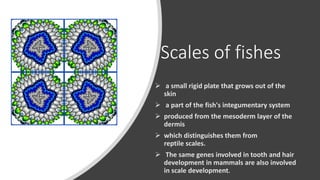
- 1. Scales of fishes a small rigid plate that grows out of the skin a part of the fish's integumentary system produced from the mesoderm layer of the dermis which distinguishes them from reptile scales. The same genes involved in tooth and hair development in mammals are also involved in scale development.
- 2. Functions of Scales Provide external protection to its body as scales are tough & slippery. Help to protect a fish from scrapes, parasites and other external injuries. provide flexibility because they are all attached at only one point.
- 3. Types of Scales • There are four different types of fish scales. 1. Cosmoid scales 2. Ganoid scales 3. Placoid scales 4. Leptoid scales • Cycloid scales • Ctenoid scales
- 4. 1. Cosmoid scales • Very rare scale type, but no doubt common in extinct species e.g; Crossopterygians • Limited today to the primitive lobefin and lungfish • Cosmoid scales evolved from placoid scales fusing together • This is because cosmoid scales have two base plates and similar external spines are composed of vitrodentine.
- 5. Inner layer of the scale is made of lamellar bone On top of this lies a layer of spongy or vascular bone a layer of dentine-like material called cosmine. These scales grow along with the fish.
- 6. 2.Placoid Scales • Also called denticles, are similar in structure to teeth • Found on sharks, skates and rays. • Formed of a rectangular base plate that is embedded within the skin of the fish. • The interior of the scale is a pulp that receives blood from the fish's vascular system • outside is made of an enamel-like substance called vitrodentine.
- 7. •Placoids have a sharp ridge down the center of the scale made of vitrodentine. Placoids do not grow with the fish
- 8. Ganoid Scales usually rhomboid in shape. They are modified Cosmoid scales consist of a bony basal layer, a layer of dentine, and an outer layer of ganoine. can be found on gars, bichirs andon and reed fishes. Rare among modern fish. do not overlap instead fit together like pieces of a jigsaw puzzle They also grow with the fish, not only in length, but in width and thickness as well.
- 9. 4. Leptoid scales Found on higher-order bony fish like Asian arowana. As they grow they add concentric layers. They come in two forms: Cycloid Scales Ctenoid Scales
- 10. Cycloid scales Cycloid (circular) scales have a smooth texture and are uniform, with a smooth outer edge or margin. They are most common on fish with soft fin rays, such as salmon and carp. Ctenoid scales Ctenoid (toothed) scales are like cycloid scales, except they have small teeth or spinules called ctenii along their outer or posterior edges. Because of these teeth, the scales have a rough texture. They are usually found on fishes with spiny fin rays, such as the perch-like fishes. Salmon fish
- 11. References: • www.wikipedia.org • www.australianmuseum.net • www.ehow.com • www.earthlife.net