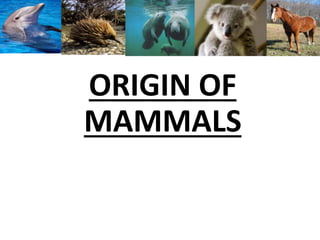
ORIGIN OF
MAMMALS
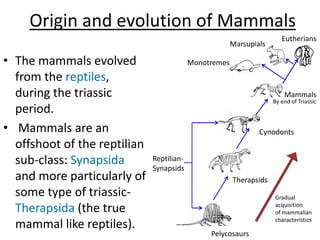
• The mammals evolved
from the reptiles,
during the triassic
period.
• Mammals are an
offshoot of the reptilian
sub-class: Synapsida
and more particularly of
some type of triassic-
Therapsida (the true
mammal like reptiles).
Pelycosaurs
Therapsids
Cynodonts
Mammals
By end of Triassic
Marsupials
Monotremes
Eutherians
Gradual
acquisition
of mammalian
characteristics
Reptilian-
Synapsids
Establishment of mammalian
characters
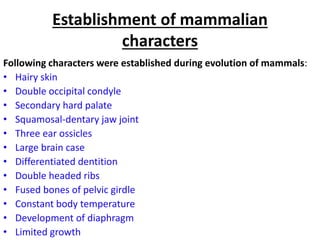
Following characters were established during evolution of mammals:
• Hairy skin
• Double occipital condyle
• Secondary hard palate
• Squamosal-dentary jaw joint
• Three ear ossicles
• Large brain case
• Differentiated dentition
• Double headed ribs
• Fused bones of pelvic girdle
• Constant body temperature
• Development of diaphragm
• Limited growth
Ancestors of
mammals: Synapsids
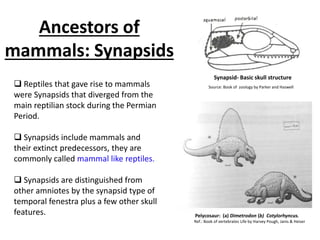
Pelycosaur: (a) Dimetrodon (b) Cotylorhyncus.
Ref.: Book of vertebrates Life by Harvey Pough, Janis & Heiser
 Reptiles that gave rise to mammals
were Synapsids that diverged from the
main reptilian stock during the Permian
Period.
 Synapsids include mammals and
their extinct predecessors, they are
commonly called mammal like reptiles.
 Synapsids are distinguished from
other amniotes by the synapsid type of
temporal fenestra plus a few other skull
features.
Synapsid- Basic skull structure
Source: Book of zoology by Parker and Haswell
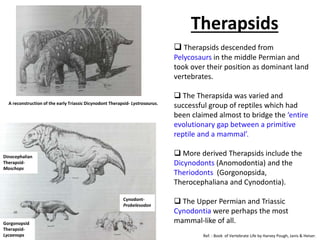
Therapsids
Dinocephalian
Therapsid-
Moschops
Gorgonopsid
Therapsid-
Lycaenops
Cynodont-
Probelesodon
A reconstruction of the early Triassic Dicynodont Therapsid- Lystrosaurus.
 Therapsids descended from
Pelycosaurs in the middle Permian and
took over their position as dominant land
vertebrates.
 The Therapsida was varied and
successful group of reptiles which had
been claimed almost to bridge the ‘entire
evolutionary gap between a primitive
reptile and a mammal’.
 More derived Therapsids include the
Dicynodonts (Anomodontia) and the
Theriodonts (Gorgonopsida,
Therocephaliana and Cynodontia).
 The Upper Permian and Triassic
Cynodontia were perhaps the most
mammal-like of all.
Ref. : Book of Vertebrate Life by Harvey Pough, Janis & Heiser.
PRIMITIVE MAMMALS OF THE
MESOZOIC PERIOD
Five orders of mammal are known from sediments
of late Triassic & Jurassic age, these orders are:
• Docodonta: They appeared in the Upper Jurassic &
they are known only from teeth. In these primitive
mammals the upper molars were expanded. The
molars do not have the form of interlocking
triangles, though the upper jaw have three roots.
• Tricodonta: These are known from partial skull,
teeth, palate & jaws. They were mainly carnivores.
These animals ranged in size from small to large.
There were three or four incisors in each jaw, well
developed canines and up to nine cheek-teeth which
cannot be separated into premolars and molars. The
molar pattern was distinctive, in these three cones
were arranged in a linear series.
Ref.: textbook of Zoology Vertebrates by Parker and Haswell.
Tricodonta- diagrammatic view
showing different types of teeth.
• Symmetrodonta: they were Jurassic and
Cretaceous animals with three molars arranged
in a symmetrical triangle but the cusp
arrangement was entirely different from that of
Tricodonta. They were carnivores and
moderate in size.
• Pantotheria: all the Pantotherians were small
in size, in the largest the jaw was only 4cm
long. Their teeth were differentiated into
incisors, canines, premolars and molars, but
the number of molars is often as many as eight.
• Multituberculata: these mammals were very
numerous and survived for over 100 million
years. They were herbivorous and longer than
any other mammalian order. They have rodent
like incisors ,the cheek teeth carried
longitudinally arranged rows of cusps probably
used for grinding the food.
Ref. : textbook of Zoology Vertebrates by Parker and Haswell.
Pantotheria - lower jaw
Multituberculata- the lower and
upper molars, palatal view of skull.
EVOLUTION OF JAWS AND EAR
Ref. : Science.education.nih.gov
 The original Synapsid condition of the
lower jaw was a tooth-bearing dentary
occupying the anterior half jaw, with a
variety of bones forming the posterior
half.
 The jaw articulation was between the
articular in the lower jaw and the
quadrate in the skull.
 In mammals and some cynodonts, the
contact between the dentary and the
squamosal formed a new jaw joint, the
dentary-squamosal jaw joint.
 Over the course of evolution of
mammals the articular and quadrate
lost their purpose in the jaw joint and
were put to new use in middle ear,
connecting to stapes.
 In mammals these three bones or
ossicles are known as malleus, incus
and stapes.
CONCLUSION
Simplified cladogram of Synapsids .
Ref. : Book of Vertebrate life by Harvey Pough, Janis and Heiser
THANK YOU

ORIGIN MAMMALS.pptx

  • 1.
  • 2.
    • The mammalsevolved from the reptiles, during the triassic period. • Mammals are an offshoot of the reptilian sub-class: Synapsida and more particularly of some type of triassic- Therapsida (the true mammal like reptiles). Pelycosaurs Therapsids Cynodonts Mammals By end of Triassic Marsupials Monotremes Eutherians Gradual acquisition of mammalian characteristics Reptilian- Synapsids
  • 3.
    Establishment of mammalian characters Followingcharacters were established during evolution of mammals: • Hairy skin • Double occipital condyle • Secondary hard palate • Squamosal-dentary jaw joint • Three ear ossicles • Large brain case • Differentiated dentition • Double headed ribs • Fused bones of pelvic girdle • Constant body temperature • Development of diaphragm • Limited growth
  • 4.
    Ancestors of mammals: Synapsids Pelycosaur:(a) Dimetrodon (b) Cotylorhyncus. Ref.: Book of vertebrates Life by Harvey Pough, Janis & Heiser  Reptiles that gave rise to mammals were Synapsids that diverged from the main reptilian stock during the Permian Period.  Synapsids include mammals and their extinct predecessors, they are commonly called mammal like reptiles.  Synapsids are distinguished from other amniotes by the synapsid type of temporal fenestra plus a few other skull features. Synapsid- Basic skull structure Source: Book of zoology by Parker and Haswell
  • 5.
    Therapsids Dinocephalian Therapsid- Moschops Gorgonopsid Therapsid- Lycaenops Cynodont- Probelesodon A reconstruction ofthe early Triassic Dicynodont Therapsid- Lystrosaurus.  Therapsids descended from Pelycosaurs in the middle Permian and took over their position as dominant land vertebrates.  The Therapsida was varied and successful group of reptiles which had been claimed almost to bridge the ‘entire evolutionary gap between a primitive reptile and a mammal’.  More derived Therapsids include the Dicynodonts (Anomodontia) and the Theriodonts (Gorgonopsida, Therocephaliana and Cynodontia).  The Upper Permian and Triassic Cynodontia were perhaps the most mammal-like of all. Ref. : Book of Vertebrate Life by Harvey Pough, Janis & Heiser.
  • 6.
    PRIMITIVE MAMMALS OFTHE MESOZOIC PERIOD Five orders of mammal are known from sediments of late Triassic & Jurassic age, these orders are: • Docodonta: They appeared in the Upper Jurassic & they are known only from teeth. In these primitive mammals the upper molars were expanded. The molars do not have the form of interlocking triangles, though the upper jaw have three roots. • Tricodonta: These are known from partial skull, teeth, palate & jaws. They were mainly carnivores. These animals ranged in size from small to large. There were three or four incisors in each jaw, well developed canines and up to nine cheek-teeth which cannot be separated into premolars and molars. The molar pattern was distinctive, in these three cones were arranged in a linear series. Ref.: textbook of Zoology Vertebrates by Parker and Haswell. Tricodonta- diagrammatic view showing different types of teeth.
  • 7.
    • Symmetrodonta: theywere Jurassic and Cretaceous animals with three molars arranged in a symmetrical triangle but the cusp arrangement was entirely different from that of Tricodonta. They were carnivores and moderate in size. • Pantotheria: all the Pantotherians were small in size, in the largest the jaw was only 4cm long. Their teeth were differentiated into incisors, canines, premolars and molars, but the number of molars is often as many as eight. • Multituberculata: these mammals were very numerous and survived for over 100 million years. They were herbivorous and longer than any other mammalian order. They have rodent like incisors ,the cheek teeth carried longitudinally arranged rows of cusps probably used for grinding the food. Ref. : textbook of Zoology Vertebrates by Parker and Haswell. Pantotheria - lower jaw Multituberculata- the lower and upper molars, palatal view of skull.
  • 8.
    EVOLUTION OF JAWSAND EAR Ref. : Science.education.nih.gov  The original Synapsid condition of the lower jaw was a tooth-bearing dentary occupying the anterior half jaw, with a variety of bones forming the posterior half.  The jaw articulation was between the articular in the lower jaw and the quadrate in the skull.  In mammals and some cynodonts, the contact between the dentary and the squamosal formed a new jaw joint, the dentary-squamosal jaw joint.  Over the course of evolution of mammals the articular and quadrate lost their purpose in the jaw joint and were put to new use in middle ear, connecting to stapes.  In mammals these three bones or ossicles are known as malleus, incus and stapes.
  • 9.
    CONCLUSION Simplified cladogram ofSynapsids . Ref. : Book of Vertebrate life by Harvey Pough, Janis and Heiser
  • 10.