MARINE WORMS
Types of Marine Worms Phylum *Platyhelminthes – flatworms Phylum Nemertea – ribbon worms Phylum Nematoda – roundworms Phylum Chaetognatha – arrow worms Phylum Pogonophora – deep-sea tube worms Phylum Sipunculida – peanut worms Phylum *Annelida - segmented worms
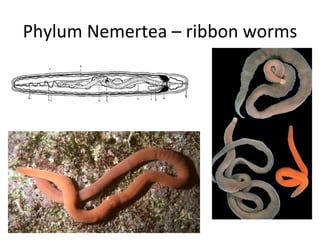
Phylum Nemertea – ribbon worms
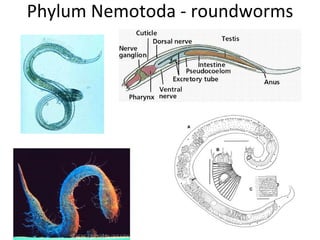
Phylum Nemotoda - roundworms
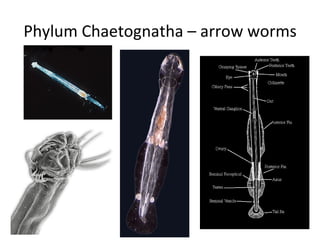
Phylum Chaetognatha – arrow worms
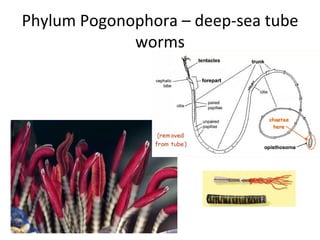
Phylum Pogonophora – deep-sea tube worms
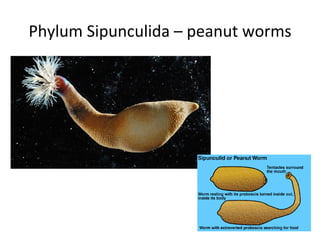
Phylum Sipunculida – peanut worms
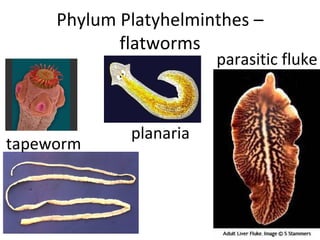
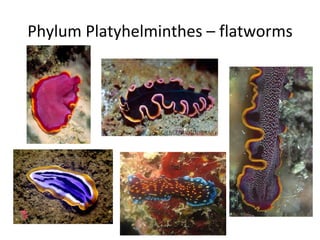
Phylum Platyhelminthes – flatworms Includes tapeworms, freshwater planaria, parasitic flukes Some parasites, many free-living predators and scavengers Can cause swimmer’s itch in people
Phylum Platyhelminthes – flatworms tapeworm planaria parasitic fluke
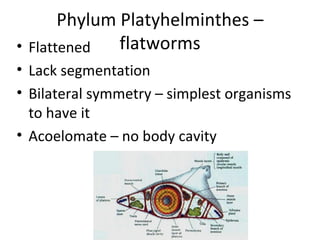
Phylum Platyhelminthes – flatworms Flattened Lack segmentation Bilateral symmetry – simplest organisms to have it Acoelomate – no body cavity
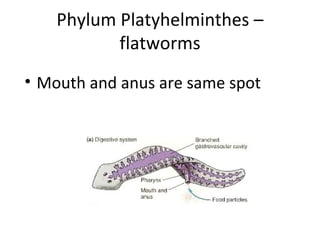
Phylum Platyhelminthes – flatworms Mouth and anus are same spot
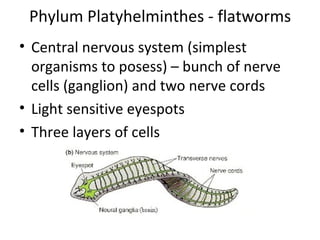
Phylum Platyhelminthes - flatworms Central nervous system (simplest organisms to posess) – bunch of nerve cells (ganglion) and two nerve cords Light sensitive eyespots Three layers of cells
Phylum Platyhelminthes – flatworms Beginning of organ development No true respiratory, excretory system – diffusion through surface Sexual (and asexual) reproduction - hermaphrodites
Phylum Platyhelminthes – flatworms
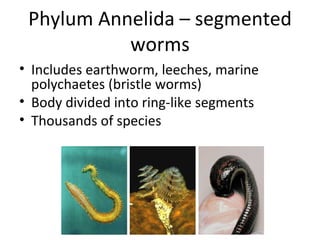
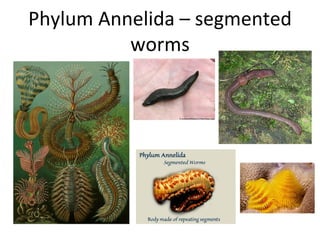
Phylum Annelida – segmented worms Includes earthworm, leeches, marine polychaetes (bristle worms) Body divided into ring-like segments Thousands of species
Phylum Annelida – segmented worms
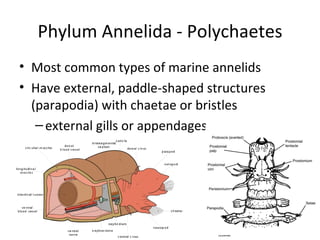
Phylum Annelida - Polychaetes Most common types of marine annelids Have external, paddle-shaped structures (parapodia) with chaetae or bristles external gills or appendages
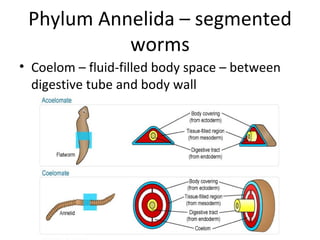
Phylum Annelida – segmented worms Coelom – fluid-filled body space – between digestive tube and body wall
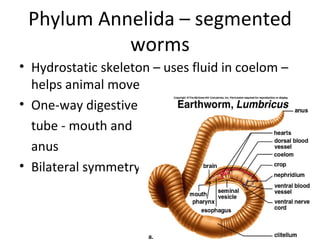
Phylum Annelida – segmented worms Hydrostatic skeleton – uses fluid in coelom – helps animal move One-way digestive  tube - mouth and  anus Bilateral symmetry
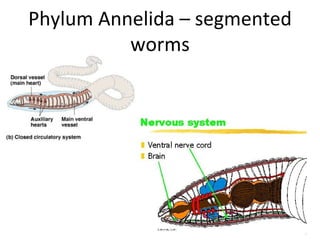
Phylum Annelida – segmented worms More developed organ systems: Digestive system Nervous system Circulatory system With hemoglobin to carry oxygen Closed – blood in veins, arteries and capillaries
Phylum Annelida – segmented worms
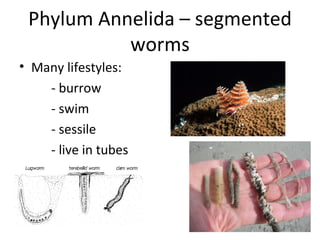
Phylum Annelida – segmented worms Many lifestyles: - burrow - swim - sessile - live in tubes
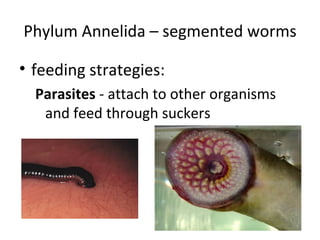
Phylum Annelida – segmented worms feeding strategies: Parasites  - attach to other organisms and feed through suckers
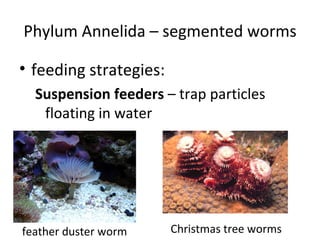
Phylum Annelida – segmented worms feeding strategies: Suspension feeders  – trap particles floating in water feather duster worm Christmas tree worms
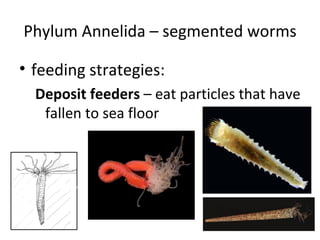
Phylum Annelida – segmented worms feeding strategies: Deposit feeders  – eat particles that have fallen to sea floor
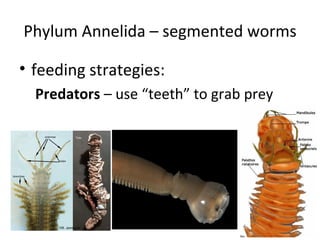
Phylum Annelida – segmented worms feeding strategies: Predators  – use “teeth” to grab prey
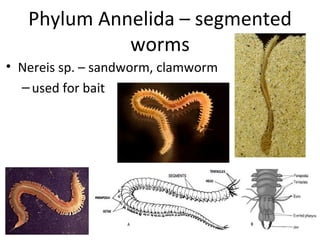
Phylum Annelida – segmented worms Nereis sp. – sandworm, clamworm used for bait

Marine worms powerpoint

  • 1.
  • 2.
    Types of MarineWorms Phylum *Platyhelminthes – flatworms Phylum Nemertea – ribbon worms Phylum Nematoda – roundworms Phylum Chaetognatha – arrow worms Phylum Pogonophora – deep-sea tube worms Phylum Sipunculida – peanut worms Phylum *Annelida - segmented worms
  • 3.
    Phylum Nemertea –ribbon worms
  • 4.
  • 5.
  • 6.
    Phylum Pogonophora –deep-sea tube worms
  • 7.
  • 8.
    Phylum Platyhelminthes –flatworms Includes tapeworms, freshwater planaria, parasitic flukes Some parasites, many free-living predators and scavengers Can cause swimmer’s itch in people
  • 9.
    Phylum Platyhelminthes –flatworms tapeworm planaria parasitic fluke
  • 10.
    Phylum Platyhelminthes –flatworms Flattened Lack segmentation Bilateral symmetry – simplest organisms to have it Acoelomate – no body cavity
  • 11.
    Phylum Platyhelminthes –flatworms Mouth and anus are same spot
  • 12.
    Phylum Platyhelminthes -flatworms Central nervous system (simplest organisms to posess) – bunch of nerve cells (ganglion) and two nerve cords Light sensitive eyespots Three layers of cells
  • 13.
    Phylum Platyhelminthes –flatworms Beginning of organ development No true respiratory, excretory system – diffusion through surface Sexual (and asexual) reproduction - hermaphrodites
  • 14.
  • 15.
    Phylum Annelida –segmented worms Includes earthworm, leeches, marine polychaetes (bristle worms) Body divided into ring-like segments Thousands of species
  • 16.
    Phylum Annelida –segmented worms
  • 17.
    Phylum Annelida -Polychaetes Most common types of marine annelids Have external, paddle-shaped structures (parapodia) with chaetae or bristles external gills or appendages
  • 18.
    Phylum Annelida –segmented worms Coelom – fluid-filled body space – between digestive tube and body wall
  • 19.
    Phylum Annelida –segmented worms Hydrostatic skeleton – uses fluid in coelom – helps animal move One-way digestive tube - mouth and anus Bilateral symmetry
  • 20.
    Phylum Annelida –segmented worms More developed organ systems: Digestive system Nervous system Circulatory system With hemoglobin to carry oxygen Closed – blood in veins, arteries and capillaries
  • 21.
    Phylum Annelida –segmented worms
  • 22.
    Phylum Annelida –segmented worms Many lifestyles: - burrow - swim - sessile - live in tubes
  • 23.
    Phylum Annelida –segmented worms feeding strategies: Parasites - attach to other organisms and feed through suckers
  • 24.
    Phylum Annelida –segmented worms feeding strategies: Suspension feeders – trap particles floating in water feather duster worm Christmas tree worms
  • 25.
    Phylum Annelida –segmented worms feeding strategies: Deposit feeders – eat particles that have fallen to sea floor
  • 26.
    Phylum Annelida –segmented worms feeding strategies: Predators – use “teeth” to grab prey
  • 27.
    Phylum Annelida –segmented worms Nereis sp. – sandworm, clamworm used for bait