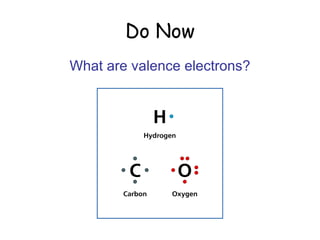
Do Now What are valence electrons?
Bonding
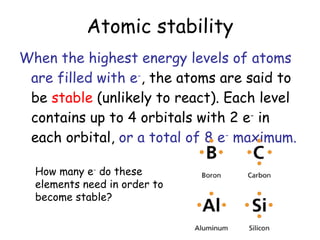
Atomic stability When the highest energy levels of atoms are filled with e - , the atoms are said to be  stable  (unlikely to react). Each level contains up to 4 orbitals with 2 e -  in each orbital,  or a total of 8 e -  maximum. How many e -  do these elements need in order to become stable?
2 – 8 – 8 Rule 1.  The first energy level contains a maximum of 2  electrons and must be completely filled before electrons can move into the next energy level.  2.  The second energy level contains a maximum of 8  electrons and must be completely filled before electrons can move into the next energy level. 3.  The third energy level contains a maximum of 8  electrons also.
2-8-8 Rule:  The 1 st  energy level in an atom can hold a maximum of 2 electrons. The next 2 levels can hold a maximum of 8 electrons. Atoms become stable only when energy levels are completely filled .
Ionic Bonds When an atom loses an electron, it loses a negative charge and become a positive ion ( cation ). When an atom gains an electron, it gains a negative charge and becomes a negative ion ( anion ).
Definitions: Chemical bond : the force that holds ions together. Ionic bond : Forms when electrons are transferred from one atom to another.  One of the atoms must be a metal. Chemical formula : the notation that shows what elements are contained in a compound and how many atoms of each element are present. Let’s answer #12 together.
Do Now What is the 2-8-8 Rule?
Look at your copy of the Periodic Table: How many e -  do Group 7A elements need to become stable? How many e -  do Group 6A elements need to become stable? How many e -  do Group 1A have available to transfer? How many e -  do Group 2A have available to transfer?
What happens at the atomic level when sodium atoms reacts with chlorine atoms?
Forming Ionic Compounds:  Practice (#14 in your notes) Using valence electrons, how can you combine magnesium and chlorine? Using valence electrons, how can you combine carbon and hydrogen?
Electron Dot Diagrams These diagrams represent the number of valance electrons in atoms and show how they are transferred from the metal to the non-metal, creating the IONIC bond.  The metal becomes the positive side (it loses electrons) and the non-metal becomes the negative side (it gains electrons).
Every element can be drawn as an electron dot diagram. Remember to add electrons to all 4 orbitals, one at a time, before adding a second electron to any orbital.
Put it all together! Oxygen has an atomic number of 8 (protons) and, therefore, a total of 8 electrons. Oxygen has 2 electrons in the 1 st  energy level, leaving 6 remaining from its total of 8. The 2 nd  energy level can contain a maximum of 8 electrons (2 – 8 – 8 ), but oxygen only has 6 available to fill this level. Each energy level contains 4 orbitals with the possibility of 2 electrons per orbital. You must place 1 electron in each orbital before placing a 2 nd . 1 2 3 4 Valence electrons are the number of electrons occupying an unfilled energy level. Valence electrons are available for bonding. 5
Electron Dot Diagram - Practice Use the handout to practice drawing electron dot diagrams for some common elements. Work with a partner and we will discuss your diagrams as a class.
Do Now What is an Ionic Bond? (Complete the 1 st  row on the chart)
Bohr Model Practice Use the space provided under Notes #17 and practice drawing Bohr Models (rings around a nucleus that are filled with electrons) for the 4 atoms.
Covalent Bonds Covalent bonds are those that hold non-metal elements together. In covalent bonds,  electrons are shared  between atoms, not transferred, as in an ionic bond.
 
How Covalent Bonds Form The force that holds atoms together in a covalent bond is the attraction between the shared pair of electrons. This is one  SINGLE COVALENT  bond.
How Covalent Bonds Form The nitrogen atom in ammonia is surrounded by eight electrons as a result of sharing electrons with hydrogen atoms. There are 3  SINGLE COVALENT  bonds
Double and Triple Covalent Bonds Each oxygen atom has 6 valence electrons (Group 6A). When they bond together, they share 2 electrons with each other forming a shared  DOUBLE BOND. Each nitrogen atom has 5 valence electrons (Group 5A). When they bond together, they share 3 electrons with each other forming a shared  TRIPLE BOND.
Metallic Bonding A metal crystal consists of positively charged metal ions embedded in a “sea” of valence electrons.
Metallic Bonding

Bonding

  • 1.
    Do Now Whatare valence electrons?
  • 2.
  • 3.
    Atomic stability Whenthe highest energy levels of atoms are filled with e - , the atoms are said to be stable (unlikely to react). Each level contains up to 4 orbitals with 2 e - in each orbital, or a total of 8 e - maximum. How many e - do these elements need in order to become stable?
  • 4.
    2 – 8– 8 Rule 1. The first energy level contains a maximum of 2 electrons and must be completely filled before electrons can move into the next energy level. 2. The second energy level contains a maximum of 8 electrons and must be completely filled before electrons can move into the next energy level. 3. The third energy level contains a maximum of 8 electrons also.
  • 5.
    2-8-8 Rule: The 1 st energy level in an atom can hold a maximum of 2 electrons. The next 2 levels can hold a maximum of 8 electrons. Atoms become stable only when energy levels are completely filled .
  • 6.
    Ionic Bonds Whenan atom loses an electron, it loses a negative charge and become a positive ion ( cation ). When an atom gains an electron, it gains a negative charge and becomes a negative ion ( anion ).
  • 7.
    Definitions: Chemical bond: the force that holds ions together. Ionic bond : Forms when electrons are transferred from one atom to another. One of the atoms must be a metal. Chemical formula : the notation that shows what elements are contained in a compound and how many atoms of each element are present. Let’s answer #12 together.
  • 8.
    Do Now Whatis the 2-8-8 Rule?
  • 9.
    Look at yourcopy of the Periodic Table: How many e - do Group 7A elements need to become stable? How many e - do Group 6A elements need to become stable? How many e - do Group 1A have available to transfer? How many e - do Group 2A have available to transfer?
  • 10.
    What happens atthe atomic level when sodium atoms reacts with chlorine atoms?
  • 11.
    Forming Ionic Compounds: Practice (#14 in your notes) Using valence electrons, how can you combine magnesium and chlorine? Using valence electrons, how can you combine carbon and hydrogen?
  • 12.
    Electron Dot DiagramsThese diagrams represent the number of valance electrons in atoms and show how they are transferred from the metal to the non-metal, creating the IONIC bond. The metal becomes the positive side (it loses electrons) and the non-metal becomes the negative side (it gains electrons).
  • 13.
    Every element canbe drawn as an electron dot diagram. Remember to add electrons to all 4 orbitals, one at a time, before adding a second electron to any orbital.
  • 14.
    Put it alltogether! Oxygen has an atomic number of 8 (protons) and, therefore, a total of 8 electrons. Oxygen has 2 electrons in the 1 st energy level, leaving 6 remaining from its total of 8. The 2 nd energy level can contain a maximum of 8 electrons (2 – 8 – 8 ), but oxygen only has 6 available to fill this level. Each energy level contains 4 orbitals with the possibility of 2 electrons per orbital. You must place 1 electron in each orbital before placing a 2 nd . 1 2 3 4 Valence electrons are the number of electrons occupying an unfilled energy level. Valence electrons are available for bonding. 5
  • 15.
    Electron Dot Diagram- Practice Use the handout to practice drawing electron dot diagrams for some common elements. Work with a partner and we will discuss your diagrams as a class.
  • 16.
    Do Now Whatis an Ionic Bond? (Complete the 1 st row on the chart)
  • 17.
    Bohr Model PracticeUse the space provided under Notes #17 and practice drawing Bohr Models (rings around a nucleus that are filled with electrons) for the 4 atoms.
  • 18.
    Covalent Bonds Covalentbonds are those that hold non-metal elements together. In covalent bonds, electrons are shared between atoms, not transferred, as in an ionic bond.
  • 19.
  • 20.
    How Covalent BondsForm The force that holds atoms together in a covalent bond is the attraction between the shared pair of electrons. This is one SINGLE COVALENT bond.
  • 21.
    How Covalent BondsForm The nitrogen atom in ammonia is surrounded by eight electrons as a result of sharing electrons with hydrogen atoms. There are 3 SINGLE COVALENT bonds
  • 22.
    Double and TripleCovalent Bonds Each oxygen atom has 6 valence electrons (Group 6A). When they bond together, they share 2 electrons with each other forming a shared DOUBLE BOND. Each nitrogen atom has 5 valence electrons (Group 5A). When they bond together, they share 3 electrons with each other forming a shared TRIPLE BOND.
  • 23.
    Metallic Bonding Ametal crystal consists of positively charged metal ions embedded in a “sea” of valence electrons.
  • 24.