CHEMICAL BONDING AND FORMULA WRITING
Things to remember: The electrons in the outer energy level of an atom are called valence electrons. All of the elements in a column have the same number of valence electrons. Atoms are the most stable when their outer energy level is completely filled.  Compounds are electrically neutral.
Chemical Bond  –  a mutual attraction of two atoms due to their number of valence electrons. IONIC BONDS COVALENT BONDS 2 TYPES:
Ionic Bond  – an attraction between two ions. Ions are atoms that have lost or gained electrons. Electrons have negative charges; therefore, when an atom gains electrons, it has a negative charge. When an atom loses electrons, it has a positive charge. Positive ions are called cations, while negative ions are called anions.
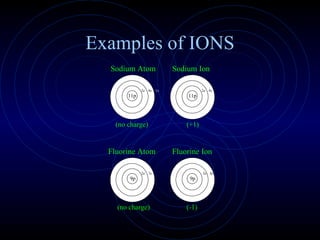
Examples of IONS
Sodium Fluoride (NaF) If Sodium atoms like to lose one electron and Fluorine atoms like to gain one electron, they will form an ionic bond. One Sodium will bond with one Fluorine and its  chemical formula  will be NaF.
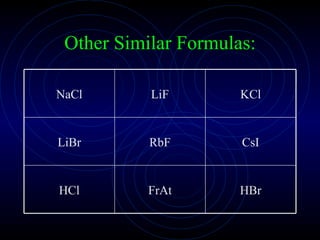
Other Similar Formulas: HBr FrAt HCl CsI RbF LiBr KCl LiF NaCl
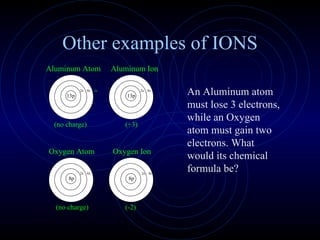
Other examples of IONS An Aluminum atom must lose 3 electrons, while an Oxygen atom must gain two electrons. What would its chemical formula be?
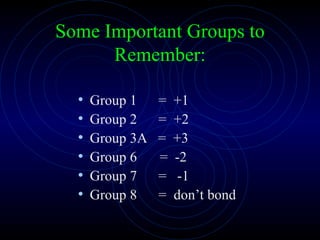
Some Important Groups to Remember: Group 1  =  +1 Group 2  =  +2 Group 3A  =  +3 Group 6    =  -2 Group 7  =  -1 Group 8  =  don’t bond
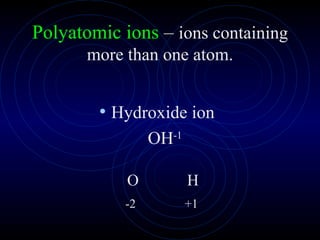
Polyatomic ions  –  ions containing more than one atom. Hydroxide ion  OH -1 O   H -2   +1
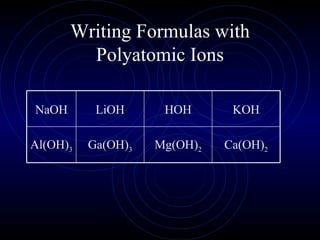
Writing Formulas with Polyatomic Ions Ca(OH) 2 Mg(OH) 2 Ga(OH) 3 Al(OH) 3 KOH HOH LiOH NaOH
Covalent Bond  –  an attraction between two atoms that  share  electrons. In ionic bonds, one ion steals electrons from the other to make them both stable. In covalent bonds, both atoms share the electrons, in order to make them both more stable.
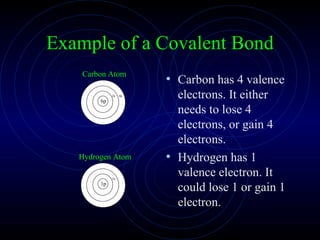
Example of a Covalent Bond Carbon has 4 valence electrons. It either needs to lose 4 electrons, or gain 4 electrons. Hydrogen has 1 valence electron. It could lose 1 or gain 1 electron.
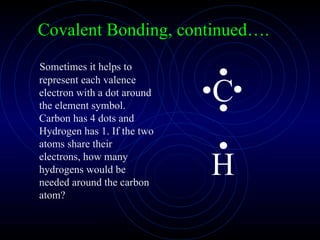
Sometimes it helps to represent each valence electron with a dot around the element symbol. Carbon has 4 dots and Hydrogen has 1. If the two atoms share their electrons, how many hydrogens would be needed around the carbon atom? Covalent Bonding, continued….
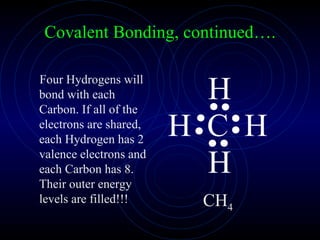
Covalent Bonding, continued…. Four Hydrogens will bond with each Carbon. If all of the electrons are shared, each Hydrogen has 2 valence electrons and each Carbon has 8. Their outer energy levels are filled!!! CH 4

Chemical Bonding and Formula Writing

  • 1.
    CHEMICAL BONDING ANDFORMULA WRITING
  • 2.
    Things to remember:The electrons in the outer energy level of an atom are called valence electrons. All of the elements in a column have the same number of valence electrons. Atoms are the most stable when their outer energy level is completely filled. Compounds are electrically neutral.
  • 3.
    Chemical Bond – a mutual attraction of two atoms due to their number of valence electrons. IONIC BONDS COVALENT BONDS 2 TYPES:
  • 4.
    Ionic Bond – an attraction between two ions. Ions are atoms that have lost or gained electrons. Electrons have negative charges; therefore, when an atom gains electrons, it has a negative charge. When an atom loses electrons, it has a positive charge. Positive ions are called cations, while negative ions are called anions.
  • 5.
  • 6.
    Sodium Fluoride (NaF)If Sodium atoms like to lose one electron and Fluorine atoms like to gain one electron, they will form an ionic bond. One Sodium will bond with one Fluorine and its chemical formula will be NaF.
  • 7.
    Other Similar Formulas:HBr FrAt HCl CsI RbF LiBr KCl LiF NaCl
  • 8.
    Other examples ofIONS An Aluminum atom must lose 3 electrons, while an Oxygen atom must gain two electrons. What would its chemical formula be?
  • 9.
    Some Important Groupsto Remember: Group 1 = +1 Group 2 = +2 Group 3A = +3 Group 6 = -2 Group 7 = -1 Group 8 = don’t bond
  • 10.
    Polyatomic ions – ions containing more than one atom. Hydroxide ion OH -1 O H -2 +1
  • 11.
    Writing Formulas withPolyatomic Ions Ca(OH) 2 Mg(OH) 2 Ga(OH) 3 Al(OH) 3 KOH HOH LiOH NaOH
  • 12.
    Covalent Bond – an attraction between two atoms that share electrons. In ionic bonds, one ion steals electrons from the other to make them both stable. In covalent bonds, both atoms share the electrons, in order to make them both more stable.
  • 13.
    Example of aCovalent Bond Carbon has 4 valence electrons. It either needs to lose 4 electrons, or gain 4 electrons. Hydrogen has 1 valence electron. It could lose 1 or gain 1 electron.
  • 14.
    Sometimes it helpsto represent each valence electron with a dot around the element symbol. Carbon has 4 dots and Hydrogen has 1. If the two atoms share their electrons, how many hydrogens would be needed around the carbon atom? Covalent Bonding, continued….
  • 15.
    Covalent Bonding, continued….Four Hydrogens will bond with each Carbon. If all of the electrons are shared, each Hydrogen has 2 valence electrons and each Carbon has 8. Their outer energy levels are filled!!! CH 4